

TL;DR:
- Choosing the right mobility aid requires prioritizing safety, budget, and user-specific needs, with funding options like the Disabled Facilities Grant easing costs.
- Proper assessment, expert installation, and thorough aftercare support are crucial to ensure safe and effective home mobility solutions.
Choosing the right mobility aid for your home sounds straightforward until you actually start looking. Stairlifts, ramps, banisters, wheelchair lifts, grants, rental options: the choices multiply fast, and each carries its own set of features, costs, and conditions. For older adults or family members trying to help a loved one stay safe and independent, the pressure to get it right is real. This guide cuts through the confusion with a clear, evidence-backed framework, walking you through exactly what to look for, which options suit which situations, and how to access funding without the usual headaches.
Table of Contents
- Key criteria for selecting mobility enhancements
- The mobility enhancements list: top UK options
- Comparing stairlift features and UK brands
- Making the right choice for your home
- Our perspective: overlooked essentials in UK home mobility
- Bridge to gentle independence: explore affordable stairlift solutions
- Frequently asked questions
Key Takeaways
| Point | Details |
|---|---|
| Prioritise safety features | Choose stairlifts with swivel seats, easy controls, and automatic stops for maximum user protection. |
| Check funding eligibility | The Disabled Facilities Grant may help cover the cost of adaptations, based on your council’s means test. |
| Compare brands and aftercare | Quality, warranty, and aftersales service all vary—always review contracts and support options before purchasing. |
| Consider minor enhancements | Simple adaptations such as banisters and grab rails deliver surprising benefits for independence. |
| Plan installation carefully | Professional fitting and placement create safer, more comfortable mobility solutions tailored to your needs. |
Key criteria for selecting mobility enhancements
Before spending a single pound or visiting a single showroom, it pays to know what you are actually comparing. Most families jump straight to product research, but without a clear set of criteria, every option looks equally appealing or equally confusing. A structured approach will save you time, money, and a great deal of stress.
Safety must come first. This is not negotiable. The Age UK guide notes that swivel seats and safety stops are among the key features to look for in a stairlift, alongside easy-to-grip controls and automatic obstruction detection. These are not optional extras; they are the features that prevent falls and accidents during daily use. A product that looks affordable but skips on safety engineering is not a bargain.
Budget is the second major pillar. Stairlifts range enormously in price depending on the type of staircase, the brand, and the features included. However, many UK households do not realise that public funding can significantly reduce the out-of-pocket cost. The Disabled Facilities Grant (DFG) is the primary route, and DFG maximum awards differ by nation: £30,000 in England, £36,000 in Wales, and £35,000 in Northern Ireland, with Scotland operating its own variable system. Eligibility is means tested, meaning your household income and savings affect the final award.
Usability and individual need must also shape your selection. A narrow Victorian staircase demands a different solution than a wide modern hallway. Someone with limited hand strength needs specifically adapted controls. A person who lives alone and cannot depend on carer assistance at the top of the stairs needs a stairlift with reliable swivel and footrest mechanics. Our mobility planning guide walks through how to assess your staircase and physical requirements together, so you match the right product to the right situation.
Professional installation and aftercare round out the criteria. A stairlift installed incorrectly is a serious hazard, and an aftercare plan that evaporates after purchase leaves you stranded when something goes wrong. Look for providers offering structured maintenance and clear engineer response commitments from the outset.
Key criteria to evaluate before purchasing:
- Safety certifications and standard compliance
- Funding eligibility (DFG or other grants)
- Staircase type compatibility (straight, curved, narrow)
- User-specific adaptations (grip, seat rotation, footrest)
- Installer reputation and aftercare contract clarity
"If you need adaptations to your home, there are a few ways to pay for them. You may be eligible for a Disabled Facilities Grant, or you may need to buy them yourself." — Age UK, Adapting Your Home
Pro Tip: Apply for a Disabled Facilities Grant well before you urgently need the stairlift. Many local councils have waiting lists of several months, and you do not want mobility needs to deteriorate while the paperwork is processed.
The mobility enhancements list: top UK options
With your criteria established, the next step is reviewing what is actually available. Stairlifts are the most well-known solution, but they sit within a broader landscape of home adaptations. Knowing the full range helps you make a genuinely informed decision rather than defaulting to the most advertised option.
Stairlifts remain the most practical choice for most UK homes. They work on both straight and curved staircases, and reconditioned models bring costs down significantly without sacrificing safety. As outlined in our affordable stairlift solutions guide, straight stairlifts can start as low as £795, while curved models require bespoke rail systems and carry a higher price point. The Age UK adaptation guide also recommends using Living Made Easy and RE-DC (the Research Institute for Disabled Consumers) as independent product review resources before committing to a purchase.
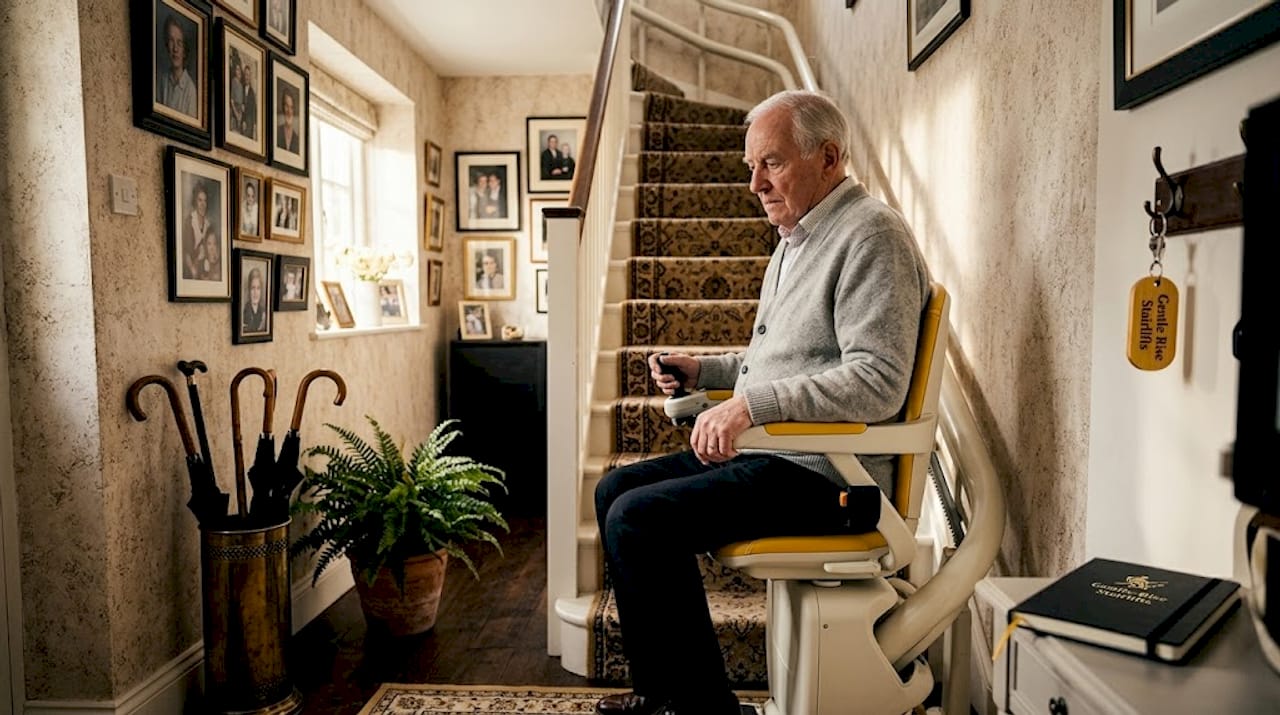
Second banisters are often underused as a first intervention. For individuals who struggle with balance but can still manage stairs safely, a second banister on the opposite wall provides an extra handhold without the cost or complexity of a full stairlift installation.
Ramps and threshold lifts serve individuals who use wheelchairs or mobility scooters. These are typically installed at entrances rather than on indoor staircases, and they can be particularly important for ground-floor access to properties with front doorstep drops.
Wheelchair and platform lifts are a more significant investment but may be necessary where stairlifts are impractical, for instance in very short staircases or where someone cannot transfer from a wheelchair to a stairlift seat. They require more structural work and planning permission in some cases.
Our mobility aids guide gives a thorough breakdown of all these categories, with specific guidance on when each is most appropriate.
Top five mobility enhancements for UK homes:
- Straight stairlift (most affordable, fastest installation)
- Curved stairlift (bespoke fit for complex staircases)
- Reconditioned stairlift (budget-friendly with safety certification)
- Platform or wheelchair lift (essential for non-ambulant users)
- Second banister or grab rail (low-cost, high-value first step)
Pro Tip: Before committing to any product, check independent reviews from Living Made Easy or the Research Institute for Disabled Consumers. Both organisations provide impartial guidance that is not tied to any specific brand or retailer.
Comparing stairlift features and UK brands
Once you know which type of stairlift you need, comparing specific brands and features is where the real decisions happen. This is also where many buyers make costly mistakes by focusing on headline price and missing the details that affect long-term satisfaction.
According to Which? stairlift review, brand reliability alone does not determine your experience. Who you buy from matters just as much, because warranty terms and aftercare contracts can differ significantly depending on whether a brand is sold directly or through a retailer or partner. This is a critical point that most buyers discover only after something goes wrong.
Here is a comparison of the key stairlift features you should be evaluating side by side:
| Feature | Why it matters | What to check |
|---|---|---|
| Obstruction sensors | Prevent injury if something is on the stairs | Test response before installation sign-off |
| Smooth start and stop | Reduces jolt discomfort for users with arthritis or joint pain | Ask for a demonstration |
| Swivel seat | Allows safe mounting and dismounting at top of stairs | Check rotation angle and locking mechanism |
| Footrest design | Affects stability and usability for people with limited mobility | Confirm it folds safely and reliably |
| Battery backup | Ensures the lift works during power cuts | Confirm included as standard |
| Aftercare contract | Determines who fixes it and how quickly | Read the full contract before signing |
| Warranty length | Protects against mechanical failure | Compare years and what is covered |
Our guide on stairlift placement covers how proper installation positioning affects how many of these features actually perform in your specific home. It is worth reviewing before your installation survey. You should also check our stairlift weight limits guide to ensure the model you select is rated for safe use.
"The best stairlift for you depends not only on the brand, but on who you buy it from and what aftercare comes with it." — Which?
Key safety features that should be non-negotiable:
- Automatic obstruction detection that halts the carriage
- Soft start and stop to minimise jolting on movement
- Lockable controls to prevent unsupervised use by children
- Swivel seat with landing position to make getting off safe
- Rechargeable battery that functions during power outages
Exploring the wider landscape of stairlift trends in 2026 shows that remote diagnostics and app-connected maintenance alerts are becoming standard features on premium models, which can be particularly valuable for older adults living alone.
Making the right choice for your home
The options are now clearly laid out. The next challenge is applying them to your specific situation. No single stairlift or adaptation suits every household, and the right decision depends on a combination of your staircase type, physical needs, budget, and support network.
A structured approach helps prevent the most common mistake: choosing the most popular product rather than the most appropriate one. Stairlift Costs' engineering review criteria outlines that a proper stairlift assessment should evaluate smooth stop and obstruction detection as well as swivel egress assistance and after-sales support for spares and engineer response. These are the practical factors that determine daily livability, not just initial comfort.
Step-by-step decision process:
- Assess the staircase: measure width, length, and any bends or landings
- Define the user's physical needs: grip strength, weight, balance, ability to stand unaided
- Set a realistic budget and check DFG eligibility before approaching suppliers
- Request free home surveys from at least two providers and compare written quotes
- Review aftercare contracts in full before signing anything
- Confirm installation timeline and what post-installation support includes
- Test the lift yourself during the installation sign-off visit
Our safe stairlift installation guide provides a detailed walkthrough of what to expect on installation day and how to verify that the work has been completed to a safe standard.
| Home layout | Recommended solution | Funding route |
|---|---|---|
| Straight staircase, tight budget | Reconditioned straight stairlift | DFG application |
| Curved staircase | Bespoke curved stairlift | DFG plus personal contribution |
| Short flight of stairs | Compact straight stairlift or platform lift | DFG or self-fund |
| Wheelchair user | Platform lift or through-floor lift | DFG application |
| Temporary recovery need | Short-term stairlift rental | Self-fund (rental rates lower) |
For full guidance on what each funding route covers, our stairlift funding options article covers grants, local authority support, and short-term rental alternatives in plain language.
Pro Tip: When comparing providers, specifically ask about engineer response times for call-outs. A stairlift that breaks down on a Friday afternoon and does not get attended to until the following Thursday is a serious problem for someone who cannot safely manage the stairs.
Our perspective: overlooked essentials in UK home mobility
Most guides focus entirely on the product and the price. They compare brands, list features, and point you toward grants. All of that is useful, but it misses what we see consistently when working with UK families: the things that make or break the actual experience are rarely the things discussed in a brochure.
Minor adaptations are dramatically undervalued. A second banister installed for a few hundred pounds can restore confidence on the stairs for years. Grab rails in key positions can delay the need for a stairlift by a meaningful amount of time. Families often arrive at a stairlift decision because no one suggested these smaller steps earlier. There is no commission in recommending a grab rail, which is part of why they are overlooked, but for many people they are genuinely the right first move.
Aftercare is the other major blind spot. We have spoken to families who were promised quarterly maintenance visits and received nothing of the sort after installation. Contracts that seem generous on the surface sometimes exclude certain parts or charge a call-out fee that makes repairs expensive in practice. Reading the full contract before signing is not just sensible: it is essential. If a provider is unwilling to walk you through every clause clearly, that tells you something important.
The "one-size-fits-all" stairlift myth causes real harm. A stairlift designed for a wide staircase installed on a narrow one is uncomfortable at best and unsafe at worst. Physical assessments conducted before installation are not a sales tactic; they are a necessary part of matching the product to the person. Our home accessibility advice covers how to push back on generic recommendations and insist on a proper assessment tailored to your home and needs.
The families who report the best outcomes are not always those who spent the most. They are the ones who asked the most questions, read the paperwork carefully, and chose a provider willing to be transparent from the start.
Bridge to gentle independence: explore affordable stairlift solutions
You now have the framework, the feature comparisons, and the funding knowledge to make a confident, informed decision about mobility enhancements for your home. The next step is finding the right solution and the right support to bring it to life.
At Gentle Rise Stairlifts, we offer a full range of stairlift options including straight, curved, and reconditioned models, with prices starting from £795. Our affordable stairlifts are installed by qualified engineers, often within hours of delivery, and our Protect+ plan provides structured stairlift aftercare support so you are never left without help when it matters. Book a free home survey today and let us match the right solution to your home, your needs, and your budget.
Frequently asked questions
What is the Disabled Facilities Grant (DFG) and how much can I get in the UK?
The DFG is a public funding programme for home adaptations including stairlifts, with maximum awards by region ranging from £30,000 in England to £36,000 in Wales and £35,000 in Northern Ireland, subject to means testing and local council assessment.
What stairlift features should I prioritise for safety and ease of use?
The most important features include swivel seats and safety stops alongside easy-to-grip controls and automatic obstruction detection, all of which reduce risk during daily use.
How do I choose between stairlift brands in the UK?
As Which? highlights, reliability depends as much on who you purchase from as on the brand itself, so always compare aftercare contracts, warranty terms, and engineer response commitments before deciding.
What other home mobility enhancements should I consider beyond stairlifts?
Ramps, wheelchair lifts and grab rails can all improve daily independence at significantly lower cost than a full stairlift, and many of these adaptations also qualify for Disabled Facilities Grant funding.
How important is aftercare and contract terms when buying a stairlift?
Aftercare quality varies considerably between providers, and brand and retailer differences in warranty and service contracts can have a direct impact on your experience, so always read the full terms before committing to a purchase.