
TL;DR:
- Professional stairlift installation ensures safety, compliance, and reliable long-term operation.
- Reconditioned stairlifts offer substantial savings, especially for straight stairs, with warranties included.
- Regular servicing and professional setup are essential for safety, efficiency, and extended lifespan.
Climbing the stairs should never feel like a challenge you dread each morning. Yet for millions of people across the UK, a change in mobility after surgery, illness, or simply the natural process of ageing turns a simple staircase into a genuine daily obstacle. A professionally installed stairlift changes that picture entirely. It restores your ability to move freely between floors, reduces the risk of falls, and gives both you and your family real peace of mind. This guide walks you through everything you need to know, from choosing the right type of stairlift to understanding costs, maintenance, and how to find reliable, affordable installation close to home.
Table of Contents
- Assessing your needs and preparing for installation
- Step-by-step guide to stairlift installation
- Maintenance, running costs, and servicing essentials
- Maximising value: reconditioned stairlifts and affordable options
- Expert insight: safety, compliance, and long-term peace of mind
- Affordable stairlift solutions for your home
- Frequently asked questions
Key Takeaways
| Point | Details |
|---|---|
| Professional installation matters | Only expert fitting ensures safety and compliance with UK regulations. |
| Annual servicing keeps stairlifts reliable | Routine checks and trusted providers help prevent breakdowns and costly repairs. |
| Reconditioned models offer big savings | You can save 40–60% and still get full warranty by choosing certified reconditioned stairlifts. |
| Home survey is essential | A free home survey matches the right stairlift to your needs and ensures a smooth installation. |
| Affordable options available | Local deals and reconditioned units make stairlifts accessible for most UK homeowners. |
Assessing your needs and preparing for installation
Getting started with a stairlift begins long before any engineer arrives at your door. The most important first step is honest reflection on what you actually need. Are you recovering from a hip or knee replacement and expecting to regain full mobility within a few months? Or is this a longer-term solution to help you stay in your home for many years to come? The answer shapes everything, from the model you choose to whether renting makes more financial sense than buying outright.
Straight versus curved staircases
The single biggest factor in choosing a stairlift is the shape of your staircase. Straight staircases are by far the most common in UK homes and they are the simplest to fit, making them the most affordable option. Curved staircases, including those with a landing or a bend partway up, require a custom-made rail that is built to match the exact contours of your stairs. This bespoke manufacturing takes longer and costs more, but it is the only safe solution for a non-straight staircase.
Here is a quick comparison to help you understand the difference at a glance:
| Feature | Straight stairlift | Curved stairlift |
|---|---|---|
| Rail type | Standard, off-the-shelf | Custom-built to staircase |
| Typical price range | From £795 | From £2,000+ |
| Installation time | 2–4 hours | Up to 14 days lead time |
| Best suited for | Standard straight stairs | L-shaped or spiral stairs |
| Reconditioned available? | Yes, commonly | Less common |
What to expect from a free home survey
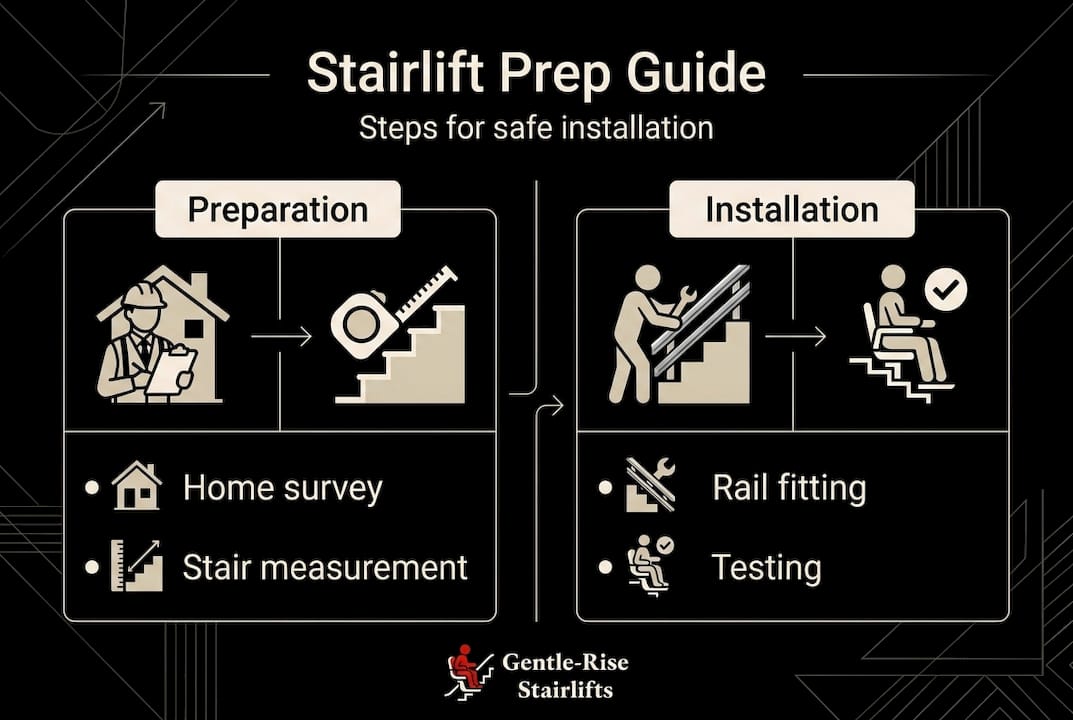
Stairlift installation involves a free home survey to measure the stairs and assess your specific needs, followed by rail fitting directly to the stair treads rather than to the walls. This is worth knowing because many homeowners worry that installation means drilling into plasterwork or damaging their walls. It does not. The rail sits on the treads themselves, so redecoration is rarely needed.
During the survey, the engineer will also ask about your weight and height to confirm the model's safe working load, check the position of electrical sockets, and discuss where the stairlift should park when not in use to keep the staircase clear for other household members.
Key things to think about before the surveyor arrives:
- Who will use the stairlift? If multiple people in the household have different mobility needs, mention this upfront.
- Do you want a fixed purchase or a rental? Short-term rentals are ideal for post-surgery recovery periods.
- Is a reconditioned model suitable? If your staircase is straight and your budget is tight, a refurbished unit can deliver excellent value.
- Is there a standard 13-amp socket at the top or bottom of the stairs? Most stairlifts simply plug into a standard wall socket.
Pro Tip: Book your free home survey before you have finalised your budget. The surveyor can often identify cost-saving options you would not have considered, such as a reconditioned model that perfectly fits your staircase with no modifications needed.
Finding expert stairlift fitting early in the process ensures you receive accurate measurements and the right model recommendation from the start. If you are still weighing up which product is right, reading up on reliable stairlift choices will help you ask the right questions during the survey.
Step-by-step guide to stairlift installation
Once preparations are complete, the actual installation process commences. Understanding each stage helps you know what to expect on the day, reduces anxiety, and ensures you can ask informed questions when the engineer arrives.
The installation process, stage by stage
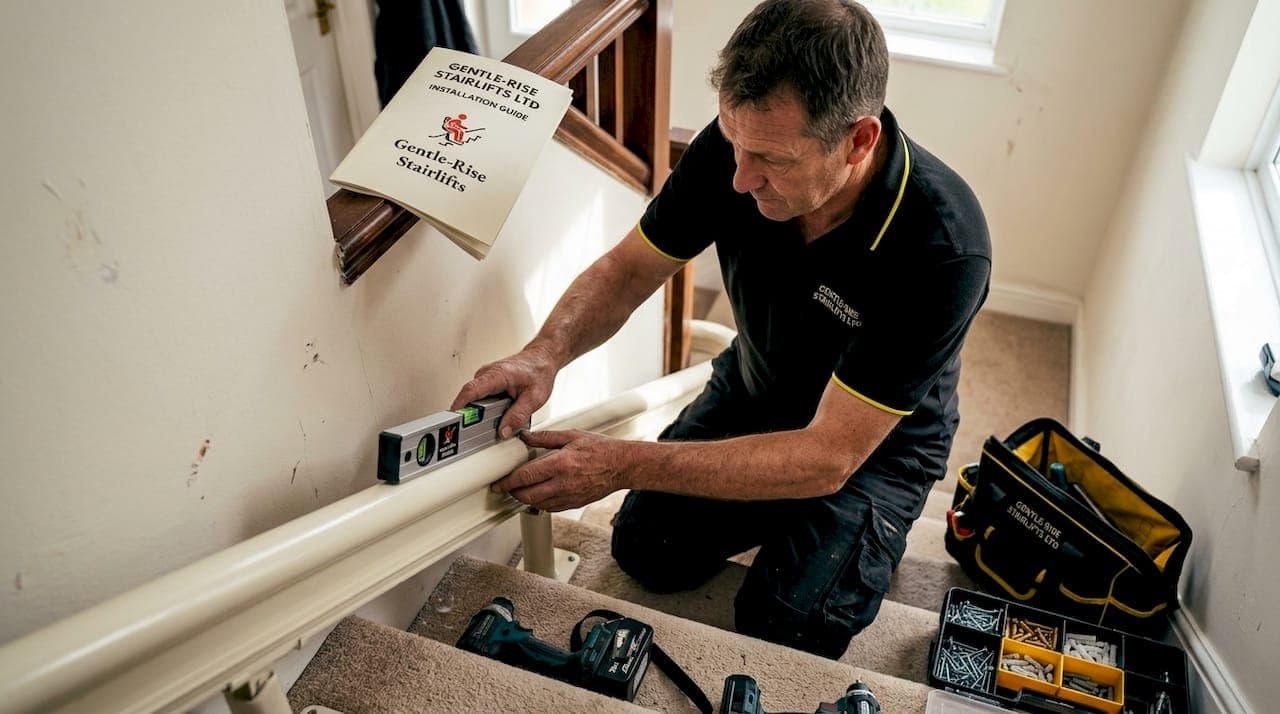
Rail fitting to stair treads, carriage and seat mounting, connection to standard electrical sockets, rigorous safety checks, and user demonstration and handover form the core stages of every professional installation. Here is how that looks in practice:
- Pre-installation check. The engineer confirms the measurements from the survey, checks the electrical supply, and lays protective covers on your carpet or flooring.
- Rail fitting. Brackets are bolted directly into the stair treads. This is the most time-consuming part of the process and must be precise to ensure safe operation.
- Carriage and seat mounting. The motorised carriage is fitted onto the rail, and the seat, armrests, and footrest are attached. Most modern models fold flat to leave room for other users on the stairs.
- Electrical connection. The stairlift is connected to the mains via a standard 13-amp socket. Charge strips along the rail keep the battery topped up continuously, meaning the lift still works during a power cut.
- Safety testing. The engineer runs a series of checks, including obstruction sensors, seatbelt function, swivel seat locking, and limit switches at the top and bottom of the rail.
- User demonstration and handover. You will be shown how to operate the controls, how to fold and unfold the seat and footrest, and what to do in the unlikely event of a fault.
How long does installation take?
| Stairlift type | Survey to fitting | Installation day |
|---|---|---|
| Straight | Same day or next day | 2–4 hours |
| Reconditioned straight | Often same day | 2–3 hours |
| Curved | Up to 14 days (rail manufacturing) | 4–6 hours |
Worth remembering: Even a curved stairlift installation day is typically completed within a single visit, once the custom rail has been manufactured and delivered.
Pro Tip: Ask the installer to leave you a laminated quick-reference card near the stairlift. If a family member or carer needs to help you use it in the first few days, clear instructions at hand make a real difference.
One thing many homeowners do not realise is that DIY installation is never a safe option. Stairlifts are covered by the Lifting Operations and Lifting Equipment Regulations 1998 (LOLER) in many scenarios, and improper fitting can void warranties, create serious injury risks, and cause legal complications. Always use a registered engineer.
Before booking, review the installation cost breakdown so you understand exactly what you are paying for. For a broader overview of the whole process, the full stairlift guide covers everything from first contact to long-term care in one place.
Maintenance, running costs, and servicing essentials
After installation, proper maintenance keeps the stairlift running safely and efficiently. This is an area where many owners underestimate both the simplicity and the importance of ongoing care.
How much does a stairlift cost to run?
The good news is that stairlifts are remarkably inexpensive to operate. Running costs range from £12 to £400 per year, depending on whether you include a maintenance plan, with electricity alone costing just £12 to £20 per year. That electricity figure is lower than most people expect. A stairlift uses roughly the same energy as a standard light bulb, and because it charges via the rail rather than a separate charging point, there is no energy wasted.
Key ongoing costs to plan for:
- Electricity: £12–£20 per year on average.
- Annual service visit: Typically £80–£150, depending on provider and model.
- Maintenance plan or warranty extension: Varies; some providers bundle this into the purchase price.
- Call-out charges for faults: Covered under warranty in the first year, and under a maintenance plan thereafter.
- Replacement parts: Battery replacement is the most common cost over time and is usually straightforward.
Why annual servicing matters
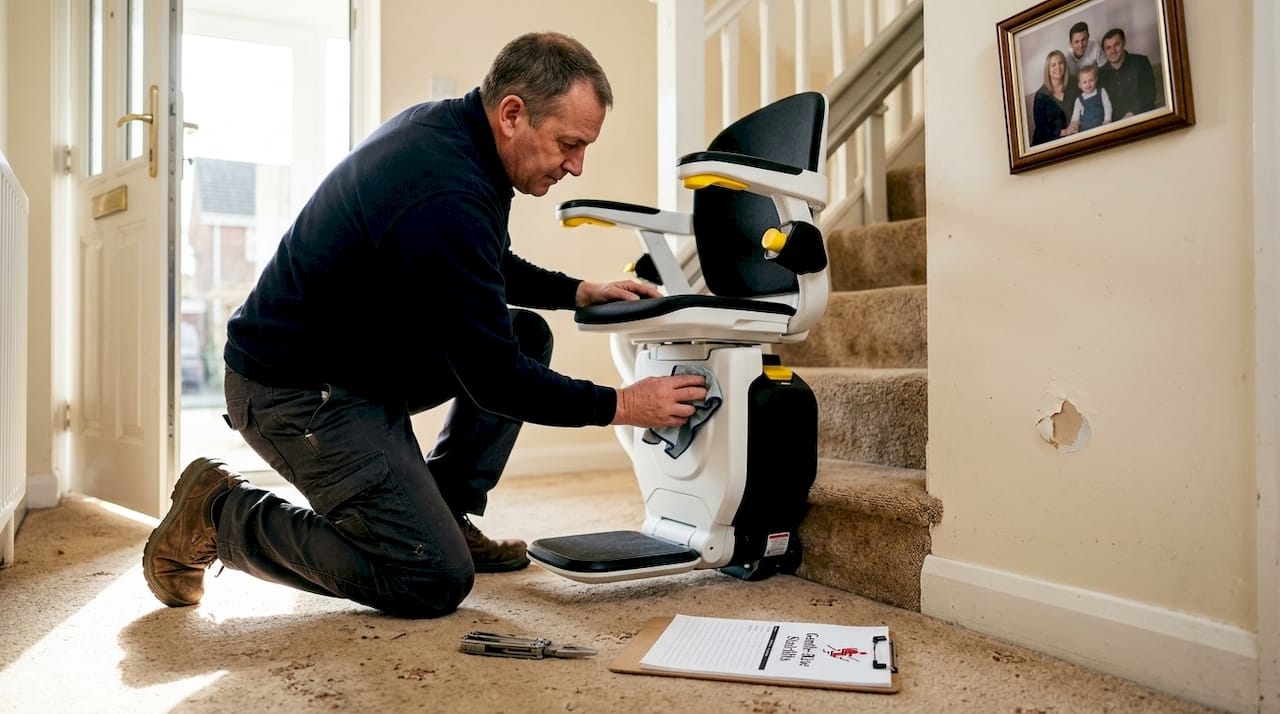
A yearly service visit is not just a nice extra. It is the single most effective way to catch minor wear before it becomes a safety issue. During a service, an engineer will lubricate the rail and drive mechanism, check all safety sensors, inspect the battery condition, test the seatbelt and swivel lock, and verify that the electrical connections remain secure.
Skipping servicing might save money in the short term, but it increases the risk of an unexpected breakdown, which is particularly concerning for anyone who relies on the stairlift daily. Think of it the same way you would your boiler: an annual check costs relatively little and prevents a far more expensive and disruptive failure.
Pro Tip: When purchasing your stairlift, ask whether an aftercare plan like the Protect+ maintenance programme is available. Bundling servicing into the purchase keeps costs predictable and ensures your engineer knows the history of your unit.
To find providers offering affordable stairlift servicing near you, or to explore local reliable providers, always prioritise companies that are members of recognised trade bodies and can provide verifiable customer reviews.
Choosing a reputable service provider
Look for engineers who are members of CECAS (the Confederation of Elevator Companies and Allied Services) or similar trade bodies. Which? Trusted Traders accreditation is another strong signal of reliability. Avoid any company that pressures you to sign up for a long-term service contract before you have had time to compare options.
Maximising value: reconditioned stairlifts and affordable options
Cost concerns often prompt a search for affordable alternatives, and the good news is that the reconditioned stairlift market in the UK is mature, well-regulated, and genuinely capable of delivering excellent results at a fraction of the price of a new unit.
What does reconditioned actually mean?
A reconditioned stairlift is a previously owned model that has been returned, professionally inspected, cleaned, and refurbished to a high standard before being reinstalled. Key components such as the battery, drive belt, and upholstery are typically replaced during refurbishment. When sold by a reputable provider, these units come with a full warranty that mirrors what you would get with a new model.
Reconditioned stairlifts can offer 40–60% savings compared to brand-new equivalents. On a straight stairlift priced at £1,200 new, that could mean paying as little as £480 to £720 for a unit that performs identically from day one.
New versus reconditioned: a practical comparison
| Consideration | New stairlift | Reconditioned stairlift |
|---|---|---|
| Upfront cost | Higher | 40–60% less |
| Warranty | Full manufacturer warranty | Full warranty from installer |
| Availability | To order, quick delivery | Subject to stock |
| Suitable for curved stairs? | Yes | Less common |
| Environmental impact | Higher (new materials) | Lower (reuse) |
| Best for | Long-term use, curved stairs | Straight stairs, tight budgets |
When a reconditioned stairlift makes excellent sense:
- Your staircase is straight.
- You need a solution quickly and cannot wait for a curved rail to be manufactured.
- You are on a fixed income or limited budget.
- You want a short-term solution while awaiting adaptations elsewhere in the home.
When a new model is the better choice:
- Your staircase is curved or non-standard.
- You want the very latest safety features and longer warranty terms.
- The stairlift will be in heavy daily use for an extended period.
Pro Tip: Always ask to see the refurbishment checklist and warranty document before agreeing to purchase a reconditioned unit. A trustworthy provider will be happy to share both without hesitation.
Explore the full range of reconditioned stairlifts available, and check for any local offers in your area that could reduce the upfront cost further.
Expert insight: safety, compliance, and long-term peace of mind
Here is something many stairlift guides will not tell you plainly: the installation itself is only a small part of the long-term safety equation. We see homeowners focus intensely on price and lead times, which is entirely understandable, and then overlook the less exciting but far more consequential question of ongoing compliance.
Professional installation is essential for safety and compliance, and DIY attempts are both risky and potentially illegal under UK regulations. This is not a technicality buried in small print. A stairlift that is improperly installed creates a genuine fall risk for the very person it is meant to protect. Beyond the physical danger, an unlicensed installation can invalidate your home insurance and create liability issues should an accident occur.
What most homeowners also underestimate is how significantly regular servicing affects the lifespan and reliability of the unit. A stairlift serviced annually will routinely last 10 years or more. One that is never serviced may develop faults within three or four years, at a far greater cost to replace. Reviewing your rights under UK stairlift regulations before you sign any contract is time well spent.
For elderly users or anyone recovering from surgery, the stairlift is not just a convenience. It is a critical safety device. Treat its maintenance the same way you would a smoke alarm or a gas boiler: not something to defer.
Affordable stairlift solutions for your home
You have now seen how the process works from survey to servicing. The next step is finding a provider you can genuinely trust to deliver both quality and affordability without cutting corners on safety.
At Gentle Rise Stairlifts, we offer straight stairlifts from just £795, with reconditioned models offering even greater savings and the same professional installation and aftercare. Our Protect+ maintenance programme gives you annual servicing and priority call-out cover, so you are never left waiting when it matters most. Whether you need a permanent solution or a short-term rental during recovery, we provide a free home survey at a time that suits you. Find out exactly what you should expect to pay by reading our stairlift cost guide, then get in touch to book your survey.
Frequently asked questions
How long does stairlift installation take?
Straight stairlifts typically take 2–4 hours to install, while curved models may require up to 14 days lead time for the custom rail to be manufactured before fitting begins.
What are the annual running costs of a stairlift?
Electricity costs £12–£20 per year for most stairlifts, with total running costs including maintenance ranging from £12 to £400 annually depending on the service plan chosen.
Is DIY stairlift installation allowed in the UK?
DIY stairlift installation is strongly discouraged and can be illegal under UK regulations. Professional installation is essential for safety, warranty validity, and compliance with lifting equipment laws.
Can reconditioned stairlifts save money?
Yes. Reconditioned models save 40–60% compared to new equivalents, and reputable providers include a full warranty covering parts and labour, making them a genuinely sound investment for straight staircases.