
TL;DR:
- Choosing the right stairlift power source is crucial for safety, reliability, and cost-effectiveness during power outages. Battery-powered models provide backup during outages and are most suitable for UK homes with unreliable power, while mains-powered lifts are simpler but cease functioning during a blackout. Proper maintenance and informed decisions about batteries and installation ensure long-term dependability and safety for users.
Most people assume a stairlift simply plugs into the wall like a kettle. It is an understandable assumption, but it is not entirely accurate, and for someone who depends on a stairlift every single day, the difference between power source options is far from a minor technical footnote. The type of power source your stairlift uses affects whether it works during a power cut, how much it costs to run each month, and how quickly a fault might leave you stranded on the stairs. This guide cuts through the confusion, explains each option in plain language, and helps you choose what actually works best for your home and your life.
Table of Contents
- Why the stairlift power source matters
- Types of stairlift power sources: mains vs battery
- Choosing the right stairlift power source for your home
- Looking after your stairlift power supply
- What most stairlift buyers miss about power sources
- Find safe, reliable stairlifts designed for your needs
- Frequently asked questions
Key Takeaways
| Point | Details |
|---|---|
| Know your options | Stairlifts can run on mains power, batteries, or both—each with distinct pros and cons. |
| Safety comes first | Choosing the right power supply protects you during outages and ensures reliable mobility every day. |
| Maintenance matters | Simple battery checks and upkeep will prevent most stairlift breakdowns and unexpected costs. |
| Plan ahead | Think about your home’s wiring, personal needs, and how often you’ll use your lift to pick the best power source from the start. |
Why the stairlift power source matters
It is easy to treat the power source as an afterthought when you are focusing on the seat comfort, the rail style, or the price tag. But getting this detail wrong can create real problems, and not just technical ones.
Think about what happens on a stormy winter evening in the UK when the power goes out. If your stairlift is entirely dependent on the mains supply with no backup, it stops working the moment the electricity fails. For someone living alone with limited mobility, that is not just an inconvenience. It is a genuine safety risk. Understanding home mobility solutions means looking at the full picture, including what happens when things do not go to plan.
Here are the key areas where your power source choice makes a tangible difference:
- Reliability during outages: The UK experiences thousands of localised power cuts each year, often without warning.
- Running costs: A stairlift left charging constantly has an energy cost, though typically a modest one.
- Safety for solo users: If the lift stops mid-staircase, a backup system is not a luxury but a necessity.
- Long-term affordability: Batteries need replacing over time, which is an expense to factor in at the outset.
- Ease of use: Some power systems require more user management than others, which matters if dexterity or memory is a concern.
According to the overview of stairlift power sources for homeowners, the power supply choice is one of the first decisions that should be made when planning an installation, not an afterthought once the rail style has been selected.
Statistic callout: In Britain, around 1.3 million power cuts are reported each year, with duration ranging from a few minutes to several hours. For anyone who relies on a stairlift daily, even a brief outage at the wrong moment can become a serious hazard.
Pro Tip: Before deciding on any stairlift, ask the installer specifically how the unit behaves during a power cut. If they cannot give you a clear answer, that tells you something important about the level of aftercare you can expect.
Types of stairlift power sources: mains vs battery
Having established why it matters, let us clarify exactly what options exist and how they work in practice.
Mains-powered stairlifts draw electricity directly from your home's mains supply through a standard 13-amp socket. The motor runs whenever you use the lift, and the unit is not storing energy in the same way a battery-based model does. Installation requires the socket to be positioned at the top or bottom of the staircase, and in some older properties a qualified electrician may need to add a dedicated outlet.
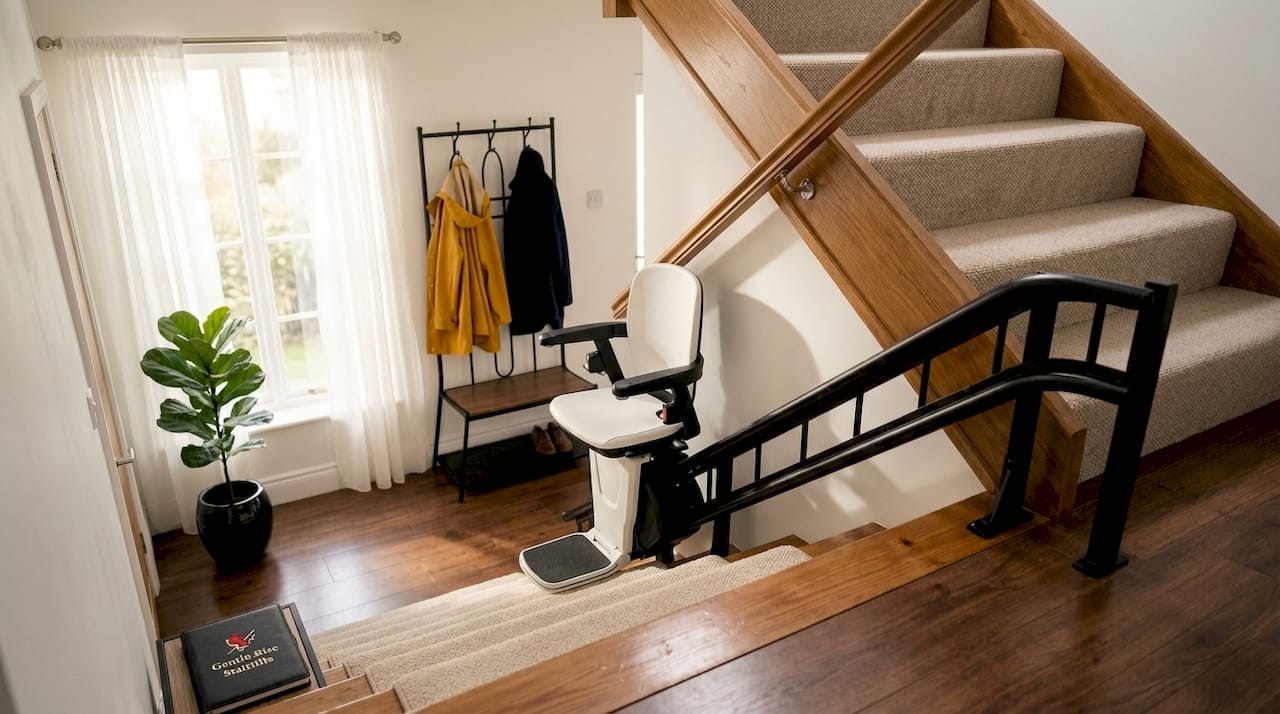
The main advantage is simplicity. There are no batteries to monitor or replace, and the power supply is as reliable as your household electricity. The significant drawback, as many homeowners only discover after purchase, is that a mains-powered model with no battery backup will stop working entirely during a power cut.
Battery-powered stairlifts are now the most common type available in the UK, and for good reason. These models use rechargeable batteries, typically sealed lead-acid or more modern gel-cell types, which are continuously topped up by charging points built into the rail at the top and bottom of the staircase. The lift charges automatically whenever it is parked at either end, meaning the batteries are almost always ready for use.
The key insight here is that most battery-powered stairlifts still connect to the mains. They are not entirely off-grid. The mains supply charges the batteries, and the batteries power the motor. The critical advantage is that during a short power cut, the stored charge in the batteries keeps the lift operational, giving you time to reach a safe landing. For ongoing guidance on safe stairlift installation and the role of power systems in that process, understanding this distinction is essential.
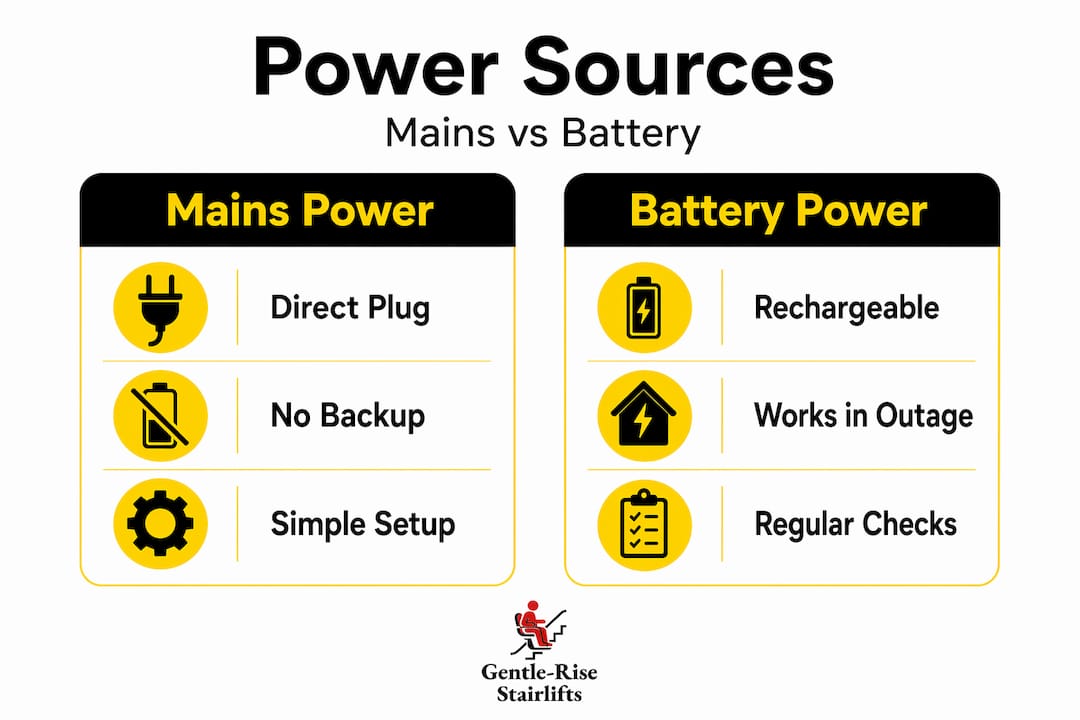
For uninterrupted stairlift operation, battery-powered models consistently outperform mains-only units precisely because the stored charge acts as a buffer during supply interruptions.
| Feature | Mains-powered | Battery-powered |
|---|---|---|
| Works during power cut | No (unless backup added) | Yes, for a limited period |
| Battery replacement needed | No | Yes, every 2 to 5 years |
| Ongoing energy cost | Moderate | Low to moderate |
| Installation complexity | Simple socket required | Charging points on rail |
| Best for | Stable power supply areas | Most UK homes and lifestyles |
| Reliability overall | Good in normal conditions | Excellent across most scenarios |
Key advantages of battery-powered models:
- Continuous trickle charge keeps batteries ready
- Operates during short to medium power outages
- Typically quieter motor operation
- Lower peak power draw from the mains
Key advantages of mains-powered models:
- No battery degradation to manage
- Lower upfront cost in some cases
- Simpler servicing in terms of electrical components
Choosing the right stairlift power source for your home
After understanding the core differences, it is time to look at the practical decision factors that help you match your home and lifestyle to the right power source.
Start by working through this checklist before speaking to any installer:
- Check your socket availability. Is there a 13-amp socket near the top and bottom of your staircase, or would one need to be installed? For battery models, two charging point locations are ideal.
- Consider your local power reliability. If you live in a rural area or have experienced repeated power cuts, battery backup is strongly advisable.
- Think about who will use the lift. If the primary user lives alone or has a condition that makes being stranded on the staircase particularly dangerous, battery backup is not optional.
- Factor in long-term costs. Battery replacements typically cost between £100 and £300 depending on the model, and they will be needed every few years. Include this in your total cost of ownership calculation.
- Assess the user's ability to manage the system. Battery stairlifts are largely self-managing, but some users may need reassurance that they do not need to do anything differently.
- Ask about your property type. Older properties, listed buildings, or those with unusual staircase layouts may have specific electrical constraints worth discussing with a qualified installer.
For a broader view of which stairlift design suits your staircase layout, the guide to types of stairlifts is a useful companion resource, particularly when you are comparing straight, curved, and outdoor models that each have slightly different power requirements.
Looking ahead, stairlift trends in 2026 point to significant improvements in battery technology and power efficiency, with newer models using less energy and offering longer backup durations than units installed even five years ago. This makes choosing battery-powered units an even more future-proof decision for many households.
If you want to take a structured approach to planning your home's accessibility, the mobility planning guide covers everything from stairlift selection to wider home adaptations that work together.
Pro Tip: When comparing models, ask the supplier how many full staircase trips the battery will support after a power cut. A good battery-powered stairlift should offer at least 10 to 20 trips on stored charge alone, giving you meaningful independence even during an extended outage.
Warning signs that your battery may be failing include the lift moving more slowly than usual, the charging indicator behaving erratically, or the unit cutting out before reaching the top or bottom of the staircase. Do not ignore these signals.
Looking after your stairlift power supply
Once you have chosen the right power source, keeping your stairlift reliable over the long term comes down to straightforward but consistent maintenance. Neglecting the power components is one of the most common reasons stairlifts fail prematurely.
Here are the maintenance steps every UK homeowner should follow:
- Always park the lift at a charging point. This sounds obvious but is frequently overlooked. Leaving the seat parked mid-rail means the batteries are not charging.
- Keep the charging contacts clean. Dust and grime on the charging strips along the rail can interrupt the charge cycle. A dry cloth every few weeks is sufficient.
- Check the indicator lights regularly. Most models have a simple green or amber light to confirm charging status. If the light is absent or red, contact your service provider promptly.
- Schedule an annual service. A professional service covers the electrical system, motor, and battery performance test, and will flag any emerging issues before they become costly failures.
- Do not ignore slow movement. A lift that runs noticeably slower than usual is often signalling a battery issue, not a mechanical one. Early diagnosis is far cheaper than an emergency call-out.
The guidance on residential stairlift electrical upkeep makes clear that consistent attention to the power system extends the useful life of the unit significantly and reduces unexpected repair costs.
| Maintenance task | Frequency | DIY or professional? | Typical cost |
|---|---|---|---|
| Park at charging point | Every use | DIY | No cost |
| Clean charging contacts | Monthly | DIY | No cost |
| Check indicator lights | Weekly | DIY | No cost |
| Battery performance test | Annually | Professional | Part of service |
| Full electrical service | Annually | Professional | £80 to £150 |
| Battery replacement | Every 2 to 5 years | Professional | £100 to £300 |
For more detail on identifying battery wear and knowing when a replacement is due, the resource on stairlift battery replacement covers the process clearly and helps you avoid being sold a replacement before it is actually needed.
"The most avoidable stairlift breakdowns we see are caused not by mechanical failure but by neglected batteries and charging habits. A stairlift that is cared for properly can serve a household reliably for fifteen years or more."
What most stairlift buyers miss about power sources
Here is something that rarely makes it into brochures. Most first-time buyers spend a great deal of time comparing seat widths, upholstery colours, and remote control styles. These things matter, of course. But the power source question gets glossed over, often because sales representatives assume the technical detail will put buyers off.
The reality is the opposite. Buyers who understand their power source make better decisions, ask sharper questions, and end up more satisfied with their purchase long term. Those who skip this step often find themselves caught out by a breakdown during a power cut or surprised by a battery replacement bill they were not expecting.
One pattern we see regularly is that people choose a model based on its purchase price without factoring in the total cost of ownership. A slightly cheaper mains-only unit with no battery backup may seem attractive initially, but if it leaves you stranded during an outage, the real cost is in the disruption to your safety and independence. When you are looking at affordable stairlift solutions, the most affordable option is not always the one with the lowest sticker price.
Ask these questions before you commit to any purchase: How long will the battery sustain the lift during a power cut? What does a battery replacement cost for this specific model? Does the service plan include a battery test? What is the average battery lifespan for this unit in typical UK residential use?
These questions take two minutes to ask and can save you considerable frustration over the lifetime of the lift. A good supplier will answer them directly and confidently. Hesitation or vague answers should prompt you to look elsewhere.
The other thing buyers often miss is that battery technology has improved considerably in recent years. Older sealed lead-acid batteries had shorter lifespans and required more careful management. Modern gel-cell and lithium alternatives last longer, charge faster, and degrade more gracefully. If you are looking at reconditioned or older models, it is worth checking which battery type they use before purchasing.
Find safe, reliable stairlifts designed for your needs
Choosing the right stairlift power source is a decision that shapes your safety and comfort every single day. Getting it right from the start is far easier than trying to correct it later.

At GentleRise Stairlifts, we guide you through exactly these decisions during a free home survey, so nothing gets overlooked. Whether you are trying to understand which stairlift is most reliable for your specific situation or want a clear breakdown of UK stairlift costs including battery considerations, our team is ready to help. With straight stairlifts from £795, rapid installation, and ongoing Protect+ aftercare, we make sure your lift works when you need it most.
Frequently asked questions
What happens to a stairlift during a power cut?
Most modern stairlifts include battery backup that keeps the unit operational even when the mains electricity fails, allowing you to complete your journey safely on stored charge.
How often should stairlift batteries be replaced?
Stairlift batteries typically last between two and five years depending on usage and model; routine maintenance checks help identify wear before it leads to a breakdown.
Do battery stairlifts use more power than mains-powered models?
Battery stairlifts charge automatically and energy consumption is low, making them broadly comparable to mains-powered units in terms of running costs and often more efficient overall.
Can I change my stairlift power source after installation?
Switching power source type after installation is rarely practical and usually not cost-effective; choosing carefully upfront based on your home's needs is always the better approach.