
TL;DR:
- Stair lifts restore home access and provide safety for people aged 60 and above.
- Proper assessment, preparation, and professional installation ensure safety and functionality.
- They enhance independence and peace of mind by enabling users to move freely within their homes.
Every trip up the stairs can feel like a mountain when your knees ache or your balance isn't what it used to be. For many people aged 60 and above across the UK, the staircase quietly becomes the biggest obstacle in their own home. A stair lift changes that completely. It restores access to every room, removes the daily anxiety of a fall, and gives both users and families genuine peace of mind. This guide walks you through everything you need to know, from assessing your home to completing safety checks, so you can approach installation with confidence and clarity.
Table of Contents
- Assessing your needs and home requirements
- Tools and preparation for stair lift installation
- Step-by-step installation guide
- Safety checks, troubleshooting and aftercare
- What most guides forget: The confidence and peace of mind a stair lift brings
- Discover affordable stair lift support and services
- Frequently asked questions
Key Takeaways
| Point | Details |
|---|---|
| Proper assessment matters | Measuring your stairs and assessing user needs ensures you choose the right stair lift model. |
| Preparation is key | Collecting essential tools and clearing the installation site minimises installation risks. |
| Follow steps for safety | Installing according to the guide and manufacturer’s instructions protects safety and lift performance. |
| Ongoing aftercare | Regular checks and support services help your stair lift last longer and operate reliably. |
Assessing your needs and home requirements
Before anything else, you need to understand what type of stair lift suits your home and your situation. Understanding your staircase layout is critical for choosing the right stair lift, because not all models fit all staircases. A straight staircase is the simplest and most affordable to fit. A curved or spiral staircase requires a custom-built track, which takes longer and costs more.
Here are the key things to evaluate before you choose a model:
- Staircase type: Straight, curved, or spiral. Measure the length, width, and any landings or turns.
- User requirements: Consider the user's weight, as most standard lifts support up to 120 kg. Check whether swivel seats, powered footrests, or remote controls are needed.
- Power supply: Most stair lifts run on a standard 13-amp socket. Check whether one is accessible at the top or bottom of the stairs.
- Space at top and bottom: There must be enough room for the chair to park safely without blocking doorways.
Cost is a major factor for most families. Our stairlift costs guide shows that straight models start from around £795, while curved lifts can range from £3,000 upwards depending on the track design. Reconditioned models offer a budget-friendly alternative without compromising on safety.
| Staircase type | Typical cost range | Installation time |
|---|---|---|
| Straight | £795 to £2,000 | 2 to 4 hours |
| Curved | £3,000 to £6,000+ | Half to full day |
| Reconditioned straight | £500 to £1,200 | 2 to 4 hours |
It is also worth checking whether you qualify for financial support. Age UK advice outlines several local authority grants and disabled facilities grants that may cover part or all of the cost. Always explore these before paying out of pocket.
For a broader overview of what to look for in a model, our stairlift guide and reliable stairlift options pages cover the most trusted brands and what makes them stand out.
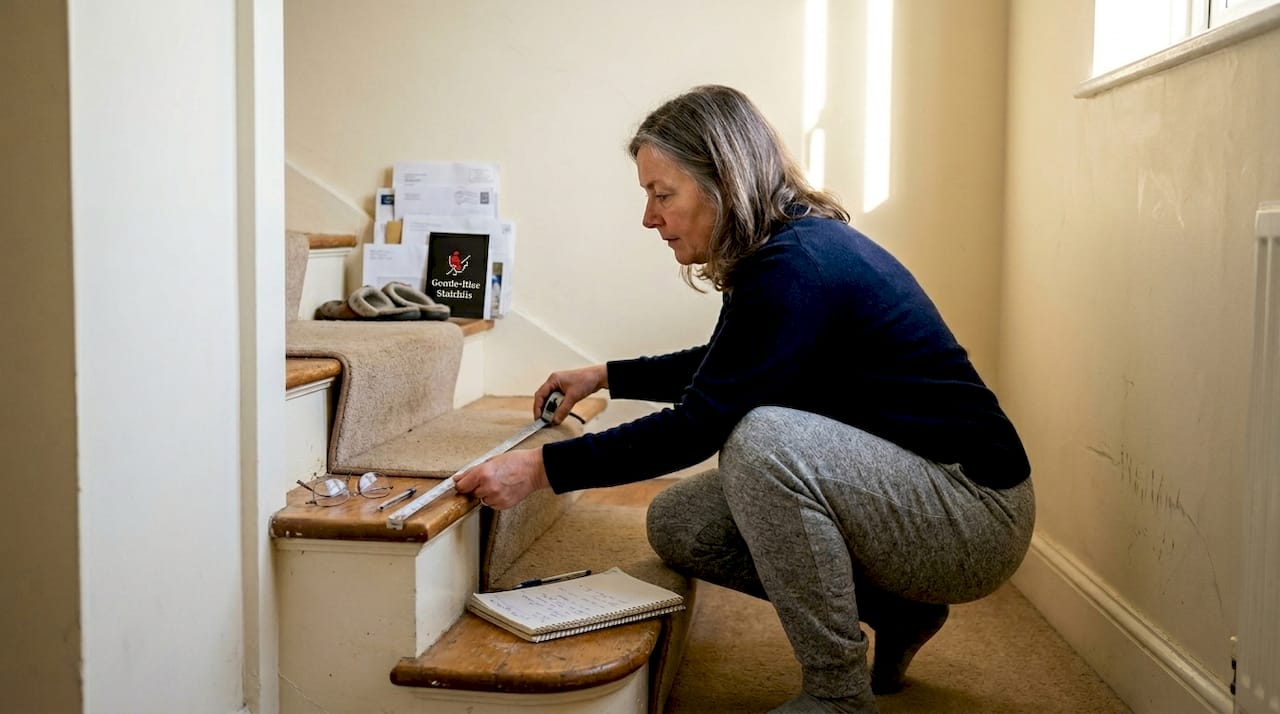
Pro Tip: Measure your staircase width before contacting any supplier. Most stair lifts require a minimum of 70 cm of stair width to install safely, and having this figure ready speeds up the quoting process considerably.
Tools and preparation for stair lift installation
With the requirements decided, let's assemble everything you'll need for installation. Whether you are overseeing a professional or following a manufacturer's DIY kit, preparation is what separates a smooth installation from a stressful one. As noted in our stairlift benefits resource, proper preparation prevents issues during installation and reduces the risk of costly errors.
Essential tools you will need:
- Power drill with masonry and wood bits
- Spirit level
- Measuring tape
- Screwdrivers (flathead and Phillips)
- Spanner set
- Pencil for marking fixing points
Materials supplied with the stair lift kit:
- Manufacturer's installation template
- Track sections (pre-cut for straight, custom for curved)
- Chair unit and armrests
- Wall and stair brackets
- Drive unit and motor assembly
- Safety sensors and remote controls
Site preparation is equally important. Clear the staircase of any rugs, loose items, or furniture. Check that there are no obstructions at the top or bottom landing. Confirm that an electrical socket is within reach, ideally no more than one metre from the base of the track.
Safety note: Always wear protective gloves and safety glasses when drilling into stairs or walls. Check the load-bearing rating of your staircase before fixing any brackets. If in doubt, consult a structural professional before proceeding.
The Which? stairlift buying guide also recommends verifying that the installer is a member of a recognised trade body, such as the British Healthcare Trades Association. This gives you added protection if something goes wrong.
| Task | DIY suitability | Professional recommended |
|---|---|---|
| Measuring and planning | Yes | Optional |
| Drilling and bracket fixing | Possible | Strongly advised |
| Electrical connection | No | Always |
| Safety testing | Partial | Always |
If you are unsure about any stage, our guide to finding a local installer can help you locate a vetted professional near you.
Step-by-step installation guide
Once you're prepared, it's time to put the stair lift together by following each step carefully. Rushing any stage creates risk, so work methodically and refer to your manufacturer's manual throughout.
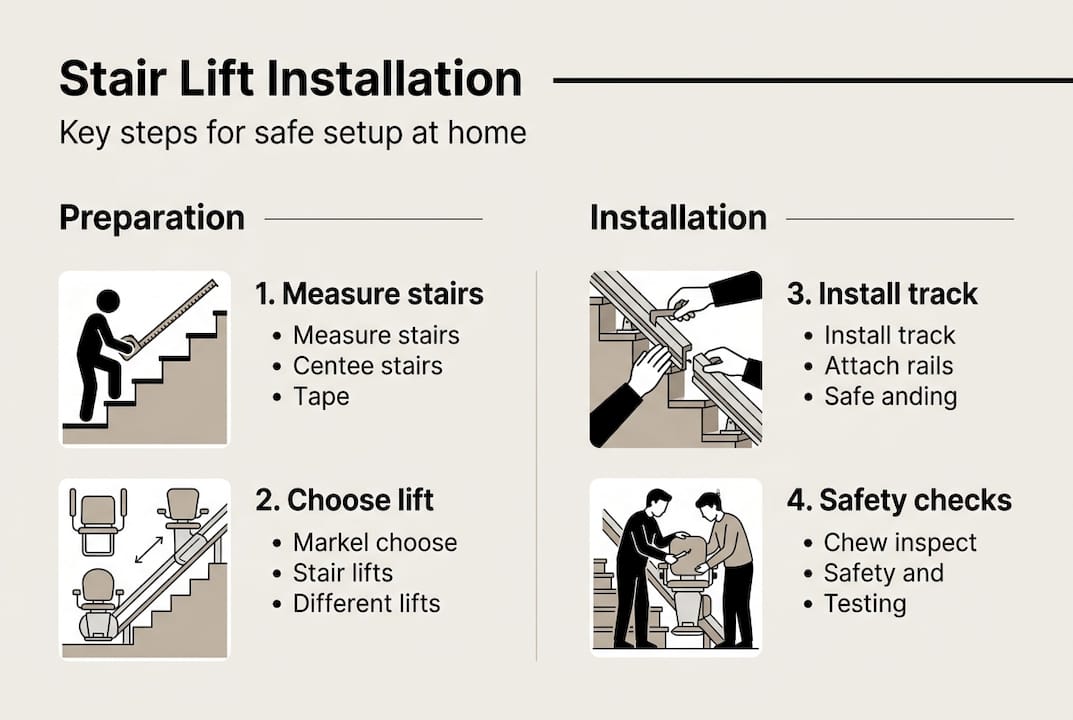
- Unpack and check all parts. Lay everything out on a flat surface and compare against the manufacturer's parts list. Do not proceed if anything is missing.
- Position the track. Lay the track along the staircase to check the fit. The track attaches to the stairs themselves, not the wall. This is important because it distributes weight more safely and avoids structural damage to plasterwork.
- Fix the brackets. Using your drill and the manufacturer's template, mark and fix the stair brackets at the specified intervals. Use the spirit level to ensure the track sits at the correct angle.
- Attach the track sections. Connect any track sections together according to the instructions. Ensure all joints are tight and secure before moving on.
- Install the drive unit. Slide the drive unit onto the track and connect the motor as directed. This is the mechanical heart of the lift, so follow the wiring diagram precisely.
- Test the drive unit. Before mounting the chair, run the drive unit along the full length of the track. Check for smooth movement, no grinding, and that it stops correctly at both ends.
- Mount the chair unit. Attach the chair to the drive unit, connect the seat controls, and ensure the swivel function operates freely.
- Set the safety stops. Adjust the upper and lower limit switches so the chair parks correctly without overrunning the track.
- Plug in and test. Connect to the mains socket and carry out a full test run with a weighted load before the user sits in it.
Following manufacturer instructions is vital for safety and performance, and skipping steps can void your warranty. For further practical guidance, the stairlift installation tips resource at SafeWise covers common pitfalls to avoid.
Pro Tip: Never test the stair lift with a person until you have completed a full weighted dummy run. Use a bag of sand or a heavy holdall to simulate the user's weight on the first test cycle.
Understanding the cost to install a stairlift in advance helps you budget accurately and avoid surprises on the day.
Safety checks, troubleshooting and aftercare
With installation complete, it's crucial to confirm safety and know how to maintain your lift for lasting independence. A stair lift is only as reliable as its upkeep, and regular aftercare and maintenance extend a stair lift's life and reliability significantly.
Essential safety checks before first use:
- Test the brakes by running the chair and pressing the stop button mid-journey
- Check all safety sensors by placing an object on the footrest and confirming the lift halts
- Verify the seat belt fastens and releases smoothly
- Confirm the swivel seat locks securely at both top and bottom positions
- Carry out a full load test with a weighted bag before the user rides it
Common problems and how to fix them:
- Chair won't move: Check the power connection and ensure the key switch is in the on position.
- Grinding or clicking noise: This usually indicates debris on the track. Clean the rail with a dry cloth and check for loose brackets.
- Charging light not showing: Verify the lift is parked on the charging strip at the top or bottom of the track.
- Remote not responding: Replace the batteries and check for signal obstructions.
From experience: Most call-outs in the first month after installation are caused by the lift not being parked on its charging point overnight. Make this part of the daily routine from day one.
For ongoing reliability, schedule a professional service once a year. Our aftercare and support programme, Protect+, covers annual servicing, priority call-outs, and parts replacement, giving you complete cover without unexpected bills.
| Maintenance task | Frequency | Who does it |
|---|---|---|
| Track cleaning | Monthly | User or carer |
| Battery check | Every 6 months | User or engineer |
| Full service | Annually | Qualified engineer |
| Safety sensor test | Monthly | User |
For guidance on running costs, our page on stairlift electricity use explains that most models cost less than £15 per year to run, making them very economical. The UK stairlift safety guidance from the Health and Safety Executive also outlines the standards your installation should meet.
What most guides forget: The confidence and peace of mind a stair lift brings
Every guide covers brackets, tracks, and test runs. Very few talk about what actually changes the morning after a stair lift is installed.
We have seen it many times. Someone who had been sleeping downstairs for months, avoiding the bedroom they have lived in for decades, walks upstairs on their own for the first time in a year. That moment is not about engineering. It is about dignity.
A stair lift does not just move a person from A to B. It gives back the whole home. The bedroom, the bathroom, the sense of privacy. For family members, it removes the constant background worry of a fall happening when no one is watching. That anxiety is exhausting, and it is often invisible until it is gone.
We believe the best stair lift is the one that makes you forget it is there. It becomes part of the home, not a reminder of limitation. When technology works quietly in the background, supporting gaining independence rather than advertising it, that is when it truly succeeds. Confidence in daily life is restored not by a machine, but by what that machine makes possible.
Discover affordable stair lift support and services
If you are ready to make your home safer and more accessible, the right support makes all the difference. At GentleRise Stairlifts, we specialise in professional installation, flexible rental options, and reconditioned models starting from £795, so there is a solution for every budget and every staircase.

Our Stairlift Protect+ aftercare programme gives you complete peace of mind after installation, covering annual servicing and priority engineer call-outs. Not sure about costs? Our UK stairlift pricing page breaks everything down clearly. Book a free home survey today and let our team help you find the right fit for your home and your life.
Frequently asked questions
Can I install a stair lift myself or should I hire a professional?
While DIY installation is possible with some kits, professional installers ensure safety and correct fitting, and they ensure your installation meets UK regulatory standards and keeps your warranty valid.
How long does it take to install a stair lift at home?
A straight stair lift typically takes 2 to 4 hours for a professional to install, while curved types take longer depending on the complexity of the track design.
Do UK stair lifts require ongoing maintenance?
Yes, regular servicing protects your warranty and prevents unexpected breakdowns. Our Protect+ aftercare plan covers annual servicing and priority call-outs for complete reassurance.
Are stair lifts suitable for all staircase types?
There are models designed for straight, curved, and spiral staircases, but custom solutions are needed for anything other than a standard straight staircase, making accurate measurement essential.