

TL;DR:
- Stairlifts enhance home safety for older adults by reducing fall risks and supporting independence.
- Buying reconditioned models and exploring financial grants can make stairlifts more affordable.
- Regular maintenance and professional servicing are essential for safe, long-term use.
Stairs can quietly become one of the biggest obstacles in your own home. For many older adults, what was once a simple climb turns into a daily source of anxiety, fatigue, or risk. A stairlift can reduce falls and support long-term independence, yet many families assume these solutions are out of reach financially. This guide walks you through how to choose the right stairlift, which affordable options are worth considering, how to maintain one safely, and where to find financial support. By the end, you will have a clear, practical framework for making a confident, cost-effective decision.
Table of Contents
- How to choose the best stairlift for your needs
- Top affordable stairlift solutions for UK homes
- Essential maintenance and safety for long-term use
- Financial support and cost-saving strategies
- Our perspective: Prioritising safety and value over the cheapest deal
- Find the ideal stairlift solution for your home
- Frequently asked questions
Key Takeaways
| Point | Details |
|---|---|
| Assess your needs | Choose a stairlift based on stair design, mobility needs, and available support. |
| Reconditioned solutions save money | Trusted reconditioned stairlifts can be as safe as new with proper service. |
| Annual maintenance is vital | Regular professional servicing prevents accidents and ensures reliability. |
| Explore funding options | Grants and VAT relief can significantly lower the overall cost for eligible users. |
How to choose the best stairlift for your needs
Choosing a stairlift is not simply a matter of picking the cheapest model you can find online. The right choice depends on a handful of practical factors that are specific to your home and your physical needs. Getting this right from the start saves money, frustration, and potential safety issues down the line.
The first thing to assess is your staircase. Straight staircases are the most straightforward to fit and the most affordable. Curved or spiral staircases require a bespoke rail, which increases both cost and lead time. Outdoor stairlifts are a separate category entirely, built to withstand weather and typically used for steps leading to a front door or garden.
Your physical requirements matter just as much as the staircase shape. Consider:
- Weight capacity: Most standard models support up to 120 kg, but heavy-duty options are available.
- Seat comfort and adjustability: Padded, swivel seats make getting on and off far easier.
- Controls: Large, simple buttons or joystick controls are easier to manage for those with arthritis or reduced grip strength.
- Footrest and armrest design: These affect how safely you can board and exit the lift.
- Safety sensors: Obstruction sensors stop the lift if something is in its path.
Budget is the next consideration, and it is closely linked to the type of unit and the level of aftercare you choose. A professional assessment of your home is always the right starting point. You can read more in our complete stairlift guide before booking a survey.
One often overlooked factor is the warranty and service plan. Stairlift experts recommend getting multiple quotes, insisting on professional installation, and prioritising long-term service plans rather than focusing purely on the lowest upfront price. A cheap unit with no aftercare can end up costing significantly more if it breaks down frequently.
Pro Tip: Reconditioned stairlifts, refurbished to a high standard by reputable providers, can offer savings of 30 to 50 per cent compared to brand-new models. They are a particularly smart option for straight staircases where the rail and mechanism are straightforward to service and replace.
Top affordable stairlift solutions for UK homes
Once you understand what you need, the next step is comparing the options available. The UK market has several reliable brands and supplier types worth knowing about.
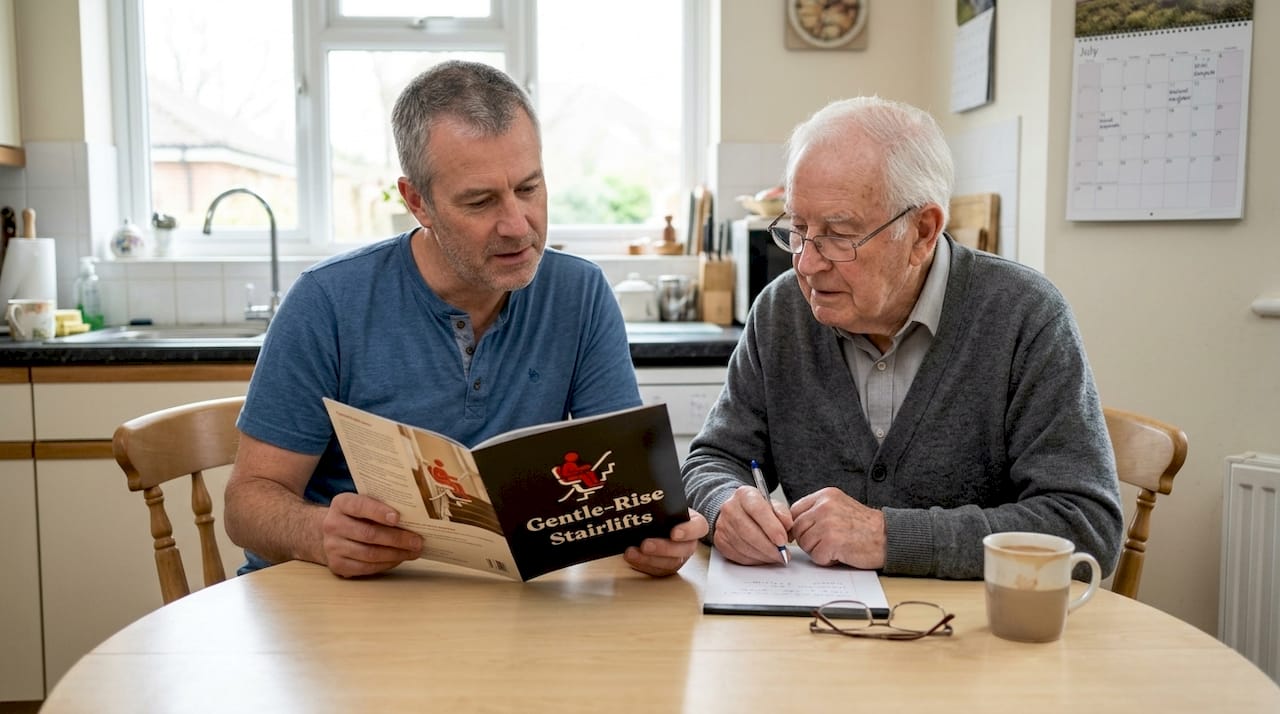
Brooks and Acorn are two of the most widely recognised names in the UK stairlift market. Both offer straight stairlift models that balance reliability with accessibility. Reconditioned straight stairlifts from these brands typically fall in the £1,500 to £2,000 range, making them a popular starting point for budget-conscious buyers.
Local and independent reconditioned providers are also worth exploring. Buying a reconditioned stairlift from a trusted local supplier often means faster installation, more personalised service, and the ability to inspect the unit before purchase.
Key features to look for across all affordable models:
- Swivel seat for safe dismounting at the top of the stairs
- Obstruction sensors on the footrest and carriage
- Simple hand-held or armrest-mounted controls
- Foldable rail option to keep the staircase clear for others
- Battery backup so the lift works even during a power cut
Financial eligibility can also shape which option makes most sense. The Disabled Facilities Grant (DFG) is a means-tested grant from your local council that can cover part or all of the cost of a stairlift. VAT relief is available to those with a qualifying disability or chronic illness, reducing the purchase price by 20 per cent. Both of these are covered in more detail in the financial section below.
Here is a quick comparison of common affordable options:
| Option | Typical price | Best for | Key consideration |
|---|---|---|---|
| New straight stairlift | £2,000 to £3,500 | Long-term use, full warranty | Higher upfront cost |
| Reconditioned straight stairlift | £1,500 to £2,000 | Budget buyers, standard stairs | Check service history |
| Rental stairlift | £50 to £80 per month | Short-term recovery needs | No ownership at end |
| Curved stairlift | £3,500 to £7,000 | Complex staircases | Bespoke rail required |
If you are comparing prices and want to understand what drives the cost differences, our page on affordable stairlifts breaks this down clearly. The independent living evidence from the UK government also reinforces how much of a difference the right mobility aid makes to daily quality of life.
Essential maintenance and safety for long-term use
Buying a stairlift is only the beginning. Keeping it safe and reliable over time requires consistent attention, and the good news is that most maintenance tasks are straightforward.
Here are the key steps for safe daily use and long-term upkeep:
- Inspect the rail weekly: Wipe it down with a dry cloth and check for any debris or obstructions.
- Test the safety sensors monthly: Place a small object in the path of the lift to confirm the sensor stops it correctly.
- Check the seatbelt condition: Look for fraying or stiff buckles and replace promptly if worn.
- Keep the charging points clear: Most stairlifts charge automatically at the top or bottom of the rail. Ensure nothing blocks the contacts.
- Book annual professional servicing: A trained engineer can spot wear on the motor, drive belt, and electrical components before they become a problem.
"Annual servicing is not optional. It is the single most effective way to ensure a stairlift remains safe and functional for years to come."
The statistics here are sobering. Stairlift falls carry a 15.7 per cent mortality rate when they do occur, which is why preventing them through proper maintenance and correct usage is so important. These incidents are rare, but they are serious enough to take the subject seriously.
For affordable service contracts, ask your installer whether they offer an annual plan at the point of purchase. Many providers bundle this into the sale price or offer it at a reduced rate for the first year. You can also find practical guidance on our stairlift maintenance tips page. Keeping a home maintenance checklist for all major home equipment, including your stairlift, is a simple habit that pays off.
Pro Tip: Always keep the emergency contact number for your stairlift provider somewhere visible near the staircase, such as on a card attached to the charging station. In the event of a fault, you will not need to search for it.
Financial support and cost-saving strategies
The cost of a stairlift does not have to fall entirely on your household. Several funding routes exist in the UK, and knowing how to access them can make a significant difference to what you actually pay.
The Disabled Facilities Grant (DFG) is the most substantial form of support available. It is administered by your local council and is means-tested, meaning the amount you receive depends on your income and savings. In England, the maximum grant is £30,000. In Wales it is £36,000, and in Northern Ireland it is £25,000. Scotland operates a similar scheme through its local authorities. DFG and VAT relief are the two most impactful ways eligible buyers can reduce their costs.
VAT relief is available to anyone with a disability or long-term illness. You simply declare your eligibility to the supplier in writing, and they remove the 20 per cent VAT from the purchase price. No formal application is required.
Additional cost-saving strategies include:
- Comparing at least three quotes before committing to a supplier
- Asking specifically about reconditioned models, which can be 30 to 50 per cent cheaper
- Checking whether your local council offers a top-up grant beyond the DFG
- Enquiring about rental options if the need is temporary, such as post-surgery recovery
- Asking whether the installer will remove and recycle your old stairlift at no extra charge
Here is a summary of the main financial support routes:
| Funding route | Who qualifies | Typical saving | How to apply |
|---|---|---|---|
| Disabled Facilities Grant | Means-tested, disability related | Up to £30,000 | Via local council |
| VAT relief | Disability or chronic illness | 20% off purchase price | Declare to supplier |
| Local authority top-up grant | Varies by council | Variable | Contact your council |
| Rental agreement | Anyone | Avoids large upfront cost | Via stairlift provider |
For a full breakdown of what you might pay and how to plan your budget, our stairlift cost breakdown page is a useful resource.
Our perspective: Prioritising safety and value over the cheapest deal
We have seen many families come to us after a disappointing experience with a low-cost stairlift purchased purely on price. The unit arrived quickly, looked fine, and then developed faults within months. The supplier was difficult to reach, the warranty was limited, and the cost of repairs quickly exceeded the original saving.
The uncomfortable truth is that a stairlift is not a one-off purchase. It is a piece of safety-critical equipment that someone you care about will use multiple times every single day. Cutting corners on installation quality or aftercare is not a financial saving. It is a deferred risk.
Our advice is to treat the service plan as non-negotiable. Ask every supplier you speak to what happens if the lift breaks down at the weekend. Ask how quickly an engineer can attend. Ask whether the service contract covers parts as well as labour. These questions separate the reliable providers from the rest.
For families researching on behalf of an elderly parent, the best thing you can do is consult an expert before making any decision. Our reliable stairlift advice page outlines exactly what to look for in a trustworthy provider.
Find the ideal stairlift solution for your home
If you have read this far, you are already better prepared than most people who start searching for a stairlift. You know what to look for, which funding routes to explore, and why aftercare matters as much as the initial price.
At GentleRise Stairlifts, we offer free home surveys, fast installation, and a range of reconditioned stairlift options to suit different budgets and staircase types. Whether you need a straight lift installed this week or want to understand your costs and quotes before committing, our team is here to help. Get in touch today and take the first step towards safer, more confident living at home.
Frequently asked questions
Are reconditioned stairlifts safe for elderly users?
Yes, when sourced from reputable suppliers and serviced annually, reconditioned stairlifts offer safety and reliability comparable to new models. Annual servicing is essential for continued safe use regardless of the unit's age.
What financial help is available for stairlifts in the UK?
The Disabled Facilities Grant and VAT relief are the two main routes for reducing stairlift costs. DFG and VAT relief are available to qualifying individuals and can significantly reduce what you pay.
How often should a stairlift be serviced?
Stairlifts should be professionally serviced at least once a year. Annual service is essential for maintaining both safety and long-term reliability.
What features should I look for in an elderly stairlift?
Prioritise swivel seats, obstruction sensors, clear controls, and a reliable aftercare plan. Experts recommend prioritising safety features and trusted aftercare over the lowest upfront price.
Recommended
- Best stair lift alternatives for safer, affordable home mobility
- Home accessibility: affordable stairlift solutions UK
- Types of mobility aids for greater independence: a guide
- Why choose GentleRise stairlifts for safer home mobility
- Access Control for Medical & Assisted Care Facilities | Security & Life Integrations