

TL;DR:
- Investing early in home mobility, such as stairlifts, reduces fall risks and preserves independence for older adults. Public funding options, like the Disabled Facilities Grant, make stairlifts affordable, especially when applied for proactively. Proper assessment and tailored solutions ensure safe access, enabling aging in place and preventing costly hospital admissions.
One in four older adults falls each year, and the most dangerous place for that fall to happen is on the stairs. For millions of UK homeowners managing reduced mobility, whether due to age, arthritis, or recovery from a hip replacement, the staircase represents a daily threat they have simply learned to live with. That is where the question of why invest in home mobility becomes genuinely urgent. Many delay acting because they assume stairlifts are expensive, unnecessary, or only for people in crisis. The reality is the opposite on all three counts.
Table of Contents
- Understanding why investing in home mobility is essential
- Addressing cost concerns: funding and affordability options in the UK
- Temporary solutions and safety nuances during recovery
- Making an informed decision: home accessibility assessments and choosing the right stairlift
- Why early and tailored home mobility investment saves lives and preserves independence
- Find cost-effective stairlift solutions to regain independence
- Frequently asked questions
Key Takeaways
| Point | Details |
|---|---|
| Falls on stairs are dangerous | Stairs are the highest-risk spot in the home and a top cause of serious injury among older adults in the UK. |
| Early investment matters | Installing mobility aids like stairlifts early prevents costly injuries and preserves independence longer. |
| Funding is available | The Disabled Facilities Grant can cover significant stairlift costs but requires assessment and early application. |
| Tailor solutions to needs | Home assessments and professional advice help choose the safest, most suitable stairlift type. |
| Temporary options exist | Short-term stairlift rentals offer recovery support without permanent commitment for post-surgery periods. |
Understanding why investing in home mobility is essential
Stairs do not just become inconvenient with age. They become dangerous. Fall-related injury and death from stairs ranks among the top causes of hospitalisation for adults over 65, and the consequences extend far beyond a broken bone. A single stair fall can trigger a chain of events: emergency admission, surgery, a temporary care home placement, and the loss of the independence the person spent decades protecting.
The maths is stark. Most UK homes are two-storey, meaning the bedroom, bathroom, and often the quietest spaces in the house are entirely inaccessible once stairs become unsafe. What is home mobility, at its core? It is the ability to move freely and safely through your own home without fear. When stairs are involved, that freedom hinges on one decision.
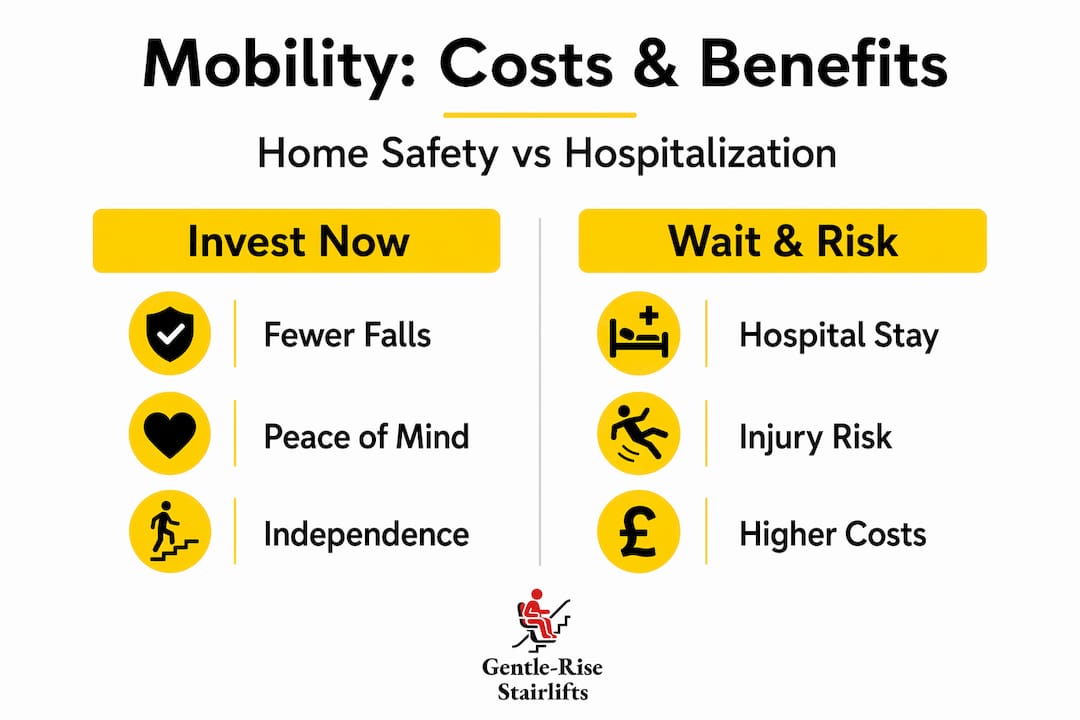
Investing early means you choose on your terms, not under pressure at 11pm after an ambulance visit. The benefits of home mobility investment include:
- Eliminating the leading fall risk in the home before injury occurs
- Preserving full access to every room, maintaining normal daily routines
- Reducing carer burden, as stairlift users regain independence from family members
- Supporting mental wellbeing by removing constant anxiety about navigating stairs
- Enabling aging in place, avoiding premature or unwanted moves into care settings
Choosing the right stairlift is the first practical step once you decide to act. And smart mobility solutions do not have to mean expensive or complicated ones. What matters is matching the solution to the person and the home.
Addressing cost concerns: funding and affordability options in the UK
Let us be honest about the biggest reason people delay. 67% of UK respondents name cost as their primary worry when it comes to stairlifts, and a significant portion of those people have no idea that substantial public funding exists to help. That is not laziness; it is a genuine information gap.

The most important funding route in England is the Disabled Facilities Grant (DFG). The DFG can cover up to £30,000 towards the cost of a stairlift or other home adaptation, and it is administered through your local council. It requires an occupational therapy assessment and a means test before any installation takes place, which is why applying early matters. Waiting until after a fall to apply means waiting weeks or months for an assessment while navigating stairs that are already unsafe.
Key facts about funding and affordability worth knowing:
- The DFG is available in England (up to £30,000), Wales (up to £36,000), and Northern Ireland (up to £25,000); Scotland has its own grant system
- Reconditioned stairlifts can cost from as little as £795, making self-funding a realistic option for many straight staircases
- Rental stairlifts require no large upfront cost and suit those who only need access temporarily
- Some councils offer additional top-up grants or interest-free loans beyond the DFG amount
- Charitable organisations such as Turn2Us and Age UK Enterprises can signpost additional financial help
The compare here is instructive. A single hospital stay following a stair fall costs the NHS an average of over £4,000 per admission, and hip fracture treatment can run far higher. The affordable stairlift types available today start well below that figure. If you are in London, stairlifts in London are readily available across the capital with fast installation times. Why invest in safe home mobility? Because the financial case, not just the safety case, is overwhelming.
Pro Tip: Apply for the Disabled Facilities Grant before committing to any purchase. Most grants require a pre-approved assessment and will not reimburse costs already incurred. Your local council's occupational therapy team is the starting point.
Temporary solutions and safety nuances during recovery
Not every mobility challenge is permanent. Many people reading this are weeks out from a knee replacement, a hip operation, or a stroke, and they are trying to work out how to get upstairs without putting their recovery at risk. Temporary stairlift rentals covering one to six months provide safe stair access precisely for this window, and they cost a fraction of a permanent installation.
Ground-floor living is often suggested as the alternative during recovery. For some people that works. But in practice, it means moving a bed into a living room, losing your routine, and often increasing dependence on others for basic tasks. A temporary stairlift installed in hours keeps your bedroom as your bedroom and your recovery as dignified as possible.
One important safety point that is frequently misunderstood: not all stairlift types suit all users. Standing stairlifts, sometimes called perch stairlifts, are designed for users who have difficulty bending at the knee but can otherwise stand steadily. Standing stairlifts are unsafe for anyone with poor balance, dizziness, or reduced cognitive ability. Using one without proper assessment is not a minor risk; it is a serious one.
Before choosing any stairlift type for a recovering user, consider:
- Whether the user can follow simple instructions consistently throughout the ride
- Balance and vestibular function, particularly relevant after stroke or inner-ear conditions
- Grip strength, especially important if the user needs to hold on during transit
- Pain levels and joint flexibility that might affect the ability to sit or stand safely at each end
- The staircase layout, including width, angle, and whether it turns mid-flight
Installing a stairlift safely involves more than the mechanics of fitting the rail. It involves matching the product to the person using it.
Making an informed decision: home accessibility assessments and choosing the right stairlift
What is a home mobility assessment? It is a professional review of your home's physical layout and your specific mobility limitations, conducted to identify which adaptations will actually help and which are unnecessary. A home accessibility assessment identifies barriers across the home, prioritises high-risk areas like stairs and bathrooms, and gives you the evidence base to budget properly and research appropriate solutions.
What is a home mobility expert? Typically this is an occupational therapist (OT), though some stairlift companies offer their own trained assessors. The OT's role is to evaluate what you can and cannot do safely, and to recommend adaptations that match your actual functional capacity. Their report is also the document that unlocks DFG funding.
Here is a practical step-by-step approach to making the right decision:
- Identify your main barriers: Begin by noting every task in your home that causes fear, pain, or avoidance. Stairs almost always top the list.
- Request a home mobility assessment: Contact your local council's social care team or ask your GP for an OT referral. Some stairlift providers offer a free survey as a starting point.
- Understand your stairlift options: The main types are straight, curved, and reconditioned. Each has different costs, timelines, and suitability considerations.
- Apply for the DFG before purchasing: Your OT assessment feeds directly into this process.
- Get at least two quotes and compare specifications, not just price.
- Confirm aftercare arrangements: A stairlift without a maintenance plan is a risk. Ask about response times for breakdowns.
| Stairlift type | Best suited to | Approximate cost (self-funded) | Lead time |
|---|---|---|---|
| Straight | Standard single-flight stairs | From £795 | Same day to 48 hours |
| Curved | Stairs with bends or landings | From £2,500 | 2 to 4 weeks |
| Reconditioned | Budget-conscious users with straight stairs | From £795 | 24 to 72 hours |
| Rental (temporary) | Post-surgery recovery or trial | Weekly or monthly rate | 24 to 48 hours |
Home mobility solutions that are properly assessed and correctly installed almost always pay for themselves in avoided injuries, avoided care costs, and preserved independence. The worst decisions happen when someone buys a stairlift without assessment and then finds it does not suit their needs or their staircase.
Pro Tip: Ask your stairlift provider whether their surveyor is independent or commission-based. An independent assessment of your home's layout is always more reliable than one conducted by someone with a financial interest in a particular product.
Why early and tailored home mobility investment saves lives and preserves independence
Here is something the general advice never quite says clearly enough: waiting for a fall to prompt action is not caution. It is risk. Most families begin mobility modifications only after an emergency, but early planning consistently delivers safer, less expensive, and more appropriately tailored outcomes.
What is home mobility restoration? It is the process of returning someone to full, safe movement through their home after a period of decline or injury. Done well, it is not just practical. It restores identity. The person who confidently uses their stairlift every morning and accesses their whole home is not living in a care setting. They are living their life.
There is a widespread misconception that stairlifts signal defeat, that fitting one means admitting you cannot cope. In practice, the people who act early are the ones who continue to age in place without the trauma of emergency hospital stays and rushed decisions made under duress. Occupational therapy assessment shapes not just funding eligibility but the quality of the adaptation itself. An OT who understands your daily routine will flag things you might not think to mention, such as whether you carry laundry downstairs or whether your cat uses the same staircase.
What is a mobility needs assessment in practice? It is a personalised look at your functional ability, not a generic tick-box exercise. The best OTs treat it as a conversation, not an inspection. That conversation is what separates an adaptation that transforms daily life from one that gathers dust in the corner. Age-friendly home modifications work best when they are chosen with professional input rather than purchased on impulse or under pressure.
The uncomfortable truth is that most families have this conversation at least six months too late. The ones who have it early spend less, stress less, and adapt better.
Find cost-effective stairlift solutions to regain independence
If this article has clarified why invest in home mobility matters, the logical next step is finding the right solution for your specific staircase, mobility level, and budget.

Gentle Rise Stairlifts Ltd offers straight, curved, and reconditioned stairlifts across the UK, with prices starting from £795 and installation often completed within hours. Whether you need a permanent installation or a short-term rental during recovery, the team provides a free home survey so you can make an informed decision without any pressure. For those managing costs carefully, the site offers clear guidance on stairlift costs in the UK and support with accessing available funding. Explore how enhancing accessibility for independence can change your daily life and book your free survey today.
Frequently asked questions
What is the main reason to invest in home mobility devices like stairlifts?
The primary reason is to reduce the risk of falls on stairs. Stair falls are the leading cause of injury-related death in adults over 65, and a stairlift removes that risk entirely while preserving access to every floor of the home.
Can the Disabled Facilities Grant help with the cost of installing a stairlift?
Yes. In England, the DFG covers up to £30,000 towards stairlift installation, subject to an occupational therapy assessment and means test that must be completed before any work begins.
Are standing stairlifts suitable for everyone?
No. Standing stairlifts require the user to stand securely with support throughout the journey and have good cognitive ability. They are not appropriate for anyone with poor balance, dizziness, or cognitive impairment.
When is the best time to consider installing a stairlift?
The best time is before a fall or health crisis occurs. Proactive planning is safer and less expensive than responding to an emergency, and it allows for proper assessment, funding applications, and adjustment time.
Can I rent a stairlift temporarily after surgery?
Yes. Short-term rentals of one to six months are widely available and provide safe stair access during recovery, making them a practical alternative to ground-floor living when your home layout makes that impractical.