

TL;DR:
- Starting with an occupational therapist assessment ensures funding eligibility and a suitable stairlift recommendation, especially when applying for grants.
- A supplier engineer visit focuses on technical measurements and model suitability, offering quicker feasibility advice without funding considerations.
Many UK homeowners assume the stairlift process begins with browsing models and collecting quotes. In reality, the very first step you take — and who you invite into your home — can determine how quickly you get a stairlift fitted, whether you qualify for funding, and whether the equipment actually suits your needs. Getting the order wrong costs time, money, and unnecessary stress. This guide walks you through every type of stairlift home visit, explains exactly what happens at each one, and shows you how to navigate the process with confidence so you can regain independence in your own home as quickly as possible.
Table of Contents
- What is a stairlift home visit and why does it matter?
- How the home visit process works: step-by-step explained
- What to expect during your stairlift home assessment
- Avoiding common pitfalls and delays
- A fresh perspective on stairlift home visits: what really speeds things up
- How GentleRise Stairlifts supports your home visit journey
- Frequently asked questions
Key Takeaways
| Point | Details |
|---|---|
| Choose the right visit | Book an occupational therapist first if you need grant funding; go direct to supplier for quick private installs. |
| Understand the process | A typical grant-funded stairlift requires an OT assessment, council paperwork, and supplier installation in sequence. |
| Solid preparation avoids delays | Clarify each visit’s purpose, take notes, and confirm what to do next to keep your stairlift plan on track. |
| Recommendations drive funding | OT recommendations are crucial for council grant eligibility and the correct stairlift fit. |
What is a stairlift home visit and why does it matter?
There are two distinct types of stairlift home visit, and they serve very different purposes. Mixing them up — or booking them in the wrong order — is the single most common reason people experience delays.
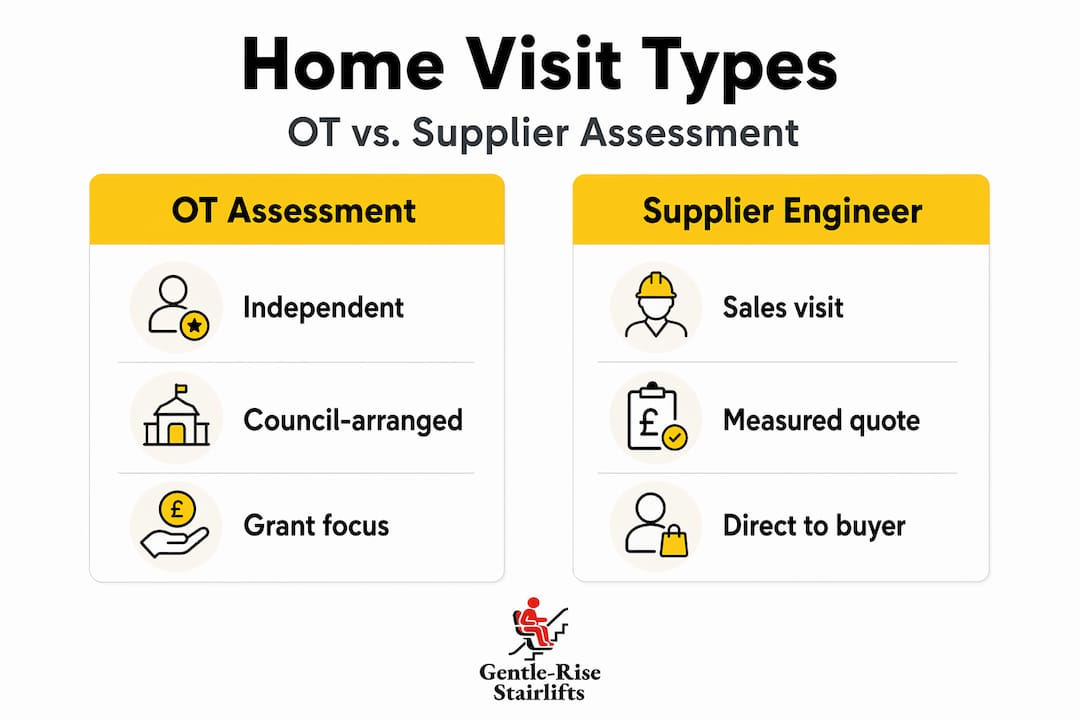
The occupational therapist (OT) assessment is carried out by a qualified health professional, usually arranged through your local council or NHS. An OT is entirely independent of any stairlift company. Their job is to assess your overall functional needs: how you move around the home, what daily tasks you struggle with, and what aids or adaptations would make a meaningful difference to your safety and quality of life. Crucially, their written recommendation is what unlocks access to a Disabled Facilities Grant (DFG), the main government funding route for stairlifts in England, Wales, and Northern Ireland.
The supplier engineer assessment is arranged directly with a stairlift company. The engineer will visit your home to measure your staircase, check access, assess power supply, and advise on which models are suitable. Their expertise is technical and product-focused. They want to match the right equipment to your home, and they can usually move quickly to provide a quote and installation date.
As noted in guidance from Stairlift Guru, an OT is independent of any specific equipment seller, and getting the OT visit before starting a grant process helps ensure recommendations align with funding eligibility. However, if you need speed and do not require grants, a supplier engineer is a quicker route to feasibility advice and equipment selection.
Here is a straightforward comparison to help you decide:
| Factor | OT assessment | Supplier engineer visit |
|---|---|---|
| Who arranges it | Council or NHS | Stairlift company |
| Independence | Fully independent | Product/sales focused |
| Main purpose | Identify mobility needs, grant eligibility | Measure stairs, advise on models, quote |
| Required for DFG | Yes | No (but quotes needed later) |
| Speed | Can have a waiting list | Often within days |
| Cost | Typically free | Usually free survey |
A useful way to think about it: the OT tells the council why you need a stairlift, and the supplier engineer works out how to fit one. Both visits are valuable. The question is simply which one you need first.
Key factors that should influence your decision:
- Applying for a Disabled Facilities Grant: Book the OT first, always.
- Self-funding or renting a stairlift: Contact a supplier engineer directly for a faster process.
- Urgency following surgery or illness: A supplier can often visit and install within days; the grant route takes longer.
- Unsure about what equipment you need: An OT can offer impartial advice before you approach any company.
Your broader mobility planning guide will help you map out all the accessibility changes you may need alongside a stairlift, so neither visit becomes an isolated decision.
How the home visit process works: step-by-step explained
Once you understand who does what, the next step is grasping the actual sequence of events. The pathway differs significantly depending on whether you are seeking grant funding or organising things yourself.
DFG-funded pathway (step-by-step):
- Contact your local council's housing or adult social care team and request a referral for an OT home assessment.
- The OT visits your home, assesses your mobility needs, and produces a written recommendation.
- The council receives the OT report and carries out means testing (income and savings assessment).
- The council makes a grant decision. If approved, they authorise you to obtain quotes from approved suppliers.
- You receive quotes (at least one or two, depending on council requirements), and the council selects or approves the chosen supplier.
- Installation is carried out and signed off.
Self-funded or urgent pathway (step-by-step):
- Contact a stairlift supplier directly and request a free home survey.
- The supplier engineer visits, measures, and provides a quote.
- You confirm your order and arrange payment or a rental agreement.
- Installation is booked, often within a few days to a couple of weeks.
- Aftercare and maintenance arrangements are confirmed.
The difference in timelines is significant. DFG stairlift funding involves a defined pathway: OT assessment, council means-testing, grant decision, and then quotes and installation, which can collectively take several weeks or even months. Self-funding, by contrast, can move from first visit to installed stairlift in as little as a week.
Here is a rough timeline comparison:
| Stage | DFG route | Self-funded route |
|---|---|---|
| Initial visit arranged | 1 to 4 weeks (OT waiting list) | Within days |
| Assessment completed | 60 to 90 minutes | 60 to 90 minutes |
| Decision/quote received | 4 to 12 weeks (council process) | Within 48 hours |
| Installation | Weeks after approval | Days after order |
| Total typical timeline | 3 to 6 months | 1 to 3 weeks |
When assessing mobility needs beforehand, think carefully about what you currently struggle with. The more specific you can be during the visit, the more accurate the recommendation or quote will be.
Pro Tip: Before either visit, write down your daily routine and note where stairs cause you problems. This takes ten minutes and saves significant time during the assessment itself, ensuring nothing important is missed.
Understanding the difference also helps if you are considering a rental stairlift for a short-term recovery period. In that case, the safe stairlift installation process via a supplier is almost always the most sensible route, with no need for the OT grant pathway at all.
What to expect during your stairlift home assessment
Whether an OT or a supplier engineer is visiting, preparation makes the appointment far more productive. Knowing what will be checked means you can have the right information ready and feel confident throughout.
What an OT will assess:
- How you currently climb and descend the stairs — do you use a bannister, stop to rest, or need support from another person?
- Whether you experience pain, breathlessness, or dizziness on the stairs.
- Your general balance, strength, and any diagnosis affecting your mobility.
- The layout of your home, including bedroom and bathroom locations relative to the stairs.
- Whether a stairlift is the right solution or whether other aids (such as grab rails or a bed downstairs) would better serve your needs.
- Any safety concerns such as narrow landings or awkward stair configurations.
What a supplier engineer will assess:
- Precise measurements of stair width, length, and angle.
- Whether the staircase is straight, curved, or spiral (each requires a different track type).
- Availability of a suitable power socket near the top or bottom of the stairs.
- The condition of the staircase wall and structure for fitting the rail.
- Space at the top and bottom for the lift to park safely without blocking doorways.
- Your weight and seating requirements to recommend the correct model and seat configuration.
OT home visits commonly take about 60 to 90 minutes and result in written recommendations covering what changes to make, including stairlifts. Supplier visits tend to be slightly shorter, focused on technical detail rather than broader health discussion.
The OT's written report is a formal document. It records your functional limitations and the recommended adaptation, and it goes directly to the council to support your grant application. Without it, the DFG process cannot move forward. The supplier's visit produces a quote document that forms the basis of your purchase or rental agreement.
Here is a practical checklist to have ready before either visit:
- A list of current medications (useful for OT visits, as some affect mobility and balance).
- Details of any recent falls, operations, or medical diagnoses related to your mobility.
- Information on who else lives in the home and uses the stairs.
- Access to the electrical consumer unit, in case the supplier needs to confirm circuit capacity.
- Any previous quotes or reports if you have had assessments before.
Pro Tip: Clear the staircase of any shoes, bags, or clutter before the visit. It sounds obvious, but a clear staircase allows both assessors to work accurately and safely, and saves time on the day.
Thinking about which stairlift type might suit your home before the supplier visit is worthwhile, as it helps you ask the right questions. Your accessibility upgrades guide can help you think about your home more holistically before either professional arrives.
Avoiding common pitfalls and delays
Even with a clear process in mind, small mistakes at key moments can push your installation back by weeks. Here are the most frequent missteps and how to avoid them.
-
Booking the supplier before the OT when you need a DFG. If you intend to apply for grant funding, going to a supplier first does not speed things up — it wastes your time. The council requires the OT recommendation before anything else moves forward. You cannot retrospectively use a supplier's quote to replace the OT report.
-
Not taking notes during the visit. Both an OT and a supplier engineer will give you a great deal of information in a short time. Write things down, or ask if you can record the conversation. Follow-up questions by phone or email are common but avoidable if you capture the key points on the day.
-
Assuming the supplier will handle all paperwork. For DFG applications, you or a family member may need to submit forms to the council directly. Clarify at the end of every visit who is responsible for the next action. A missed form can delay the entire process.
-
Not confirming the next step before the assessor leaves. Whether it is a council reference number, a quote follow-up date, or an installation booking, always end the visit knowing exactly what happens next and who you need to contact.
-
Ignoring the waiting list reality. OT appointments through the council can have waiting times of several weeks. If your mobility is deteriorating, ask the council if an urgent referral is possible, or explore self-funding or rental options while you wait.
As Stairlift Guru highlights, if funding is likely, arranging OT recommendations early then using those to support the council process is essential — otherwise you can lose significant time while paperwork catches up with you. The sequence genuinely matters.
Pro Tip: Ask the OT or council caseworker for a reference number or written confirmation of your application at the end of every interaction. This gives you a clear record and makes it far easier to follow up without starting from scratch.
Exploring affordable stairlift solutions in parallel with your assessment process means you are never caught out if the grant route takes longer than expected.
A fresh perspective on stairlift home visits: what really speeds things up
Here is something most guides will not tell you. The official pathway is well-documented, clear on paper, and entirely workable. But the real bottleneck is almost never the assessors or the council process itself. It is the small gaps between steps: the form that sits in a drawer for a week, the phone call that keeps getting put off, and the paperwork that arrives at the council the day after the monthly review meeting.
In our experience, the people who move through the stairlift process fastest are the ones who treat it like a project. They write things down. They ask clear questions at the end of every conversation. They follow up within 48 hours if they have not heard anything. None of this is complicated. It just requires a small shift in mindset.
There is also a persistent myth that the OT and the supplier engineer are working against each other — one recommending a grant route, the other pushing a sale. In practice, the two roles complement each other well when handled in the right order. An OT recommendation that clearly describes the need for a powered stairlift on a straight staircase gives a supplier engineer a precise brief to work from. The result is a more accurate quote, a faster approval, and a better-fitted product.
The other thing worth saying plainly: if your mobility is deteriorating quickly, do not feel obliged to wait for a council process. Rental stairlifts can be installed within days and can bridge the gap while a grant application works its way through. Choosing the right stairlift early, even temporarily, is almost always better than waiting in discomfort. Independence is not something that should be delayed while paperwork catches up.
How GentleRise Stairlifts supports your home visit journey
Navigating assessments, funding routes, and installation timelines is much easier when you have expert guidance from the outset. At GentleRise Stairlifts Ltd, we offer free home surveys carried out by experienced engineers who understand both the technical and personal dimensions of the process.

Whether you are self-funding, exploring rental options, or waiting on a DFG decision, we can help you understand your choices without pressure. Our team can walk you through stairlift costs transparently, from reconditioned straight models starting at £795 to bespoke curved installations. We are committed to enhancing independence at every stage, with aftercare through our Protect+ maintenance programme to keep your stairlift running safely long after installation. Book your free home survey today and take the first step with confidence.
Frequently asked questions
Who should I book first for a stairlift home visit — an OT or the stairlift supplier?
If you plan to apply for grant funding, book the occupational therapist first, as their independent recommendation is required before the council will process a Disabled Facilities Grant; if you are paying privately or need a stairlift urgently, booking a supplier directly is considerably faster.
How long does a stairlift home assessment typically take?
A stairlift home assessment by either an OT or a supplier engineer typically takes 60 to 90 minutes, though supplier visits for straightforward straight staircases may be slightly shorter.
What steps come after my home assessment if I want a DFG stairlift grant?
After your OT assessment, the council will conduct means testing on your income and savings, make a formal grant decision, and then authorise you to obtain quotes before confirming installation with an approved supplier.
What is checked during a stairlift home visit?
The assessor checks your stair measurements, nearby power supply, structural suitability, and your personal mobility needs and safety to ensure the recommendation or quote is accurate and appropriate for your home.