
TL;DR:
- Dual-rail stairlifts offer enhanced stability and smoother operation on complex, curved, or narrow staircases, making them essential for demanding home layouts. They are more expensive and complex to install but provide higher weight capacity, durability, and safety for non-standard stairs. Choosing the right model depends on staircase shape, user needs, and long-term value, emphasizing proper assessment over brand prestige.
When a family member starts struggling with the stairs, choosing a stairlift can feel overwhelming. Many people assume all stairlifts are essentially the same piece of kit, differing only in price. That assumption can lead to costly mistakes, poor fit, and even safety concerns. Dual-rail stairlifts are a distinct category, built specifically to handle the kinds of staircases that defeat standard single-rail models, and understanding how they work is the first step towards choosing the right solution for your home.
Table of Contents
- What is a dual-rail stairlift?
- When and why choose a dual-rail stairlift?
- Comparing costs: dual-rail versus single-rail stairlifts
- Installation and maintenance: what to expect
- Key considerations before you decide
- A practical perspective: why fit matters more than features
- Next steps: access trusted stairlift support
- Frequently asked questions
Key Takeaways
| Point | Details |
|---|---|
| Dual-rail design explained | Dual-rail stairlifts use two rails for added stability and support, especially on curved or complex staircases. |
| Best for unique stairs | They are ideal for non-standard, narrow, or winding stairs where single-rail models may not fit safely. |
| Cost reflects complexity | Dual-rail options often have higher upfront costs but yield greater reliability and comfort for challenging layouts. |
| Professional fitting crucial | Proper installation and regular maintenance are essential to ensure safety and longevity of dual-rail stairlifts. |
What is a dual-rail stairlift?
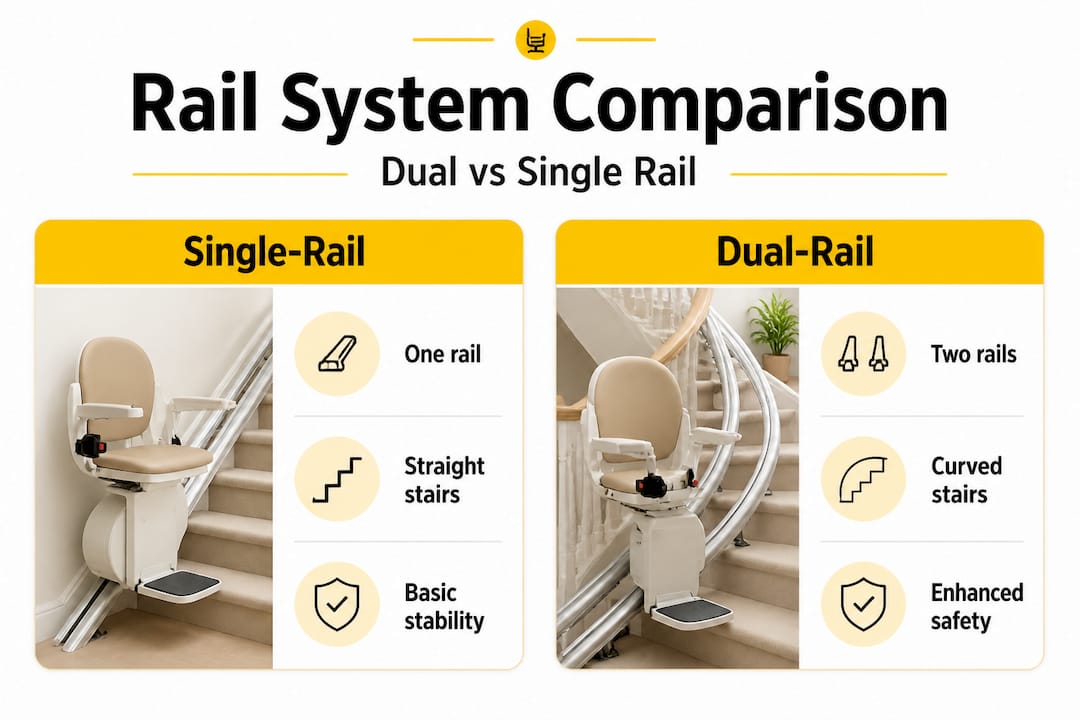
Not all stairlifts are built the same way. A standard single-rail stairlift attaches to one continuous track running alongside your staircase. The seat and carriage grip this single rail and travel up and down it. That design works well for the majority of straightforward, standard-width staircases. A dual-rail stairlift, as the name suggests, uses two parallel rails running along the staircase. The carriage sits between or astride both rails, distributing weight and force more evenly across the full width of the track system.
This twin-track design makes a meaningful practical difference. Think of it like the difference between a single-beam bridge and a double-beam bridge. Both can carry a load, but the double-beam design handles variations, imbalances, and heavier weight with greater stability. For choosing the right stairlift, understanding this structural distinction guides homeowners towards models genuinely suited to their home layout and user requirements.
The core components of a dual-rail stairlift include:
- Twin rails: Two precisely engineered tracks, custom-made to fit the specific staircase shape
- Drive mechanism: Usually a rack-and-pinion or cable-driven motor system running along both rails simultaneously
- Carriage and seat: A broader, reinforced platform carrying the seat, armrests, and footrest
- Controls: Joystick or paddle controls on the armrest, plus remote handsets for calling the lift to either floor
- Safety sensors: Obstruction detectors along both rails to stop the lift if anything is in the path
Dual-rail systems are especially well-suited to curved or spiral staircases, staircases with intermediate landings, very narrow or unusually shaped staircases found in older UK properties, and situations where a heavier-duty weight capacity is needed. Exploring home mobility solutions that account for these variations can save considerable time, money, and frustration later.
Pro Tip: If your staircase has any bends, turns, or an unusual width, ask specifically about dual-rail options from the outset. Retrofitting the wrong rail system costs far more than choosing correctly from the start.
| Feature | Single-rail stairlift | Dual-rail stairlift |
|---|---|---|
| Rail configuration | One track | Two parallel tracks |
| Best suited for | Straight, standard staircases | Curved, narrow, or complex staircases |
| Weight capacity | Standard (typically up to 120 kg) | Higher (often up to 160 kg or more) |
| Ride stability | Good on straight stairs | Superior on bends and non-standard layouts |
| Installation complexity | Simpler, faster | More complex, may take longer |
| Cost | Lower | Higher, but better value for complex stairs |
When and why choose a dual-rail stairlift?
Once you understand what a dual-rail stairlift is, the next question is whether it is the right choice for your home. The answer depends on a combination of your staircase shape, the needs of the user, and the long-term demands you will place on the equipment.
Many UK homes, particularly Victorian and Edwardian terraced houses, have staircases that curve or turn between floors. Heritage properties and older council dwellings may have unusually narrow or steep stairs. In these situations, a single-rail system simply cannot navigate the bends safely without compromising the smoothness or security of the ride. Dual-rail stairlifts are engineered to handle sharper bends and tighter turns than single-rail lifts, which is why they are the preferred solution for curved staircases across the UK.
The advantages are worth spelling out clearly:
- Enhanced stability: Two rails mean the carriage cannot rock or tilt to one side, which is critical on staircases where the angle changes
- Smoother ride around bends: The twin-track mechanism allows precision control through curves, reducing any lurching or jerking
- Higher weight capacity: Dual-rail designs are structurally suited to supporting heavier users comfortably and safely
- Greater confidence for the user: People who have experienced anxiety on stairs often report feeling far more secure on a dual-rail system
- Longevity in complex homes: The engineering tolerances are built for demanding use, meaning less wear over time
"Dual-rail stairlifts provide superior stability and smoother operation on curved or non-standard staircases, making them the most reliable choice where single-rail systems simply would not cope. For heritage homes and complex layouts, they are not a luxury but a necessity." This reflects the professional consensus on how essential home mobility aids should be matched to the real demands of a home.
Consider also the user's specific needs. An elderly person recovering from hip surgery, for example, requires a lift that provides a completely steady and controlled descent. Any vibration or instability could be distressing and potentially dangerous. For those users, dual-rail models provide reassurance that a single-rail system on a curved staircase simply cannot match.
If you are weighing up whether the investment is justified, looking at affordable stairlift solutions that match your specific staircase can help you understand that dual-rail models are not simply a premium upsell. They are the technically correct solution for a large proportion of UK homes.
Pro Tip: Before you request any quotes, measure your staircase. Note any turns, the width at its narrowest point, and whether there are any intermediate landings. This information will make your initial conversation with any provider far more productive and help them recommend the right system immediately.
Comparing costs: dual-rail versus single-rail stairlifts
Understanding the cost difference between single-rail and dual-rail stairlifts helps you budget accurately and avoid being caught off-guard by the final invoice. The investment required is genuinely different, but so are the circumstances each type is designed for.
A straight single-rail stairlift in the UK typically starts around £795 and can run to approximately £2,000 for a quality model with additional features. Curved single-rail stairlifts, where the rail is custom-bent to your staircase, start closer to £3,000 and can reach £6,000 or more depending on complexity. Dual-rail stairlifts, given their more complex engineering and installation requirements, sit at a comparable or slightly higher price point than curved single-rail systems. Understanding UK stairlift costs in full helps you compare quotes meaningfully.
| Type | Typical cost range | Installation time | Best value scenario |
|---|---|---|---|
| Straight single-rail | £795 to £2,000 | Half a day | Standard, straight staircase |
| Curved single-rail | £3,000 to £6,000+ | Full day | Moderate curves, standard width |
| Dual-rail | £3,500 to £7,000+ | One to two days | Complex curves, narrow or heritage stairs |
| Reconditioned models | £1,500 to £3,500 | Half to full day | Budget-conscious, compatible staircase |
Several factors in stairlift pricing influence where your final quote lands:
- Rail customisation: Custom-bent dual rails require specialist manufacturing. The more complex your staircase, the higher this cost
- Installation complexity: More rails means more brackets, more precision alignment, and a longer fitting day
- Weight capacity requirements: Heavy-duty models with reinforced components cost more
- Additional features: Swivel seats, powered footrests, and premium upholstery all add to the price
- Aftercare plans: Maintenance packages like a Protect+ programme add to running costs but reduce the risk of expensive emergency call-outs
One insight that surprises many homeowners: dual-rail stairlifts frequently last longer in demanding applications than a single-rail model pushed beyond its ideal operating conditions. A single-rail lift fitted to a challenging curved staircase may wear its drive mechanism faster, leading to repairs within a few years. The dual-rail version, engineered for exactly that kind of staircase, maintains performance for longer, which makes the higher upfront cost more justifiable over a ten or fifteen-year lifespan.
Hidden costs worth asking about: removal of the old unit (if replacing a previous lift), structural modifications to very narrow staircases, and extended warranties beyond the standard offer.
Installation and maintenance: what to expect
Knowing what the installation process involves removes one of the biggest sources of anxiety for families. The good news is that dual-rail stairlift installation, while more involved than a straight single-rail fitting, is still a professionally managed process with a clear sequence of steps.
Here is a realistic overview of what the process looks like from start to finish, as detailed in our stairlift installation guide:
- Home survey: A specialist visits your property to measure the staircase precisely, assess any challenges, and confirm the correct rail design. For dual-rail systems, this stage is especially important because both rails must be perfectly aligned.
- Rail manufacturing: Custom-bent rails are produced to match your staircase measurements exactly. This may take one to two weeks for complex curved designs.
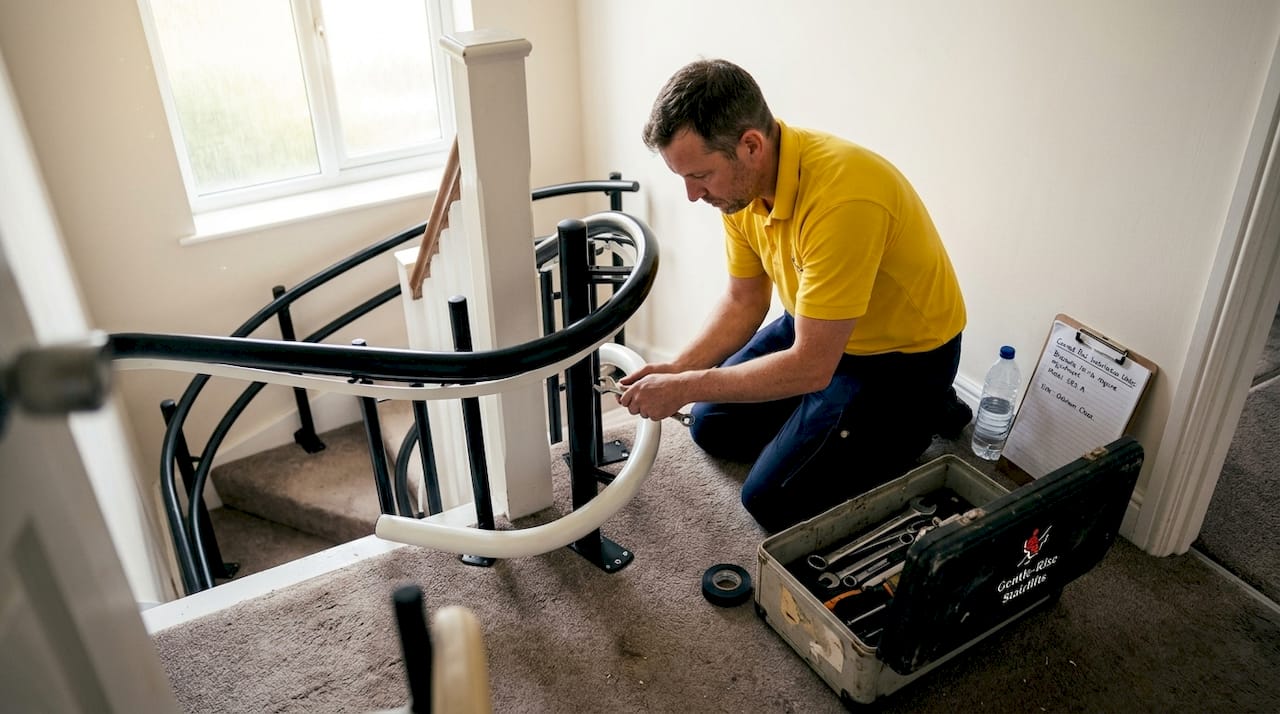
- Installation day: Engineers fix the brackets to the staircase treads (not the walls, in most cases), assemble both rails, fit the carriage and seat, and connect the electrical supply.
- Testing and calibration: The lift is run through its full range of motion multiple times. Speed, stopping points, and safety sensors are all tested and adjusted.
- User training: Before the engineer leaves, they demonstrate all controls, explain how to use the remote handsets, and answer any questions from the user and family members.
Most dual-rail installations are completed within one to two days, depending on staircase complexity. For homes with multiple floors or intermediate landings requiring separate lift sections, the process may extend slightly.
Ongoing maintenance is straightforward but important. The user's responsibilities include keeping the rails clean and free of debris, checking that the seat belt operates correctly, and reporting any unusual sounds or changes in movement speed. Professional servicing should cover lubrication of the drive mechanism, inspection of all safety sensors, checking the battery backup (most modern stairlifts run on rechargeable batteries rather than direct mains), and testing the full range of movement.
Pro Tip: Schedule an annual service appointment at the same time each year, ideally before winter. Colder temperatures can affect lubricants and battery performance, so a pre-winter check catches small issues before they become costly faults.
Key considerations before you decide
Making the right choice comes down to honestly assessing your situation across four core areas. Rushing the decision without addressing each one often leads to regret.
Staircase type: Is your staircase straight, curved, narrow, or does it have landings? A professional survey is the only reliable way to confirm this. Photos and rough measurements are a useful starting point, but they rarely capture every nuance of a real staircase.
User needs: What are the mobility challenges the user faces? Think about weight capacity, the importance of a smooth and steady ride, ease of boarding and alighting, and whether the user will operate the lift independently or with assistance. Some users benefit enormously from a swivel seat that rotates them towards the landing before they stand.
Budget and aftercare: What is the realistic total cost, including installation, any necessary modifications, and a maintenance plan? Choosing a provider who offers transparent pricing from the outset, alongside a structured aftercare programme, protects your investment.
Questions to ask any provider before you commit:
- Can you provide a written survey report before I agree to anything?
- Are the rails manufactured specifically for my staircase?
- What weight capacity does this model support?
- What does the warranty cover, and for how long?
- What aftercare plan options are available?
- How quickly can you respond to a breakdown call?
Getting clear answers to these questions protects you from vague promises and ensures you are comparing like-for-like when you assess multiple quotes. A well-chosen stairlift, reviewed thoroughly against your home mobility needs, restores genuine confidence and independence.
A practical perspective: why fit matters more than features
Here is something the marketing materials rarely tell you plainly: the most sophisticated stairlift on the market is worthless if it is the wrong design for your staircase or if it does not suit the person using it day to day.
We see it regularly. A family is attracted by a well-known brand's premium model with every conceivable feature. They invest a significant sum. Six months later, they contact us because the ride is uncomfortable on their curved staircase, or the carriage does not quite clear the newel post at the bottom, or the user finds the controls confusing. All of that could have been avoided with a more careful assessment of fit at the start.
The principle of choosing based on personal fit above brand recognition is genuinely the most important advice we can offer. A dual-rail stairlift that matches your specific staircase geometry and suits the user's physical needs will deliver far more satisfaction, safety, and long-term reliability than a premium single-rail system stretched beyond what it was designed to do.
A well-chosen dual-rail lift is not just a purchase. It is an investment in independence. When the right lift is fitted correctly, most users describe it as transformative. Confidence returns. People who had been sleeping downstairs or avoiding parts of their home start living fully in their space again. That outcome is not achieved by chasing features. It is achieved by getting the fit right from day one.
Next steps: access trusted stairlift support
Choosing between stairlift types is much easier once you have the right information and a trusted specialist to guide you through your specific situation. If this article has helped clarify the difference between dual-rail and single-rail options, the most valuable next step is speaking with a provider who will assess your home honestly and transparently.
At Gentle Rise Stairlifts, we offer free home surveys with no obligation, so you can get a professional assessment of your staircase before committing to anything. Our team explains reliable stairlift options clearly, without pressure, and we provide straightforward guidance on current stairlift costs so you can plan your budget with confidence. Whether you need a straight, curved, or dual-rail solution, we are here to help you find the right fit for your home and the people who matter most in it.
Frequently asked questions
Can a dual-rail stairlift be fitted to any staircase?
Dual-rail stairlifts are designed for a wide variety of staircase shapes, including curves and tight bends, though a professional home survey is essential to confirm compatibility with your specific layout.
Are dual-rail stairlifts more expensive than single-rail models?
Dual-rail stairlifts typically cost more due to complex installation and custom-manufactured rails, but they often represent better long-term value for curved or unusually shaped staircases, as detailed in our overview of UK stairlift costs.
How long does installation of a dual-rail stairlift usually take?
Most dual-rail stairlifts can be fitted within one to two days, depending on staircase complexity. Learn more about timescales in our installation guide.
Do dual-rail stairlifts require more maintenance?
They may require slightly more maintenance due to additional moving parts, but a regular annual service, as recommended in our stairlift maintenance guidance, minimises this difference significantly.