
TL;DR:
- Curved stairlifts are bespoke products tailored with custom-manufactured tracks that follow your staircase precisely. They cost between £5,300 and £10,000 in the UK due to complex engineering, longer installation times, and personalized design. These tracks include advanced safety features such as sensors and swivelling seats, significantly enhancing user safety and independence.
If you have a staircase with a bend, corner, or intermediate landing, explaining curved stairlift tracks is not as straightforward as a quick product search might suggest. Most people assume a stairlift is a stairlift. It is not. Curved stairlifts are entirely bespoke products, measured and manufactured specifically for your home's unique staircase shape. Understanding how they work, what they cost, and what safety features they include is essential before you invest, and this guide covers everything you need to know.
Table of Contents
- Understanding curved stairlift tracks: what makes them unique
- Curved stairlift track costs and installation timelines in the UK
- How curved stairlift tracks enhance safety and ease of use
- Curved versus straight stairlift tracks: which suits your home best?
- Practical considerations when choosing and installing curved stairlift tracks
- Reconsidering the true value of bespoke curved stairlift tracks
- Explore tailored curved stairlift solutions with Gentle Rise Stairlifts Ltd
- Frequently asked questions
Key Takeaways
| Point | Details |
|---|---|
| Custom design necessity | Curved stairlift tracks are bespoke, custom-made to fit the unique shape of your staircase. |
| Higher costs | Due to custom manufacturing and complexity, curved stairlifts cost roughly double compared to straight models. |
| Extended installation time | Installing a curved stairlift typically takes 4 to 8 hours compared to 2 to 4 hours for straight stairlifts. |
| Essential safety features | Sensors, swivel seats, and precise stopping improve safety and reduce fall risks on curved stairlifts. |
| Careful home planning | Proper home surveys and clear budgeting ensure successful, safe curved stairlift installation in UK homes. |
Understanding curved stairlift tracks: what makes them unique
Unlike straight stairlift rails, which come in standard lengths and can be cut to fit, curved stairlift rails are custom-manufactured to match your exact staircase following precise home surveys. This is the single most important fact to grasp when comparing types of stairlifts. There is no off-the-shelf curved rail. Every bend, every change of angle, every intermediate landing is measured and replicated in metal before installation even begins.
The process starts with an engineer visiting your home to take precise measurements of the staircase's entire length, angle, width, and any curves or turns. These measurements are then sent to a specialist manufacturer, where the rail is fabricated using complex metalwork. The result is a track that follows your staircase exactly, allowing the carriage (the seat unit) to travel smoothly around bends without jolting or hesitating.
Here is what makes the track design genuinely complex:
- Multiple rail segments are joined and shaped to follow corners and spirals
- Helical bends (three-dimensional curves found on spiral staircases) require especially precise engineering
- Top and bottom parking positions must account for landing space and exit direction
- The rail is fixed to the stair treads, not the wall, so the staircase structure itself influences the design
Pro Tip: When booking your home survey, photograph your staircase from multiple angles before the engineer arrives. This helps you communicate specific concerns, such as a tight corner or a narrow landing, clearly during the visit.
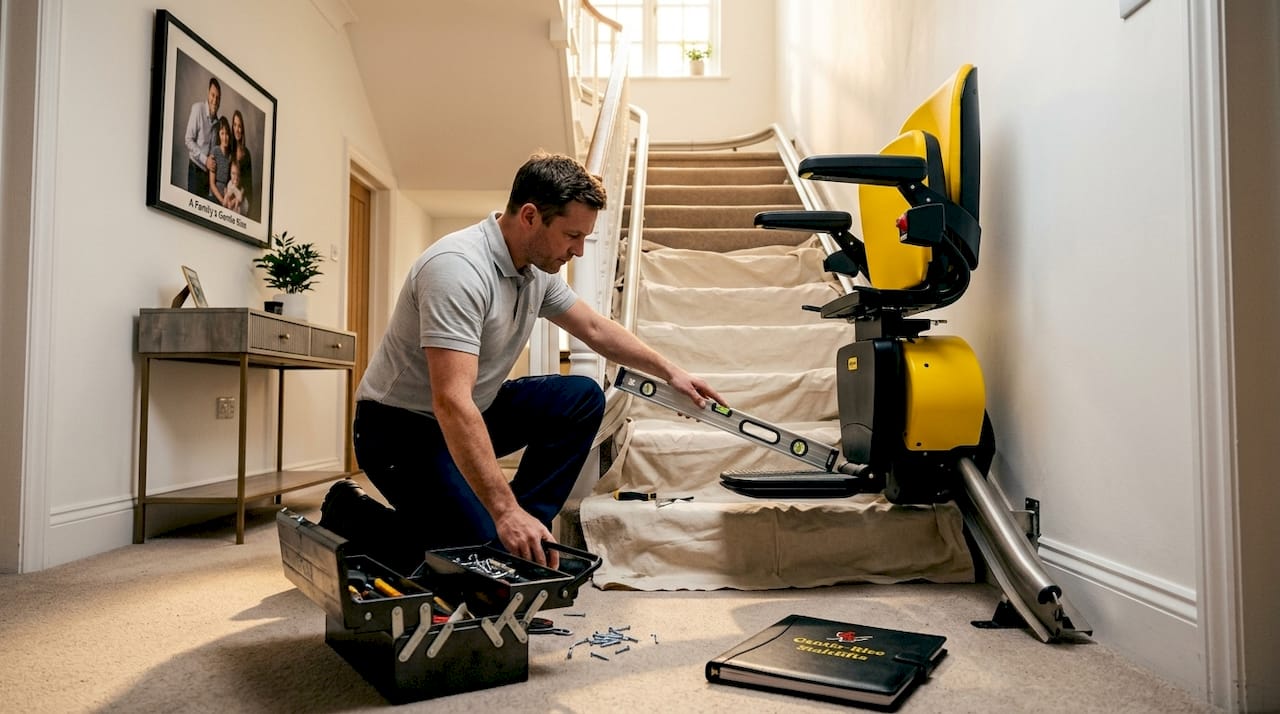
Installation takes noticeably longer than a straight stairlift. Expect 4 to 8 hours for a curved installation compared to 2 to 4 hours for a standard straight model, reflecting the complexity of fitting a bespoke rail onto a unique staircase.
Now that you understand why curved stairlift tracks are different, let us look at the factors influencing their cost and installation.
Curved stairlift track costs and installation timelines in the UK
Cost is where curved stairlifts surprise most homeowners. Curved stairlift costs typically range between £5,300 and £10,000 or more in the UK, roughly double the price of straight stairlifts, due to bespoke rails and longer installation. That gap exists for a clear reason: every component from the rail to the fitting is built around your home specifically.
Here is a breakdown of the key cost factors:
| Cost factor | Straight stairlift | Curved stairlift |
|---|---|---|
| Rail type | Standard, off-the-shelf | Bespoke, custom-manufactured |
| Typical price range | £795 to £2,500 | £5,300 to £10,000+ |
| Installation time | 2 to 4 hours | 4 to 8 hours |
| Survey requirement | Basic measurement | Detailed engineer survey |
| Manufacturing lead time | Minimal | Several weeks typically |
The higher price is not simply a mark-up. The bespoke manufacturing process, the skilled engineering time, and the extended installation all contribute meaningfully to the final figure. It is also worth knowing that curved stairlift installation usually takes 4 to 8 hours after bespoke rail manufacture, which means your home needs to be ready for a full day's work by the installation team.
Key things to budget for beyond the headline price:
- The initial home survey (sometimes free, sometimes chargeable)
- Manufacturing lead time, typically several weeks, meaning you cannot rush a curved installation
- A longer installation visit requiring access to the full staircase for the day
- Any aftercare or service plan, which is wise given the complexity of the product
Pro Tip: Ask your supplier for a fully itemised quote that separates the rail manufacture cost from the installation charge. This makes it far easier to compare quotes from different providers fairly, rather than comparing headline figures that may include different services.
For a detailed overview of the full stairlift installation guide, including what to expect on the day and how to prepare your home, it is worth reviewing this before committing to any provider.
Having covered costs and timelines, let us now look at the safety features built into curved stairlift tracks.
How curved stairlift tracks enhance safety and ease of use
Safety is where the bespoke design of a curved stairlift pays dividends beyond simple convenience. Because the track follows the staircase precisely, the lift's safety systems can be calibrated to that specific layout. This is not possible with a generic rail.
The most important safety features include end-of-rail sensors that stop the lift exactly at parking positions, while swivel seats rotate safely onto landings. This matters enormously for older users or those with reduced balance. Rather than stepping off a moving seat sideways at the top of the stairs, the seat swivels to face the landing before the user stands. That single feature removes one of the most common causes of stairlift-related falls.
The core safety functions built into modern curved stairlift tracks:
- End-of-rail sensors detect the precise stopping position at both the top and bottom of the track, preventing the carriage from overshooting
- Swivel seats rotate to face the landing before the user dismounts, reducing lateral movement and fall risk
- Obstruction sensors positioned under the footrest and carriage trigger instantly if a small object is detected
- Seatbelt systems keep the user securely in place throughout the journey
- Dead man's controls require constant pressure to keep the lift moving, stopping immediately if released
Obstruction sensors trigger instantly on small objects like pets or toys, preventing accidents during travel, especially on curved tracks. This is a practical point many buyers overlook. A family home with pets or grandchildren visiting is a different risk environment to an empty staircase, and the sensor sensitivity of a well-specified curved stairlift accounts for that.
"The ability to park safely at an exact landing position and swivel to face forward before standing is not a luxury feature. For an older person with reduced confidence on stairs, it is the difference between using the lift with ease and using it with anxiety."
Explore more about stairlift safety features and how to assess which ones matter most for your specific circumstances.
Understanding these safety benefits helps clarify why the bespoke design of curved tracks is worth the investment. Next, let us compare curved and straight stairlifts directly.
Curved versus straight stairlift tracks: which suits your home best?
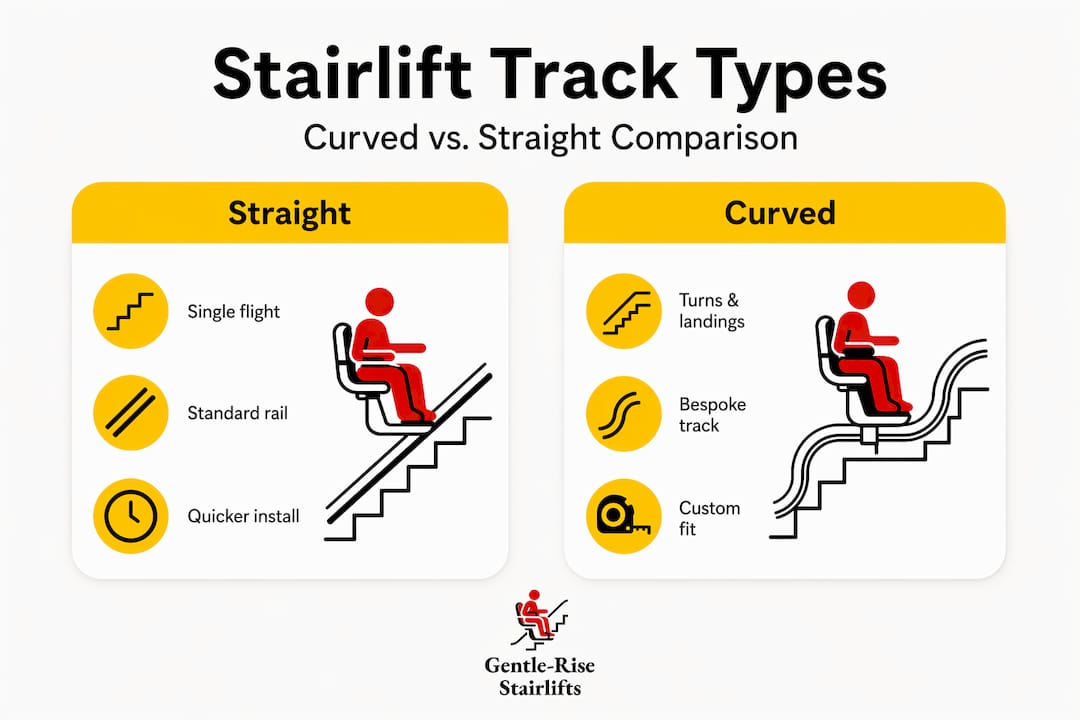
The choice between curved and straight stairlifts is not really a choice at all for many homeowners. If your staircase has a bend or landing, you need a curved model. Full stop. The more useful question is understanding the differences so you can make an informed decision about specification, cost, and provider.
| Feature | Straight stairlift | Curved stairlift |
|---|---|---|
| Suitable staircase | Single straight flight | Staircases with bends, corners, or landings |
| Price range | £795 to £2,500 | £5,300 to £10,000+ |
| Rail type | Standard | Bespoke custom rail |
| Installation time | 2 to 4 hours | 4 to 8 hours |
| Swivel seat | Optional | Standard on most models |
| Resale value | Moderate | Lower, due to bespoke design |
One important practical point: curved stairlift costs range approximately £5,300 to £10,000 or more, while straight stairlifts are generally significantly cheaper. The resale point above is worth noting. Because a curved rail is built for one specific staircase, it cannot simply be removed and sold on as a standard second-hand unit. This affects the long-term financial calculation.
Key points to help you decide:
- A single straight flight of stairs, even a long one, almost always suits a standard straight stairlift
- Any staircase with a bend, a quarter-turn landing, a half-turn landing, or a spiral layout requires a curved model
- Curved stairlifts offer greater safety features as standard because the bespoke design enables more precise calibration
- Budget planning for curved models should include manufacturing lead time, not just the purchase price
For homeowners looking at affordable stairlift options across both categories, understanding this distinction upfront prevents wasted survey visits and unrealistic expectations.
With a better grasp of these differences, let us look at practical steps for making the right choice for your home.
Practical considerations when choosing and installing curved stairlift tracks
Choosing the right curved stairlift is part research, part preparation, and part asking the right questions before anyone sets foot in your home. Here is a practical sequence to follow.
- Assess your staircase honestly. Walk up and down and note every point where the angle or direction changes. Include any intermediate landings, half-turns, and the available floor space at the top and bottom.
- Book a professional survey. Accurate stair measurements and space for top and bottom landings are critical for successful curved stairlift installation, so do not rely on your own tape measure for this step.
- Budget for the full picture. Include rail manufacture, installation time, and an aftercare plan in your initial budget, not just the headline product price.
- Check the safety specification. Confirm the model includes obstruction sensors, swivel seat, and precise end-of-rail stopping before agreeing to a quote.
- Prepare the staircase. Clear all obstacles, ensure a nearby power socket is accessible, and arrange for someone to be present throughout the full installation day.
Additional things worth considering before you sign any agreement:
- Ask specifically about the manufacturing lead time so you can plan around it, particularly if mobility is already significantly restricted
- Discuss whether a service and maintenance plan is included or available as an add-on
- Ask your provider whether the model chosen has a removable or folding rail at the bottom, which keeps the staircase accessible for other household members
- Clarify warranty terms for both the mechanical components and the bespoke rail itself
Pro Tip: If your home mobility planning involves other adaptations alongside a stairlift, such as grab rails or bathroom aids, coordinate the timing so building or fitting work does not delay or obstruct the stairlift installation.
After covering these practical steps, here is a perspective that challenges some common assumptions about curved stairlifts.
Reconsidering the true value of bespoke curved stairlift tracks
There is a persistent view that curved stairlifts are a luxury purchase. Something for people with larger budgets who happen to have an interesting staircase. We think that framing does a real disservice to the people who need them most.
Consider the alternative. An older person with a curved staircase who cannot safely access the upper floor of their home faces a narrow set of options: move to accommodation without stairs, pay for residential or assisted care, or rely increasingly on others for basic daily tasks. When you look at the cost of a curved stairlift against those alternatives, the five-figure investment looks considerably more reasonable.
The curved stairlift's custom top landing finish allows safe dismounting onto flat floor space, a critical safety and comfort advantage. That precision landing is not achievable with any other solution. A straight rail installed on a curved staircase simply does not exist as a viable option. The bespoke nature is not an upsell; it is the product working correctly.
What we also see repeatedly in practice is how much confidence the right stairlift restores. The anxiety of navigating a curved staircase with reduced mobility is not just a physical risk. It erodes independence over time. People stop going upstairs. They sleep downstairs. They begin to feel that their home no longer fits their life. A well-fitted curved stairlift directly reverses that pattern, and the stairlift trends for 2026 show continued improvement in both safety calibration and user-centred design.
The cost is real. We are not dismissing it. But the value delivered by a properly installed, well-specified curved stairlift, measured in independence, safety, and quality of daily life, is equally real and often underestimated in the initial decision.
Explore tailored curved stairlift solutions with Gentle Rise Stairlifts Ltd
You now have a grounded understanding of what curved stairlift tracks involve, what they cost, and why their bespoke design directly protects the people who use them. The next step is finding a provider who delivers on all of it.
Gentle Rise Stairlifts Ltd specialises in curved stairlift installation across the UK, offering thorough home surveys, bespoke rail manufacture, and professional fitting backed by long-term aftercare through the Protect+ maintenance programme. Whether your staircase has a quarter-turn, half-turn, or something more complex, we will assess it accurately and give you a clear, itemised quote. For a full breakdown of stairlift costs in the UK or guidance on choosing the most reliable stairlift for your needs, our team is ready to help. Book a free home survey today and take the first confident step towards safer, more independent daily living.
Frequently asked questions
How long does it typically take to install a curved stairlift in the UK?
Installation typically takes between 4 and 8 hours once the custom rail is ready, longer than straight stairlifts due to bespoke fitting requirements. Manufacturing the rail beforehand adds additional lead time of several weeks in most cases.
Why are curved stairlifts more expensive than straight ones?
Curved stairlifts require a bespoke rail precisely manufactured to match the staircase's unique shape, which adds significant complexity and cost. Curved stairlift costs generally double those of straight ones because of bespoke rails and custom manufacturing.
What safety features do curved stairlift tracks include to prevent accidents?
End-of-rail sensors and swivel seats enhance safety, and obstruction sensors stop the lift instantly if needed. These features work together to ensure precise stopping, safe dismounting, and immediate response to unexpected obstacles on the track.
Can curved stairlifts be installed on all types of staircases?
Curved stairlifts are designed for staircases with turns, corners, or intermediate landings but depend on available space. The staircase must be wide enough and have sufficient landing space at the top and bottom to accommodate the rail and seat safely.
Is renting a curved stairlift cost-effective for long-term use?
Because curved stairlifts involve high installation and manufacturing costs, curved stairlift rental is significantly more expensive than straight and rarely cost-effective for long-term use. Rental works better as a short-term solution during recovery or while assessing long-term needs.