
TL;DR:
- Swivel seat stairlifts are essential safety features that rotate users to face the room, reducing fall risk during transfers. Powered swivel seats are recommended for those with limited strength, as they eliminate the need for physical effort and provide safer, more confident movement. Proper system design, professional installation, and thorough testing ensure maximum safety and independence for stairlift users.
Most people assume a swivel seat on a stairlift is simply about comfort, a little extra thoughtfulness built into the design. It is not. Understanding what is a swivel seat stairlift, and precisely why that rotating mechanism exists, could be the difference between a safe transfer and a serious fall. The swivel function addresses the single most dangerous moment in stairlift use: standing up at the top landing. This article covers how the mechanism works, why it matters for your safety, how to choose between manual and powered options, and what practical steps will help you make the right decision.
Table of Contents
- Key takeaways
- How a swivel seat stairlift works
- Why swivel seats make transfers safer
- Manual versus powered swivel seats
- Features that work with swivel seats
- Practical tips for choosing the right stairlift
- My honest view on swivel seat safety
- How Gentlerisestairlift can help you choose
- FAQ
Key takeaways
| Point | Details |
|---|---|
| Swivel seats improve safety | They rotate the user away from the stair edge, making transfers at the landing significantly safer. |
| Transfer is the riskiest moment | The highest-risk point in stairlift use is standing up at the top landing, not the ride itself. |
| Powered swivels suit many users | Those with arthritis, limited strength, or reduced trunk mobility benefit most from automatic rotation. |
| Features work as a system | Footrests, armrests, sensors, and seat belts all work together with the swivel seat for maximum safety. |
| Professional advice matters | A free home survey helps match the right swivel seat type to your specific mobility needs and home layout. |
How a swivel seat stairlift works
A swivel seat stairlift is a standard stairlift fitted with a seat that can rotate, typically 90 degrees, once the lift reaches the top or bottom landing. Rather than arriving at the landing still facing the stairs, you are turned to face the room. That distinction is far more significant than it sounds.
The mechanism itself varies between models. On manual versions, the user presses or pulls a lever once the carriage stops, then physically pushes the seat around to the new position. On powered versions, the seat rotates automatically as part of the stopping sequence, requiring no physical effort from the user at all. In both cases, a locking mechanism holds the seat firmly in the riding position during travel, and then releases to allow rotation at the landing.
Key components involved in a typical swivel seat stairlift include:
- A pivot bearing beneath the seat that allows smooth rotation
- A manual lever or powered motor to drive the rotation
- A locking pin or solenoid that secures the seat during the ride
- Sensors that detect the carriage has reached the correct position before enabling the swivel
Pro Tip: Ask your installer to demonstrate the full swivel cycle during any home survey or trial. Watching it in motion will tell you more than any brochure about whether a manual or powered version suits your strength and dexterity.
The safe transfer geometry created by this rotation is what makes the swivel seat a genuine safety feature rather than a luxury add-on. When you are facing the room instead of the stairs, your feet land on solid, flat floor. You stand up with your weight moving forward and away from any drop.
Why swivel seats make transfers safer
Many people focus on the stairlift ride itself when thinking about risk. The reality is quite different. The highest-risk moment in the entire process is standing up at the top landing, not the journey between floors.
Think about what happens without a swivel seat. You arrive at the top landing still facing downstairs. To stand up and step onto the landing, you must push yourself forward, twist your body, and pivot around with your back to the wall and your feet close to the stair edge. For someone with reduced balance, weak legs, or limited joint mobility, that is an extremely precarious sequence of movements.
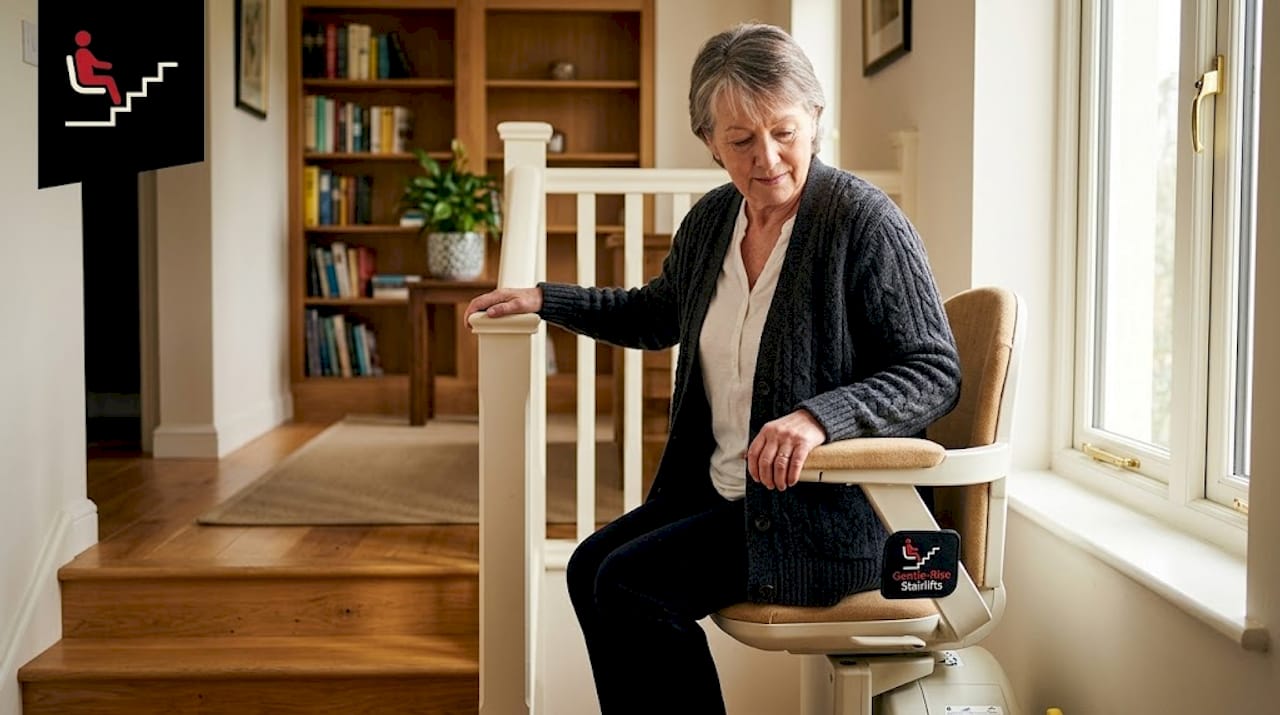
The swivel seat changes all of this. By rotating you to face the landing before you stand, it removes the need to twist. Your centre of gravity shifts toward the floor rather than toward the stairwell.
| Transfer type | User position at landing | Proximity to stair edge | Twisting required |
|---|---|---|---|
| Without swivel seat | Facing downstairs | Very close | Yes, significant |
| With manual swivel seat | Facing landing | Away from edge | Minimal |
| With powered swivel seat | Facing landing, automatically | Away from edge | None |
Swivel seats lock securely in place at both the riding and exit positions, which means there is no wobble or unexpected movement while you stand. That locking function is critical for users whose balance may already be compromised. A seat that shifts unexpectedly underfoot during a transfer is exactly the kind of event that leads to falls.
"The transfer at the stair landing is the moment with greatest risk of falling. Swivel seats significantly mitigate this risk by improving user positioning." Stair Lifts With Swivel Seats for Safer Transfers
For users recovering from hip or knee surgery, the benefit is especially clear. Excessive twisting of the lower body during early recovery is precisely what physiotherapists warn against. A swivel seat makes it far easier to comply with those restrictions while still moving independently between floors. Explore safer living for elderly users for further reading on how these features translate into daily independence.
Manual versus powered swivel seats
Once you understand why the swivel matters, the next question is which type suits you best. The choice between manual and powered swivel seats is worth thinking through carefully, because what works well for one person can be genuinely difficult for another.
Manual swivel seats require the user to operate a lever and then physically rotate the seat. For someone who is relatively strong and has reasonable hand and wrist function, this is manageable. For someone with arthritis, weak grip, or reduced upper body strength, it can feel like a struggle precisely at the moment when they most need stability.
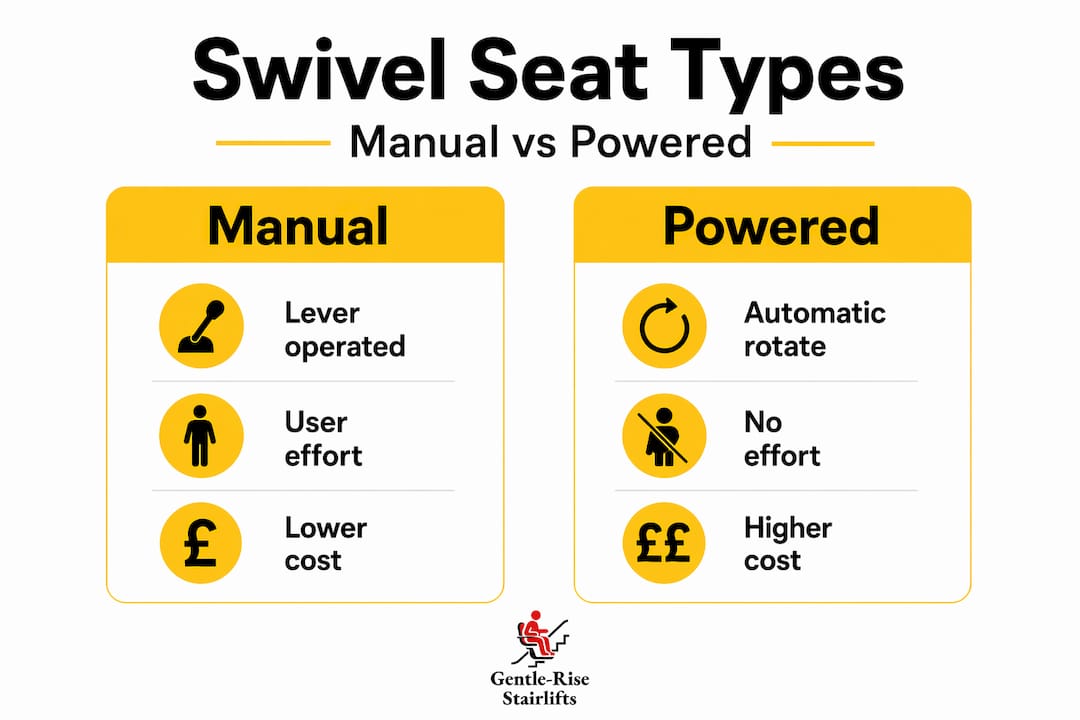
| Feature | Manual swivel seat | Powered swivel seat |
|---|---|---|
| Rotation method | Lever operated by user | Automatic on reaching landing |
| Physical effort required | Moderate | Minimal |
| Suitable for arthritis | Often not ideal | Yes, well suited |
| Typical cost | Lower | Higher |
| Maintenance complexity | Lower | Slightly higher |
| Recommended for | Active users with good strength | Users with limited mobility or strength |
Powered swivel seats rotate automatically upon reaching the landing, removing the physical demand from the user entirely. For those with limited hand strength or arthritis, this is not a luxury. It is what makes the transfer safe and controlled. Trying to rotate a manual seat when your grip is unreliable introduces exactly the instability the swivel is meant to prevent.
The cost of a swivel seat stairlift varies by type. Straight stairlift models with manual swivel seats typically start at lower price points, while powered swivel models carry a premium that reflects their additional mechanism and safety benefit. For specific UK pricing, stairlift costs in the UK provides a useful breakdown.
Pro Tip: If you are unsure whether a powered swivel is necessary, ask your stairlift consultant to let you try both types during a home demonstration. Your reaction after two or three practice transfers will usually make the decision obvious.
Features that work with swivel seats
The swivel seat does not operate in isolation. It works most effectively as part of a wider transfer system, and the quality of that surrounding system shapes how much safety the swivel actually delivers.
The features that matter most alongside a swivel seat include:
- Folding footrests with obstruction sensors. These lift automatically when the stairlift approaches the landing, preventing the footrest from catching on the floor or skirting boards and destabilising the user mid-transfer.
- Armrests positioned for easy push-off. Arms that are too high, too wide, or poorly padded make it harder to use them for support when standing. Well-designed armrests sit at a height that allows you to push up from a natural position without straining your shoulders.
- Retractable seat belts. The seat belt keeps you secure during the ride. It should be easy to fasten and release without requiring awkward reaches or fine motor control, particularly important if finger dexterity is limited.
- Swivel seat cushioning and height. Seat height and cushioning affect how easy it is to stand up after a ride. A seat that is too low places greater demand on the legs and increases the risk of a slow, uncontrolled rise.
When reviewing swivel seat stairlift features during a demonstration, assess all of these elements together rather than focusing solely on the swivel mechanism. The whole system either works for you or it does not. A well-designed stairlift mobility solution brings all of these components into a coherent, safe experience.
Practical tips for choosing the right stairlift
Making the right choice requires more than reading reviews or comparing specifications online. Your individual circumstances, your home layout, and your specific mobility limitations all shape which swivel seat stairlift will serve you best.
- Assess your mobility needs honestly. Consider not just where you are today but where your mobility may be in two to three years. If arthritis is progressing or post-surgical recovery is expected to be long, factor that into your choice from the start.
- Measure your top landing carefully. The swivel seat needs space to rotate and for you to stand comfortably. A cramped landing can limit which models are practical, and some will need a curved rail or perch seat design as a workaround.
- Always request a home demonstration. Photographs and specifications cannot tell you how a seat feels under your weight or how easy the transfer actually is. Insist on trying the swivel function yourself before committing.
- Ask about the maintenance programme. Powered swivel seats have additional moving parts that benefit from regular servicing. Check whether the provider offers an aftercare plan that covers the swivel mechanism specifically.
- Use professional installation. A correctly fitted stairlift rail is critical to the swivel functioning safely. Poor installation affects how the carriage stops and positions, which in turn affects the alignment of the swivel seat relative to the landing.
Broader home mobility planning resources can also help you assess whether a stairlift is part of a wider set of changes needed in your home.
My honest view on swivel seat safety
I have worked with a great many people navigating stairlift decisions, and I am consistently struck by how often the swivel seat gets treated as a comfort upgrade rather than a safety essential. People will spend time discussing rail colour or upholstery fabric, then wave away the question of manual versus powered swivel as if it were incidental.
In my experience, that is the wrong priority. The ride portion of a stairlift trip is, genuinely, quite safe. The carriage moves slowly, the belt is fastened, and the rails are fixed. But standing up at the top of the stairs, with your weight shifting, your balance adjusting, and your joints under load, that is where things go wrong for real people in real homes.
What I have found, time and again, is that powered swivel seats do not just improve physical safety. They restore confidence. When a user knows the seat will rotate for them, without any effort or coordination on their part, they stand up with more composure. They do not rush. They do not grab for the wall. That composure itself reduces fall risk in a way that no specification sheet captures.
My advice: treat the swivel seat as the most important safety decision in your stairlift purchase, not the most forgettable one. Evaluate it seriously, trial it thoroughly, and choose powered if there is any doubt about your upper body strength or hand function.
— lee
How Gentlerisestairlift can help you choose
At Gentlerisestairlift, we understand that choosing a stairlift is not simply a product decision. It is a decision about how safely and confidently you move through your own home. Our range includes both manual and powered swivel seat stairlifts, across straight, curved, and reconditioned models, with prices starting from £795. Every installation is carried out by our professional team, often within hours, and we offer the Protect+ aftercare programme to keep your stairlift performing safely long after fitting. Book a free home survey and let us assess your staircase, your landing space, and your mobility needs in person, so you get a solution that genuinely works for you. Read more about enhancing your independence with the right stairlift solution.
FAQ
What is a swivel seat stairlift?
A swivel seat stairlift is a stairlift fitted with a seat that rotates, usually 90 degrees, at the top or bottom landing. This turns the user to face the room rather than the stairs, making transfers safer and reducing the risk of falls.
Is a powered swivel seat worth the extra cost?
For users with arthritis, limited grip strength, or reduced trunk mobility, a powered swivel seat is worth the additional investment. It removes the physical effort of rotating the seat, which is precisely the moment when manual rotation can become unsafe.
How do swivel seats reduce the risk of falling?
Swivel seats alter transfer geometry by directing the user away from the stair edge before they stand up, eliminating the need to twist the body and significantly improving balance and stability during the transfer.
What should I look for alongside the swivel mechanism?
Look at the full transfer system, including folding footrests, armrest height and padding, seat height and cushioning, and the ease of operating the seat belt. A swivel seat performs best when the surrounding design supports a safe and comfortable exit.
How much does a swivel seat stairlift cost in the UK?
The cost of a swivel seat stairlift in the UK varies by model and swivel type, with straight stairlifts starting around £795. Powered swivel models carry a higher price point. A free home survey from a provider like Gentlerisestairlift will give you an accurate quote for your specific staircase.