
TL;DR:
- Outdoor stairlifts are specially designed with weatherproof features to withstand British rain, frost, and UV exposure. Unlike indoor models, they incorporate sealed electronics, corrosion-resistant rails, UV-resistant plastics, and marine-grade seat covers for durability and safety. Proper installation, drainage management, and electrical assessment are essential to ensure long-term reliability and cost-effectiveness.
Many people assume that any stairlift will do the job, indoors or out. That assumption can be dangerous. An outdoor stairlift is an entirely different category of product, built specifically to handle rain, frost, UV exposure, and the general unpredictability of British weather. If you are an older adult, someone recovering from surgery, or a carer planning ahead, understanding what is an outdoor stairlift and what separates it from its indoor counterpart could save you money, frustration, and risk. This guide covers everything from how these lifts work to what they cost in the UK in 2026, and how to choose the right one.
Table of Contents
- What is an outdoor stairlift and how does it work
- Features and differences from indoor stairlifts
- Cost considerations and pricing in the UK
- Installation process and practical considerations
- Choosing the right outdoor stairlift for your home
- Why outdoor stairlift choices deserve careful planning
- Finding the right outdoor stairlift with GentleRise Stairlifts
- Frequently asked questions
Key Takeaways
| Point | Details |
|---|---|
| Weatherproof design | Outdoor stairlifts include sealed electronics and corrosion-resistant components for durability. |
| Cost differences | Outdoor models cost 20–40% more than indoor lifts due to specialised materials and installation. |
| Installation importance | Professional surveys and tailored installation prevent long-term issues and ensure safety. |
| Straight vs curved | Straight stairlifts are usually more affordable; curved rails require custom fabrication. |
| Regular maintenance | Six-monthly servicing and protective covers help maintain reliability and lifespan. |
What is an outdoor stairlift and how does it work
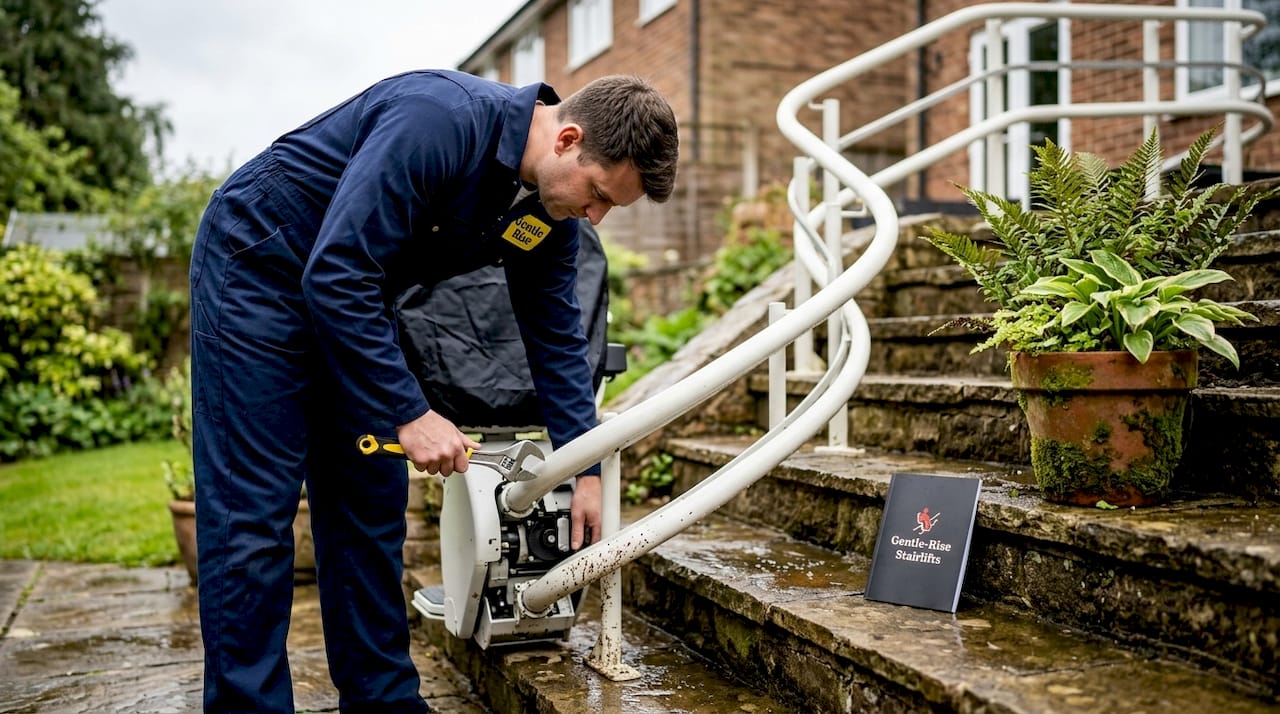
An outdoor stairlift is a chairlift system installed on external steps so a person can travel up and down those outdoor stairs while seated. It looks similar to an indoor stairlift but every component is engineered to survive outside. The motor, rail, seat, and controls all receive weatherproofing treatments that indoor models simply do not have.
The basic principle is the same as an indoor lift. A metal rail is fixed to the staircase, and a motorised carriage travels along that rail, carrying the seat and its occupant. The rider uses a joystick or button control to move up and down. Most models also come with a remote control so a carer can summon the chair from the top or bottom of the steps.
What makes the outdoor version distinctive is the engineering beneath that familiar exterior. Consider what a British garden staircase endures each year: standing water after autumn rain, frost that expands into crevices, summer sun that bleaches and warps plastic, and coastal salt air for those near the sea. Every component of an outdoor stairlift is designed to survive all of that.
These lifts are available for a range of exterior staircases, including:
- Straight garden steps leading from a patio or lawn down to a lower level
- Front door porches with a short flight of two to five steps
- Side passages between properties with narrow stair configurations
- Long sloped pathways with gradual stepped sections
- Curved or turning staircases at the entrance of older UK terraced or detached homes
If you are based in or near London and are considering options, our stairlifts London service can help you identify the right fit for your specific exterior staircase layout.
Features and differences from indoor stairlifts
It is worth being direct here. Indoor stairlifts lack the sealed electronics, weather-resistant coatings, and marine-grade components needed for outdoor exposure, creating genuine safety hazards and voiding warranties. This is not a matter of a slight performance dip. Using an indoor model outside is a real risk to both the equipment and the person using it.
So what does a proper outdoor model include that an indoor one does not? The differences are found in every layer of the product:
- Sealed electronics: All wiring, circuit boards, and motor components are enclosed in waterproof housings to prevent moisture damage
- Corrosion-resistant rails: Typically powder-coated aluminium or stainless steel rather than standard steel, which would rust within months outdoors
- UV-resistant plastics and fabrics: Seat materials and trim are stabilised against sun fading and cracking
- Marine-grade seat covers: Similar to outdoor boat upholstery, these repel water without becoming stiff or cracked in cold temperatures
- Key lock switches: These prevent unauthorised or accidental use when the lift is parked outside unattended
- Weatherproof battery backup: In the event of a power cut, the battery system itself is rated for outdoor temperature ranges
Pro Tip: When reviewing outdoor stairlift options, ask the supplier to confirm the IP rating of the motor housing. An IP55 rating or higher means the unit is protected against both dust ingress and water jets from any direction. Anything lower may not be adequate for a fully exposed British garden staircase.
When you are choosing reliable stairlifts, the difference in materials is not just about durability. It directly affects your safety on those stairs for years to come.
Cost considerations and pricing in the UK
Cost is often a major factor in decision-making, so let us break down what you can expect to pay for an outdoor stairlift in the UK.
Outdoor stairlifts typically cost 20 to 40% more than indoor equivalents, with straight models ranging from £3,000 to £5,000 and curved models from £5,500 to £9,000 fully installed. That premium reflects the additional materials, engineering, and installation complexity involved.
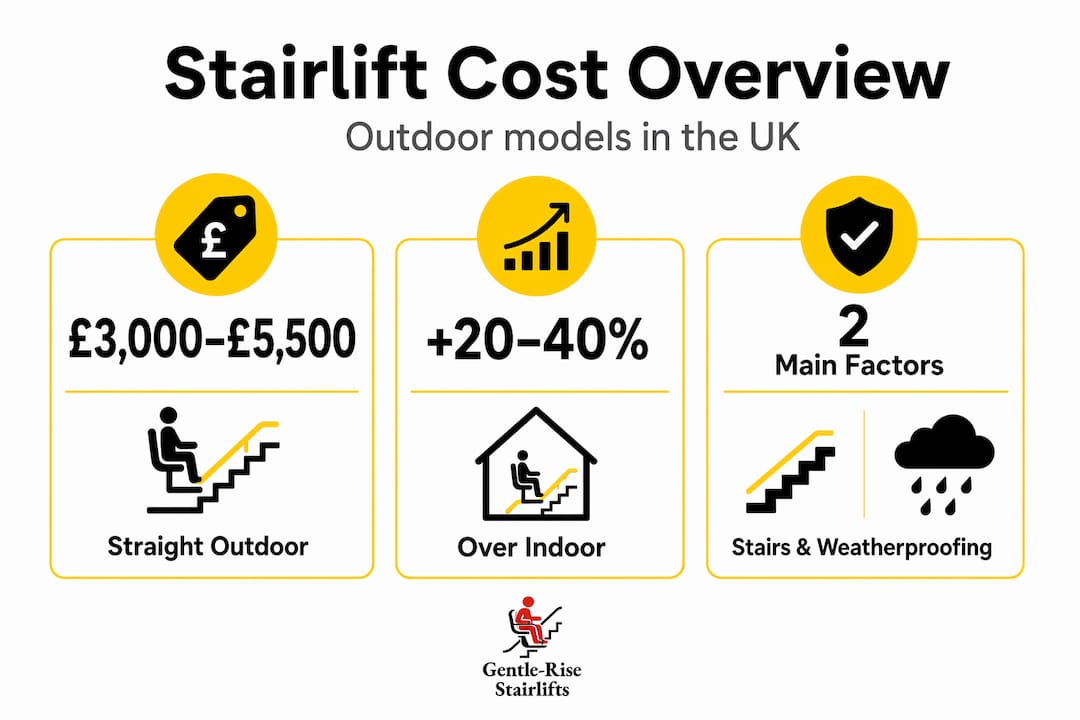
Here is how the main cost factors compare:
| Factor | Straight outdoor stairlift | Curved outdoor stairlift |
|---|---|---|
| Rail type | Standard length, pre-made | Custom fabricated to your staircase |
| Typical price range | £3,000 to £5,000 | £5,500 to £9,000 |
| Installation complexity | Lower | Higher |
| Lead time | Days | Weeks |
| Electrical work required | Often yes | Often yes |
Beyond the stairlift itself, several additional costs can affect your budget:
- Electrical supply: Most outdoor stairlifts require a weatherproof outdoor socket within reach of the rail. If one does not already exist, a qualified electrician must install one, which can add £150 to £400 to your total
- Ground preparation: If the staircase surface is uneven or crumbling, repairs may be needed before the rail can be safely mounted
- Extended rail lengths: Very long staircases with more than ten steps will increase material costs
- Cover or canopy: Some homeowners choose to add a retractable canopy above the stairlift parking position to reduce weathering, which is an optional but worthwhile expense
For a broader view of what different stairlift types cost, the stairlift costs UK guide covers indoor and outdoor options side by side, which helps with budgeting across the board.
Installation process and practical considerations
Understanding installation is key to setting expectations and preparing your home for a new outdoor stairlift.
The process follows a clear sequence, but there are practical details at each stage that are easy to overlook. Here is what a typical outdoor stairlift installation looks like from start to finish:
- Site survey: An engineer visits to measure the staircase, assess slope angle, check the condition of steps, evaluate drainage, and identify where the power supply will come from
- Quotation and order: Once the survey is complete, the supplier confirms the rail specification, lead time, and total price
- Electrical preparation: If a new outdoor socket is required, this work must be completed before the installation day, ideally by a Part P certified electrician
- Rail delivery and fitting: Installation typically takes 2 to 6 hours for the rail fitting, with testing and user instruction following. For most straight outdoor stairlifts, this means the entire job can be completed in a single day
- Drainage check: The engineer should confirm that water cannot pool around the rail mounting points, as standing water accelerates corrosion even on treated metal
- Testing and handover: Before leaving, the engineer runs the lift through its full range of motion, tests the safety sensors, and walks you through using the controls confidently
Pro Tip: Ask your installer where water will run off the steps once the rail brackets are fixed in place. Brackets that sit flush against step edges without drainage clearance are a common source of long-term corrosion problems. A small adjustment during fitting can add years to the rail's life.
For ongoing care once the lift is fitted, maintaining your stairlift correctly from the first month makes a measurable difference to reliability over time.
Choosing the right outdoor stairlift for your home
Knowing the installation process helps, but making the right choice starts with understanding your outdoor staircase and budget constraints.
The single biggest cost lever available to you is whether your staircase can accommodate a straight rail. Treating outdoor stairs as straight when possible reduces costs significantly because curved rails require custom fabrication and are pricier. Even if your steps have a slight turn or a small landing midway, it is worth asking a surveyor whether a straight rail with a parking position at the landing could work.
Here is what to look at before you book a survey:
- Step width: The rail requires clearance on one side. Steps that are narrower than 70 centimetres may limit your options
- Step condition: Cracked or loose steps must be repaired before a rail can be safely mounted. A reputable supplier will flag this at survey stage
- Top and bottom clearance: The seat needs space to swivel and fold at each end of the rail
- Power proximity: The closer an existing outdoor socket is to the stairlift's parking position, the lower your electrical costs
- Shade and exposure: A north-facing staircase in a sheltered passage weathers differently from a south-facing open porch. This can influence which materials are most appropriate for your installation
- Turning points: If your stairs change direction more than once, a curved rail is likely unavoidable, and you should budget accordingly
Seat comfort matters too, particularly for longer staircases or users with hip or back conditions. Ask about seat width, armrest height, and footrest adjustability before committing. An outdoor stairlift you use every day should fit you properly, not just fit your staircase.
For those looking at affordable stairlift options, reconditioned outdoor models can offer a meaningful saving, though you should confirm the weatherproofing materials have been fully refreshed and not simply cosmetically cleaned.
Why outdoor stairlift choices deserve careful planning
Here is something most buying guides will not tell you plainly: the stairlift itself is rarely where things go wrong. The problems tend to come from what surrounds it.
After years of working with UK homeowners on stairlift installations, the issues that shorten the life of an outdoor lift are almost never the motor or the electronics. They are the things that happen around the mounting points. Rail mounting and water drainage management are critical for outdoor stairlift reliability and longevity. A poorly placed bracket that channels rainwater directly onto a mounting bolt will cause corrosion in two winters that a well-placed one would not see in ten.
The second hidden complexity is electrical supply. Many homeowners assume there is already a suitable outdoor socket nearby, only to discover during installation that the existing socket is not rated for outdoor use, or is on a circuit that does not comply with current wiring regulations for external power. Sorting that out at short notice on installation day is expensive and sometimes delays the job by days. Getting the electrical assessment done at the survey stage, not after, is the single most useful thing you can do before ordering.
The broader lesson here is that outdoor stairlift installation is a project, not a product delivery. The lift itself is one part of a system that includes the staircase, the power supply, the drainage, and the ongoing maintenance schedule. Choosing a provider with reliable stairlift choices and genuine installation experience is not a luxury. It is the difference between a lift that performs safely for a decade and one that gives you problems within its first year.
Budget-conscious decisions are entirely reasonable, and reconditioned models represent genuine value when the weatherproofing has been properly refreshed. But cutting corners on the installation assessment is where the real cost lies.
Finding the right outdoor stairlift with GentleRise Stairlifts
If you are ready to explore tailored options and professional installation, GentleRise Stairlifts can guide you every step of the way.

At GentleRise Stairlifts, we specialise in outdoor stairlift solutions designed specifically for UK homes and UK weather. Our engineers carry out thorough site surveys that cover drainage, electrical supply, and staircase condition before a single bracket is fitted. We offer straight and curved outdoor models, including reconditioned options for those working to a tighter budget. Our team also handles the weatherproof electrical setup, so there are no surprises on installation day. Whether you are in Dudley or anywhere across the UK, our affordable stairlift options and our UK stairlift cost guide can help you plan with confidence. Book a free home survey today.
Frequently asked questions
Can I use an indoor stairlift outdoors?
No. Indoor stairlifts lack the sealed electronics and marine-grade components required for outdoor exposure, and using them outside creates safety hazards while voiding the manufacturer's warranty.
How long does it take to install an outdoor stairlift?
Rail fitting typically takes 2 to 6 hours, meaning most straight outdoor stairlift installations are completed within a single day, including testing and instruction.
What factors affect the price of an outdoor stairlift in the UK?
The main factors are whether your staircase is straight or curved, the level of weatherproofing required, and whether additional electrical work is needed for a safe outdoor power supply.
Can outdoor stairlifts withstand UK weather conditions?
Yes. Outdoor stairlifts use corrosion-resistant materials including marine-grade seat covers and sealed electronics, all rated for the rain, frost, and temperature fluctuations typical of British conditions.
What maintenance is required to keep an outdoor stairlift reliable?
Six-monthly servicing is recommended for outdoor lifts, along with using a protective cover when the lift is not in use, to minimise corrosion and maintain safe, reliable operation.