
TL;DR:
- A perch stairlift features a raised seat that allows users with joint pain to travel in a semi-standing position. It is ideal for those with limited knee or hip flexion, especially on narrow staircases, but requires good balance for safe use. Professional home surveys are essential to ensure proper fit and safety for individual mobility needs.
If you've been searching for a stairlift but struggle to sit fully due to knee or hip pain, a perch stairlift could be exactly what you need. Many people haven't heard of them, and those who have often confuse them with fully standing stairlifts. The two are not the same. A perch stairlift uses a small, raised seat that lets you travel in a near-upright, semi-sitting position. This guide covers what a perch stairlift is, how it works, who it suits, what installation involves, and what you can expect to pay in the UK.
Table of Contents
- Key takeaways
- What is a perch stairlift and how does it work?
- Key benefits and advantages of perch stairlifts
- Who should and shouldn't use a perch stairlift?
- Perch stairlift installation: what to expect
- Understanding perch stairlift costs in the UK
- My honest take on perch stairlifts
- Ready to find the right stairlift for your home?
- FAQ
Key takeaways
| Point | Details |
|---|---|
| Not a standing stairlift | A perch stairlift uses a raised seat for semi-sitting travel, not full standing. |
| Best for joint pain | Ideal for users with limited knee or hip flexion who cannot sit in a standard stairlift. |
| Suits narrow staircases | The compact design fits staircases too tight for traditional seated models. |
| Balance is required | Users need adequate core stability and balance to use a perch stairlift safely. |
| Professional survey matters | A home survey is the only reliable way to confirm whether a perch stairlift is right for you. |
What is a perch stairlift and how does it work?
A perch stairlift is a type of stairlift fitted with a small, elevated seat that positions the user in a semi-standing posture during travel. Rather than sitting down fully as you would in a chair, you lean forward and rest your weight on the seat at roughly hip height. Your legs remain slightly bent, your back stays upright, and you hold the armrests for support throughout the ride.
The term "perch" refers to that leaning, half-settled position. It's worth knowing that most so-called standing stairlifts are actually perch models. The "standing stairlift" label is largely a marketing phrase. No mainstream home stairlift requires the user to travel in a fully upright standing position.
Here is what makes a perch stairlift distinct in terms of design and operation:
- Raised seat position: The seat sits significantly higher than a standard stairlift seat, reducing the degree of knee and hip bend needed to mount and ride it.
- Small seat footprint: The seat itself is compact, which is partly what gives perch stairlifts their space-saving advantage.
- Adjustable armrests: Padded armrests sit at a height that allows the user to bear some weight through their arms, taking further pressure off the joints.
- Seatbelt or restraint: A safety belt keeps the user secure during transit, as with traditional seated models.
- Standard rail mechanism: The lift travels on a fixed rail mounted directly to the stair treads, powered by a quiet electric motor with rechargeable batteries for reliability during power cuts.
A perch seat stairlift features this elevated design specifically to relieve joint pain by removing the need to fully flex the knees and hips. For someone with arthritis, post-surgical stiffness, or a fused knee joint, this difference can make using a stairlift possible where a traditional model would not be.
Key benefits and advantages of perch stairlifts
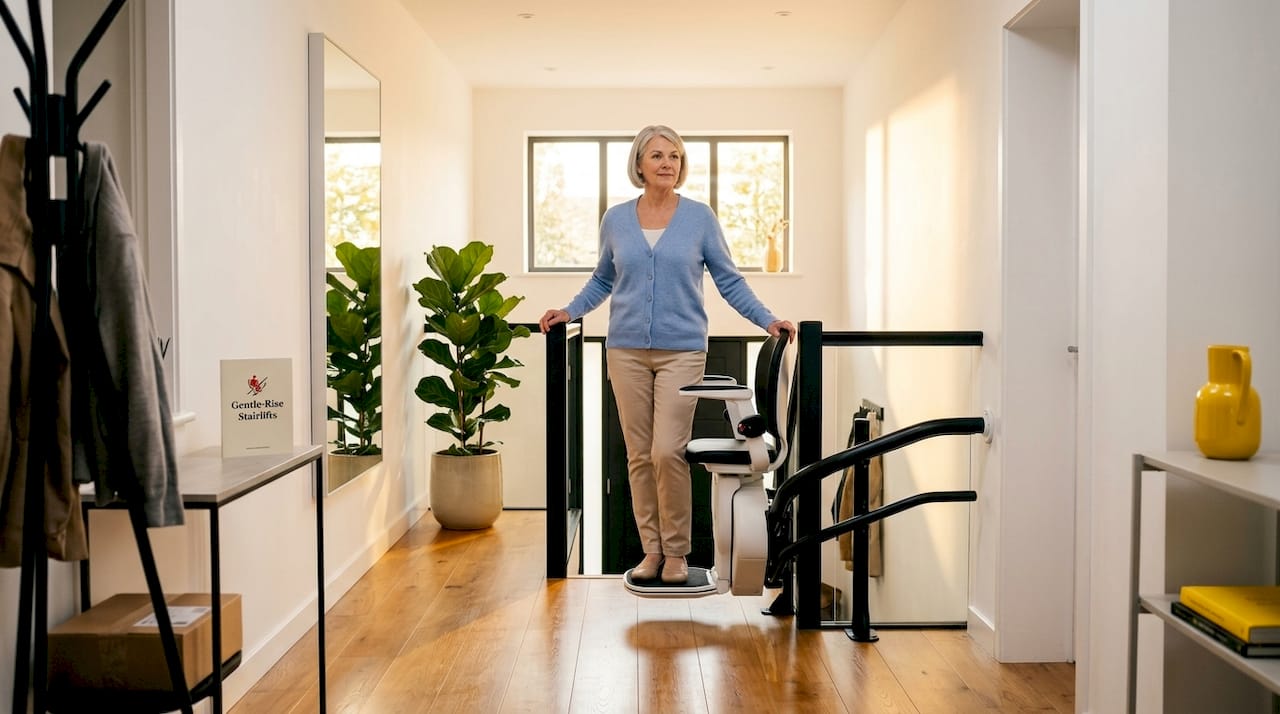
The perch stairlift benefits go well beyond simply offering an alternative to sitting down. For the right user, the advantages are genuine and practical.
Preserved independence for joint pain sufferers. People with limited knee or hip flexion often find that a standard stairlift seat is simply too low and too far back. Getting on and off requires a deep bend that causes pain or is physically impossible. Perch stairlifts preserve independence by removing that barrier entirely, letting users travel between floors without assistance.
Reduced joint strain during the ride. Because you remain in a near-standing posture, the hips and knees are never forced into full flexion. This matters for people with conditions such as osteoarthritis, a hip replacement, or severe knee stiffness, where sitting deeply causes discomfort even for short periods.
Compact design for narrow staircases. One of the most overlooked advantages of perch stairlifts is what they offer homeowners with tight stairways. A smaller footprint makes them suitable for staircases where full seated models simply cannot be installed without blocking the passage entirely. Victorian terrace houses and older UK properties with steep, narrow stairs often benefit most from this design.
Easier transfers on and off. Because the seat is already at a near-standing height, the movement needed to mount and dismount is much smaller. Most stairlift incidents happen during boarding and alighting, so reducing the physical effort at those moments directly reduces risk for suitable users.
More natural posture throughout. Travelling in an upright position feels more dignified and comfortable for many users. It avoids the slumped, reclined posture that some people find disorienting or physically awkward on a traditional stairlift.
Pro Tip: If you have a knee replacement or a fused joint, ask specifically about perch stairlift models during any home survey. Many assessors default to suggesting seated stairlifts unless the user raises joint flexion as a concern.
Who should and shouldn't use a perch stairlift?
This is where honest, practical guidance matters most. A perch stairlift is not the right choice for every mobility challenge, and understanding the distinction could genuinely affect your safety at home.
When a perch stairlift works well
The ideal perch stairlift user has limited knee or hip flexion but retains reasonable balance and core stability. If you can stand at a kitchen counter, walk short distances without a frame, and shift your weight from one foot to the other with some confidence, a perch model is likely within your capability.
When a traditional seated stairlift is safer
Balance and core stability are the deciding factors. If you experience frequent fatigue, dizziness, significant weakness in the legs, or poor balance, a traditional seated stairlift offers more physical support and is considerably safer. The perch position requires the user to maintain some postural control throughout the journey.
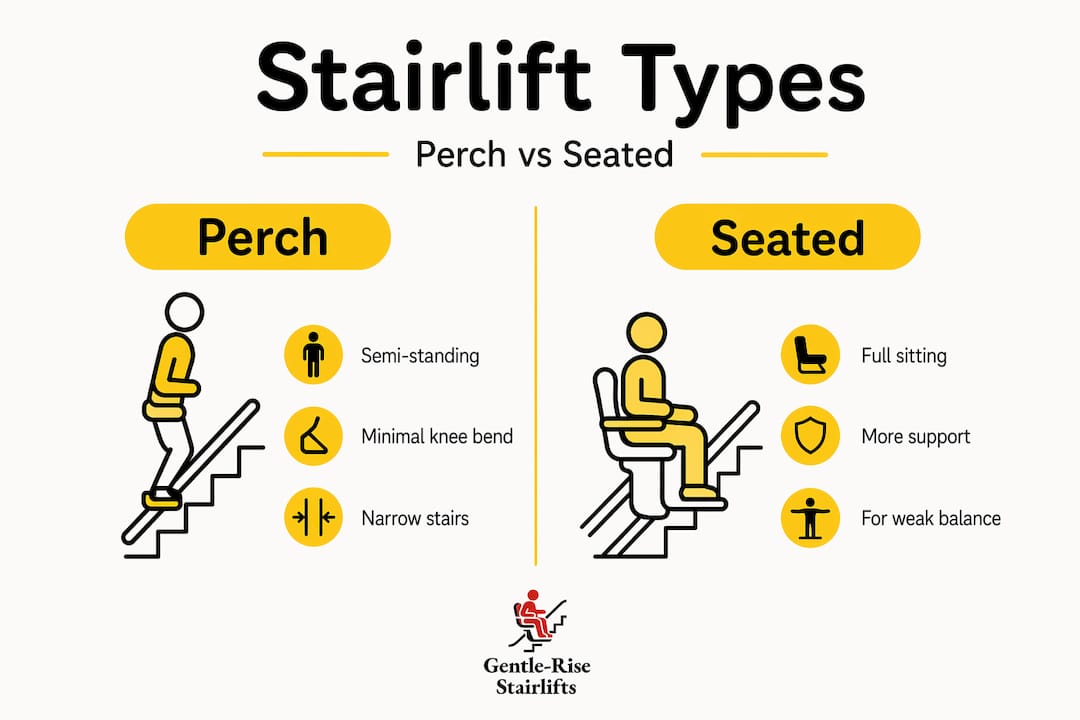
Here is a side-by-side comparison to help you self-assess:
| Factor | Perch stairlift | Seated stairlift |
|---|---|---|
| Knee/hip flexion needed | Minimal | Full seated position required |
| Balance required | Yes, moderate core stability needed | Less critical, full back and seat support |
| Staircase width | Better for narrow staircases | Requires more space |
| Transfer effort | Lower height means smaller movement | Requires deeper sit-to-stand transfer |
| Best suited for | Arthritis, joint replacements, stiff joints | Fatigue, poor balance, general frailty |
The biggest safety concern with any stairlift is boarding and exiting. Professional home surveys assess exactly this: whether the user's mobility profile matches the demands of the lift type being considered. Never skip that step. You can explore how different stairlift types compare for various home layouts through this guide on types of stairlifts.
Pro Tip: If you're unsure whether your balance is sufficient for a perch model, ask a physiotherapist or occupational therapist to assess you before your stairlift survey. Their written notes will help the installer recommend the safest option.
Perch stairlift installation: what to expect
Perch stairlift installation follows largely the same process as fitting a standard model, but with additional attention to customisation for the user's specific body dimensions and mobility needs.
Here is what the process typically involves:
- Home survey first: A qualified assessor visits your property to measure the staircase, assess the user's mobility, and confirm whether a perch model is appropriate. This is free with most reputable providers and non-obligatory.
- Staircase specifications: The installer will measure tread width, total rise, any bends or landings, and the available head height. Perch models work on both straight and curved staircases, though curved rail fitting adds complexity and cost.
- Customised fitting: Seat height adjustment and armrest placement are tailored to the user's body during installation. This is not optional. A poorly fitted perch seat puts unnecessary strain on the joints and increases the risk of an incident. A well-fitted seat height reduces joint stress and eases mounting and dismounting.
- Installation timeline: Most straight-staircase perch stairlift installations are completed within a few hours. Curved staircases require a bespoke rail and may take longer, sometimes requiring a second visit for the rail to be manufactured and returned.
- Safety checks: Before handover, the installer will run the lift through several test cycles, adjust the speed settings, and walk you through the controls, including the emergency stop.
For more detail on what safe installation looks like in practice, the guide on installing a stair lift safely covers the process thoroughly.
Understanding perch stairlift costs in the UK
Cost is one of the most common questions people have, and it's fair to want clarity before committing. Perch stairlift costs vary depending on several factors, and the final price is rarely a flat figure.
Here are the main cost considerations in order of impact:
- Staircase shape: Straight staircases are the most affordable to fit. Curved or L-shaped staircases require custom-manufactured rails, which increase cost significantly.
- New vs reconditioned: Reconditioned perch stairlift models offer the same core function at a lower price. They are a legitimate option for many users, provided they come with a warranty and professional installation.
- Customisation requirements: Specialised seat heights, extended rails, and powered swivel seats all add to the base price.
- Installation complexity: Staircases with landings, tight turns, or low head clearance take longer to fit and may require more bespoke components.
- Aftercare and maintenance: A service plan such as the Protect+ programme from Gentlerisestairlift adds a modest ongoing cost but provides significant peace of mind.
At Gentlerisestairlift, straight stairlift options start from £795, making them one of the more affordable routes to restored stair mobility. Perch models may sit at a similar price point for straight staircases, though the precise figure depends on the survey outcome. Comparing prices is sensible, but the cheapest lift without proper fitting is not a good deal. Reliability and safety are what you are ultimately paying for.
My honest take on perch stairlifts
I've spoken with enough families researching stairlift options to know that perch stairlifts are frequently misunderstood on both sides. Some people assume they won't be able to use any stairlift because they "can't sit properly." They've written themselves off before they've even asked the right question. For those people, a perch stairlift can be genuinely life-changing.
On the other side, I've seen people push for a perch model because it sounds more active or dignified, when their balance profile actually makes a seated stairlift the safer and more practical choice. Neither type is inherently superior. The right choice is the one that matches the specific mobility profile of the person using it.
What I find gets overlooked most often is the boarding and dismounting phase. People focus on the ride itself, but most incidents occur during the moments of getting on and off. A good installer will spend time on this during the demonstration. If yours doesn't, ask them to.
My consistent advice: don't buy any stairlift, perch or otherwise, without a professional home survey. It costs nothing with most providers and removes the guesswork entirely. Choosing based on a brochure alone is where mistakes happen.
— lee
Ready to find the right stairlift for your home?
At Gentlerisestairlift, we specialise in matching the right stairlift to the right person. Whether a perch model suits your mobility needs or a traditional seated lift would serve you better, our team provides free home surveys across the UK to give you a clear, personalised recommendation.
We offer a full range of stairlift solutions, including straight, curved, and reconditioned perch stairlifts, with prices starting from £795. Installation is typically completed within hours, and our Protect+ aftercare plan keeps your lift running safely for years ahead. If you're asking whether a perch stairlift is the right fit for you, the fastest way to get a reliable answer is a no-obligation home survey. Get in touch with Gentlerisestairlift today to book yours.
FAQ
What is a perch stairlift?
A perch stairlift is a stairlift with a small, raised seat that allows the user to travel in a semi-standing, near-upright position. It is designed for people who cannot fully sit down due to knee or hip pain or limited joint flexion.
How does a perch stairlift differ from a standing stairlift?
Despite the similar name, most standing stairlifts are perch models. The user does not travel fully upright but instead leans on a raised seat in a semi-sitting posture throughout the journey.
Can a perch stairlift help me if I have a knee replacement?
Yes, a perch stairlift is often well-suited to users with knee replacements, as it requires far less knee flexion than a standard seated stairlift. A professional home survey will confirm suitability for your specific mobility needs.
Is a perch stairlift safe for elderly users?
A perch stairlift is safe for seniors who retain reasonable balance and core stability. Those with significant weakness or poor balance are generally safer using a traditional seated stairlift, which provides full back and seat support.
How much does a perch stairlift cost in the UK?
Costs vary depending on staircase type, customisation, and installation complexity. Straight stairlift options at Gentlerisestairlift start from £795, with perch model pricing confirmed following a free home survey.