
TL;DR:
- Reusability in stairlifts involves refurbishing, reconditioning, and redeploying units and components to extend their lifespan and reduce environmental impact. It offers significant cost savings through reconditioned sales and rental programs while lowering carbon footprints by minimizing manufacturing and waste. Properly inspected and certified reconditioned stairlifts provide safe, reliable mobility solutions and support sustainable home accessibility practices.
Reusability in stairlifts is defined as the practice of refurbishing, reconditioning, or redeploying stairlift units and components across multiple users or households, extending product life while reducing cost and environmental waste. This practice sits at the heart of sustainable home mobility and is increasingly recognised as the industry term "stairlift refurbishment." Whether you are weighing a reconditioned unit from Gentlerise Stairlifts, considering a short-term rental, or simply trying to make a responsible choice, the role of reusability in stairlifts affects both your wallet and your carbon footprint. The financial and environmental case for reuse is strong, and understanding it puts you in a far better position to choose wisely.
How does stairlift reusability work in practice?
Stairlift reusability covers two distinct approaches: refurbishing a complete unit for resale, and redeploying individual components such as motors, seats, and control panels into other machines. Both approaches extend the working life of equipment that would otherwise go to landfill or recycling.
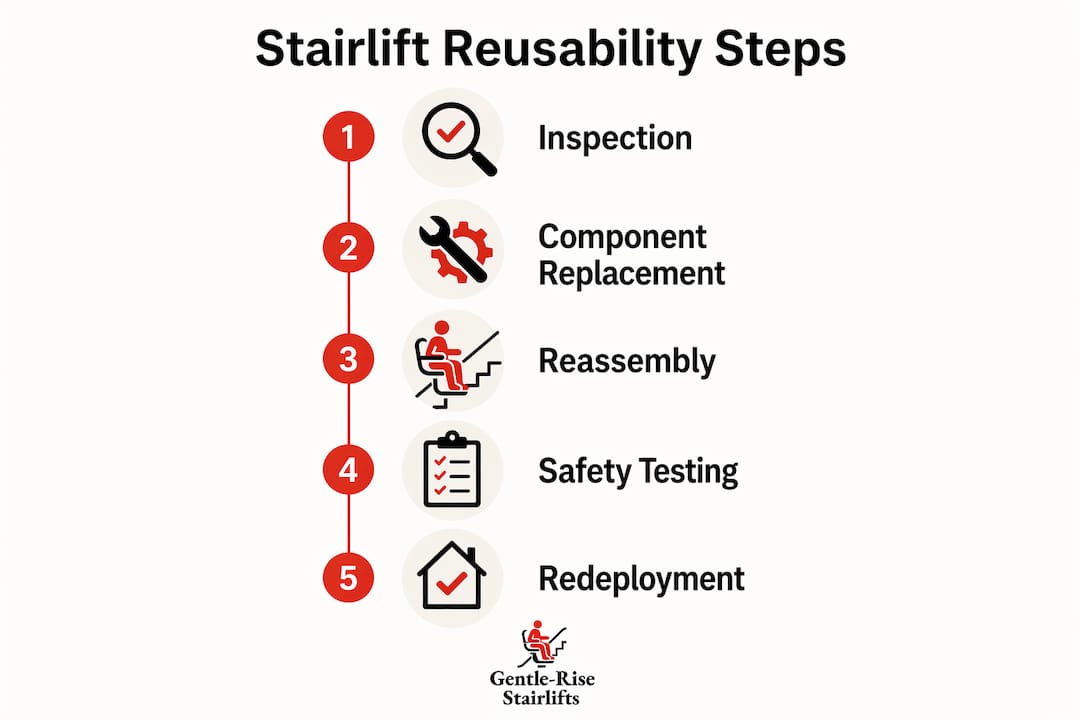
The reconditioning process follows a structured sequence:
- Full inspection. A qualified engineer assesses the chair, motor, rail, and electrical systems for wear, damage, or safety concerns.
- Component replacement. Worn parts, including drive belts, batteries, and upholstery, are replaced with new equivalents. Rental stairlifts undergo thorough testing and most worn components are replaced before re-rental.
- Safety testing. The reconditioned unit is tested against current safety standards before it is approved for reuse.
- Redeployment. The unit is installed in a new home, either sold as a reconditioned model or entered into a rental programme.
The distinction between rental and buying used matters here. A rental stairlift stays owned by the provider, who maintains it throughout its life and retrieves it when no longer needed. A used stairlift purchased outright transfers full ownership and responsibility to you. Rental programmes are particularly effective at maximising product use across multiple users, which is why they are considered a leading sustainable practice in home mobility.
One significant limitation applies to curved stairlifts. Curved stairlift rails are custom-manufactured to fit a specific staircase and cannot generally be reused in another home. This means curved stairlift reusability is largely restricted to the chair and mechanical components rather than the rail itself. Straight stairlift rails, by contrast, are standardised and far more transferable.
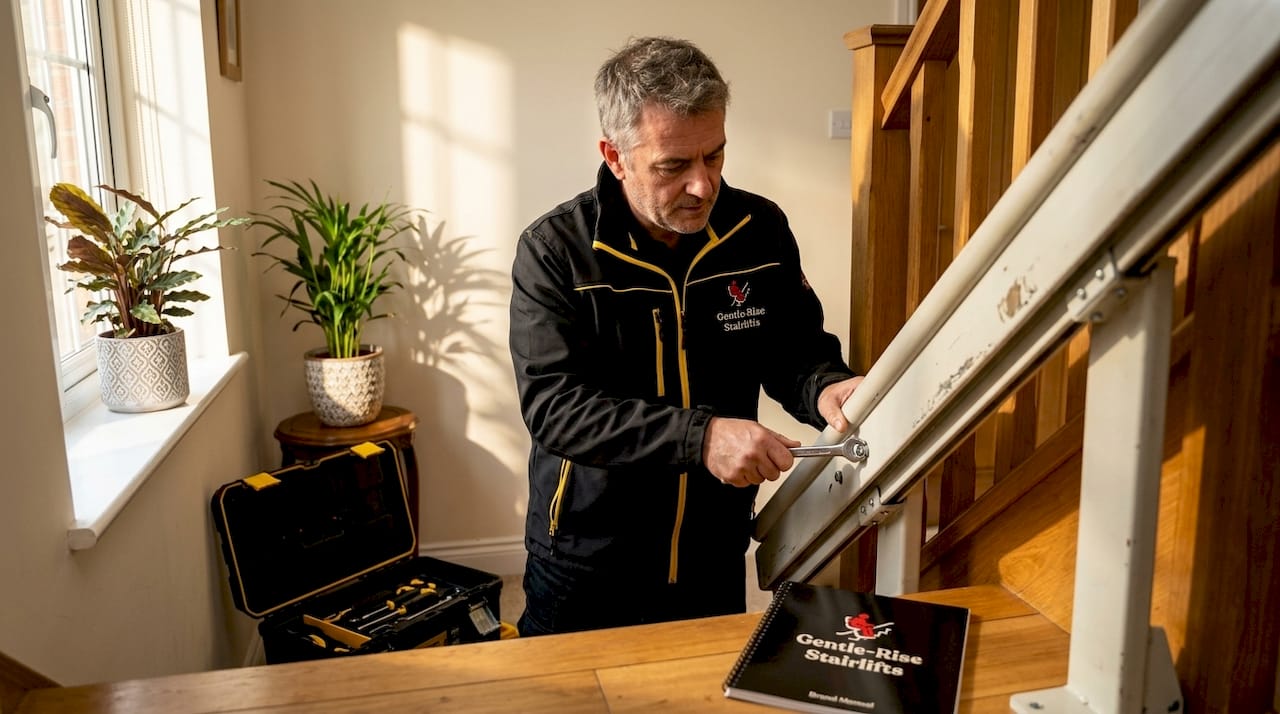
Pro Tip: If you are considering a reconditioned stairlift, ask the provider specifically which components have been replaced and request a written inspection report before agreeing to purchase or rent.
What are the financial benefits of stairlift reusability?
The cost difference between a new stairlift and a reconditioned or rental option is substantial. A new straight stairlift costs approximately £3,500 in the UK, while reconditioned models from providers like Gentlerise Stairlifts start at £795. That gap represents real money for households on fixed incomes or those managing temporary mobility needs after surgery.
| Option | Typical cost | Best suited for |
|---|---|---|
| New straight stairlift | From £795 to £3,500+ | Long-term permanent use |
| Reconditioned stairlift | From £795 | Budget-conscious buyers needing long-term use |
| Rental stairlift | £200 to £500 per month | Short-term or uncertain duration needs |
| Rent-to-own scheme | Monthly payments applied to purchase | Flexible needs with possible long-term use |
For short-term needs, renting is often the cheaper route. Renting for under 18 months can be cheaper than buying outright, since 12 months of rental including installation typically costs £3,600 to £6,000. Beyond that threshold, buying a reconditioned unit almost always makes more financial sense.
The benefits of stairlift reusability extend further when you factor in resale. A well-maintained stairlift retains residual value. If your mobility needs change, a straight stairlift can often be resold or returned to a provider for credit against a different model.
- Reconditioned stairlifts carry a lower upfront cost than new units.
- Rental contracts typically include maintenance and repairs, removing unexpected costs.
- Rent-to-own schemes allow monthly payments to count towards eventual purchase, giving flexibility for uncertain long-term needs.
- Reselling a used straight stairlift is a realistic option that partially recoups your original outlay.
Pro Tip: Before committing to a rental contract, calculate the total cost over 12 and 24 months and compare it directly with the purchase price of a reconditioned unit. The crossover point is usually around 15 to 18 months.
How does reusability affect stairlift sustainability?
Manufacturing a new stairlift requires significant raw materials, including aluminium for the rail, copper for wiring, and steel for the chassis. Each new unit produced carries an embedded carbon cost from extraction, processing, and transport. Refurbishing an existing unit avoids the majority of that manufacturing burden.
"Choosing reconditioned stairlifts can reduce carbon footprints and offer affordable options for individuals with temporary or long-term mobility needs."
The environmental advantages of stairlift reuse are concrete and measurable:
- Waste reduction. Refurbishing a unit keeps it out of landfill and delays the need for raw material extraction.
- Resource conservation. Reusing aluminium rails and copper wiring avoids the energy-intensive process of smelting and re-manufacturing.
- Lower transport emissions. A reconditioned unit sourced locally generates far fewer transport emissions than a new unit shipped from a factory overseas.
- Extended product cycles. Rental programmes encourage sustainability by cycling one unit through multiple users, multiplying the environmental return on the original manufacturing investment.
When a stairlift does reach the true end of its working life, responsible recycling of its components matters. Aluminium and copper are both highly recyclable materials. Providers who operate formal stairlift recycling options, rather than simply disposing of old units, close the loop on the product lifecycle. Gentlerise Stairlifts' approach to refurbishment and redeployment reflects this broader commitment to reducing waste in home mobility.
The impact of reusability on stairlifts at a sector level is also worth noting. As the UK population ages, demand for home mobility equipment will grow. If the industry defaults to new-unit sales alone, the cumulative environmental cost will be significant. Reuse and refurbishment are not just individual choices. They represent a structural shift in how home mobility equipment is produced, used, and retired.
What should you consider when choosing a refurbished stairlift?
Choosing a reusable or refurbished stairlift is not simply a matter of finding the cheapest option. Several practical factors determine whether a reconditioned unit will serve you safely and reliably.
-
Staircase compatibility. Straight staircases are well-served by reconditioned units because the rails are standardised. Curved staircases present a greater challenge. Since curved rails are bespoke, curved stairlift rentals are rare and more expensive. For a curved staircase, you are more likely to be purchasing a reconditioned chair fitted to a new custom rail.
-
Warranty and after-sales cover. Refurbished stairlifts usually come with limited warranties that differ from those on new units. Verify exactly what is covered, for how long, and whether a maintenance plan such as Gentlerise Stairlifts' Protect+ programme is available to supplement the warranty.
-
Safety certification. Any reconditioned unit sold or rented in the UK must meet current safety standards. Ask for documentation confirming the unit has been tested and certified. A reputable provider will supply this without hesitation.
-
Installation quality. The rail and fixings must be installed correctly regardless of whether the unit is new or reconditioned. Review safe installation practices before your appointment so you know what a proper installation looks like and can ask informed questions.
-
Component age and service history. Ask how old the unit is, how many previous users it has had, and which components have been replaced. A good provider maintains service records and shares them transparently.
The stairlift lifespan and reusability are directly linked. A well-maintained straight stairlift can last 10 years or more. A reconditioned unit that has been properly serviced and had key components replaced can realistically offer another five to eight years of reliable use, making it a sound investment for most users.
Key takeaways
Reusability is the single most effective way to reduce both the cost and environmental impact of stairlift ownership, and straight stairlift refurbishment offers the clearest practical route to achieving both goals.
| Point | Details |
|---|---|
| Refurbishment extends product life | Reconditioned stairlifts can deliver five to eight more years of reliable use after key components are replaced. |
| Rental suits short-term needs | Renting for under 18 months is typically cheaper than buying; beyond that, purchasing a reconditioned unit saves money. |
| Curved rails cannot be reused | Curved stairlift rails are bespoke and cannot transfer between homes; only the chair and mechanical parts are reusable. |
| Environmental gains are real | Refurbishing avoids the carbon cost of new manufacturing and keeps aluminium and copper out of landfill. |
| Verify warranty and certification | Always confirm safety certification and warranty terms before accepting a reconditioned or rental unit. |
Why reusability deserves more credit than it gets
I have spoken with hundreds of people over the years who assume a reconditioned stairlift is a compromise. They picture something worn, unreliable, or second-rate. That assumption is wrong, and it costs people money.
The misconception comes from conflating "used" with "unserviced." A properly reconditioned stairlift, with replaced batteries, a new drive belt, fresh upholstery, and a full safety check, is functionally equivalent to a new unit in most respects. The rail is the same aluminium profile. The motor is the same design. What you are not paying for is the factory packaging and the dealer margin on a brand-new product.
What I find genuinely interesting is the environmental argument, which most buyers ignore entirely. When you choose a reconditioned unit, you are not just saving money. You are avoiding the manufacture of a new product that requires mining, smelting, and international shipping. For a piece of equipment that weighs 50 to 80 kilograms and contains significant quantities of aluminium and copper, that is a meaningful environmental decision.
The one area where I would urge caution is warranty coverage. Some providers offer very limited cover on reconditioned units, and the small print matters. A maintenance plan that covers call-outs and parts is worth paying for, particularly in the first year. The affordable stairlift solutions available in the UK today make it entirely possible to get safe, reliable home mobility without paying full price for a new unit. The key is choosing a provider who stands behind the work they have done.
— lee
How Gentlerise Stairlifts supports reusable stairlift solutions
Gentlerise Stairlifts offers reconditioned and rental stairlift options across the UK, with straight stairlifts starting at £795. Every refurbished unit goes through a full inspection and component replacement process before installation, and the Protect+ maintenance programme provides ongoing cover to keep your stairlift running reliably. If you are weighing up stairlift costs in the UK or want to understand which option suits your staircase and budget, Gentlerise Stairlifts offers free home surveys with no obligation. Visit Gentlerise Stairlifts to explore reconditioned, rental, and new stairlift options backed by professional installation and aftercare.
FAQ
What does stairlift reusability mean?
Stairlift reusability refers to refurbishing, reconditioning, or redeploying stairlift units and components across multiple users. It includes rental programmes, reconditioned sales, and the recycling of parts such as motors, rails, and control systems.
Can curved stairlift rails be reused?
Curved stairlift rails are custom-manufactured for a specific staircase and cannot generally be reused in another home. Only the chair unit and mechanical components from a curved stairlift are typically suitable for refurbishment.
Is a reconditioned stairlift safe to use?
Yes, provided it has been properly inspected, had worn components replaced, and meets current UK safety standards. Always ask for written certification and confirm warranty terms before accepting a reconditioned unit.
How long does a refurbished stairlift last?
A well-maintained reconditioned stairlift can provide five to eight years of reliable use after refurbishment, depending on the age of the unit and the extent of component replacement during reconditioning.
When is renting a stairlift more cost-effective than buying?
Renting for under 18 months is generally cheaper than buying outright. For longer-term needs, purchasing a reconditioned stairlift almost always delivers better value than continuing to pay monthly rental fees.