
TL;DR:
- A stairlift buyback program involves a company purchasing your used stairlift, providing professional removal and payment based on several factors like type, age, and brand. Straight stairlifts under 10 years old from trusted brands typically fetch £400 to £1,200, while curved units hold almost no resale value due to bespoke rails. For optimal payout, prepare by cleaning the unit, gathering paperwork, and obtaining multiple quotes, considering alternative options like private sales or donations for less valuable units.
A stairlift buyback is a programme where a company purchases your used stairlift, arranges professional removal, and pays you based on the unit's type, age, condition, and brand. The term "buyback" is widely used by homeowners, though the industry also refers to this as a stairlift resale or part-exchange scheme. Either way, the core process is the same: you hand over your stairlift, and a company compensates you for it. Brands such as Acorn, Stannah, and Handicare are the most commonly accepted in these schemes, largely because their parts remain in demand. Understanding how buyback programmes work, and what genuinely affects the payout, puts you in a far stronger position before you pick up the phone.
What factors affect your stairlift buyback value?
The single biggest factor in any buyback offer is whether your stairlift runs on a straight or curved rail. Straight stairlifts hold meaningful resale value, with units typically fetching between £400 and £1,200 depending on age and condition. Curved stairlifts, by contrast, are built on bespoke rails shaped to fit a specific staircase. Those rails almost never fit another home, which means curved units carry near-zero resale value on the open market. This is the most common misconception homeowners bring to the buyback process, and it leads to genuine disappointment when offers come in far lower than expected.
Age is the second major variable. Most buyback schemes cap acceptance at units that are between 7 and 10 years old. A stairlift installed in 2018 sits comfortably within that window; one installed in 2013 may only be accepted for parts. This matters because parts-only purchases attract far lower offers. Dealers buying units for parts typically pay £100 to £300, which is a fraction of the original purchase price. That figure is not a negotiating starting point. It reflects the actual secondary market for components.
Brand reputation plays a genuine role too. Acorn, Stannah, and Handicare consistently attract stronger buyback offers because engineers know the parts, spares are available, and refurbished units sell reliably. Lesser-known brands may be refused outright, or offered only scrap value. Working condition also matters significantly. A fully functioning unit is worth considerably more than one with a fault, even a minor one. Buyers factor in repair costs, and those costs come directly off your offer.
Documentation adds confidence to any transaction. Keeping your original purchase receipt, warranty paperwork, and any service records from a maintenance programme gives the buyer evidence of how the unit has been treated. It will not transform a low offer into a high one, but it removes doubt and can tip a borderline decision in your favour.
| Factor | Impact on buyback value |
|---|---|
| Straight rail | Strong resale potential, £400 to £1,200 typical range |
| Curved rail | Near-zero resale; parts-only offers of £100 to £300 |
| Age under 7 years | Accepted by most buyback schemes at full value |
| Age over 10 years | Often refused or accepted for parts only |
| Recognised brand (Acorn, Stannah, Handicare) | Higher demand and stronger offers |
| Full working order | Significantly higher payout than faulty units |
Pro Tip: Before contacting any buyback company, check the manufacture date on your stairlift's serial plate. If it is over 10 years old, focus your enquiries on parts buyers or donation routes rather than standard buyback programmes.
How does the stairlift buyback process work?
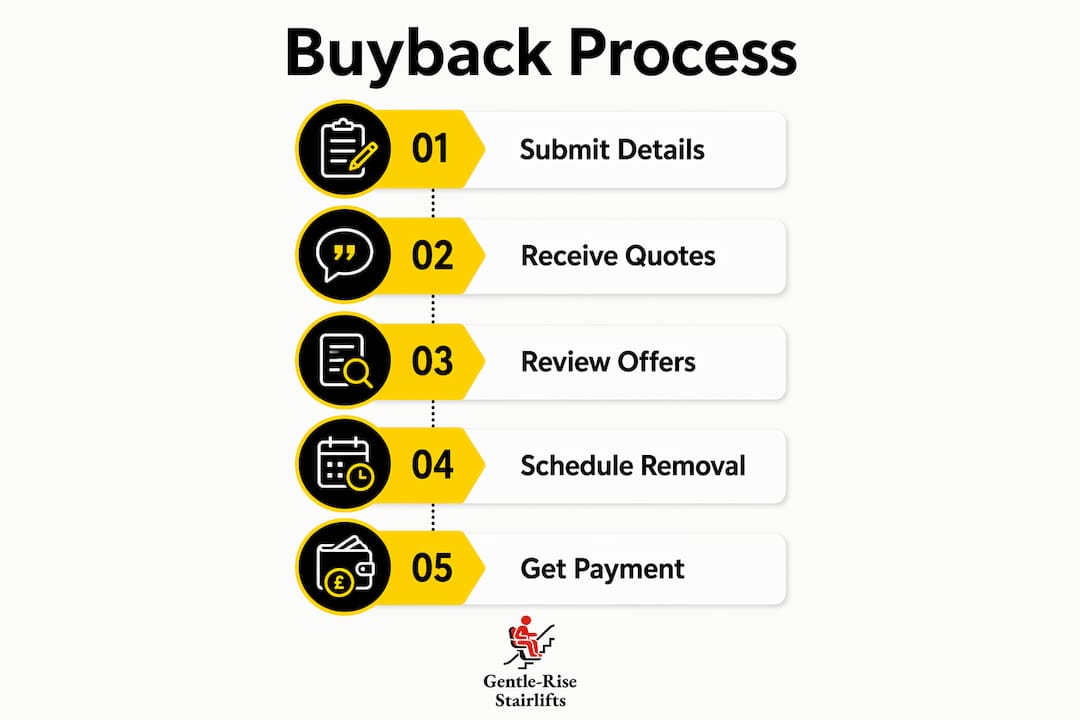
The buyback workflow follows a consistent pattern across most reputable companies, whether you approach your original dealer or an independent buyer. Knowing each stage in advance prevents delays and avoids misunderstandings about what is included in the offer.
- Identify your stairlift type and model. Find the model name and serial number, usually on a plate beneath the seat or on the rail. Note whether it is a straight or curved unit, as this determines which buyers will consider it.
- Contact your original dealer first. Many manufacturers and installers run their own buyback or trade-in programmes. These can be straightforward, particularly if you are upgrading to a newer model, as the credit is applied directly to your new purchase.
- Submit photos and details for a valuation. Most companies now handle initial valuations remotely. Send clear photographs of the seat, rail, controls, and any visible wear. Include the model number and approximate age.
- Receive a written offer. A reputable buyer provides a written quote that specifies the payment amount, whether removal is included, and the timeline for collection. Do not accept a verbal offer alone.
- Agree removal and collection. Buyback offers typically include free professional removal, which would otherwise cost £200 to £500 if arranged independently. Confirm this is included before signing anything.
- Receive payment. Bank transfer is the most common payment method. Confirm the payment timeline before the collection date, and do not hand over the unit until you have written confirmation of the agreed terms.
One important distinction to clarify upfront: some companies offer cash payment, while others offer trade-in credit towards a new stairlift. The financial outcome can look similar on paper, but cash gives you flexibility whereas credit locks you into a purchase with that specific supplier. Always ask which type of payment is on offer before progressing.
Pro Tip: Request at least three written quotes from different buyers before committing. The spread between the lowest and highest offer can be substantial, particularly for well-maintained straight stairlifts from recognised brands.
Buyback vs. other stairlift resale options: which is right for you?
Buyback is not the only route available, and for some homeowners it is not the best one. The right choice depends on how much time you are willing to invest, how urgently you need the stairlift removed, and the type of unit you have.
Private sale offers the highest potential return for straight stairlifts in good condition. Platforms such as eBay or Facebook Marketplace give you direct access to buyers, and you set the price. The trade-off is that you take on all responsibility: arranging removal, transporting the unit, and managing buyer enquiries. Selling a curved stairlift privately is rarely viable because the bespoke rails fit almost no other home, which eliminates most of your potential buyer pool before you start.
Donation is an underused option that deserves serious consideration, particularly for curved or older units. Donating to a registered charity can provide tax deductions that exceed what a buyback company would pay, especially when the cash offer is already low. Charities that support elderly or disabled individuals sometimes accept working stairlifts for redistribution. The financial benefit is indirect, but for units with minimal resale value, it can be the most rewarding outcome.
Scrapping is the last resort, used for units that are too old, faulty, or obscure for any buyer to accept. Some removal companies will take the unit for free in exchange for the scrap metal value. You receive nothing financially, but the stairlift is gone without cost to you.
- Buyback: Fast, hassle-free, includes removal, lower payout than private sale
- Private sale: Higher potential return, more effort, not viable for curved units
- Trade-in: Convenient if upgrading, credit rather than cash, ties you to one supplier
- Donation: Tax benefit possible, suits curved or older units, no direct cash
- Scrapping: Zero financial return, free removal, last resort for unacceptable units
For most homeowners with a straight stairlift under seven years old from a recognised brand, buyback offers the best balance of speed, convenience, and fair return. For home mobility planning on a tighter budget, the removal cost saving alone can make buyback the financially sensible choice.
How to maximise your stairlift resale or buyback offer
Getting the best possible offer requires preparation before you contact a single buyer. These steps apply whether you are pursuing a buyback programme, a private sale, or a trade-in.
- Clean the unit thoroughly. Wipe down the seat, rail, and controls. A clean stairlift photographs better and signals to buyers that it has been maintained with care.
- Test all functions before valuation. Run the stairlift up and down the full length of the rail. Check the remote controls, safety sensors, and charging contacts. Identifying and fixing a minor fault before valuation can meaningfully improve your offer.
- Gather all paperwork. Locate the original purchase receipt, any warranty documents, and records of servicing. If you have been on a maintenance programme such as Gentlerise Stairlifts' Protect+ plan, those records demonstrate consistent upkeep.
- Time your sale well. Units under seven years old from Acorn, Stannah, or Handicare attract the strongest offers. If your unit is approaching that threshold, acting sooner rather than later preserves more of its value.
- Confirm removal terms in writing. Clarify whether the offer includes free removal or whether a removal fee will be deducted from your payment. Unexpected removal costs are one of the most common sources of dissatisfaction in buyback transactions.
- Request multiple quotes. Contact your original installer, at least one independent buyback company, and check whether any local mobility retailers are buying. Compare written offers, not verbal estimates.
Pro Tip: If you are considering buying a replacement stairlift, ask each buyback company whether they also supply new or refurbished units. Combining a buyback with a new purchase from the same supplier sometimes unlocks better trade-in terms than a straight cash offer.
You can also explore stairlift alternatives if your mobility needs have changed and a replacement stairlift is not the right next step.
Key takeaways
A stairlift buyback is a practical route to partial cost recovery, but the payout depends almost entirely on whether you have a straight rail, a recognised brand, and a unit under 10 years old.
| Point | Details |
|---|---|
| Straight vs. curved rail | Straight units resell for £400 to £1,200; curved units are near-zero value due to bespoke rails. |
| Age threshold | Most buyback schemes accept units up to 7 to 10 years old; older units are parts-only or refused. |
| Brand matters | Acorn, Stannah, and Handicare attract stronger offers due to parts availability and demand. |
| Removal costs | Buyback typically includes free removal worth £200 to £500, which offsets a lower cash payout. |
| Know your payment type | Confirm whether the offer is cash or trade-in credit before agreeing to any terms. |
Why I think most people approach stairlift buyback the wrong way
Most homeowners contact a buyback company expecting to recover a significant portion of what they originally paid. That expectation is understandable, but it rarely matches reality. A stairlift is not an investment. It is a mobility aid, and like most mobility equipment, its value depreciates quickly once installed. Treating buyback as a means of partial cost recovery, rather than a windfall, leads to far less frustration.
The curved stairlift situation is the clearest example of this. I have spoken with homeowners who genuinely believed their curved unit would fetch £800 or more, simply because it was only four years old and in perfect condition. The bespoke rail problem is not about condition. It is structural. No amount of cleaning or documentation changes the fact that the rail fits one staircase in one house.
Where I think buyback genuinely earns its place is in the convenience it offers. Free professional removal is worth real money, and the speed of a buyback transaction compared to a private sale is significant when you are managing a bereavement, a house move, or a change in care needs. The homeowners who get the best outcomes are those who go in informed, gather multiple quotes, and treat the payout as a bonus rather than a primary objective.
Dealing with a reputable company matters more than squeezing out an extra £50. A company that provides a written offer, confirms removal terms clearly, and pays promptly is worth more than one that promises a higher figure and then deducts fees at collection. Check reviews, ask for written confirmation of every term, and do not hand over the unit until payment is confirmed.
— lee
How Gentlerise Stairlifts can help you move forward
If you are ready to sell your stairlift or explore what comes next, Gentlerise Stairlifts offers trusted buyback programmes with professional removal across the UK.
Gentlerise Stairlifts provides a straightforward process: submit your stairlift details, receive a clear written offer, and have the unit professionally removed at a time that suits you. Beyond buyback, Gentlerise offers a wide selection of new and refurbished stairlifts, with straight stairlift prices starting at £795 and quick installation often completed within hours. Whether you are upgrading, downsizing, or simply need the stairlift gone, the team at Gentlerise Stairlifts is ready to help you find the most cost-effective path forward. Book a free home survey today.
FAQ
What is a stairlift buyback programme?
A stairlift buyback programme is a service where a company purchases your used stairlift, typically including professional removal and a cash or credit payment based on the unit's type, age, and condition.
Do curved stairlifts have any resale value?
Curved stairlifts have near-zero resale value because the rails are custom-made for a specific staircase and rarely fit another home. Most buyers will only accept curved units for parts, offering between £100 and £300.
How old can a stairlift be for a buyback scheme to accept it?
Most buyback schemes accept stairlifts up to 7 to 10 years old. Units older than this are typically refused or accepted only as parts donors at significantly reduced prices.
Is removal included in a stairlift buyback offer?
Most reputable buyback offers include free professional removal, saving homeowners £200 to £500 in removal fees. Always confirm this in writing before agreeing to any terms, as some companies deduct removal costs from the final payment.
Should I sell my stairlift privately or use a buyback scheme?
A private sale may yield a higher price for a straight stairlift in good condition, but it requires more effort and carries more risk. Buyback offers speed, convenience, and free removal, making it the better choice for most homeowners who want a straightforward transaction.