

TL;DR:
- Stairlift warranties mainly cover manufacturing defects but often exclude user error and wear and tear.
- Extended warranties offer broader coverage and longer protection, especially for daily or complex users.
- Proper maintenance, thorough documentation, and understanding each clause are key to successful warranty claims.
Many UK homeowners buy a stairlift and assume the warranty acts as a complete safety net. It feels logical: you've paid a significant sum, so surely everything is covered. But the reality is far messier. Warranties often contain exclusions, ambiguous language, and claim processes that catch buyers off guard at the worst possible moment. Whether you're purchasing for an elderly parent or recovering from surgery yourself, understanding exactly what your warranty does and doesn't cover could save you hundreds of pounds and a great deal of frustration. This guide breaks down the key facts and practical steps you need.
Table of Contents
- What does a stairlift warranty actually cover?
- Comparing standard versus extended stairlift warranties
- How exclusions and disputes affect your warranty claims
- Practical tips for maximising your stairlift warranty
- What most stairlift buyers misunderstand about warranties
- Explore reliable stairlift options and warranty support
- Frequently asked questions
Key Takeaways
| Point | Details |
|---|---|
| Read the fine print | Stairlift warranties often include exclusions you must understand before purchase. |
| Consider extending cover | Extended warranties provide added protection and clarity for homeowners seeking peace of mind. |
| Watch out for exclusions | Misuse and user error can void your warranty, making maintenance and correct use essential. |
| Document everything | Keeping records and communicating clearly is crucial if your warranty claim faces dispute. |
| Explore reliable providers | Choose stairlift companies that offer transparent terms and responsive aftercare support. |
What does a stairlift warranty actually cover?
Most stairlift warranties follow a similar structure. They protect against manufacturing defects, mechanical failures, and faulty parts during a set period, typically one to two years for a standard warranty. Labour costs for repair visits are usually included, as are replacement parts that fail under normal operating conditions. On paper, this sounds reassuring.
The problems start when you look at the exclusions. A typical stairlift warranty will not cover:
- Accidental damage caused by the user or a third party
- Normal wear and tear on components such as batteries and upholstery
- Damage resulting from improper use or failure to follow the manufacturer's guidelines
- Faults arising from modifications made by anyone other than an authorised engineer
- Issues caused by power surges or environmental factors
These exclusions matter enormously in practice. Consider a real example: Handicare, one of the UK's largest stairlift providers, faced a situation where warranties excluded misuse and user error, allowing them to deny a repair despite the customer believing the fault was a manufacturing issue. The customer was left without a functioning stairlift and facing a costly out-of-pocket repair.
"The difference between a 'manufacturing defect' and 'user error' is often decided by the manufacturer, not the customer — and that distinction can cost you dearly."
This is why reading the full terms for your specific model matters so much. A warranty document is a legal contract, and the language used to define exclusions varies between brands and models. Before purchasing, check your stairlift aftercare options carefully and ask the provider to explain every exclusion in plain language.
For those planning ahead, understanding safe stairlift installation from the outset reduces the risk of inadvertently voiding your warranty. Equally, exploring affordable accessibility solutions can help you find providers who are transparent about what their warranties genuinely cover.
Comparing standard versus extended stairlift warranties
Understanding what a warranty covers opens the door to comparing your options. Here's how standard protection differs from extended offers.
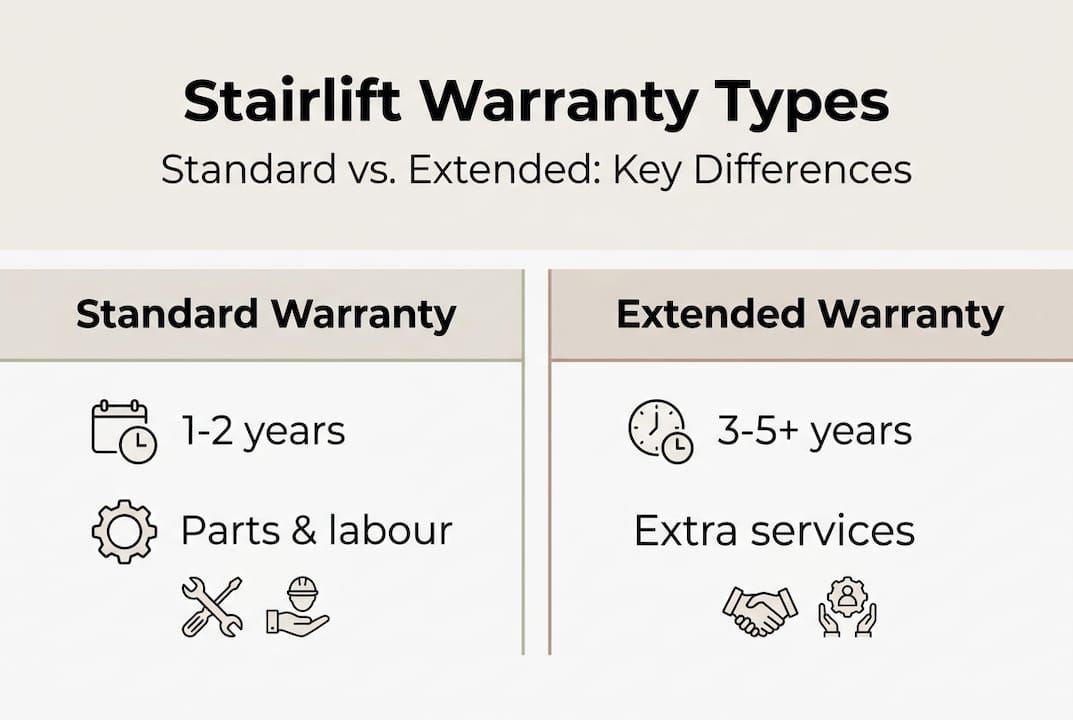
A standard warranty typically lasts one to two years from the date of installation. It covers parts and labour for manufacturing defects but excludes the common items listed above. Once it expires, any repair costs fall entirely on you.
An extended warranty (sometimes called a service plan or aftercare plan) runs beyond the standard period, often for three to five years or longer. It may also include annual servicing visits, priority call-out response times, and broader parts coverage. Some plans cover consumable items like batteries, which standard warranties almost never include.
Here's a quick comparison to help you weigh the options:
| Feature | Standard warranty | Extended warranty |
|---|---|---|
| Duration | 1 to 2 years | 3 to 5+ years |
| Parts coverage | Manufacturing defects | Broader parts coverage |
| Labour included | Yes | Yes |
| Annual servicing | Not usually | Often included |
| Battery replacement | Excluded | Sometimes included |
| Typical cost | Included in purchase | £100 to £300 per year |
Extended warranties are particularly worth considering if the stairlift user is elderly or has complex mobility needs, where any downtime creates a genuine safety risk. Consumer pressure or media attention has resolved warranty disputes in the past, which highlights that clear, written terms and comprehensive extended cover are your strongest protections.
Pro Tip: Always ask for the extended warranty terms in writing before signing anything. A verbal promise of "full cover" means nothing if the written document contradicts it. A reputable service warranty guide can help you understand what reasonable terms look like.
When is an extended warranty most recommended? If the stairlift is being used daily by someone with limited alternatives, if the stairlift is a curved model (which is more complex and costly to repair), or if the provider's standard warranty period is unusually short. Explore reliable aftercare services to see what a well-structured plan looks like in practice.
How exclusions and disputes affect your warranty claims
Choosing the right warranty sets you up well, but exclusions and disputes can still derail your claim. Here's what you need to know.
The most common reasons a warranty claim is denied include:
- The fault is classified as user error rather than a manufacturing defect
- The stairlift was not serviced according to the manufacturer's schedule
- An unauthorised engineer carried out previous repairs or adjustments
- The damage is deemed accidental rather than mechanical
- The claim is made after the warranty period has lapsed
Disputes over misuse versus manufacturing faults are particularly common, and consumer pressure or media attention has been shown to resolve some of these cases. That said, you shouldn't rely on going public to get a fair outcome.
"Document everything from day one. A photograph of a fault taken the moment it appears is worth more than any verbal account when disputing a claim."
To give yourself the best chance of a successful claim, follow these practical steps:
- Keep all paperwork, including your original purchase contract, warranty document, and any service records
- Photograph or video any fault as soon as it appears, before any repair attempt
- Report issues in writing (email is ideal) so you have a dated record
- Refer specifically to the warranty clause you believe applies when making your claim
- If a claim is denied, ask for the denial in writing with the specific exclusion cited
Pro Tip: Understanding how to maintain your stairlift properly is one of the most effective ways to avoid giving a provider grounds to deny your claim. Equally, knowing how to repair a Stannah stairlift step by step can help you understand what counts as a genuine fault versus user-caused damage.
For broader context on how warranties function in repair situations, a dedicated warranty role in repairs resource can help you understand your rights more clearly.
Practical tips for maximising your stairlift warranty
Knowing the risks is important, but practical steps help ensure your stairlift warranty works for you. Here are expert recommendations.
The single biggest thing you can do is follow the manufacturer's recommended maintenance schedule. Most warranties require annual professional servicing to remain valid. Skipping even one service visit can give a provider grounds to reject a claim, even if the fault is clearly mechanical.
Here's what to do from the moment your stairlift is installed:
- Read the warranty document in full on the day of installation, not when something goes wrong
- Register your warranty if required; some manufacturers invalidate cover if registration is not completed within a set period
- Book your annual service in advance and keep the engineer's report as proof
- Avoid DIY repairs, even minor ones; any unauthorised work can void your cover
- Use the stairlift as instructed, staying within the weight limit and following all guidance in the manual
When it comes to checking your coverage, don't assume. Warranties may exclude misuse or user error in ways that aren't immediately obvious from a quick read. Ask your provider to confirm in writing which specific scenarios are and aren't covered for your model.
Pro Tip: Use a resource like this check warranty coverage guide to build a simple checklist before your warranty expires. Knowing your renewal options in advance prevents a gap in cover.
Our stairlift maintenance guide walks you through the specific steps that keep both your stairlift and its warranty in good standing. And if you're still choosing a model, our most reliable stairlift guide highlights which options come with the strongest aftercare support.
What most stairlift buyers misunderstand about warranties
Here's an uncomfortable truth: most buyers treat a warranty like a simple guarantee, when it's actually a conditional contract full of clauses that favour the manufacturer. The standard advice is to "read the small print," but that misses the real issue. Even when buyers do read it, ambiguous language around terms like "misuse" or "normal wear" leaves enormous room for interpretation.
We've seen situations where a perfectly reasonable repair request is denied because the provider defines the fault differently from the customer. The fix isn't just reading more carefully. It's asking hard questions before you buy: What exactly counts as misuse? Who decides? What happens if we disagree?
Extended cover isn't just an upsell. For many families, it's a hedge against the confusion that standard warranties create. Our GentleRise safety insights explain why we believe transparency in aftercare is just as important as the quality of the stairlift itself. Wise buyers push for written clarity and don't accept vague reassurances.
Explore reliable stairlift options and warranty support
With a clearer grasp of stairlift warranties, take the next step by exploring options that put reliability at the heart of every purchase.
At Gentle Rise Stairlifts, we believe aftercare should be as reliable as the stairlift itself. Our stairlift extended warranty through the Protect+ programme is designed with transparency in mind, so you know exactly what's covered before you commit.

Browse our full range of reliable stairlift options to find the right model for your home, whether straight, curved, or reconditioned. Every purchase from Gentle Rise Stairlifts comes with honest guidance on aftercare, so you're never left guessing when you need support most.
Frequently asked questions
Are stairlift warranties transferable if I sell my home?
Stairlift warranties are usually not transferable, but some extended cover plans may offer this feature; check your policy for details before assuming the new owner is protected.
Can a warranty claim be denied due to user error?
Yes, warranties often exclude user error, accidental damage, or misuse, meaning repairs can be denied even when the fault appears genuine to the customer.
Do I need regular servicing to keep my stairlift warranty valid?
Most warranties require regular professional servicing to remain valid, so always follow the maintenance schedule set out in your terms to avoid giving grounds for a claim refusal.
What should I do if my warranty claim is disputed?
Keep clear written records and communicate assertively; consumer pressure or media attention has helped resolve disputes in the past, particularly where exclusion clauses are ambiguous.