
TL;DR:
- Making your home more accessible is a practical step that supports independence and can increase property value, yet many delay improvements until a crisis occurs. Simple, low-cost modifications like grab bars, lever handles, and improved lighting can significantly enhance safety and comfort without extensive renovation. Prioritizing impact, affordability, and future flexibility, and consulting professionals like occupational therapists, can help you implement cost-efficient, tailored solutions gradually.
Making your home more accessible is one of the most practical things you can do for yourself or someone you care for, yet most people put it off until a crisis forces the issue. The challenge with accessibility improvement ideas, or what professionals call "universal design modifications," is knowing where to start and how much to spend. Accessible homes sell faster and support lifelong comfort for people of all ages and abilities, yet millions of UK households still lack even the most basic modifications. This guide cuts through the guesswork with ten practical, cost-efficient ideas you can act on now.
Table of Contents
- Key takeaways
- How to choose the right accessibility improvements for your home
- 10 practical accessibility improvement ideas for 2026
- Comparing the most popular options side by side
- Budget-friendly and creative accessibility solutions you may have missed
- My honest take on home accessibility planning
- How Gentlerise Stairlifts can help you move forward
- FAQ
Key takeaways
| Point | Details |
|---|---|
| Start with low-cost wins | Items under £500 like grab bars and lever handles can make an immediate, measurable difference to safety. |
| Stairlift type matters | Straight stairlifts are significantly cheaper than curved models, so your staircase shape directly affects your budget. |
| Plan before you retrofit | Incorporating changes during routine maintenance or early renovations costs far less than emergency retrofitting later. |
| Funding can reduce costs | Grants, Disabled Facilities Grants, and rental schemes can make larger modifications financially achievable. |
| Think in phases | Prioritise by impact and urgency rather than trying to do everything at once. |
How to choose the right accessibility improvements for your home
Before spending a penny, it helps to think through a few criteria that will shape every decision you make. Not every modification suits every home or every person, and spending money in the wrong order can mean redoing work later.
The most useful framework covers six things:
- Impact on safety and mobility. Will this change meaningfully reduce fall risk or restore independence? Prioritise modifications that address the most hazardous areas first, typically stairs, bathrooms, and entryways.
- Affordability and cost tiers. There is a wide spectrum here, from a £15 grab bar to a £10,000 curved stairlift. Knowing your budget range before you start prevents expensive surprises.
- Speed and ease of installation. Some changes take an afternoon. Others require building regulations approval and weeks of work. Factor disruption into your decision.
- Aesthetic fit. Modern accessibility products are far less clinical than they used to be. Choosing options that blend with your existing décor reduces the psychological reluctance many people feel about visible modifications.
- Available funding. The Disabled Facilities Grant in England and Wales can contribute up to £30,000 toward qualifying works. Local councils may also offer low-interest loans or adaptations services.
- Future flexibility. Choose modifications that will still serve you in five or ten years, not just today. Modular and adjustable products tend to offer better long-term value.
Pro Tip: Talk to an occupational therapist before committing to any major modification. A single assessment, often free through the NHS, can prioritise your list and prevent costly mistakes.
10 practical accessibility improvement ideas for 2026
1. Install grab bars in bathrooms and hallways
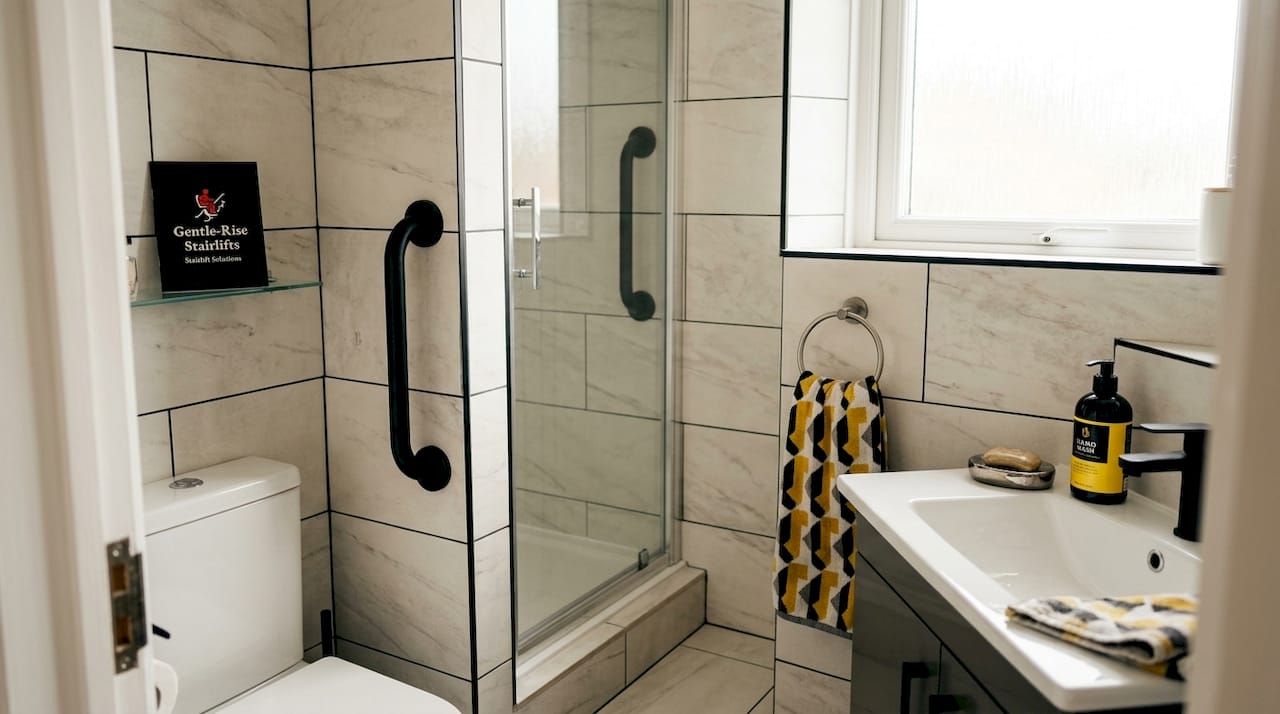
This is the single highest-impact, lowest-cost change available to most homeowners. Grab bars and improved lighting under £500 can significantly improve safety and accessibility before any major renovation begins. Modern grab bars come in chrome, brushed steel, and even wooden finishes, so they need not look clinical. Fit them beside the toilet, inside the shower, and at the bathroom entrance.
2. Swap round door knobs for lever handles
Round knobs require grip strength that many people with arthritis, Parkinson's disease, or post-surgery fatigue simply do not have. Lever handles require only a gentle downward push. A full set for a standard three-bedroom house typically costs under £150 in parts, and fitting is straightforward for any competent handyperson.
3. Improve lighting throughout the home
Poor lighting is an underrated hazard. Motion-activated night lights costing £10 to £30 are highly effective at preventing nighttime falls on landings and in corridors. Pair them with brighter bulbs in kitchens and bathrooms where tasks require clear visibility. This is one of the simplest ways to enhance accessibility without touching a single structural element.
4. Replace or secure flooring to reduce trip hazards
Loose rugs, uneven thresholds, and worn carpet edges cause thousands of falls every year in UK homes. Removing rugs entirely, or replacing them with non-slip alternatives, costs very little. Threshold strips between rooms can be fitted in minutes and eliminate a common stumbling point for anyone using a walking frame or wheelchair.
5. Install a stairlift for safe stair access
For anyone who struggles with stairs, a stairlift is often the single most transformative modification available. Straight stairlift costs are considerably lower than curved models, which require custom-built rails to follow the geometry of the staircase. If your staircase has a bend or half-landing, it is worth asking whether minor layout adjustments could allow a straight model to be fitted instead, which can reduce costs substantially.
Gentlerise Stairlifts offers straight and curved stairlift options with prices starting at £795, and installations are often completed within hours. For people recovering from surgery or needing only short-term support, rental schemes are also available.
Pro Tip: Getting three or more quotes from reputable dealers can produce a 20 to 40 per cent price variation for stairlift installations, making comparison shopping one of the most effective cost-reduction strategies available.
6. Convert a bath to a walk-in or curbless shower
A standard bath is one of the most dangerous features in any home for a person with limited mobility. Walk-in showers with a flat, curbless entry remove the step-over risk entirely. Curbless shower conversions vary in cost depending on the size and finish, but they reliably improve both safety and daily independence. Add a fold-down shower seat and a handheld showerhead for maximum benefit.
7. Widen doorways for wheelchair and frame access
Standard UK doorways are often too narrow for a wheelchair or wide walking frame. A full door-widening project involves structural work and is not cheap, but there is a clever, low-cost alternative. Offset door hinges can add approximately two inches of clearance to an existing doorway without any construction at all. At around £20 to £40 per door, this is one of the most overlooked creative accessibility solutions available.
8. Raise toilet height with a comfort-height seat
A standard toilet pan sits too low for many older adults or those with hip or knee problems, making sitting and standing genuinely difficult and risky. Comfort-height toilet seats or raised seat adapters cost between £25 and £150 and require no plumbing work. Paired with a nearby grab bar, this modification can restore meaningful independence in the bathroom.
9. Adapt the kitchen for safer, easier use
The kitchen often receives far less attention than the bathroom in accessibility planning, but it deserves equal focus. Pull-out shelves and lazy Susans in lower cabinets reduce the need to reach deep into awkward spaces. Accessible kitchen doors with D-ring handles are easier to grip than recessed finger pulls. Lowering one section of worktop to a seated height makes food preparation possible for wheelchair users without a full kitchen redesign.
10. Use smart home technology to support independence
Voice-activated devices, smart lighting controlled by app or voice, and video doorbells that can be answered remotely are all now available at consumer prices. A smart plug and a voice assistant can allow someone with limited mobility to control heating, lighting, and even door locks without moving across the room. These tools function as inclusive design ideas that layer over existing home infrastructure without requiring any building work at all.
Comparing the most popular options side by side
| Modification | Typical cost | Installation time | Impact level | Funding available? |
|---|---|---|---|---|
| Grab bars | £15 to £150 | Under 1 hour | High | Sometimes |
| Lever door handles | £20 to £150 | Under 2 hours | Medium | Rarely |
| Motion-sensor lighting | £10 to £80 | Under 1 hour | High | Rarely |
| Offset door hinges | £20 to £80 | Under 2 hours | Medium | Rarely |
| Comfort-height toilet seat | £25 to £150 | Under 1 hour | High | Sometimes |
| Walk-in shower conversion | £1,500 to £5,000+ | 2 to 5 days | Very high | Often |
| Straight stairlift | From £795 | Hours | Very high | Often |
| Curved stairlift | £3,000 to £10,000+ | 1 to 2 days | Very high | Often |
| Vertical platform lift | £5,000 to £15,000+ | Several days | High | Sometimes |
Financial barriers and administrative complexity are among the most cited reasons that people delay larger modifications like platform lifts, despite the clear benefits. If funding feels like the obstacle, speak to your local council's housing adaptations team before ruling anything out.
Budget-friendly and creative accessibility solutions you may have missed
Most lists of ways to enhance accessibility focus on the big, expensive items. But some of the most effective changes cost almost nothing and get overlooked entirely.
- Renting a stairlift instead of buying outright makes strong financial sense for post-surgery recovery or short-term needs. Gentlerise Stairlifts offers rental options precisely for this reason, and it avoids committing thousands of pounds to a modification you may not need permanently.
- Reconditioned stairlifts are another underused route. A professionally refurbished model from a reputable supplier costs significantly less than a new unit and carries the same safety certifications.
- Doorbell cameras and smart locks can allow a housebound resident to manage visitors without reaching the front door, which matters enormously for people with severe mobility limitations.
- Contrasting colours on stair nosings cost only the price of a tin of paint or adhesive strips, yet they dramatically improve stair visibility for people with low vision.
- Incorporating changes into routine maintenance is the most cost-effective long-term accessibility enhancement strategy. When carpets need replacing, choose non-slip. When taps need renewing, choose lever style. Accessibility built into early planning consistently costs less than retrofitting later.
Pro Tip: Before starting any modification, photograph and measure every doorway, corridor, and staircase in the home. Having those measurements to hand means you can get accurate quotes quickly and avoid paying for a site survey you do not need.
My honest take on home accessibility planning
I have spoken with enough homeowners and caregivers to know that the most common mistake is not the one you would expect. People do not usually make terrible decisions. They just make them too late.
The families who get this right treat accessibility as something they plan for, not something that happens to them. They make one or two small changes a year, folding them into routine maintenance rather than scrambling after a fall or a diagnosis. Early identification of accessibility needs consistently reduces long-term costs and produces better outcomes.
What I find genuinely underappreciated is the psychological dimension. When someone regains the ability to climb their own stairs safely, or to shower without needing help, the confidence that returns is not trivial. It shapes everything from their social life to their mental health. Accessible design does not just solve a practical problem. It gives people their home back.
My honest advice: do not wait for a crisis to make the list feel urgent. Pick one modification from this article, price it up this week, and take one step. The momentum builds from there.
— lee
How Gentlerise Stairlifts can help you move forward
If stairs are the main barrier in your home, Gentlerise Stairlifts offers one of the most straightforward routes to safe, independent stair access in the UK. With stairlift costs starting at £795 for straight models, and a range covering reconditioned, curved, and rental options, there is a solution for most budgets and most staircases. Installations are typically completed within hours, and the Protect+ aftercare programme means your lift stays in safe working order long after fitting. You can explore your options and book a free home survey with no obligation. Getting the right advice early costs you nothing and could save you thousands.
FAQ
What are the cheapest accessibility improvements for a home?
Grab bars, lever door handles, motion-sensor night lights, and comfort-height toilet seat adapters all cost under £150 and can be fitted in a matter of hours. These low-cost changes deliver high safety impact before any structural work is needed.
How much does a stairlift cost in the UK?
Straight stairlifts from Gentlerise Stairlifts start at £795, while curved models vary depending on the staircase geometry and can cost considerably more. Getting multiple quotes and considering reconditioned models are the most effective ways to reduce the price.
Can I get funding for home accessibility modifications?
Yes. The Disabled Facilities Grant in England and Wales can contribute up to £30,000 toward qualifying adaptations, and local councils may offer additional support. Speak to your council's housing team or an occupational therapist to find out what you are eligible for.
What is the difference between a straight and curved stairlift?
A straight stairlift runs on a single, unbending rail and is far less expensive to produce and install. A curved stairlift uses a custom-built rail to follow bends or half-landings in the staircase, which increases both cost and lead time significantly.
Is renting a stairlift a good option?
Renting makes strong practical sense for short-term needs such as post-surgery recovery, or when you are unsure whether a permanent installation is the right choice. It avoids a large upfront cost and gives you flexibility without compromising on safety or function.