
TL;DR:
- Risk-free stairlift trials offer the opportunity to assess whether a stairlift suits your home, body, and routine before making a long-term commitment.
- They include short-term rentals, money-back guarantees, and grant-funded options, each with different conditions and suitability periods.
Choosing a stairlift is a significant decision, and the phrase "risk-free stairlift trial" gets used freely by suppliers without always meaning the same thing. Understanding why risk-free stairlift trials exist, and what they genuinely offer, can save you from a costly mismatch or a purchase you later regret. These trials are not simply a marketing gesture. They give you the chance to assess whether a stairlift genuinely works for your home, your body, and your daily routine before any long-term commitment is made.
Table of Contents
- Key takeaways
- Types of risk-free stairlift trials in the UK
- How to evaluate a stairlift during your trial
- Financial and practical benefits of trials versus buying outright
- Spotting marketing traps in "risk-free" offers
- How to prepare for and maximise your trial
- My take: trials are not optional extras
- Try Gentlerisestairlift's free home assessment
- FAQ
Key takeaways
| Point | Details |
|---|---|
| Trials come in several forms | Short-term rentals, money-back guarantees, and grant-funded options each work differently and carry different conditions. |
| In-home testing is irreplaceable | Showroom rides cannot replicate your staircase, your habits, or your physical needs at home. |
| "Free" rarely means unconditional | Disabled Facilities Grants depend on means testing and occupational therapist assessments, not just need. |
| Curved stairlift decisions carry more risk | Custom rail fabrication takes weeks, making early trial evaluation of straight versus curved usability especially worthwhile. |
| Rentals protect against end-of-life costs | Monthly rental removes the burden of reselling or disposing of a stairlift when it is no longer needed. |
Types of risk-free stairlift trials in the UK
The term "risk-free" covers several quite different arrangements, and knowing which one you are being offered matters enormously.
Short-term rental trials are the most genuinely flexible option. These suit people recovering from a stroke, hip operation, or other surgery where reduced mobility is temporary. Post-surgery stairlift rentals let you use a lift safely during recovery without committing to ownership. A straight stairlift can typically be installed in two to four hours, and the monthly fee usually covers the lift itself, servicing, and removal when the rental ends. There is no residual asset to deal with. That alone removes a considerable amount of stress.
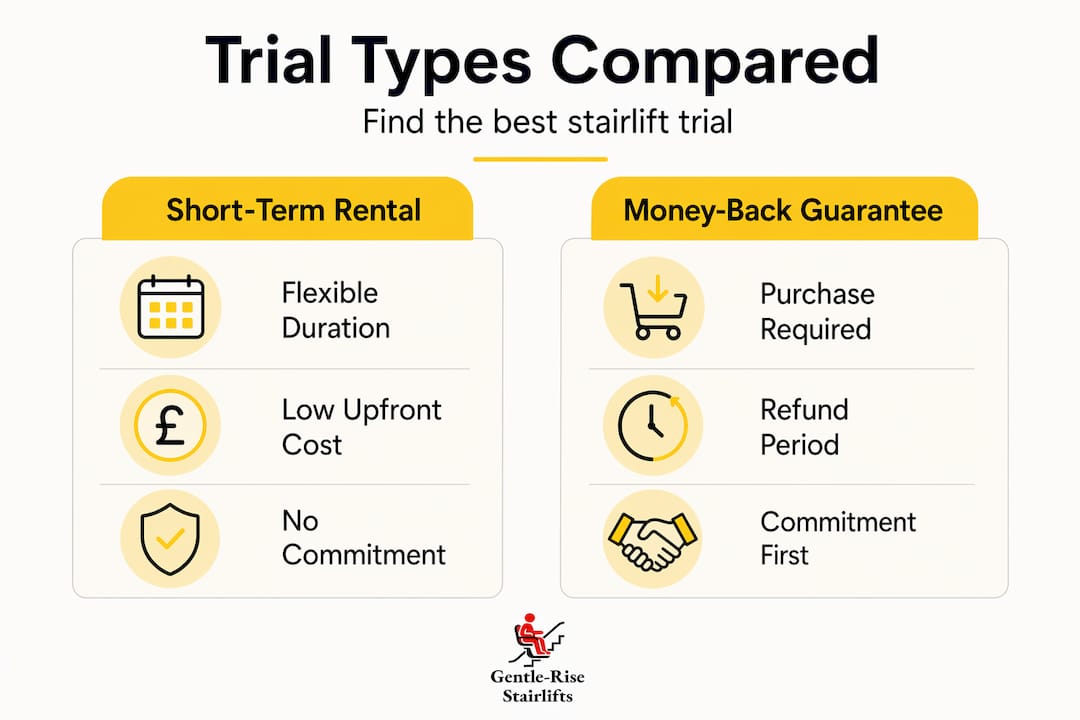
Money-back guarantee offers work differently. You purchase or deposit, the lift is installed, and you have a defined window to request a refund or exchange if it does not suit. The conditions vary significantly between suppliers. Some cover full removal costs; others do not. Read the small print carefully before agreeing to anything.
Grant-funded "free" stairlifts are the category most often misunderstood. There is no universal entitlement to a free stairlift in the UK. Disabled Facilities Grants are means-tested, considering your income and savings, and approval depends on an occupational therapist confirming the adaptation is both necessary and appropriate. "Free" in this context means the grant covers costs after eligibility is confirmed. It is not a promotional offer.
Straight versus curved stairlift trials carry different practical implications. Curved stairlifts require custom rail fabrication taking four to eight weeks, compared to one to two weeks for straight models. Committing to a curved lift without testing whether a straight configuration might meet your needs first is a risk worth avoiding.
| Trial type | Typical conditions | Best suited for |
|---|---|---|
| Short-term rental | Monthly fee, servicing and removal included | Temporary mobility needs or post-surgery recovery |
| Money-back guarantee | Set return window, conditions vary by supplier | Those uncertain about long-term suitability |
| Disabled Facilities Grant | Means-tested, OT assessment required | Permanent mobility needs, eligible households |
| Showroom test ride | No commitment, limited real-home replication | Initial product familiarity only |
Pro Tip: Before agreeing to any trial, ask your supplier directly: what type of arrangement is this, what are the return or cancellation conditions, and what costs remain if you decide the stairlift is not right for you?
How to evaluate a stairlift during your trial
The primary risk in buying a stairlift is choosing one that does not feel right in practice. Trials reduce this risk by letting you assess real-life use rather than relying on a brochure or a showroom demonstration. Your staircase, your posture, and your daily habits are unique. A trial at home is the only meaningful test.
Here is a practical checklist for evaluating a stairlift during your trial period:
- Seating comfort over time. Sit in the chair for longer than a single ride. Does the seat support your back and hips? Does any discomfort build over repeated journeys?
- Controls and accessibility. Can you reach and operate the controls easily from both the seat and the landing? Are the buttons or joystick intuitive under realistic conditions?
- Start and stop smoothness. The lift should accelerate and decelerate gently. A jerky start can feel alarming and may indicate a settings issue or a poor fit for your needs.
- Noise levels. Listen carefully on both ascent and descent. Some noise is normal, but grinding or rattling sounds warrant investigation before the trial ends.
- Safety belt fitting. The belt should fasten and release easily and hold you securely without causing discomfort or restricting movement.
- Boarding and disembarking clearance. Check whether you have enough space to step on and off at both ends of the rail without having to manoeuvre awkwardly. This is especially relevant in homes with tight landings or angled walls.
- Caregiver interaction. If a family member or carer assists you, have them participate in several trial runs. Their workflow matters too.
- How you feel after several days, not just the first ride. Initial unfamiliarity can make any new device feel slightly strange. Give yourself a minimum of three to four days before drawing conclusions.
Pro Tip: Ask your installer to schedule a follow-up visit partway through the trial. Adjustments to fitting and technique during this visit can transform what initially feels uncomfortable into something that works well. Do not dismiss a stairlift based on early impressions alone.
Financial and practical benefits of trials versus buying outright
The financial case for trialling before buying is straightforward, but the practical benefits often go unrecognised.
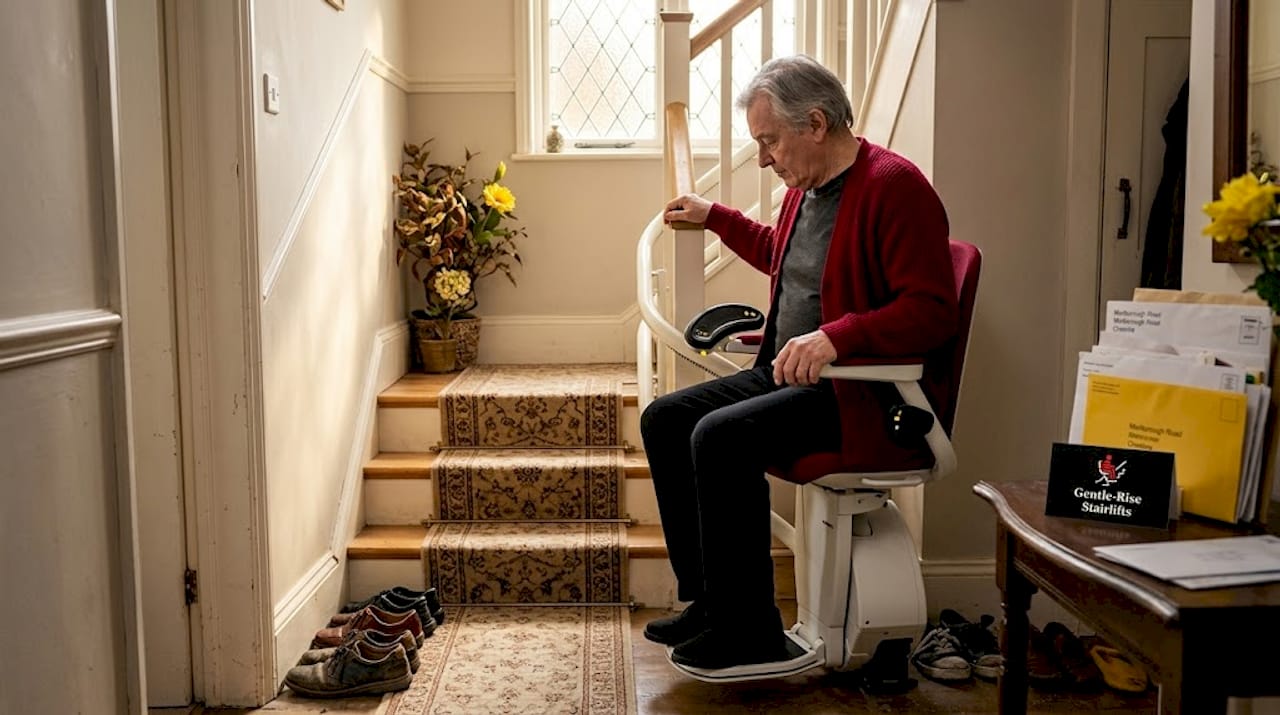
Renting a stairlift for under 12 months is almost always cheaper than purchasing, and it removes end-of-life responsibilities entirely. When a rented lift is no longer needed, the supplier collects it. You do not face the task of finding a buyer, arranging removal, or disposing of a piece of specialist equipment that has limited resale value.
For longer-term needs, a trial period helps you avoid the most expensive mistake: buying the wrong configuration. Testing straight versus curved stairlift usability early means you avoid the commitment of a custom rail fabrication process that is difficult and costly to reverse.
Consider these practical advantages:
- Avoiding product mismatch costs. A stairlift that is unsuitable for your home or body leads to either costly adaptation or full replacement. A trial catches this before money is spent.
- Testing caregiver workload. Trials reveal whether the lift genuinely reduces carer burden or creates new complications, such as a swivel seat that proves difficult for an older spouse to assist with.
- Clarifying your long-term needs. Some people discover during a post-surgery rental that their mobility improves enough to manage without a permanent lift. Others confirm the opposite. Either outcome is valuable information before a purchase decision.
- Reducing upfront financial exposure. A short-term rental guide highlights how rental keeps upfront costs predictable while the situation becomes clearer.
The end-of-life considerations for stairlifts are genuinely overlooked by most buyers. A trial period that functions as a rental period protects you from those future administrative and financial burdens in ways that a purchase, however well-chosen, cannot.
Spotting marketing traps in "risk-free" offers
Some stairlift offers use the language of risk-free and free without the substance behind it. Being aware of common patterns helps you ask the right questions.
"Marketing claims of 'risk-free' or 'free' stairlifts can obscure actual conditions like assessments and means tests. Consumers should treat offers cautiously until verified."
Here is what to watch for:
- Vague return windows. An offer described as "risk-free" should specify exactly how long you have to return the lift, and under what conditions. "Satisfaction guaranteed" without a timeframe is not a guarantee.
- Hidden assessment requirements. Some "free stairlift" promotions are actually referrals into the Disabled Facilities Grant system. There is nothing wrong with that, but means testing and OT assessments determine eligibility. You may not qualify, and the process takes time.
- Regional variation in grant availability. Local authority funding for grants varies across England, Wales, Scotland, and Northern Ireland. What a neighbour received in one area may not be available in yours.
- Curved stairlift commitments buried in trial terms. A "trial" for a curved lift that begins the custom fabrication process is not the same as a trial for a straight model that can be removed the next day. Confirm this distinction explicitly.
Ask suppliers directly: who pays for removal if the trial does not work out, what happens to the deposit, and whether installation costs are separate from trial costs.
How to prepare for and maximise your trial
A stairlift trial works best when you treat it as a structured evaluation rather than a passive experience. Use the time well by following these steps:
- Schedule a home assessment before the trial begins. A practical home visit allows the installer to recommend the right configuration and spot any staircase features that affect suitability.
- Keep a simple daily log. Note comfort levels, any difficulties with controls, and observations from caregivers or family members after each day of use.
- Use the lift at different times of day. Morning stiffness, post-activity fatigue, and evening tiredness each present different physical demands. Test the lift under all of them.
- Ask specific questions about aftercare before the trial starts. What is included in the supplier's support during the trial? Can an engineer visit if you have concerns? What is the process at the end of the trial period?
- Decide in advance what "not working" means to you. Set your own criteria: comfort, ease of use, noise tolerance, clearance. Having defined expectations makes the final decision cleaner and less emotionally difficult.
Pro Tip: Confirm the post-trial return or purchase process in writing before installation begins. Knowing exactly what happens next removes pressure during the trial itself, letting you focus on honest evaluation.
My take: trials are not optional extras
I've spoken with a great many people who approached a stairlift trial as something they had to go through before buying rather than something genuinely worth taking seriously. That framing consistently leads to poor outcomes.
What I've learned from observing how stairlift decisions actually unfold is this: the trial is often the single most important step in the whole process. Not because people have bad taste in chairs, but because a stairlift has to work in a specific body, on a specific staircase, with a specific daily routine. Specifications tell you almost nothing useful about that fit.
The uncomfortable truth about curved stairlifts in particular is that once fabrication begins, you are committed in a way that is genuinely difficult to reverse. I've seen buyers realise mid-process that they could have managed perfectly well with a straight model at a fraction of the cost, and by then the decision was already made. A well-structured trial evaluates that question before it becomes expensive.
My genuine advice is to approach any risk-free stairlift trial as a working evaluation with a checklist, a log, and a follow-up visit built in. It is not a formality. It is how you make a decision you will not regret.
— lee
Try Gentlerisestairlift's free home assessment
If you are ready to explore a stairlift trial that is structured to give you genuine confidence before committing, Gentlerisestairlift offers free home assessments for both straight and curved stairlift options across the UK. Their team helps you identify the right configuration, explains exactly how the trial or rental arrangement works, and supports you through the process with no pressure and no surprises.

Gentlerisestairlift's stairlift pricing guide gives you honest cost expectations before you speak to anyone. For those assessing products before purchase, their reliability comparison resource helps you focus your trial on the factors that matter most. Contact Gentlerisestairlift today to schedule your free home survey and arrange a trial that is genuinely risk-free in every sense of the word.
FAQ
What are risk-free stairlift trials?
Risk-free stairlift trials are arrangements where you can use a stairlift in your home before committing to a permanent purchase. They typically take the form of short-term rentals with servicing and removal included, or money-back guarantee periods with defined return conditions.
How long does a stairlift trial typically last?
Trial and rental periods vary by supplier and arrangement, but in-home mobility trials of around seven days are common in the industry. Short-term rentals often run month to month, making them well suited to post-surgery recovery periods.
Are free stairlifts genuinely available in the UK?
There is no universal entitlement to a free stairlift. Disabled Facilities Grants can cover full or partial costs, but eligibility depends on means testing and an occupational therapist's assessment of your specific needs and circumstances.
Is it worth trialling a stairlift before buying?
Yes. The primary risk in buying a stairlift is choosing one that does not fit your home, your body, or your routine. A trial lets you assess real-world comfort, ease of use, and caregiver interaction before any long-term financial commitment.
What questions should I ask before a stairlift trial?
Ask who covers removal costs if the trial does not work out, whether installation costs are separate, what support is available during the trial period, and what the process is for purchasing or returning the lift at the end.