
TL;DR:
- Choosing the right mobility aid depends on your recovery stage, home layout, and physical needs, and correct fitting is essential for safety.
- Affordable options, environmental modifications, and professional assessments can optimize recovery and independence.
Choosing the right equipment after surgery or during a mobility setback is harder than it sounds. The options are many, the terminology is confusing, and the stakes are high. Get it wrong and you risk falls, discomfort, or a slower recovery. Get it right and you regain independence faster than you thought possible. This recovery-focused mobility equipment list cuts through the noise and gives you a practical framework for selecting the aids that actually match your needs, your home, and your budget.
Table of Contents
- Key takeaways
- What makes a good recovery-focused mobility equipment list
- 1. Canes
- 2. Crutches
- 3. Walkers
- 4. Wheelchairs
- 5. Mobility scooters
- 6. Pressure-relief cushions
- 7. Bathroom transfer aids
- 8. Stairlifts and home access modifications
- Side-by-side comparison: choosing the right device
- My take on what people get wrong with mobility equipment
- Make your home safer with Gentlerisestairlift
- FAQ
Key takeaways
| Point | Details |
|---|---|
| Fit determines safety | Incorrectly sized aids increase fall risk; always verify handle height and ergonomic fit before use. |
| Match device to recovery stage | Early post-surgery needs differ from later functional recovery; choose aids accordingly. |
| Accessories matter as much as devices | Bathroom aids, cushions, and home modifications are part of any complete rehabilitation equipment list. |
| Affordability is achievable | Funding schemes and secondhand options make quality assistive devices for recovery accessible on most budgets. |
| Stairs are a separate challenge | Standard mobility aids do not solve stair access; a stairlift may be the safest long-term solution. |
What makes a good recovery-focused mobility equipment list
Before you look at a single product, you need a framework. The right aid is not the most expensive one, or the one your neighbour used. It is the one that matches your specific recovery stage, home layout, and physical capability.
Here is what to assess before you buy or borrow anything:
- Safety and stability. The device must handle your weight and support your balance at your current level of function. An aid that feels secure builds confidence; one that wobbles does the opposite.
- Fit and adjustability. Sizing is not optional. Proper walker handle height should place your elbow at a 15 to 30 degree bend when gripping. Too high and you hunch; too low and you strain your wrists and shoulders.
- Functional suitability. A cane suits minor instability. Crutches suit non-weight-bearing recovery. A wheelchair suits someone who cannot walk at all. Match the device to where you are now, not where you hope to be in six weeks.
- Affordability and access. Funding pathways exist for mobility equipment and home improvements; check your eligibility before paying retail price for everything.
- Ease of use. If a device is too complicated or physically demanding to operate independently, it creates a barrier rather than solving one.
Pro Tip: Ask your physiotherapist or occupational therapist to formally assess you before purchasing. Mobility aids for recovery must be individually prescribed and fitted to maximise safety; there is no universal default.
1. Canes
Canes are the lightest, most portable entry on any rehabilitation equipment list. They suit people with mild balance issues or minor leg weakness who still bear most of their own weight.
The critical rule most people get wrong: hold the cane on the side opposite the injured leg. Using a cane on the uninjured side shifts your weight away from the weaker limb and genuinely improves stability. Single-point canes work on most surfaces. Quad canes, with their four-point base, offer more stability than a single point but less than a walker. They suit those with moderate balance concerns who are not ready to graduate fully.
2. Crutches
Crutches are your go-to when you cannot put weight through one leg at all. They come in two main types.
Axillary (underarm) crutches are standard for short-term injuries like ankle fractures. Forearm (elbow) crutches are better for longer recoveries because they distribute load more evenly and are easier to manage over time. One safety point nobody tells you clearly enough: crutches must never press into your armpits during use because sustained pressure there can damage the radial nerve, causing temporary arm weakness. The hands bear the weight, not the axilla.
3. Walkers
Walkers provide maximum stability and suit early post-surgical recovery well. There are three main types worth knowing.
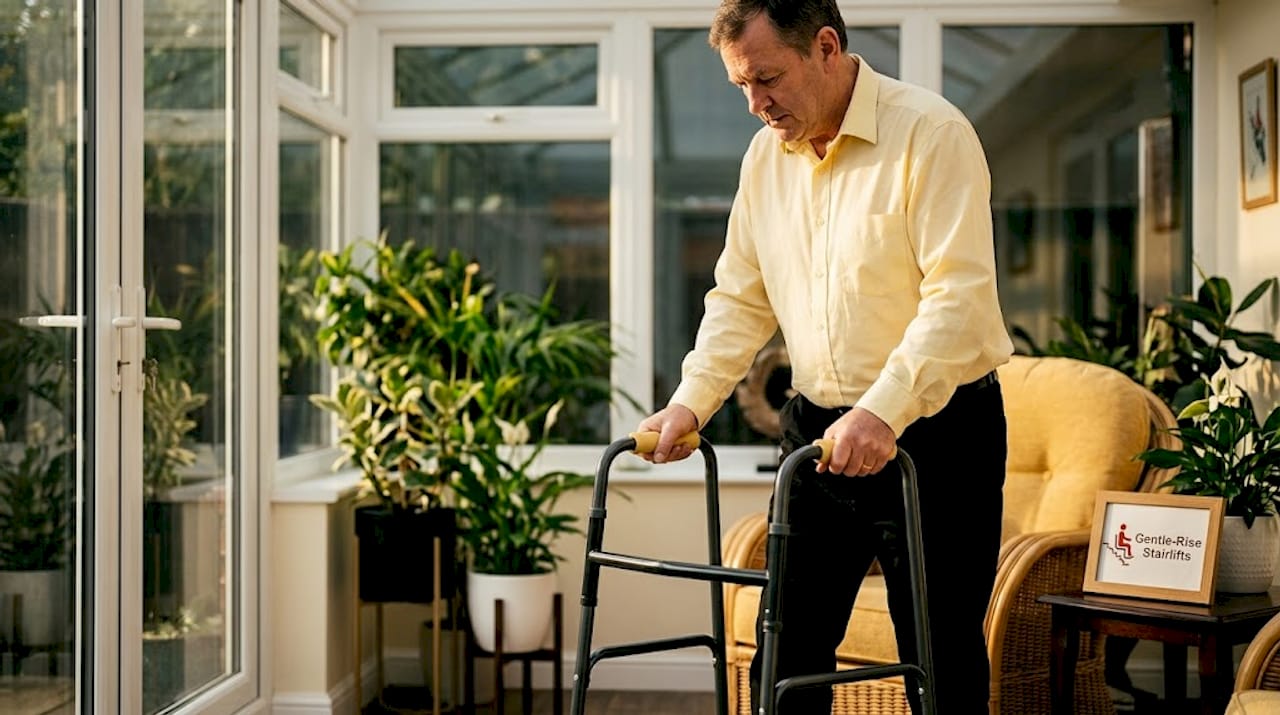
Standard walkers have no wheels, which makes them stable but slow. You lift and place them with every step. Two-wheeled walkers glide more easily on smooth floors, which suits people who find lifting difficult. Rollators are the most popular choice for those who are mobile but tire quickly. Rollators have four wheels, brakes, and a built-in seat so you can pause and rest without looking for a chair. Always lock the brakes before sitting down on a rollator. It is a small step that prevents a serious fall.
Pro Tip: To verify your walker handle height quickly, stand inside the frame, let your arms hang naturally, then grip the handles. Your elbow should flex by roughly 15 to 30 degrees. If it does not, adjust before you take a single step.
4. Wheelchairs
Wheelchairs belong on any complete assistive devices for recovery list because they cover situations where walking simply is not possible. Manual self-propelling chairs give users control and preserve upper body strength. Assistant-propelled chairs are lighter and easier for carers to manoeuvre but offer less independence to the user. Wheelchair models vary significantly in their stability and propulsion design, so the selection should reflect both the user's ability and the carer's role.
Powered wheelchairs are an option where upper body strength is compromised, though they require a wider turning radius and more space at home.
5. Mobility scooters
Mobility scooters fill a specific gap: longer distances outdoors for people who can stand and transfer independently but cannot walk far. They are battery-powered, straightforward to operate, and available in three or four-wheel configurations for different terrain and turning needs.
Scooters are not a substitute for a walker or wheelchair in acute post-surgical recovery. They are better suited to later-stage recovery or ongoing mobility management, particularly for getting to appointments or shops without fatigue.
6. Pressure-relief cushions
This is the item most people leave off their list until it is too late. If you are spending long periods seated during recovery, pressure injury is a real risk, not a theoretical one.
Alternating-pressure wheelchair cushions work by cycling air through internal cells automatically, redistributing pressure across the seated surface. Some models run for up to ten hours on battery power, which makes them practical for home use without needing to be near a socket. These are medical devices used in hospitals and rehabilitation centres precisely because they work. If your clinician has not mentioned one and you are spending most of the day seated, ask specifically.
7. Bathroom transfer aids
The bathroom is where most home falls happen during recovery. The three most useful items here are a raised toilet seat, grab bars, and a non-slip mat. Used together, they form a layered safety system rather than independent fixes.
Raised toilet seats add between 2 and 5 inches of height to a standard toilet. Post-hip replacement protocols specifically target a seat height that keeps hip flexion below 90 degrees during transfers, which protects the joint. Grab bars fitted beside the toilet and in the shower give you something solid to push from and hold onto. A non-slip mat completes the setup by eliminating the most common trigger for bathroom falls.
8. Stairlifts and home access modifications
Standard mobility aids solve movement on flat surfaces. They do not solve stairs. For anyone recovering from hip or knee surgery, or managing a long-term mobility condition, stairs are often the single biggest barrier to safe independence at home.
Home modifications like ramps, grab rails, and stairlifts change the risk profile of a home entirely. A stairlift removes the physical effort and fall risk of climbing stairs without requiring any structural work to the property. Rental options are available for temporary recovery needs, which means you do not have to commit to a permanent installation if your need is short-term.
Side-by-side comparison: choosing the right device
| Device | Best for | Stability level | Approximate cost (UK) | Recovery stage |
|---|---|---|---|---|
| Single-point cane | Mild balance issues | Low | £10 to £40 | Later recovery |
| Quad cane | Moderate instability | Medium | £25 to £70 | Mid recovery |
| Axillary crutches | Short-term non-weight-bearing | Medium | £20 to £60 | Acute post-op |
| Forearm crutches | Longer-term non-weight-bearing | Medium | £30 to £90 | Acute to mid |
| Standard walker | Maximum stability, slow pace | High | £30 to £80 | Early post-op |
| Rollator | Stability with rest capability | High | £60 to £200 | Early to mid |
| Manual wheelchair | Non-ambulatory or fatigue | Very high | £150 to £600 | Any stage |
| Mobility scooter | Outdoor longer distances | High (seated) | £400 to £2,000 | Later recovery |
| Stairlift | Stair access at home | Very high | From £795 | Any stage |
Low-complexity, functional devices like walkers and canes are generally the most affordable entries on any rehabilitation equipment list and suit the majority of home recovery scenarios well.
My take on what people get wrong with mobility equipment
I have spoken with a lot of people who have been through surgery and the same patterns come up again and again. Most people underestimate how much the fit of a device matters compared to the type of device. Someone using a correctly fitted walker will recover more confidently than someone using a poorly adjusted forearm crutch, even if the crutch is technically the "better" device for their diagnosis.
The elbow-angle rule for walkers is something physiotherapists mention, but rarely demonstrate. I have seen people using walkers adjusted six inches too high because nobody showed them how to check. That single error changes your posture, increases back pain, and adds fatigue to every step you take.
My other strong view is on cost. People assume quality mobility support costs a lot. It often does not. Secondhand walkers and wheelchairs in good condition are widely available. The mobility aids for recovery that require real investment are the home modifications. A stairlift, grab bars fitted properly, a ramp. These change your environment rather than just your movement, and they last far longer than a post-surgical walking aid you will use for three months.
If you are putting together your own list, start with what you cannot do safely right now, not with what you might need later. Solve the immediate problem first, build outward from there.
— lee
Make your home safer with Gentlerisestairlift
If you are setting up for recovery at home, your staircase deserves its own plan. All the walkers and grab bars in the world do not make stairs safe for someone in early post-surgical recovery.

Gentlerisestairlift specialises in stairlift installation across the UK, with straight models starting from £795 and rental options available for temporary needs. Installation typically takes just a few hours, and the team offers free home surveys to help you find the right fit. If you want to understand stairlift costs in the UK before committing to anything, that information is clear and straightforward on the website. For anyone managing stairs during recovery, it is worth a conversation.
FAQ
What is recovery mobility equipment?
Recovery mobility equipment refers to assistive devices for recovery such as canes, crutches, walkers, wheelchairs, and bathroom aids that help individuals move safely following surgery or injury. It also includes home modifications like stairlifts and grab rails.
How do I know which mobility aid is right for my recovery?
Your choice depends on your weight-bearing status, balance, and recovery stage. A physiotherapist or occupational therapist can prescribe the right device and ensure it is correctly fitted to your body.
Can I get mobility equipment funded rather than paying full retail price?
Yes. Assistive technology funding schemes provide eligibility-based pathways for equipment and home modifications. Contact your GP or local council for guidance on what support is available in your area.
How do I fit a walker correctly?
Stand inside the walker frame with your arms hanging naturally at your sides, then grip the handles. Your elbows should be flexed between 15 and 30 degrees. Adjust the leg height until this angle is achieved before walking.
Are stairlifts suitable for short-term post-surgical recovery?
Yes. Rental stairlifts are available for temporary needs, making them a practical option for people recovering from hip, knee, or lower limb surgery who need safe stair access without committing to a permanent installation.