
TL;DR:
- Emergency stairlift support includes 24/7 helplines, urgent repairs, and safety checks for vulnerable users.
- Response times vary widely, so it's essential to confirm provider commitments before choosing.
- A reliable stairlift paired with accredited support ensures safety and peace of mind for users.
When your stairlift stops working, every minute matters. For many elderly users and those recovering from surgery, a malfunctioning stairlift is not simply an inconvenience — it can mean being stranded on the stairs, cut off from essential rooms, or facing a genuine safety risk. What surprises many families is that there is no national repair standard for domestic stairlifts in the UK, meaning response times and service quality vary enormously between providers. This guide explains what stairlift emergency support actually covers, when you are most likely to need it, and how to choose a provider who will genuinely be there when it counts.
Table of Contents
- What stairlift emergency support means
- Typical scenarios needing emergency stairlift support
- What to expect from a stairlift emergency response service
- How to choose the right stairlift emergency support
- The reality behind stairlift emergency support: Our take
- Get peace of mind with reliable stairlift support
- Frequently asked questions
Key Takeaways
| Point | Details |
|---|---|
| Recognise real support | Emergency stairlift support means 24/7 access to help when your equipment fails. |
| Know response times | Service speed varies greatly, so always verify your provider’s emergency processes before signing. |
| Choose wisely | Look for accredited, reputable providers who prioritise reliability over just low prices. |
| Prepare for emergencies | Understand your contract and keep key emergency contacts to hand for complete peace of mind. |
What stairlift emergency support means
Stairlift emergency support is a dedicated service that helps users when their stairlift breaks down or behaves unexpectedly outside of routine servicing. It is quite different from standard customer service. Ordinary customer service handles queries, bookings, and general advice. Emergency support exists for situations where the stairlift has stopped working entirely, is behaving dangerously, or is leaving someone in a vulnerable position.
Most reliable providers offer some combination of the following features as part of their stairlift aftercare and support plans:
- 24/7 telephone helplines staffed by trained advisers who can talk you through basic checks
- Emergency call-out engineers who visit your home when remote guidance is not enough
- Next-day or priority repair scheduling for parts and full fixes
- Loan chairs or temporary solutions in some cases while a repair is arranged
- Regular safety checks to catch problems before they become emergencies
The reason urgent response matters so much is straightforward. For a younger person, stairs are simply inconvenient to avoid. For an elderly individual or someone enhancing home independence after surgery, being unable to use the stairlift can mean being trapped on one floor, missing medications stored upstairs, or being unable to access a bathroom safely. The psychological toll of feeling stranded is real too, and not to be underestimated.
It is also worth being honest about the variation in the market. While no national benchmarks exist for stairlift repairs in domestic settings, reliability is recognised as especially critical for vulnerable users. Some providers advertise emergency support but may not have engineers available at nights or weekends, or may charge significant call-out fees. The term "emergency support" is used loosely across the industry.
Pro Tip: When comparing providers, ask specifically whether their emergency helpline is staffed in-house or outsourced to a call centre. In-house teams who know your stairlift model can often resolve issues faster. For a broader view of what to expect from your equipment, the full stairlift guide is a helpful starting point.
Typical scenarios needing emergency stairlift support
Knowing what situations qualify as genuine emergencies helps you respond calmly and act quickly. Here are the most common urgent scenarios stairlift users and their families face:
- Getting stuck mid-staircase. The stairlift stops between floors, leaving the user unable to move safely up or down. This is among the most distressing situations and requires immediate assistance.
- Complete loss of power. If the mains supply fails or a fuse trips, the stairlift may stop working. Many modern stairlifts run on rechargeable batteries that provide backup, but older models may not.
- Battery failure during a power cut. Even battery-backed chairs can fail if the batteries are old or poorly maintained. During a winter power outage, this can become urgent very quickly.
- Remote control or sensor faults. A faulty sensor may prevent the chair from moving, or the remote may stop responding entirely. These are common faults that can appear without warning.
- Noisy, jerky, or unusually slow operation. Sudden changes in how the stairlift moves are a signal that something mechanical has changed and the lift should not be used until inspected.
- Chair not returning to the base or top station. This can block access to the staircase for other household members and cause logistical problems in a multi-person home.
"For vulnerable users, a swift response to stairlift faults is not a luxury. It is a safety necessity. Reliability is especially critical when a breakdown occurs during a power cut or at night, when reaching alternative support is hardest."
The common thread running through all these situations is time. Delays in getting help can quickly escalate from inconvenience to genuine risk. Exploring affordable mobility solutions that include robust support packages is always worthwhile when planning for long-term home safety.
What to expect from a stairlift emergency response service
Once an emergency occurs, understanding how your provider responds helps you avoid frustration and make better decisions. The honest answer is that response times and service quality vary widely, because there is no regulated standard in the UK for domestic stairlifts.
For reference, data on rail lift repairs in the public transport sector shows an average fix time of 21.7 hours, but no comparable domestic benchmarks exist. This means when choosing a home stairlift provider, you must ask questions rather than rely on assumptions.
| Feature | Strong provider | Average provider | Weak provider |
|---|---|---|---|
| Emergency helpline | 24/7, in-house | Office hours only | No dedicated line |
| Call-out response | Same day or next day | 2 to 5 days | No guarantee |
| Repair costs included | Yes, under contract | Partial cover | Pay per visit |
| Parts availability | Stock held locally | Ordered as needed | No commitment |
| Out-of-hours support | Yes | Limited | No |
When signing up with a provider, ask the following questions before committing:
- What are your guaranteed response times for emergencies?
- Is out-of-hours support included in the price, or charged separately?
- How do you handle faults that require parts to be ordered?
- Do you have local engineers, or do you use a national third-party network?
- What happens if you cannot fix the fault on the first visit?
For further clarity on what you might pay, reviewing typical stairlift costs alongside support plan pricing helps you see the complete picture. A stairlift with a low purchase price but no reliable backup support is rarely the better deal over time. Understanding what makes a reliable stairlift also helps when evaluating any provider's claims.
How to choose the right stairlift emergency support
Choosing the right emergency support package is as important as choosing the stairlift itself. Here is a practical framework to help you decide.
Look for accredited providers first. Which? Trusted/Checkatrade accredited providers are recommended because they are subject to independent review and must meet minimum service standards. This matters because self-certified claims of quality are unverifiable without third-party oversight.
Compare contracts carefully using this checklist:
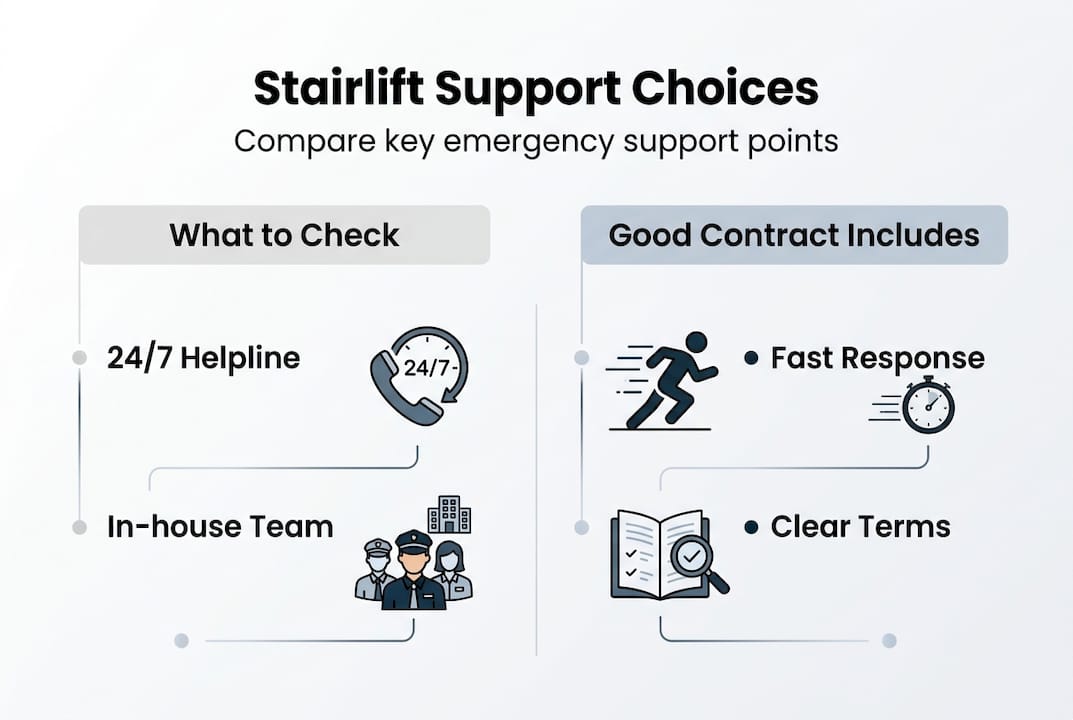
| What to check | What a good contract includes |
|---|---|
| Emergency call-out clause | Defined response window, not just "as soon as possible" |
| Parts and labour cover | Both included, not just one |
| Annual service visits | At least one included per year |
| Cancellation terms | Reasonable notice period, no punitive fees |
| Escalation process | Clear steps if first response fails |
Pro Tip: Do not judge a support plan purely on its annual cost. A plan that is £40 cheaper but takes three days to send an engineer is far more costly in practice, particularly if it means arranging alternative care or accommodation.
For those exploring longer-term value, stairlift subscription services can bundle maintenance, support, and even upgrades into a predictable monthly payment. This is worth comparing against outright purchase with a separate maintenance contract.
If budget is a priority, reconditioned stairlifts can provide dependable performance at a significantly lower upfront cost, but only when supplied by a reputable provider who also backs them with proper emergency cover. Before any installation, ensure the safe installation advice provided by your engineer is followed to the letter. Poor installation is one of the leading causes of early faults.
- Ask for references or online reviews from local customers specifically mentioning emergency support experiences
- Check whether engineer visits are from employed staff or subcontractors
- Confirm the make and model of your stairlift is one the provider regularly services
- Verify that any 24/7 line connects to someone with technical knowledge, not just a message-taking service
The reality behind stairlift emergency support: Our take
After years working in this industry, one thing stands out clearly. Most buyers assume that all providers supply roughly equal emergency cover. They do not. The gap between a genuinely responsive service and one that simply ticks a box on a brochure can be measured in hours of distress for a vulnerable person.
There is also a tendency to focus so heavily on advertised support packages that buyers overlook the most fundamental factor: how reliable is the stairlift itself? The best emergency plan in the world cannot substitute for a well-built, properly installed chair that rarely breaks down in the first place. Support plans exist for emergencies, not to compensate for poor equipment.
What we have found most effective, and what we genuinely recommend, is a combination approach. Choose a reliable stairlift from a reputable manufacturer, pair it with a clearly defined emergency support plan from an accredited provider, and ask locally for real-world experiences before signing anything. Word of mouth in your area is often the most reliable measure of how a provider actually performs when things go wrong.
Get peace of mind with reliable stairlift support
At Gentle Rise Stairlifts, we believe that buying a stairlift should never mean worrying about what happens if it stops working. Our Stairlift Protect+ support plan is designed around the real needs of elderly users and their families, with clear response commitments, qualified local engineers, and transparent pricing from the outset.

Whether you are considering a new installation, a reconditioned model, or simply want to review your existing support arrangement, GentleRise emergency stairlift support is here to help. Our team is available to talk you through your options without any obligation. When it comes to choosing a reliable provider, starting with a no-obligation conversation costs nothing and could make all the difference.
Frequently asked questions
What should I do first if my stairlift breaks down?
Stay calm and make sure you are in a safe position, then call your provider's emergency helpline straight away. Most reputable providers offer a 24/7 line for exactly this situation.
How quickly can stairlift emergency support arrive?
There is no national standard in the UK, so response times vary considerably. Some providers arrive the same day, while others may take over a day, so always confirm your provider's specific commitments before signing up.
Does my stairlift warranty always include emergency call-outs?
Not always. Some warranties cover parts only, while others exclude call-outs entirely or charge a fee. Policy details differ between providers, so read your contract carefully before assuming you are covered.
What credentials should I look for in a reliable stairlift support provider?
Prioritise providers with Which? Trusted or Checkatrade accreditation, and always ask for confirmed emergency response times rather than vague assurances.