
Stair mobility aids cover five main categories: seated or perch stairlifts, platform/wheelchair stairlifts, through-floor homelifts, powered stair-climbers and portable step lifts, and simple home adaptations such as grab rails and improved lighting. If you are unsure which suits your situation, the single most useful first step is to book a professional home survey or an occupational-therapy (OT) assessment. Your local council can arrange a free home assessment and, under NHS guidance on home adaptations, which must fund minor adaptations costing under a thousand pounds, with larger works potentially eligible for a Disabled Facilities Grant.
Here is a quick guide to which category fits which situation:
- Ambulant but unsteady (can walk but lacks confidence on stairs): grab rails, handrail extensions, or a seated stairlift
- Wheelchair user: platform stairlift or through-floor homelift
- Short-term recovery (post-surgery, temporary injury): rental or reconditioned seated stairlift, or a portable step climber with carer assistance
- Narrow or tightly curved stairs: curved stairlift with modular rail, or a through-floor lift if space allows
- Single-step access only: short-rise/step lift or a portable threshold ramp
Key takeaways
The right stair mobility aid depends on your mobility profile, stair configuration, and whether the need is temporary or permanent. A professional survey or OT assessment is the single most important step before committing to any solution.
| Point | Details |
|---|---|
| Start with an OT or home survey | An occupational-therapy assessment identifies the right solution for your specific mobility and staircase. |
| Minor adaptations first | Grab rails and improved lighting cost under £1,000 and are often funded free by your local council. |
| Rental and reconditioned options exist | Short-term recovery or budget-conscious buyers can access stairlifts without full new-purchase costs. |
| Check DFG eligibility for larger works | The Disabled Facilities Grant is the main UK funding route for through-floor lifts and major adaptations. |
| Gentlerise Stairlifts | Offers free home surveys, new and reconditioned stairlifts from £795, rental, and the Protect+ aftercare plan. |
Table of Contents
- What types of stair mobility aids are available?
- How each option works, who it suits, and what to expect
- What safety features and servicing should you expect?
- How much do stair mobility aids cost, and can you get funding?
- How do you choose the right aid and what should you ask providers?
- What can you do if a stairlift isn't immediately possible?
- What Gentlerise Stairlifts offers and why it may suit you
- Why independence should shape your decision, not just cost
- Gentlerise Stairlifts: from free survey to fitted and supported
- Sources
- FAQ
What types of stair mobility aids are available?
Living Made Easy's factsheet on stair equipment groups stair solutions into three broad tiers: minor adaptations, mechanical or assisted aids, and powered lifts. Understanding where each option sits helps you narrow the field before you speak to a supplier or OT.
Minor adaptations are the starting point. Grab rails, handrail extensions, stair-tread nosing strips, and motion-activated lighting cost relatively little, often fall within council minor-adaptations budgets, and can make a meaningful difference for someone who is ambulant but unsteady.
Mechanical and assisted aids include products like the AssiStep, a rail-mounted support handle that moves with you as you climb, giving extra balance without a motorised seat. These suit people who can still walk stairs but need a confidence-building handhold beyond a standard rail.
Powered lifts span the widest range: seated stairlifts (straight and curved), standing or perch lifts, platform stairlifts for wheelchair users, short-rise step lifts, and through-floor homelifts. Each is a permanent or semi-permanent installation, and each carries different space, structural, and cost implications.
Portability matters too. Powered stair-climbers and portable step lifts can be moved between locations or stored away, making them a practical short-term option. Fixed lifts, by contrast, are designed to stay in place. Anyone choosing between these categories should have a professional survey or OT input first, particularly where stairs are narrow, curved, or shared with other household members.
How each option works, who it suits, and what to expect
Seated stairlifts
A motorised seat travels along a rail fixed to the stair treads. The user sits, fastens a seatbelt, and operates the lift via a joystick or remote. Straight stairlifts can typically be installed in a day because the rail attaches to the treads rather than the wall, requiring no structural alterations. Curved models use modular rails shaped to the staircase, which has reduced lead times considerably.
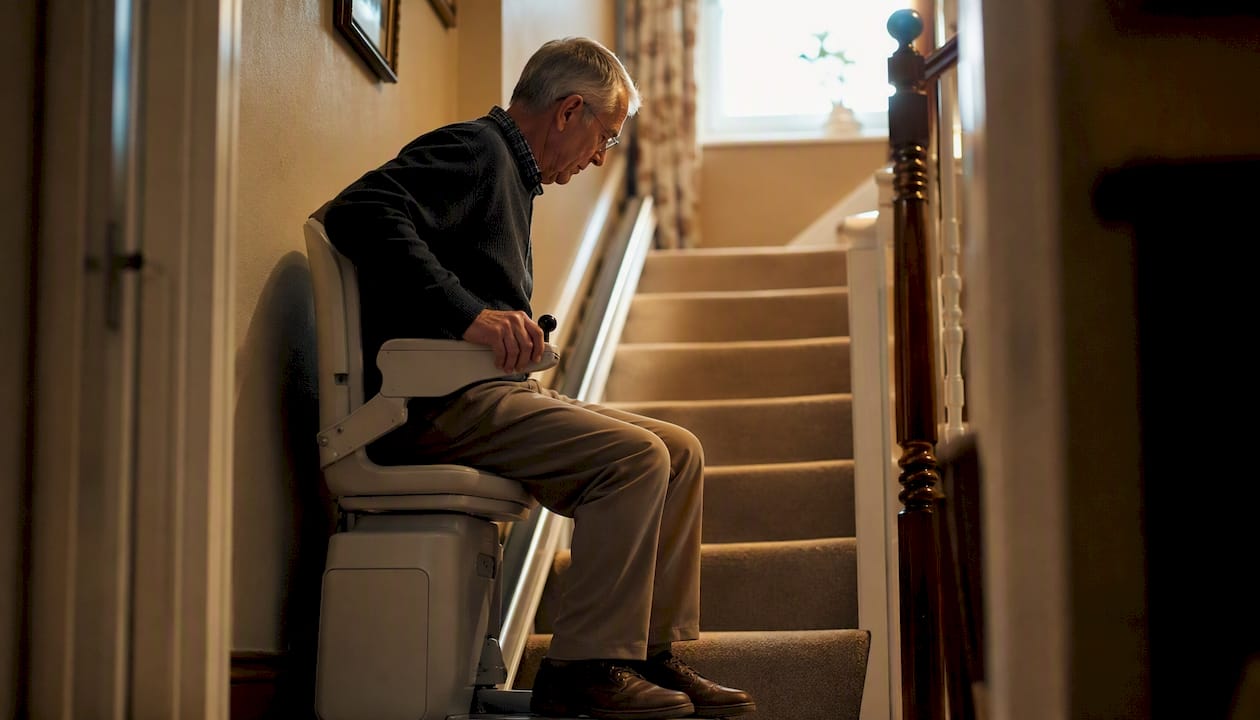
Best for: Anyone who can transfer safely to and from a seat, has sufficient upper-body strength to hold on, and has a staircase wide enough to accommodate the folded seat and rail (usually at least 70 cm clear width).
Pros: Widely available new, reconditioned, and on rental; fast installation; no major building work; suitable for most straight and curved domestic stairs.
Cons: The user must be able to transfer independently or with assistance; not suitable for wheelchair users who cannot transfer; the rail remains on the stairs when folded, reducing usable width slightly.
Standing and perch stairlifts
A smaller, saddle-style seat allows the user to lean rather than sit fully. This suits people who find it difficult to bend their knees deeply, such as those with hip or knee replacements.
Best for: Post-surgical recovery, limited knee or hip flexion.
Cons: Requires reasonable upper-body strength and balance; not suitable for those with significant weakness or balance impairment.
Platform stairlifts
A flat platform carries a wheelchair or mobility scooter up the stairs. The user remains seated in their chair throughout. These require more stair width than a seated lift and typically need a professional structural assessment.
Best for: Wheelchair users who cannot transfer; multi-storey homes where a through-floor lift is not feasible.
Cons: Higher cost than a seated lift; requires wider stairs; more complex installation.
Through-floor homelifts
A compact lift travels vertically through a ceiling opening between floors, requiring a structural opening and a small footprint on each level. No staircase is needed at all.
Best for: Wheelchair users or those with very limited mobility who need a permanent, future-proof solution; homes where stairs are too narrow for any rail-based lift.
Cons: Structural work required; higher cost; longer installation timeline; planning permission may be needed in some cases.
Short-rise and step lifts
A low-platform lift raises the user by a single step or a short height, typically up to around 800 mm. These are common at doorways or for a single external step.
Best for: Single-step access problems, threshold barriers, or external steps at entrances.
Cons: Not a full stair solution; limited to small height changes.
Powered stair-climbers and portable step lifts
Battery-powered devices that a carer operates to move a seated or standing user up stairs. Some models fold flat for storage or transport.
Best for: Short-term recovery; care settings; situations where a fixed installation is not possible or not yet arranged.
Cons: Requires a trained carer to operate; not suitable for independent use; battery life needs monitoring.
Mechanical aids: AssiStep and assisted handrail solutions
The AssiStep is a rail-mounted handle system that moves alongside the user as they walk up or down stairs, providing dynamic support. Unlike a stairlift, the user walks under their own power. It suits people who are ambulant but need more than a static rail.
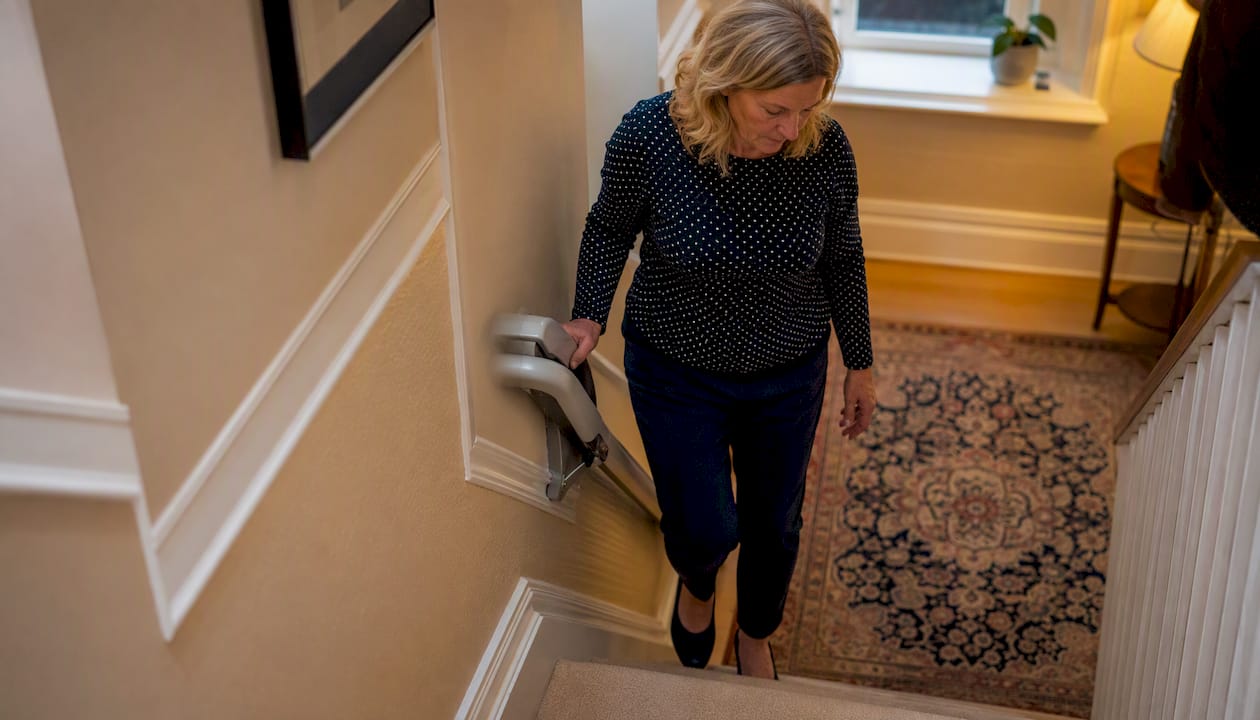
Best for: Those who can still climb stairs but lack confidence or have mild balance issues; narrow stairs where a motorised seat would not fit.
Cons: The user must still be able to walk stairs; not suitable for significant mobility impairment.
Comparison at a glance
| Option | Best for | Installation complexity | Typical cost shape | Portability | Key safety features |
|---|---|---|---|---|---|
| Seated stairlift (straight) | Ambulant, can transfer to seat | Low (rail to treads, one day) | From ~£795 new; reconditioned and rental available | Fixed | Seatbelt, obstruction sensors, battery backup |
| Seated stairlift (curved) | Ambulant, curved/narrow stairs | Moderate (modular rail, one to two days) | Higher than straight; rental available | Fixed | As above |
| Perch/standing stairlift | Limited knee/hip flexion | Low to moderate | Mid-range | Fixed | Seatbelt, sensors |
| Platform stairlift | Wheelchair user, can transfer | Moderate to high | Higher cost | Fixed | Safety edges, interlocks |
| Through-floor homelift | Wheelchair user, no transfer needed | High (structural work) | Highest cost band | Fixed | Door interlocks, emergency lowering |
| Short-rise/step lift | Single-step access | Low | Lower cost | Semi-portable | Safety edges |
| Powered stair-climber | Short-term, carer-assisted | None | Hire or purchase | Fully portable | Carer-operated controls |
| AssiStep / mechanical rail aid | Ambulant, mild balance issues | Low | Lower cost | Fixed rail | Dynamic support handle |
What safety features and servicing should you expect?
Safety is not a bonus feature on a stairlift. It is the baseline. When evaluating any powered stair mobility aid, check for these as standard:
- Obstruction sensors on the rail and footrest that stop the lift if something is in its path
- Seatbelt or harness appropriate to the user's size and transfer ability
- Interlocks that prevent the lift moving unless the seat, armrests, and footrest are in the correct position
- Battery backup so the lift continues to operate during a power cut (most modern seated stairlifts run on rechargeable batteries that charge at the rail ends)
- Ergonomic controls that are easy to operate with limited hand strength, including remote handsets for calling the lift to the correct floor
Servicing matters as much as the initial installation. A well-maintained stairlift should be serviced at least once a year by a qualified engineer. A service visit typically covers drive mechanism checks, rail lubrication, battery condition, sensor testing, and a full safety inspection. Ask any supplier whether their aftercare plan, such as Gentlerise Stairlifts' Protect+ programme, covers call-outs between scheduled visits and what the response time is.
At the point of installation, ask for a certificate of conformity, confirm the warranty period covers both parts and labour, and check that the engineer demonstrates the lift to the user and any carers before leaving.
Pro Tip: If there is any chance the user's mobility will decline further, ask specifically about modular rail systems and seat-swap options. A curved rail that can be extended, or a seat that can be upgraded to a perch or platform model, protects your investment and avoids a full replacement later. Protect+-style care plans that include annual servicing and priority call-outs are worth factoring into the total cost from the start.
How much do stair mobility aids cost, and can you get funding?
Cost varies significantly by solution type, stair configuration, and whether you buy new, reconditioned, or rent.
Reconditioned and rental stairlifts offer a practical route for short-term recovery or for households that want to trial a solution before committing. Rental and reconditioned options make stair access achievable for short-term needs, though a professional survey remains important to confirm the unit is compatible with your specific staircase.
Funding routes worth knowing
Your local council is the first port of call. Under NHS home adaptations guidance, councils must fund minor adaptations costing under a thousand pounds, which covers grab rails, handrail extensions, and some external step work. For larger adaptations, the Disabled Facilities Grant (DFG) is the principal UK government route. DFG eligibility is subject to a local authority assessment and means test, but it can fund significant works including through-floor lifts and major stairlift installations.
To start the process, apply for a needs assessment through social services via your local council. A Home Improvement Agency (HIA) in your area can also help with applications and project management. Gather medical evidence from your GP or consultant before the assessment, as this supports your case for the level of adaptation needed.
Key funding fact: Minor home adaptations, including grab rails, are typically funded free by your local council following a home assessment.
How do you choose the right aid and what should you ask providers?
The decision process works best as a sequence rather than a single leap to a product.
- Establish your mobility profile. Can you walk stairs at all? Can you transfer to a seat? Do you use a wheelchair? Is the need temporary or long-term? Honest answers here narrow the field immediately.
- Book an OT or home assessment. Occupational-therapy assessments evaluate balance, stair safety, and functional ability, and can trial walking equipment before recommending a more substantial adaptation. This step prevents costly mismatches.
- Shortlist suitable categories. Use the taxonomy above to identify one or two realistic options based on your stair configuration, mobility profile, and budget.
- Request a site survey from installers. A reputable supplier will always visit before quoting. The survey confirms rail compatibility, stair width, power supply location, and any structural considerations.
- Compare quotes and aftercare. Price is one factor; aftercare quality, warranty terms, and servicing response times are equally important.
Questions to ask every provider
- Is the home survey free and does it come with a written quote?
- What is the warranty period, and does it cover both parts and labour?
- What does the service plan include, and how quickly do you respond to call-outs?
- Does the lift have battery backup for use during power cuts?
- What is the realistic installation timescale from survey to completion?
- If my mobility changes, can the equipment be adapted or upgraded?
- For reconditioned units: what is the service history, and has it been safety-tested to current standards?
Red flags to watch for
A provider who quotes without visiting your home, offers vague warranty terms, cannot explain their servicing schedule, or applies pressure to sign quickly is worth walking away from. A legitimate installer welcomes your questions and gives you time to decide.
What can you do if a stairlift isn't immediately possible?
Sometimes installation must wait, whether for funding approval, a survey appointment, or a decision still being made. There are practical steps you can take in the meantime to reduce stair risk.
Immediate interim measures:
- Fit grab rails at the top and bottom of the staircase and at any mid-flight landing. Placement matters: correct positioning by an OT makes rails significantly more effective, and poorly sited rails can increase risk at transition points.
- Install motion-activated LED lighting on the staircase so every tread is clearly visible at night.
- Secure any loose carpet or stair treads and remove clutter from landings.
- Keep a spare walking aid at both the top and bottom of the stairs. NHS clinician guidance specifically recommends this for anyone using two sticks or crutches, as carrying both aids while climbing leaves no hand free for the rail.
- Use the clinician-endorsed technique: lead with the stronger leg going up ("up with the good"), and lead with the weaker leg coming down ("down with the bad").
Short-term alternatives:
Portable ramps handle single-step thresholds without any installation. Powered stair-climbers, operated by a carer, can bridge the gap during post-surgical recovery. A rental or reconditioned seated stairlift can be installed quickly and removed when no longer needed, making it a cost-effective option for temporary mobility challenges. For small step lift options including buying, renting, or refurbishing, a specialist can advise on the most practical route.
Pro Tip: If you are weighing a permanent stairlift against moving to single-level living, factor in the full cost of moving (stamp duty, legal fees, removal costs, and the disruption to your support network) against the cost of a well-specified lift with a service plan. For most people already settled in their home, a stairlift is the more practical and less disruptive route.
What Gentlerise Stairlifts offers and why it may suit you
Gentlerise Stairlifts provides a complete service from first contact to long-term aftercare, covering the full range of options most households need:
- Free home survey with a written quote and no obligation to proceed
- New straight and curved stairlifts, installed typically within hours for straight models
- Reconditioned stairlifts at lower price points, safety-tested and warranted
- Rental stairlifts for short-term recovery or temporary mobility needs
- Protect+ maintenance programme, covering annual servicing, safety checks, and priority call-outs
- Custom installation for straight, curved, and complex stair configurations
Gentlerise Stairlifts suits homeowners who want a quick, professionally managed installation without navigating multiple contractors, as well as those who need a rental or reconditioned option to keep costs down. The Protect+ plan is particularly well-suited to anyone who wants predictable aftercare costs and a guaranteed response time if something goes wrong.
To arrange a free home survey, contact Gentlerise Stairlifts directly. The surveyor visits your home, assesses your staircase and mobility needs, and provides a written quote covering installation, warranty, and aftercare options. There is no pressure to decide on the day.
Why independence should shape your decision, not just cost
The most common mistake people make when choosing a stair mobility aid is treating it as a one-time purchase rather than a long-term investment in how they live at home. A grab rail fitted in the wrong place, a stairlift chosen without a proper survey, or a rental unit that doesn't match the staircase configuration can all create new problems rather than solving the original one.
Occupational therapists consistently emphasise that prescribed solutions should reflect both current and likely future needs. A seated stairlift that works well today may need to be a platform lift in three years if mobility declines. Choosing a supplier with modular rail options and a genuine aftercare plan is not a luxury; it is the difference between a solution that grows with you and one that needs replacing entirely.
Professional home surveys and OT assessments are not bureaucratic hurdles. They are the mechanism by which you get the right answer for your specific home, your specific staircase, and your specific mobility profile. The home mobility planning guide from Gentlerise Stairlifts sets out this planning process clearly for anyone at the start of that decision.
The goal is not the cheapest fix. The goal is staying safely and confidently in your own home for as long as you choose to.
Gentlerise Stairlifts: from free survey to fitted and supported
Straight stairlifts from £795, curved models, reconditioned units, and short-term rentals: Gentlerise Stairlifts covers every route to safer stairs without the complexity of managing multiple suppliers. The Protect+ aftercare plan means your lift stays maintained and your call-outs are prioritised, so you are not left waiting if something needs attention.
The free home survey is the natural next step. A Gentlerise Stairlifts surveyor visits your home, assesses your staircase and your needs, and provides a written quote with no obligation. To book your free survey or find out more about the full range of stairlift solutions, visit the Gentlerise Stairlifts website today.
Sources
The sources below provide authoritative, practical guidance on assessments, funding, and equipment choices. Each is worth bookmarking before you speak to a supplier or local authority.
- Home adaptations - Social care and support guide - NHS
- Choosing equipment to get up and down stairs - Living Made Easy
- Stairlifts, homelifts, stairclimbing solutions - Independent Living
- Climbing stairs with or without walking aids - WWL NHS leaflet
- Gov
This article is general information, not a substitute for advice from a qualified doctor. Consult a qualified healthcare professional about your own circumstances before acting on anything here.
FAQ
How can I get up the stairs without a stairlift?
Grab rails, handrail extensions, and the clinician-endorsed technique of leading with the stronger leg going up and the weaker leg coming down can help ambulant users manage stairs more safely. Mechanical aids such as the AssiStep provide dynamic rail support for those who can still walk but need extra balance assistance.
Can a disabled person get a free stairlift?
A stairlift itself is rarely provided free, but the Disabled Facilities Grant can fund a significant portion of the cost following a local authority assessment. Minor adaptations under £1,000, such as grab rails, are typically funded in full by your local council after a free home assessment.
Why do I have difficulty walking down stairs?
Descending stairs places greater load on the knee and hip joints than climbing, and is often harder for people with arthritis, muscle weakness, or balance impairment. An OT assessment can identify whether the cause is strength, balance, or joint-related and recommend the appropriate aid or technique.
Do stair-climbing devices actually work?
Powered stair-climbers work effectively for carer-assisted transfers and short-term recovery, but they require a trained carer to operate and are not suitable for independent use. For long-term or independent stair access, a seated or platform stairlift is a more reliable solution.