

TL;DR:
- For UK buyers, Gentlerise Stairlifts offers reconditioned, rental, and new stairlifts with free surveys and quick installation options. Alternative solutions include grab rails, ramps, and through-floor lifts depending on mobility needs and home layout. Always verify funding options and choose reputable providers with clear warranties and aftercare plans.
If you're looking for alternatives to dlsl.co.uk, the clearest routes for most UK readers are: Gentlerise Stairlifts for new, reconditioned, or rental stairlift installation; grab rails and minor adaptations for lower-cost, council-funded safety improvements; and through-floor lifts or home elevators for wheelchair users or those needing full floor-to-floor access.
Here is a quick-reference shortlist before we go deeper:
- Gentlerise Stairlifts — sales, rental, and reconditioned stairlifts with free home survey and Protect+ aftercare; straight models from £795
- Grab rails and handrails — low-cost, often free under council funding for adaptations under £1,000
- Through-floor lifts — the right call for wheelchair users; higher cost but full accessibility
- Portable ramps and step climbers — flexible, temporary solutions for thresholds or short-term recovery
| Route | Best for | Typical UK cost | Temporary or permanent |
|---|---|---|---|
| Gentlerise Stairlifts (new/reconditioned/rental) | Straight or curved stairs, long-term or short-term | From £795 (straight, reconditioned) | Both |
| Grab rails and handrails | Mild mobility issues, fall prevention | £20–£200, often funded free via local council | Permanent |
| Through-floor lift or home elevator | Wheelchair users, full floor access | several thousand pounds, sometimes up to tens of thousands | Permanent |
| Portable ramp | Wheelchair, mobility scooter, threshold access | around £500 to a few thousand pounds | Flexible |
| Portable step climber / stair climber | Occasional use, carer-assisted | typically one to four thousand pounds | Portable |
Your single best next step: book a free home assessment through your local council or request a free home survey from Gentlerise Stairlifts before committing to any option.
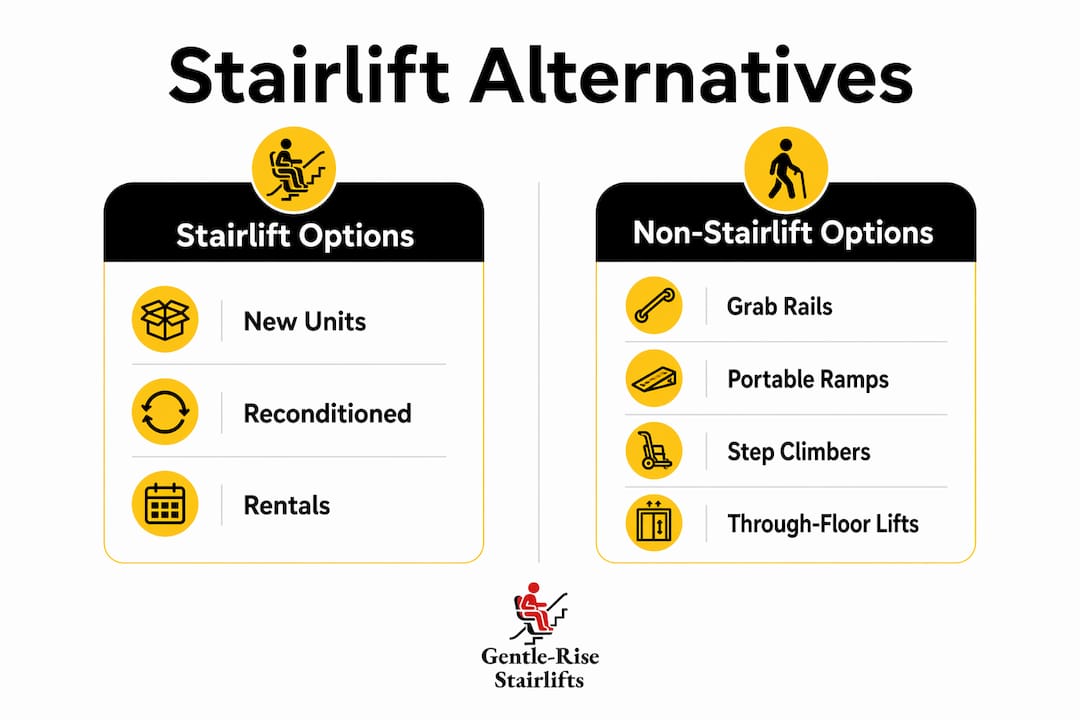
Table of Contents
- What are the best dlsl.co.uk alternatives for UK buyers?
- Which non-stairlift alternatives are worth considering?
- Should you rent, buy new, or buy reconditioned?
- How do you choose between alternatives and what should you ask providers?
- Our recommendation: which alternative to dlsl.co.uk suits you best?
- Key takeaways
- What actually matters when judging installers and alternatives
- Gentlerise Stairlifts: free home survey and same-day installation
- Useful sources and further reading
- FAQ
What are the best dlsl.co.uk alternatives for UK buyers?
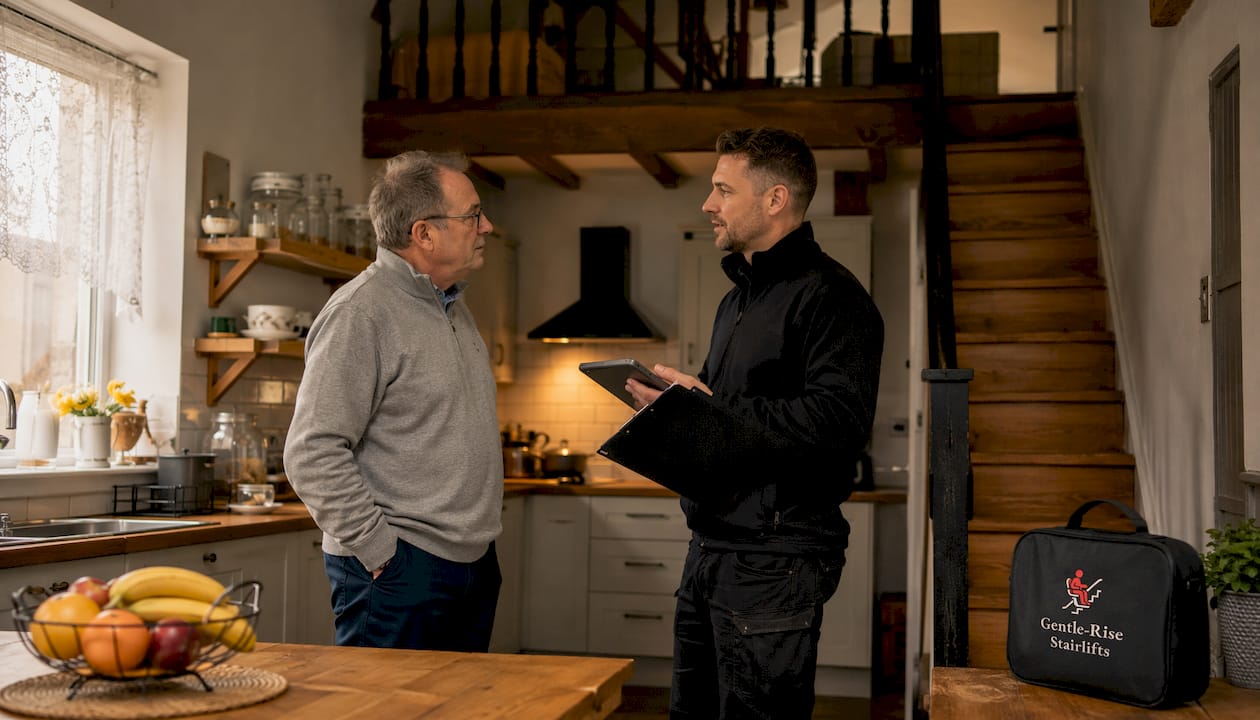
When comparing provider types, the key differences come down to what they actually offer, how quickly they can install, and what support you get afterwards. The table below uses generic provider-category labels so you can compare fairly.
| Provider type | Price range | Services | Best for | Lead time | Warranty / aftercare | OT support | UK availability |
|---|---|---|---|---|---|---|---|
| Local full-service installer (e.g. Gentlerise Stairlifts) | From £795 (straight reconditioned); rental available | New, reconditioned, rental, installation, Protect+ aftercare | Straight or curved stairs; short or long-term | Often same day or within hours for straight models | Protect+-style maintenance plan; clear warranty | Free home survey; can liaise with OT | Nationwide |
| Rental-only firms | Monthly fee plus install charge | Rental only; limited model choice | Post-surgery or temporary recovery | Days to weeks | Basic maintenance; check terms carefully | Rarely included | Variable |
| Through-floor lift specialists | several thousand pounds, sometimes up to tens of thousands+ | Supply and install; structural works required | Wheelchair users; full floor access | Weeks to months | Typically included; check length | Sometimes included | Specialist; not universal |
| Minor adaptations (council-funded) | Free for adaptations under £1,000 | Grab rails, handrails, small ramps | Mild mobility issues; fall prevention | Days to a few weeks | Not applicable | OT assessment often required | England (council-administered) |
What each category typically offers:
- Local full-service installers carry new, reconditioned, and rental units. Gentlerise Stairlifts, for example, starts at £795 for straight reconditioned models and can complete straight-stair installations within hours. Protect+ aftercare keeps the unit serviced long after installation day.
- Rental-only firms suit short-term needs but often offer limited model choice and variable aftercare. Always check the minimum hire period and what the monthly fee covers.
- Through-floor lift specialists require structural works and longer lead times, but deliver full wheelchair accessibility between floors.
- Council minor adaptations are the fastest, cheapest route for mild mobility issues. Adaptations that cost less than a thousand pounds are typically provided free by the local council.
Pro Tip: Providers that offer a free home survey, transparent reconditioning history, and a named aftercare contact reduce your risk considerably. Use these as minimum selection criteria when comparing quotes.
Which non-stairlift alternatives are worth considering?
Not every mobility challenge needs a stairlift. Several alternatives suit specific situations better, and some cost a fraction of the price.
Handrails and grab rails
Handrails and grab rails are the most cost-effective first step for reducing stair fall risk. They cost between £20 and £200, can be fitted quickly, and often fall under minor adaptations eligible for council funding. They work well for people with mild balance issues who can still manage stairs independently.
Pros: Low cost; fast installation; often free via council. Cons: Not suitable for significant mobility loss; no powered assistance.
Portable ramps
Access ramps provide a smooth slope for wheelchairs and mobility scooters to navigate thresholds or shallow steps. Prices typically run from £500 to £3,000 depending on length and load rating. They are a practical choice for wheelchair users who need to move between ground-level areas, though they are less suited to steep staircases or homes with limited space.
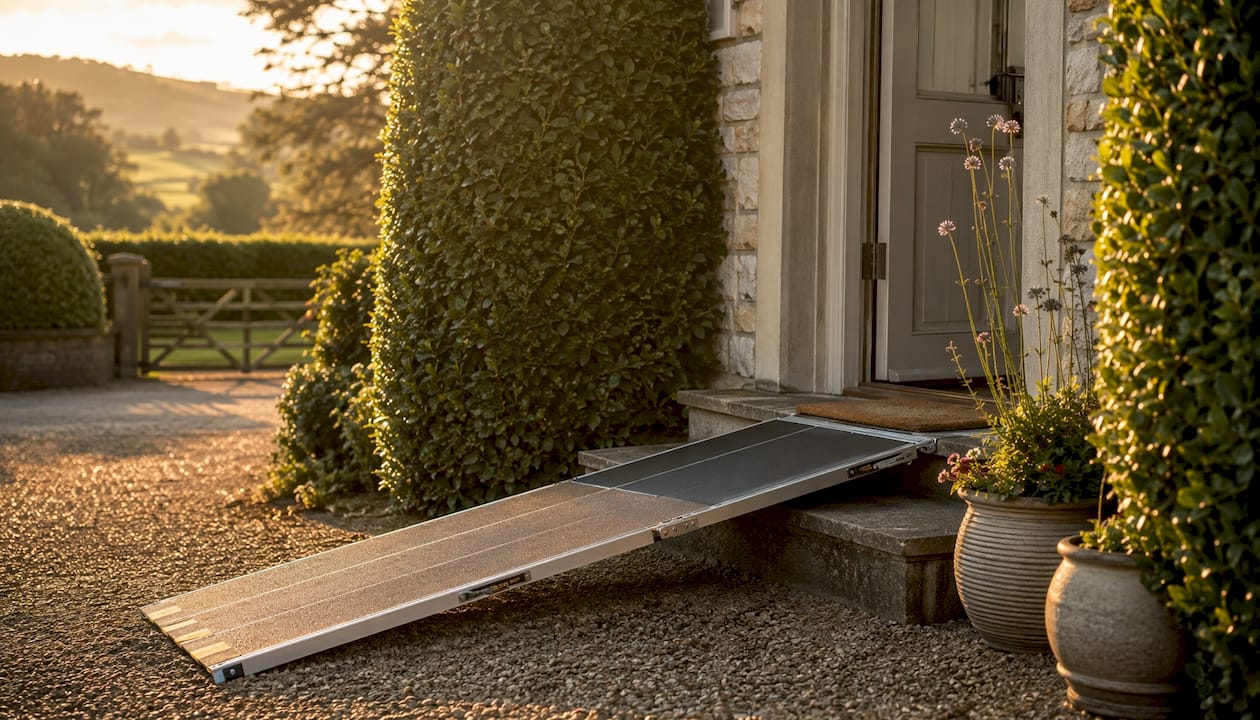
Pros: Portable; suits multiple mobility aids; no structural work. Cons: Not practical for full staircases; space required.
Step climbers and stair climbers
Stair climbers are carer-operated devices that carry a seated person up and down stairs. They are powered by rechargeable battery, can manage some curved staircases, and do not require permanent installation. The critical caveat: the carer must be trained before use, and the device has weight limits. They suit occasional use rather than daily journeys.
Pros: No installation; portable; works on multiple staircases. Cons: Requires trained carer; weight limits apply; can feel unsettling facing downstairs.
Through-floor lifts and home elevators
Through-floor lifts eliminate the need to transfer out of a wheelchair and provide full floor-to-floor access. They typically cost several thousand pounds and require structural works. Home elevators sit at the higher end, often several thousand pounds, sometimes up to tens of thousands, and need significant space. Both are long-term investments rather than quick fixes.
Pros: Full wheelchair access; long-term solution; can add property value. Cons: High cost; structural works; longer lead time.
Moving key rooms downstairs
For some people, the most practical solution is rearranging the home so that the bedroom, bathroom, and living areas are all on the ground floor. This avoids stair use entirely and can be combined with a bathroom safety remodel to create a fully accessible ground-floor living space.
Pros: No equipment cost; permanent solution; works for any mobility level. Cons: Requires suitable ground-floor space; may need bathroom adaptation.
| Alternative | Typical UK cost | Best for | Council funding possible? |
|---|---|---|---|
| Grab rails / handrails | £20–£200 | Mild balance issues | Yes (under £1,000 threshold) |
| Portable ramp | around £500 to a few thousand pounds | Wheelchair / scooter users | Possibly via DFG |
| Step climber | typically one to four thousand pounds | Occasional carer-assisted use | Unlikely |
| Through-floor lift | several thousand pounds, sometimes up to tens of thousands | Wheelchair users, full access | Yes, via Disabled Facilities Grant |
| Moving rooms downstairs | Variable | Any mobility level | Partial (adaptation costs) |
Pro Tip: Starting with small, evidence-based adaptations does not prevent installing a stairlift later. Incremental upgrades can also improve your eligibility for council funding or a Disabled Facilities Grant.
Should you rent, buy new, or buy reconditioned?
The right answer depends on how long you need the stairlift and what your budget looks like.
Rental suits post-surgery recovery or any situation where the need is temporary. You pay an installation fee plus a monthly charge, and the unit is removed when you no longer need it. The downside: model choice is often limited, and rental costs add up quickly over 12 months or more.
Reconditioned stairlifts offer the best value for long-term use. Gentlerise Stairlifts reconditioned straight models start at £795, and when purchased from a reputable installer with a service history and warranty, they carry little additional risk over a new unit. The track for a straight stairlift can usually be re-sited; curved tracks generally cannot, though some manufacturers can fit a new track to your staircase using a reconditioned seat and motor.
New stairlifts carry the longest warranties and the widest choice of features. They cost more upfront but make sense when the need is permanent, the staircase is unusual, or you want the full range of safety features and colour options.
- Rent when: recovery is expected within 6–12 months; you are in rented accommodation; you want zero long-term commitment.
- Buy reconditioned when: the need is long-term; budget is the priority; you are buying from a provider who can show full reconditioning history and offers a warranty.
- Buy new when: you have a curved staircase; you want maximum warranty cover; the stairlift is a permanent home adaptation.
For a fuller breakdown of pricing options, the affordable stairlifts guide covers new, reconditioned, and rental comparisons in detail.
How do you choose between alternatives and what should you ask providers?
A clear process saves time and avoids expensive mistakes. Work through these steps before signing anything.
- Book an OT assessment first. Your local council offers a free home assessment and can recommend whether minor adaptations, physiotherapy, or a stairlift is appropriate. Many people who expect to need a stairlift benefit instead from a combination of physiotherapy and minor adaptations.
- Shortlist your options. Based on the OT recommendation, narrow down to two or three routes (e.g. stairlift vs through-floor lift; rental vs reconditioned).
- Check funding. Ask your council about minor adaptations funding (free for works under £1,000) and whether you qualify for a Disabled Facilities Grant for larger works.
- Request a free home survey. Any reputable stairlift installer should carry out a professional home survey before quoting. Refuse any quote given without one.
- Compare warranties and aftercare. Ask specifically about the length of warranty, what the maintenance plan covers, and who your named aftercare contact is.
Questions to ask every provider:
- What is your installation lead time for my staircase type?
- How long is the warranty, and what does it cover?
- Do you offer a named maintenance plan (such as Protect+)?
- For reconditioned units: can you show the full service and reconditioning history?
- What are the weight limits for this model?
- Is this model compatible with my staircase width and shape?
- What happens if the unit breaks down outside business hours?
Red flags to watch for:
- No home survey before quoting
- Vague or verbal-only warranty terms
- No aftercare plan or named service contact
- Missing safety certification or trade association membership (look for BHTA or LEIA membership)
- Pressure to sign on the day of the first visit
Our recommendation: which alternative to dlsl.co.uk suits you best?
For most UK readers searching for comparable sites to dlsl.co.uk, Gentlerise Stairlifts is the recommended stairlift option. It covers new, reconditioned, and rental units, offers free home surveys, and backs installations with Protect+ aftercare. Straight models start at £795, and same-day installation is available for straight staircases. You can read more about choosing a reliable stairlift to understand what separates a quality installation from a rushed one.
That said, a stairlift is not the right answer for everyone:
- Choose grab rails or minor adaptations if your mobility issues are mild, you can still manage stairs independently, and you want a fast, low-cost solution that may be free via your council.
- Choose a through-floor lift if you use a wheelchair and need full floor-to-floor access without transferring.
- Choose a portable ramp if your main challenge is a threshold or a small number of steps, particularly for wheelchair or scooter access.
- Consider moving rooms downstairs if your ground floor can accommodate a bedroom and bathroom and you want to avoid stair use entirely.
Funding reminder: book an OT assessment through your local council, check whether your adaptations qualify as minor works under £1,000, and ask about a Disabled Facilities Grant for anything larger.
Key takeaways
The clearest route for most UK readers looking for dlsl.co.uk substitutes is to start with an OT assessment, then match the solution to the mobility need and budget.
| Point | Details |
|---|---|
| Start with an OT assessment | Your local council offers a free home assessment that can change the recommended route entirely. |
| Minor adaptations are often free | Adaptations costing under £1,000, such as grab rails, are typically funded free by the local council in England. |
| Match solution to need | Grab rails suit mild issues; reconditioned stairlifts suit long-term needs from £795; through-floor lifts suit wheelchair users. |
| Rental for short-term needs | Rental stairlifts suit post-surgery recovery or temporary mobility loss without long-term commitment. |
| Gentlerise Stairlifts | Offers new, reconditioned, and rental stairlifts with free home survey and Protect+ aftercare across the UK. |
What actually matters when judging installers and alternatives
Most articles about similar platforms to dlsl.co.uk focus on price. Price matters, but it is rarely where the real risk sits.
The evaluation criteria that count are: a professional home survey before any quote is given; a written warranty with a named aftercare contact; transparent reconditioning history for used units; and a maintenance plan that does not expire the moment the installation van leaves your driveway. An OT assessment is not a bureaucratic hurdle. It is the single most useful step in this process, because it often reveals that a less expensive adaptation achieves the same outcome.
What I look for in a trustworthy provider: they carry out a free home survey without pressure; they provide a written quotation with a clear lead time; they can show the service history of any reconditioned unit; and they offer a named aftercare plan. Providers who tick all four of those boxes are rare enough that finding one is worth prioritising over a marginally lower headline price.
For readers planning longer-term accessibility changes, the home mobility planning guide covers the full assessment-to-installation process in practical detail.
Gentlerise Stairlifts: free home survey and same-day installation
Where other top choices like dlsl.co.uk leave you comparing quotes with little guidance, Gentlerise Stairlifts offers something more direct: a free home survey, a written quote, and installation often completed within hours for straight staircases. Reconditioned straight models start at £795, rental options are available for short-term needs, and every installation is backed by the Protect+ aftercare plan so you have a named contact if anything goes wrong.
Gentlerise Stairlifts covers new, reconditioned, and rental stairlifts for straight and curved staircases across the UK, with professional fitting and ongoing service support built in from day one.
- Straight stairlifts from £795 (reconditioned)
- Same-day or next-day installation available for straight models
- Rental options for post-surgery or temporary mobility needs
- Protect+ maintenance plan with named aftercare contact
- Free home survey with no obligation to proceed
Book your free home survey and get a written quote with a clear lead time before committing to anything.
Useful sources and further reading
These are the primary sources used in this article. Each is worth bookmarking if you are working through the funding or assessment process.
- NHS: Home adaptations guide — explains free home assessments, OT referrals, and how councils can point you to grants and Home Improvement Agencies.
- NHS: Care and support you can get for free — confirms that adaptations costing under £1,000, including grab rails, are typically funded by the local council in England.
- GOV.UK: Disabled Facilities Grants — the main funding route for larger adaptations such as stairlifts and through-floor lifts; explains eligibility and how to apply.
- Gentlerise Stairlifts blog: stairlift alternatives — practical cost ranges and safety caveats for portable ramps, step climbers, and through-floor lifts.
This article provides general information only and is not professional medical, occupational therapy, or financial advice. Confirm your eligibility for funding and the suitability of any adaptation with your local council, a registered occupational therapist, or a qualified installer before proceeding.
FAQ
Does a stairlift devalue your house?
A stairlift does not automatically devalue a property. Most units can be removed cleanly, and for buyers who need accessibility features, a fitted stairlift can be a positive selling point.
Can you get a free stairlift on the NHS?
The NHS does not directly fund or provide stairlifts. However, an NHS occupational therapist can assess your needs and recommend adaptations, and funding for a stairlift may then come via a Disabled Facilities Grant administered by your local council.
What can you do instead of a stairlift?
Grab rails, portable ramps, step climbers, through-floor lifts, and rearranging rooms to avoid stair use are all practical alternatives, depending on your mobility level, staircase type, and budget.
How do you get up the stairs safely without a stairlift?
For mild mobility issues, well-fitted handrails on both sides of the staircase reduce fall risk significantly and are typically funded free by the local council as a minor adaptation for adaptations under £1,000. For more significant mobility loss, a carer-operated step climber or a through-floor lift may be more appropriate.