
TL;DR:
- Temporary stair accessibility solutions are vital for preventing falls and maintaining independence during short-term recovery. Installing stairlifts, handrails, or using portable stairclimbers enhances safety, reduces caregiver burden, and preserves home routines. Booking assessments before surgery ensures safety measures are in place upon discharge, with rental options being cost-effective for most temporary needs.
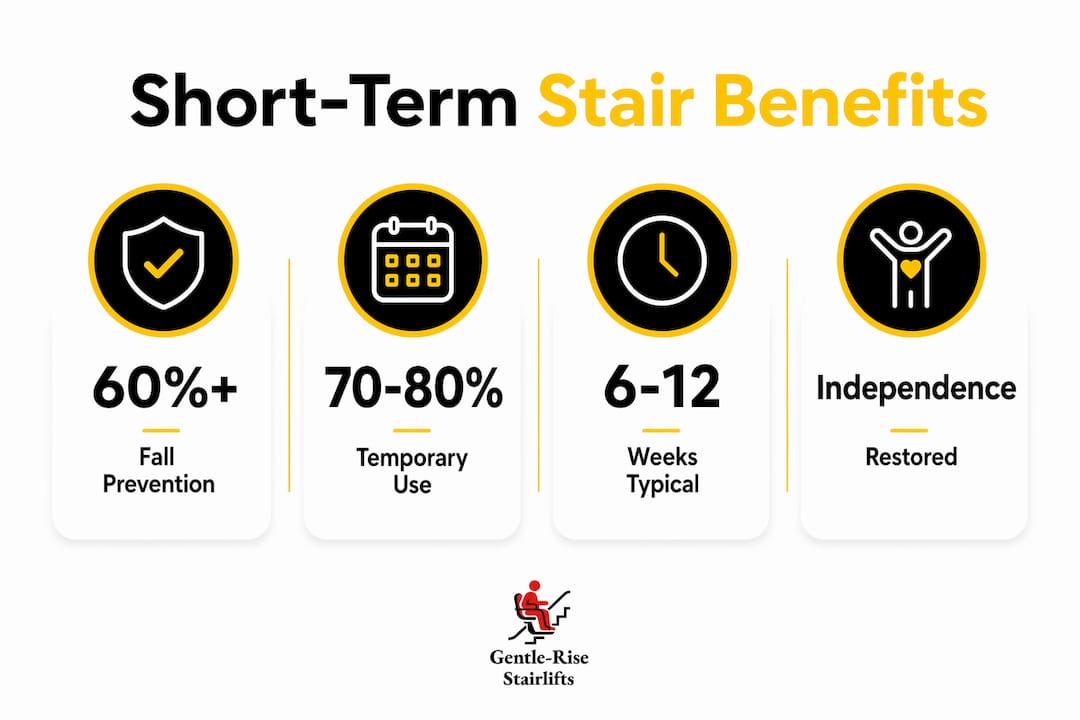
Short-term stair accessibility is defined as the temporary provision of safe, independent stair use for people facing time-limited mobility challenges, most commonly after surgery, injury, or illness. The importance of stair accessibility during these periods is not a matter of comfort. It is a life-safety issue. Falls on stairs cause over 60% of accident-related deaths among elderly people, and injuries from stair falls carry a 10% mortality rate within 12 months. For anyone returning home after a hip replacement, knee surgery, or a significant injury, the stairs are the single greatest hazard in the house. Temporary solutions such as stairlift rentals, portable stairclimbers, and handrail upgrades exist precisely to close that gap between hospital discharge and full recovery.
What practical benefits do temporary stair accessibility solutions provide?
The core benefit of short-term stair accessibility is fall prevention, but the advantages extend well beyond that single point. Temporary solutions restore independence, protect dignity, and reduce the physical and emotional burden on family members and carers.
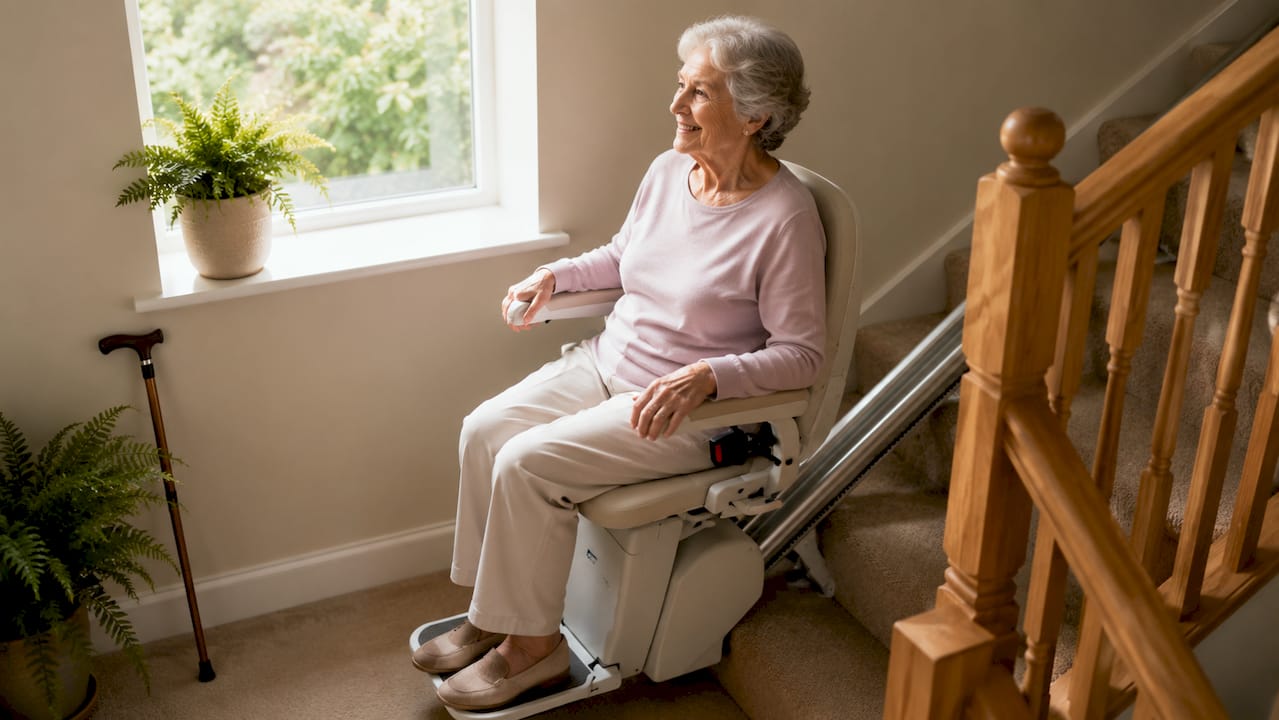
Safety is the non-negotiable foundation. Stair falls are not minor incidents for people in recovery. A second fall after hip surgery can undo weeks of rehabilitation and, in some cases, prove fatal. Installing a temporary stairlift or upgrading handrails removes the most dangerous daily task from the equation entirely.
Independence in a multi-storey home is preserved. Without stair access, most people are effectively confined to one floor. Bedrooms, bathrooms, and personal spaces become unreachable. A rented stairlift restores access to the whole home, which matters enormously for mental wellbeing during a long recovery.
Usual routines and privacy are maintained. Sleeping in your own bed, using your own bathroom, and moving through your home without assistance are things most people take for granted. Temporary stair solutions make those things possible again without requiring a carer to be present for every movement.
The benefits also extend to those around you:
- Reduced physical strain on family members who would otherwise need to assist with stair navigation
- Lower risk of secondary injury to carers from supporting a person on stairs
- Fewer disruptions to household routines during the recovery period
- Greater peace of mind for everyone in the home
Pro Tip: Book your temporary stairlift rental before your surgery date, not after discharge. Having the equipment in place when you arrive home removes a critical gap in safety.
Rental or relocation: how do you choose the right short-term solution?
The right approach depends almost entirely on how long your recovery will take. For recoveries under two weeks, moving a bed to the ground floor is often the most practical option. It avoids installation costs and disruption. For anything longer, a stairlift rental becomes the more sensible and safer choice.
| Recovery duration | Recommended approach | Key consideration |
|---|---|---|
| Under 2 weeks | Move bed to ground floor | Avoids rental costs; requires accessible bathroom on same floor |
| 2–6 weeks | Short-term stairlift rental | Fast installation; restores full home access |
| 6 weeks to 6 months | Stairlift rental or purchase | Rental costs £200–£500 per month; purchase may be more economical beyond 6 months |
| Ongoing or permanent | Purchase or lease-to-own | Long-term value; consider reconditioned models for cost savings |
Between 70% and 80% of stairlift needs after hip replacement are temporary, with most patients regaining stair-climbing ability within 3–6 months. That figure tells you something important: the majority of people who need a stairlift after surgery do not need one permanently. Renting rather than buying is the financially rational choice for most post-surgical recoveries.
The ground-floor option only works if your home layout supports it. You need a toilet and washing facilities on the same floor as your temporary bedroom. If that is not the case, a stairlift rental is the only practical path.
Pro Tip: Evaluating one-floor living before committing to a rental can save you money. Walk through the logistics with a family member before your surgery date.
What types of temporary stair accessibility solutions are available?
Several distinct options exist for short-term stair access, and they suit different situations, budgets, and stair configurations.
Rented stairlifts
Rented stairlifts are the most widely used short-term accessibility solution for people recovering from surgery or injury. Straight-rail models are the most common because straight stairlifts install in 2–4 hours, often within 48 hours for urgent cases. Curved stairlifts take longer to install and are more expensive to rent, but they are available for homes with bends or landings in the staircase. Reconditioned models offer a lower-cost entry point without compromising on safety standards.
Portable stairclimbers
Portable stairclimbers are motorised devices that assist a person up and down stairs with the help of a carer or trained operator. They do not require installation and can be moved between locations. They are best suited to very short-term needs or situations where a stairlift installation is not feasible, such as listed buildings or rented properties with landlord restrictions.
Temporary handrails and grab bars
Additional handrails and grab bars are the lowest-cost intervention and the fastest to install. They do not replace a stairlift for someone with significant mobility limitations, but they meaningfully reduce fall risk for people who can still manage stairs with support. Fitting a second handrail on the opposite wall, for example, gives bilateral support and is often recommended as a first step.
| Solution | Installation time | Approximate cost | Best suited for |
|---|---|---|---|
| Rented straight stairlift | 2–4 hours | £200–£500 per month | Post-surgical recovery, 2–6 months |
| Rented curved stairlift | 1–2 days | Higher monthly rate | Homes with non-straight staircases |
| Portable stairclimber | None | Variable hire cost | Very short-term or installation-restricted homes |
| Additional handrails | Under 1 hour | Low one-off cost | Mild mobility limitations with some stair ability |
How to arrange temporary stair accessibility before you come home
Timing is everything. Most patients are discharged 1–2 days after hip or knee surgery, which means the window between the operation and arriving home is extremely short. The stairlift needs to be in place before you walk through the front door.
Here is the process that works:
- Book a home survey 1–3 days before your surgery date. Planning the survey before surgery allows the provider to assess your staircase, confirm the right model, and schedule installation for the day of or after discharge. Gentlerise Stairlifts offers free home surveys with no obligation.
- Confirm your discharge date with the hospital. Most surgical teams can give you an expected discharge window. Share this with your stairlift provider so installation can be scheduled accordingly.
- Arrange a next-day installation slot if needed. Urgent installations are available for straight-rail stairlifts and can often be completed within 48 hours of booking.
- Request an occupational therapist assessment if your needs are complex. OT consultation is recommended for recoveries involving neurological conditions, significant weakness, or balance impairment. You do not need a formal referral to book a private rental, but an OT's input ensures the equipment matches your specific needs.
- Complete a safety walkthrough on installation day. The engineer will demonstrate safe use, show you how to operate the controls, and confirm the seat, footrest, and armrests are correctly adjusted for your height and mobility level.
- Coordinate with your medical team on weight-bearing restrictions. Some post-surgical protocols limit how much weight you can put through a leg or hip. Your stairlift provider needs to know this to configure the unit correctly.
Most patients benefit from stairlift use for 6–12 weeks after discharge. Plan your rental term around that window, with the option to extend if recovery takes longer than expected.
What safety and design factors matter for short-term stair solutions?
Safety in a temporary stair setup is not just about the stairlift itself. The wider environment around the staircase determines how effective any solution will be.
Addressing environmental risks first maximises the effectiveness of any stair accessibility equipment. Before or alongside a stairlift installation, consider the following:
- Handrails on both sides of the staircase. A single handrail is the minimum standard, but bilateral rails give far greater support for anyone with weakness on one side.
- Adequate lighting on every step. Poor lighting is a leading contributor to stair falls. Motion-activated lighting or plug-in LED strip lights along the stair edge are low-cost and highly effective.
- Contrast strips on step edges. High-contrast tape or nosing strips on the front edge of each step make the stair depth far easier to judge, particularly for anyone with reduced vision.
- Clear the staircase of clutter. Bags, shoes, and objects left on stairs are a hazard for anyone, but especially for someone using a walking frame or crutches.
Short-term stair accessibility is a critical life-safety intervention, not a convenience measure. The combination of environmental improvements and the right temporary equipment is what makes the difference between a safe recovery and a preventable second injury.
Universal design principles support temporary stair modifications by making homes more usable for everyone without creating a clinical appearance. Grab bars in contrasting colours, well-designed handrails, and good lighting are improvements that benefit the whole household long after the temporary equipment has been removed.
Key takeaways
Short-term stair accessibility is a life-safety intervention that prevents falls, restores independence, and supports faster recovery for anyone facing temporary mobility limitations at home.
| Point | Details |
|---|---|
| Safety is the primary driver | Falls on stairs cause over 60% of accident-related deaths among elderly people, making temporary solutions a medical priority. |
| Recovery duration guides your choice | Relocate to one floor for under two weeks; rent a stairlift for recoveries lasting two weeks to six months. |
| Book before surgery, not after | Arrange your home survey 1–3 days before your operation so the stairlift is ready on discharge day. |
| Environment matters as much as equipment | Handrails, lighting, and contrast strips reduce fall risk alongside any stairlift installation. |
| Most post-surgical needs are temporary | Between 70% and 80% of stairlift users after hip replacement recover fully within 3–6 months, making rental the smarter financial choice. |
Why I think people wait too long to sort this out
I have spoken with a great many people who arranged their stairlift rental the week after they came home from hospital. Almost all of them describe the same thing: a frightening few days of managing stairs with crutches, relying on a family member to be present for every trip upstairs, and feeling far less in control of their recovery than they expected.
The misconception I encounter most often is that a stairlift is only necessary for people who cannot manage stairs at all. That is not how falls work. Most stair falls happen to people who can manage stairs most of the time. It is the one moment of fatigue, distraction, or misjudgement that causes the injury. Post-surgical recovery is full of those moments.
The other thing people underestimate is how quickly a stairway adaptation can be arranged. A straight-rail stairlift can be surveyed, ordered, and installed within 48 hours. There is no lengthy waiting period, no complex process. The barrier is almost always awareness, not logistics.
My honest view is this: if your recovery is going to last more than two weeks and your bedroom is upstairs, book the survey before your surgery. The cost of a short-term rental is modest compared to the cost of a second injury, in every sense of the word.
— lee
How Gentlerise Stairlifts can help you get home safely
If you are planning surgery or managing a recovery right now, Gentlerise Stairlifts provides fast, professional stairlift rentals across the UK, with free home surveys and installations often completed within 48 hours.

Gentlerise Stairlifts offers straight, curved, and reconditioned stairlift models for short-term rental, with flexible terms suited to recoveries of any length. The stairlift rental and installation process starts with a no-obligation home survey, so you can get accurate advice before committing to anything. For a clear picture of what to expect on costs, the UK stairlift pricing guide covers rental and purchase options side by side. Contact Gentlerise Stairlifts today to book your free survey and have everything in place before you come home.
FAQ
How long do most people need a stairlift after surgery?
Most patients use a stairlift for 6–12 weeks after discharge, with the majority regaining full stair-climbing ability within 3–6 months. A short-term rental is the most cost-effective approach for this window.
Can I rent a stairlift without a doctor's referral?
Yes. You can book a home survey and arrange a private stairlift rental without a formal medical referral. An occupational therapist assessment is recommended for complex mobility needs but is not a requirement.
How quickly can a temporary stairlift be installed?
Straight-rail stairlifts can be installed in 2–4 hours, with urgent installations often completed within 48 hours of booking. Curved stairlifts require longer lead times due to custom rail fabrication.
Is it better to rent or buy a stairlift for a short recovery?
Renting is the better choice for recoveries lasting under six months. Rental costs typically fall in the range of £200–£500 per month, making purchase only financially worthwhile for longer-term or permanent needs.
What should I do if I cannot install a stairlift in my home?
If installation is not possible, a portable stairclimber operated by a carer is the next best option. Adding handrails on both sides of the staircase and improving lighting are also effective low-cost measures that reduce fall risk significantly.