
TL;DR:
- Vertical platform lifts provide safe, space-efficient, and cost-effective multi-level access for wheelchair users. They eliminate transfer risks, occupy less space than ramps, and reduce caregiver physical strain. Proper planning and professional installation ensure safety, reliability, and long-term satisfaction.
A vertical platform lift is a mechanical device that moves individuals, including wheelchair users, safely between floor levels inside or outside a home, without the need for a full residential elevator. For homeowners managing mobility challenges or caring for someone who does, understanding why consider vertical lifts matters now more than ever. Unlike ramps or stairlifts, a vertical lift accommodates a wheelchair directly, removing the risky transfer step entirely. Providers such as Pollock Residential Elevators and RAM Elevators have long positioned these units as the practical middle ground between a basic ramp and a costly home elevator.
Why consider vertical lifts over other mobility solutions?
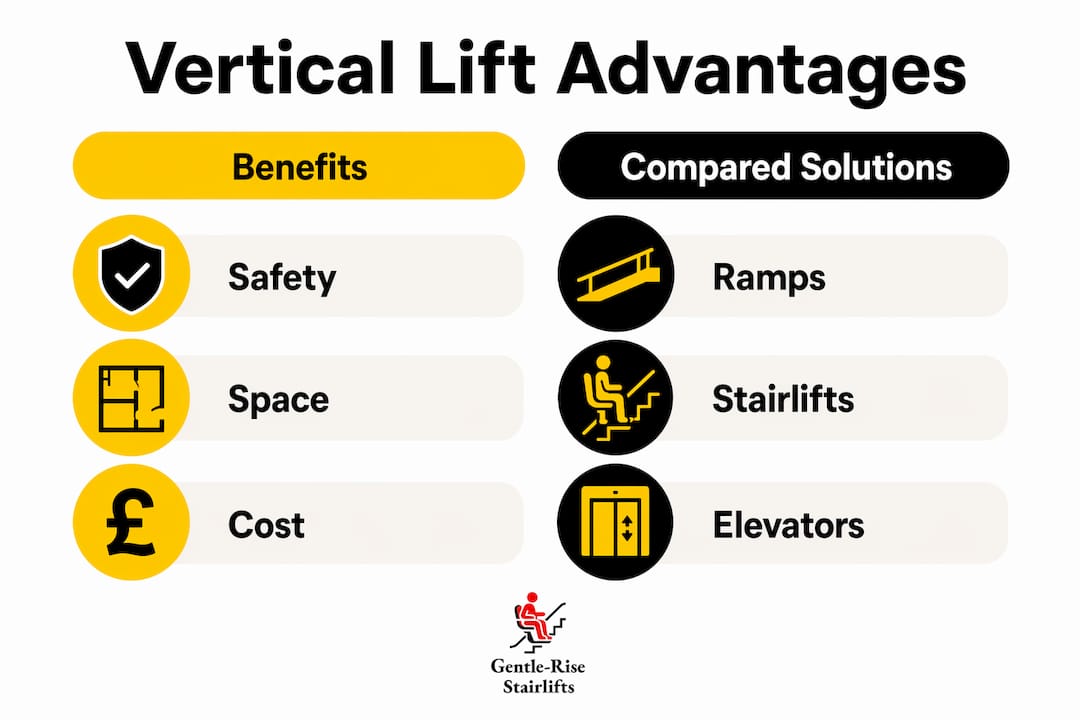
Vertical lifts outperform ramps, stairlifts, and residential elevators across three key measures: safety, space, and cost.
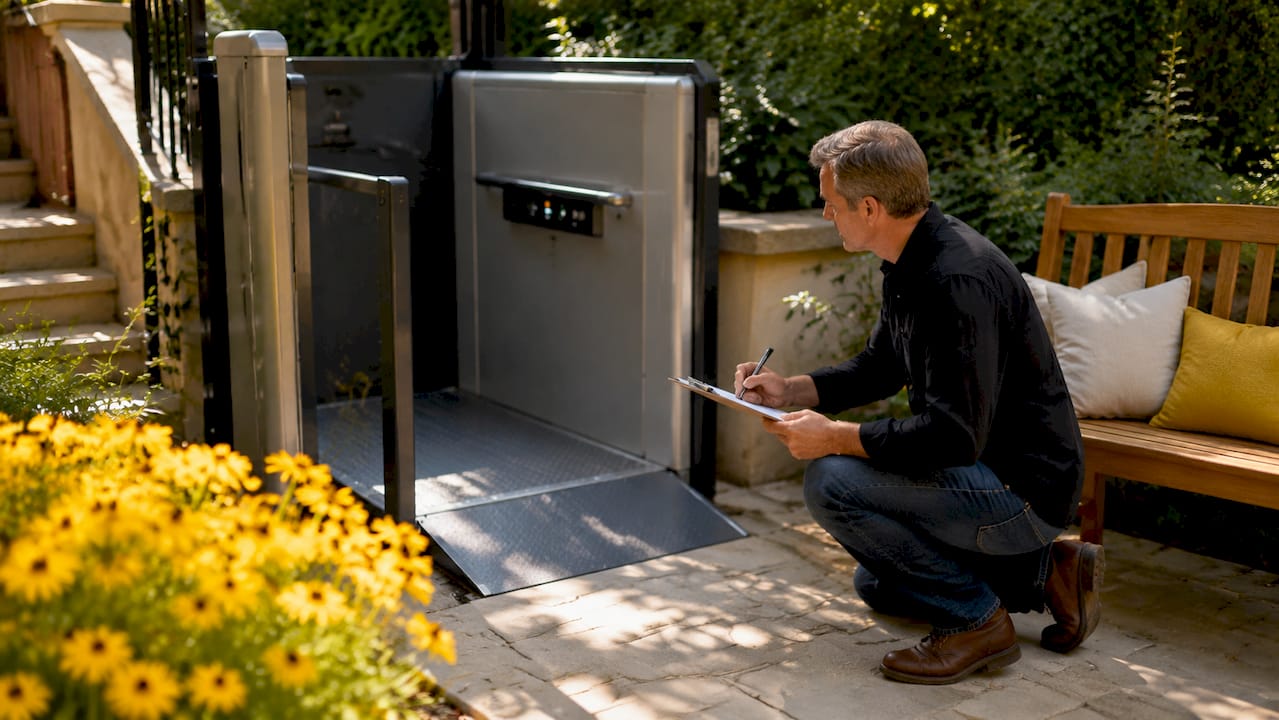
Safety is the clearest advantage. A February 2026 Public Health Reviews study confirmed that vertical lifts reduce fall risk by eliminating the high-risk transfer phase that stairlifts require. With a stairlift, a wheelchair user must move from their chair to the lift seat and back again at both ends. That transfer is where falls happen. A vertical lift removes that step entirely.
Space efficiency is the second major benefit. Ramps for a 3-foot rise need a run of at least 36 feet at the standard 1:12 gradient to remain safe. Most homes simply do not have that length available. A vertical platform lift occupies a compact footprint and travels straight up, making it far more practical for typical UK homes with limited hallway or garden space.
Cost sits comfortably between the two extremes. Residential elevators add resale value and offer full-floor access, but they cost significantly more and require far greater structural work. A vertical platform lift is a functional accessibility tool, not a luxury amenity. The table below shows how the four main options compare.
| Solution | Typical Cost | Space Needed | Wheelchair Friendly | Installation Complexity |
|---|---|---|---|---|
| Ramp | Low | Very high | Yes | Low |
| Stairlift | £795 upwards | Low | No (transfer needed) | Low |
| Vertical Platform Lift | Mid-range | Low | Yes | Moderate |
| Residential Elevator | High | High | Yes | High |
The core vertical lift advantages are clear: you get wheelchair-direct access, a small footprint, and a cost that most households can plan for without a full structural renovation.
How do vertical lifts work and what does installation involve?
A vertical platform lift operates on a simple principle. A motorised drive system, typically a hydraulic ram or a screw-drive mechanism, raises and lowers a platform between two fixed levels. The user drives or is pushed onto the platform, presses a constant-pressure control, and the platform travels vertically to the destination level. Controls are designed so the lift stops the moment pressure is released, which is a built-in safety feature.
The installation process follows a predictable sequence for most homes:
- Site survey: A specialist assesses the rise height, available footprint, and surface conditions.
- Surface preparation: The landing area must be solid and level. Uneven or wooden floors often require concrete pad construction, which adds to both cost and timeline.
- Electrical check: The motor load must be verified against your existing supply. Standard outlets may not support the motor's draw, so a licensed electrician must confirm compatibility before installation begins.
- Unit installation: The lift tower, platform, and controls are fitted, typically within one to two days for a straightforward domestic installation.
- Commissioning and handover: The installer tests all safety features and demonstrates operation to the user and any carers.
For outdoor installations, weather-proofing is not optional. Outdoor vertical lifts need weather-proof packages to prevent condensation-related electrical failures, even in moderately wet climates like the UK. Heated controls and moisture sealing are standard inclusions in a quality outdoor kit.
Pro Tip: Before agreeing to any installation quote, ask your supplier to confirm in writing that an electrician has assessed your home's electrical supply. Many homeowners discover mid-installation that their consumer unit needs upgrading, which adds unexpected cost.
The typical cost for a residential vertical platform lift ranges from $9,000 to $20,000 in the US market as of 2026, with UK pricing varying by rise height, platform size, and site conditions. Budget for potential hidden costs including surface reinforcement and electrical upgrades from the outset.
What safety and caregiver benefits do vertical lifts offer?
Vertical lift safety goes well beyond preventing falls for the primary user. The benefits extend directly to the person providing care.
A January 2026 report confirmed that vertical lifts ease caregiver physical strain by removing the need for manual pushing up ramps and eliminating dangerous manoeuvres that damage the musculoskeletal health of family carers. Pushing a wheelchair up even a modest ramp creates significant shoulder and lower back load. Over months and years, that accumulates into serious injury. A vertical lift removes that load entirely.
The safety features built into modern vertical platform lifts are worth understanding in detail:
- Constant-pressure controls: The lift moves only while the button is held. Release it and the platform stops immediately.
- Emergency stop buttons: Positioned at both upper and lower landings, accessible to the user and any carer present.
- Safety edges and obstruction sensors: If the platform meets resistance during travel, it stops automatically.
- Non-slip platform surfaces: Reduce the risk of wheelchair movement during travel.
- Lockable controls: Prevent unsupervised use where needed.
For carers managing elderly relatives, the 2026 caregiver guide on elderly safety measures highlights how removing manual handling from daily routines reduces both physical injury and carer fatigue. That reduction in fatigue matters. A carer who is not exhausted or injured provides better, more consistent support.
Seasonal conditions add another layer of risk that vertical lifts address. Wet ramps become slippery in autumn and winter. A covered or enclosed vertical lift platform removes that weather-dependent hazard from the equation entirely.
What should homeowners know when choosing and maintaining a vertical lift?
Selecting the right vertical lift requires more than picking a price point. Several practical factors determine whether a unit will serve you well for years or become a source of frustration.
Rise height and platform size are the starting point. Measure the exact vertical distance between your two levels. Then consider the platform dimensions: a standard powered wheelchair requires a platform of at least 30 inches by 48 inches. If you use a larger power chair or a scooter, confirm the platform dimensions before ordering.
Open versus enclosed platforms is a genuine decision. Open platforms are lower cost and suit indoor or sheltered outdoor locations. Enclosed platforms offer weather protection and a greater sense of security for users who feel exposed on an open deck. For UK outdoor use, an enclosed unit with a weather-proof kit is the more reliable long-term choice.
Maintenance requirements are modest but non-negotiable. Key practices include:
- Annual servicing by a qualified engineer to check drive mechanisms, safety edges, and controls.
- Monthly visual checks of the platform surface, gate latches, and control buttons.
- Immediate reporting of any unusual noise, slow travel, or jerky movement to your service provider.
Pro Tip: When reviewing warranty terms, check whether the warranty covers both parts and labour, and whether it requires servicing by the original installer. Some warranties become void if a third-party engineer carries out annual checks.
Understanding stairlift alternatives for home mobility helps put vertical lifts in context. They are not the right solution for every situation. For a standard staircase inside a home where the user can transfer, a stairlift remains a lower-cost option. But for wheelchair users, multi-level access needs, or outdoor step access, a vertical platform lift is the more appropriate tool.
Customisation options are broader than most homeowners expect. Colour choices, platform finishes, gate styles, and control heights can all be specified to suit the user's needs and the property's appearance. These details matter for long-term satisfaction.
Key takeaways
Vertical platform lifts are the most practical home accessibility solution for wheelchair users needing safe, space-efficient, and cost-effective multi-level access.
| Point | Details |
|---|---|
| Fall risk reduction | Vertical lifts eliminate the transfer phase that makes stairlifts hazardous for wheelchair users. |
| Space efficiency | A vertical lift needs a fraction of the space a compliant ramp requires for the same rise height. |
| Caregiver protection | Removing manual ramp pushing reduces musculoskeletal injury risk for family carers significantly. |
| Hidden installation costs | Budget for surface reinforcement and electrical upgrades before committing to a final price. |
| Proactive installation | Installing before a mobility crisis improves integration, reduces urgency costs, and preserves independence longer. |
The case for installing before you urgently need one
I have seen the same pattern repeat itself across many home accessibility consultations. A family waits until a fall or a hospital discharge forces the decision, then rushes the installation under pressure. The result is a unit chosen too quickly, sometimes on a surface that was not properly assessed, with electrical work done as an afterthought.
The proactive case for vertical lifts as aging-in-place solutions is compelling precisely because early installation allows proper planning. You choose the right platform size. You get the surface prepared correctly. You have time to compare open and enclosed options without a discharge date looming.
There is also a dignity argument that does not get enough attention. A person who has used a vertical lift for two years before their mobility declines significantly has already built confidence with the equipment. They are not learning to use it at their most vulnerable. That matters enormously for independence and self-esteem.
The misconception I encounter most often is that vertical lifts are only for people in wheelchairs. They are not. Anyone with limited leg strength, balance issues, or post-surgical restrictions benefits from removing the physical demand of navigating steps. The advantages of using vertical lifts extend to a far wider group than most homeowners initially consider.
My honest recommendation: if you are planning any home adaptation for mobility, assess the vertical lift option at the same time as the stairlift option. The right answer depends on the individual, but the comparison should always be made.
— lee
How gentlerise stairlifts can help you find the right solution
Gentlerise Stairlifts specialises in home mobility solutions across the UK, including vertical platform lifts, straight stairlifts, curved stairlifts, and reconditioned models. If you are weighing up your options for safer access at home, the right starting point is a free home survey with a specialist who can assess your specific layout, rise height, and surface conditions.
Gentlerise Stairlifts offers professional installation, flexible rental options for short-term needs, and the Protect+ maintenance programme to keep your lift running safely year after year. Prices for straight stairlifts start from £795, and the team can advise on the most cost-effective route for your circumstances. Book your free survey today and get expert guidance tailored to your home.
FAQ
What is a vertical platform lift?
A vertical platform lift is a motorised device that raises and lowers a platform between two fixed levels, allowing wheelchair users and those with limited mobility to move between floors or overcome steps without transferring from their chair.
How do vertical lifts differ from stairlifts?
A stairlift travels along a rail fitted to a staircase and requires the user to transfer from a wheelchair to the lift seat. A vertical lift carries the wheelchair directly, removing the transfer step and reducing fall risk significantly.
Are vertical lifts suitable for outdoor use in the UK?
Yes, provided the unit includes a weather-proof kit with moisture sealing and heated controls. Outdoor vertical lifts without weather-proofing are vulnerable to condensation-related electrical failures in wet climates.
What are the main hidden costs of installing a vertical lift?
The two most common hidden costs are surface reinforcement, where uneven or wooden floors require a concrete pad, and electrical upgrades, where the existing supply cannot support the motor load without modification.
How much does a vertical platform lift cost in the UK?
UK pricing varies by rise height, platform size, and site conditions. US market data for 2026 shows a typical cost range of $9,000–$20,000, and UK buyers should request itemised quotes that include surface preparation and electrical work to avoid surprises.