
Installing an internal stairlift in a standard UK house does not require planning permission. Stairlifts are classified as minor, non-structural adaptations under permitted development rights, meaning the government grants automatic planning consent for them without any application to your local council. There are no planning fees for adaptations made for disabled persons in this category. That said, a handful of exceptions apply, and building regulations compliance is always required regardless of property type.
Here is a quick summary of the key rules:
- Standard houses: internal stairlifts are permitted development. No planning application needed.
- Listed buildings: Listed Building Consent (LBC) is required even for internal installations.
- Conservation areas: indoor stairlifts are generally fine, but outdoor stairlifts visible from a public road may need permission.
- Flats and maisonettes: permitted development rights do not apply. Landlord or freeholder consent is needed.
- Outdoor stairlifts: rarely require permission, but check with your local planning authority if the property has any protected status.
- Article 4 Directions: local councils can withdraw permitted development rights in specific areas, making a planning application necessary.
Pro Tip: Before any installation, contact your local planning authority for a quick pre-application check. Most councils offer free advice for small householder works, and five minutes on the phone can save you considerable trouble later.
What are permitted development rights for stairlifts?
Permitted development rights are a form of automatic planning consent granted by the government, not by your local council. They are set out in the Town and Country Planning (General Permitted Development) (England) Order 2015 and allow homeowners to carry out certain works without submitting a formal planning application. Stairlifts fall comfortably within this framework because they attach to stair treads rather than the structural fabric of the building, and they can be removed without leaving any lasting alteration.

Crucially, these rights apply to houses only. The Planning Portal confirms that permitted development allowances for accessible adaptations do not extend to flats, maisonettes, or other building types. If you live in a converted flat or a purpose-built apartment block, different rules apply entirely.
A stairlift installation qualifies as permitted development when all of the following conditions are met:
- The property is a house, not a flat or maisonette.
- The stairlift is fitted internally to the staircase.
- No structural alterations are made to the building fabric.
- The installation is reversible with minimal trace.
- No Article 4 Direction has been applied to the area by the local council.
Article 4 Directions are worth understanding. A council can use them to withdraw permitted development rights in specific streets or neighbourhoods, typically in areas of particular character or sensitivity. If your home sits within such a designated area, works that would ordinarily be automatic may require a full planning application. Checking with your local authority takes minutes and removes all uncertainty.
When do you need special consent? Listed buildings, conservation areas, and outdoor lifts
The straightforward permitted development position changes significantly for certain property types and locations. Understanding where the exceptions lie is just as useful as knowing the general rule.
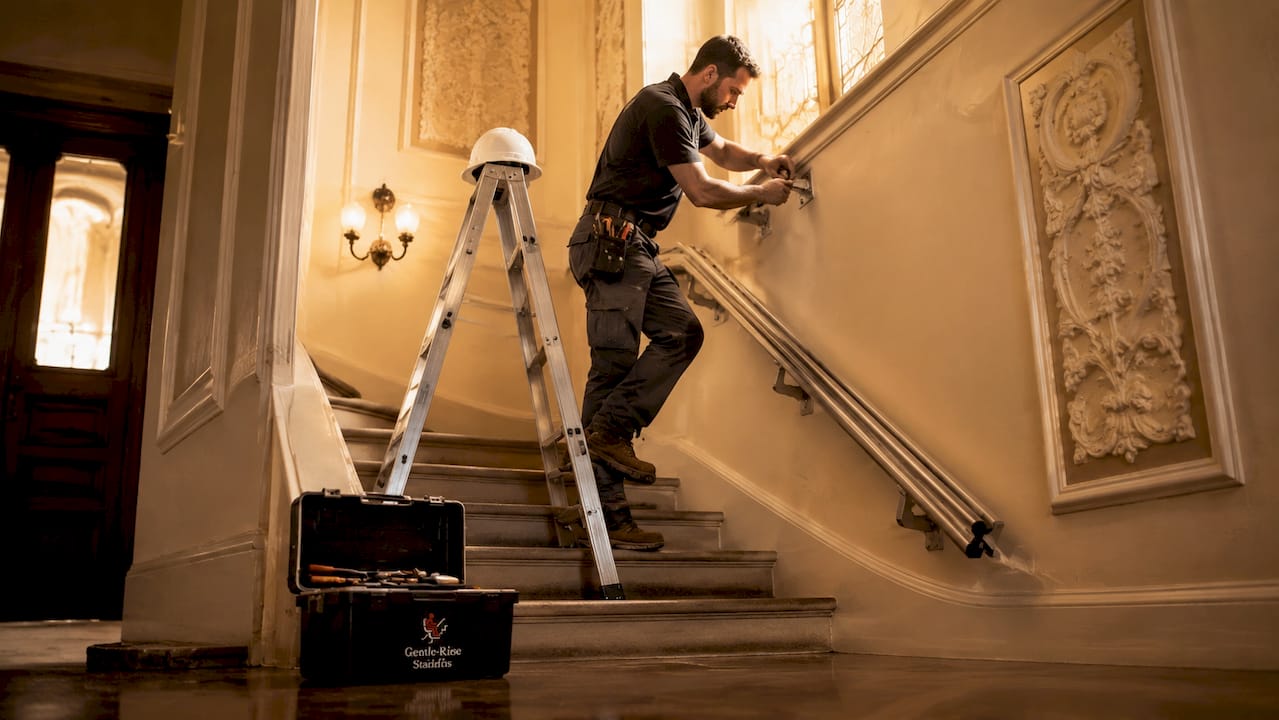
Listed buildings are the most common situation where additional consent is needed. If your home is Grade I, Grade II*, or Grade II listed in England and Wales, you will need Listed Building Consent before any stairlift installation, even for a fully internal unit. The reason is practical: fitting a stairlift typically involves drilling into stair treads, and in a listed property the staircase itself is often a protected historic feature. LBC is a separate application from planning permission and is free to submit. Decisions typically take 8–13 weeks, so factor that into your timeline. Your council's conservation officer is the right first point of contact; most are sympathetic to accessibility needs and will help you frame the application constructively.
Conservation areas are less restrictive for indoor stairlifts. Conservation area protection focuses primarily on external changes, so an internal stairlift is invisible from the street and generally raises no planning issues. The exception is outdoor stairlifts. If you are installing an external unit on the front or side of a property in a conservation area, particularly where it would be visible from a road or public footpath, planning permission may be required.
Key scenarios that require permission or LBC:
- Any stairlift installation in a listed building (LBC required).
- An outdoor stairlift on the front or side elevation of a property in a conservation area.
- An outdoor installation that requires additional construction such as new concrete pads or an external power supply box visible from outside.
- Any property subject to an Article 4 Direction removing standard permitted development rights.
For heritage properties, a track design that screws into existing balusters rather than drilling into stair treads tends to receive a more favourable response from conservation officers. It is worth discussing this with your installer before the application is submitted.
Building regulations: what compliance looks like in practice
Planning permission and building regulations are two separate things, and it is easy to conflate them. Even where no planning application is needed, stairlift installations must still meet relevant safety standards. The Planning Portal guidance confirms that stairlifts must be installed in line with BS EN 81-40:2020, the British and European standard covering safety requirements for stairlift installation.
In practice, this covers electrical safety, structural stability of the fixing points, and fire safety considerations. A qualified installer registered with a recognised competent person scheme will self-certify compliance, meaning you do not need to notify your local building control department separately. Choosing an installer who is a member of an industry body such as the British Healthcare Trades Association (BHTA) provides an additional layer of assurance that the work meets legal standards.
Key building regulation considerations for stairlift installations:
- Compliance with BS EN 81-40:2020 is mandatory for all stairlift installations.
- Electrical safety must meet current wiring regulations.
- The installer should be able to demonstrate competent person scheme membership or equivalent qualification.
- BHTA member installers provide assurance of adherence to industry codes of practice.
- Fire escape routes must not be obstructed by the installed equipment.
For a broader view of how permitted development rules interact with home improvement projects, it helps to understand the wider framework governing householder works.
Flats, maisonettes, and rented properties: different rules apply
If you live in a flat, maisonette, or rented home, the permitted development position changes considerably. Permitted development rights do not apply to flats or maisonettes, so the automatic consent that covers most houses simply does not exist for these property types.
For tenants, the situation requires an additional layer of approval. Even where planning permission is not needed, written landlord consent is required before any stairlift installation. This applies whether you rent from a private landlord, a housing association, or a local council. Leaseholders face a similar requirement: most leases include a clause prohibiting alterations without the freeholder's written consent, and a stairlift counts as an alteration regardless of how minor it appears.
Approvals and permissions to secure for flats, maisonettes, and rented homes:
- Written consent from your landlord or housing association before installation.
- Freeholder approval if you hold a leasehold interest in the property.
- Confirmation from the managing agent if the building has one.
- A check on whether the communal staircase (if relevant) falls under separate management rules.
If you are a tenant applying for a Disabled Facilities Grant to fund a stairlift, the grant process itself does not require planning permission, but your landlord's written agreement is still a prerequisite before any work can begin.
Ready to install? Gentlerise Stairlifts can help

For most UK homeowners, installing a stairlift is straightforward from a planning perspective. No application, no fees, no waiting. Gentlerise Stairlifts handles the full process, from your free home survey through to professional installation that meets all relevant building regulations. With stairlift solutions starting from £795 for straight models, and flexible rental options for short-term needs, there is an option to suit most budgets and circumstances. Get in touch today to book your free survey.
Key takeaways
Most UK homeowners can install an internal stairlift without planning permission, as stairlifts fall under permitted development rights, though listed buildings, conservation areas, and flats require additional consent.
| Point | Details |
|---|---|
| Permitted development applies to houses | Internal stairlifts in standard houses do not require a planning application. |
| Listed buildings need LBC | Listed Building Consent is required for any stairlift in a listed property, even internal ones. |
| Flats have no automatic rights | Permitted development rights do not cover flats or maisonettes; landlord consent is always needed. |
| BS EN 81-40:2020 is mandatory | All stairlift installations must comply with this safety standard regardless of planning status. |
| Article 4 Directions can change the rules | Local councils can withdraw permitted development rights; always check with your local authority first. |
FAQ
Do you need planning permission for a stairlift?
No. Planning permission is not required for an internal stairlift in a standard UK house, as it falls under permitted development rights. The only exceptions are listed buildings, certain conservation area outdoor installations, and properties subject to Article 4 Directions.
What counts as permitted development for stairlifts?
Permitted development covers internal stairlift installations in houses where no structural alterations are made and the work is reversible. It does not apply to flats, maisonettes, listed buildings, or areas where an Article 4 Direction has removed those rights.
Can you put a stairlift in a Grade II listed building?
You can, but you will need Listed Building Consent before any work begins. The application is free and is handled separately from planning permission, with decisions typically taking 8–13 weeks.
Does an outdoor stairlift need planning permission?
Outdoor stairlifts rarely require permission, but if the installation is on the front or side of a property in a conservation area and visible from a public road, you should check with your local planning authority before ordering.