
TL;DR:
- Mobility adaptation involves modifying homes to improve safety and independence for people with disabilities or age-related conditions. Minor adaptations are typically low-cost or free, while major structural changes can cost thousands and require formal approval. Starting the process early with an occupational therapist is crucial to securing funding and ensuring timely, effective home modifications.
Mobility adaptation is defined as the process of modifying a home to enable safer, more independent movement for people with physical disabilities or age-related conditions. These changes range from simple grab rails to major structural works such as stairlifts, widened doorways, and wet rooms. The industry term used by occupational therapists and local councils is "home adaptation," though "mobility adaptation" describes the same concept accurately. In the UK, government-backed funding through the Disabled Facilities Grant (DFG) makes many of these changes financially accessible. Understanding your options is the first step to reclaiming confidence and safety at home.
What is mobility adaptation and what types exist?
Mobility adaptation covers a wide spectrum of physical changes, from the very simple to the structurally complex. The distinction between minor and major adaptations matters because it directly affects cost, funding eligibility, and how quickly you can get help.
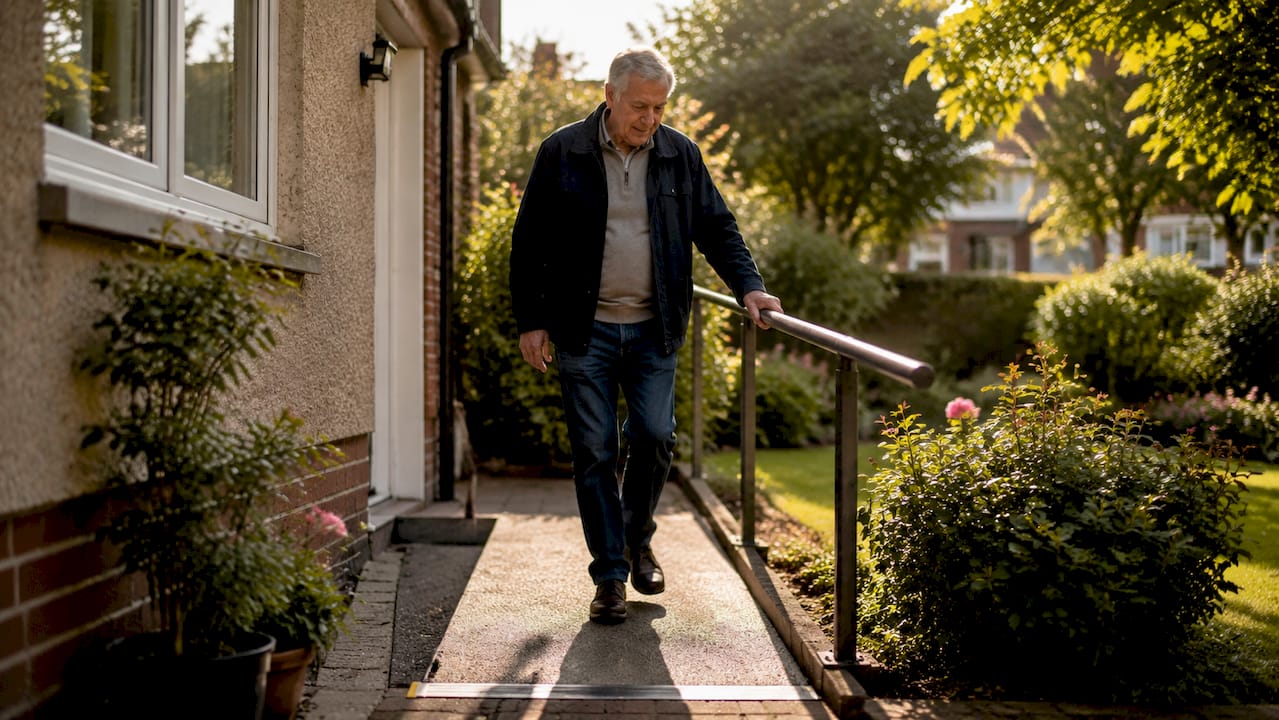
Minor adaptations cost under £1,000 and are often provided free by local authorities without a means test. Grab rails, door lever handles, and portable ramps fall into this category. Minor aids under £1,000 are frequently overlooked by people who assume every modification requires a lengthy grant application. They do not.
Major adaptations involve structural changes and carry significantly higher costs. Major adaptations cost between £3,500 and £18,000, depending on complexity. These include stairlifts, wet rooms, through-floor lifts, and widened doorways.
| Adaptation type | Typical cost | Typical installation time |
|---|---|---|
| Straight stairlift | £3,200 | 4–6 hours |
| Walk-in shower | £6,800 | 3–5 days |
| Permanent ramp | £2,800 | 1–2 days |
| Kitchen modifications | Varies | 5–10 days |
| Grab rails | Under £200 | Under 1 hour |
The table above draws on published UK installation data and reflects typical costs rather than fixed prices. Your actual quote will depend on property layout and specification.
Common mobility adaptation examples by room include:
- Stairs: stairlifts (straight or curved), through-floor lifts
- Bathroom: wet rooms, walk-in showers, raised toilet seats, grab rails
- Kitchen: lowered worktops, pull-out shelving, lever taps
- Doorways and hallways: widened doorways, ramps, threshold ramps
- Living areas: handrails, non-slip flooring, improved lighting
Pro Tip: When speaking to your local authority, ask specifically about affordable home mobility solutions for minor aids. These can often be arranged within days and at no cost to you.
How does the mobility adaptation process work?
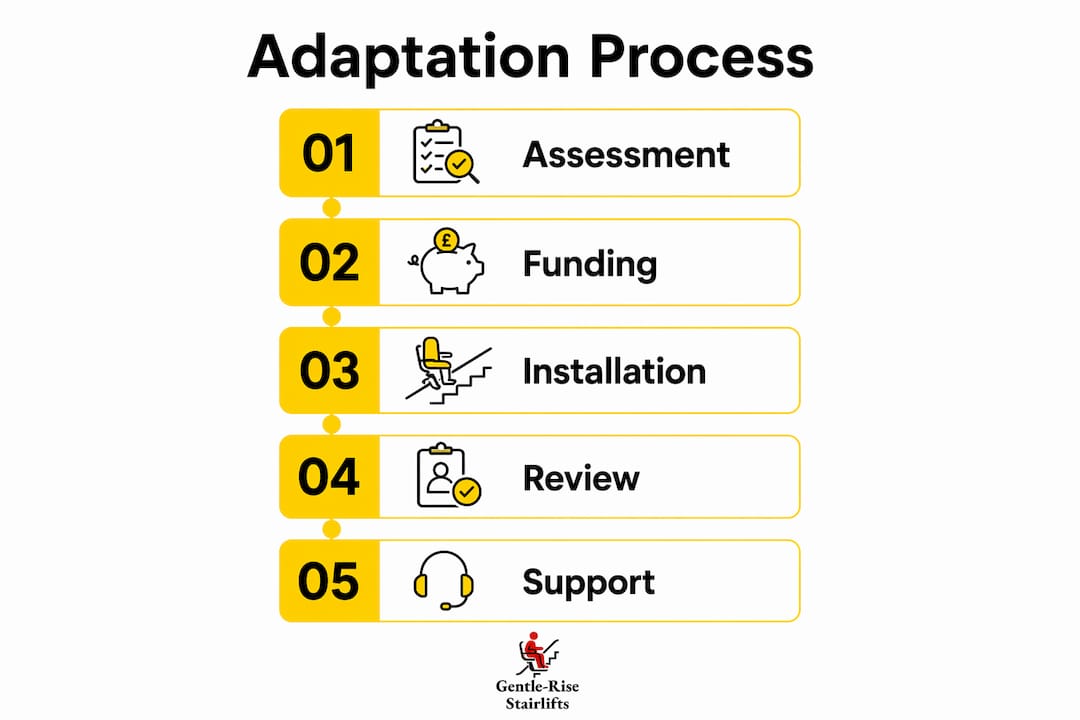
The process follows a clear sequence, though the timeline varies depending on the scale of work and your local council's capacity.
- Contact your local authority's adult social care team. Request a referral to an occupational therapist (OT). This is the starting point for almost all funded adaptations.
- Attend an OT assessment. The OT evaluates your ability to carry out essential daily living tasks at home. Frame your concerns around specific tasks such as bathing, using the toilet, and moving between floors. Framing your assessment around essential daily tasks improves prioritisation and leads to better outcomes.
- Receive the OT report and recommendations. The OT submits a formal report to the council, identifying which adaptations are necessary and practicable for your existing home.
- Apply for the Disabled Facilities Grant. The DFG application requires proof of ownership or tenancy, bank statements for means testing, contractor quotes, and the OT report. Councils must decide on valid applications within six months.
- Await formal written approval. Do not begin any work before receiving written consent from the council. Starting work before approval almost always results in losing grant funding eligibility entirely.
- Appoint an approved contractor and schedule works. Once approved, your council may provide a list of vetted contractors or allow you to source your own.
Pro Tip: If you rent your home, you must obtain your landlord's written consent before any structural adaptation work begins. Landlord approval is a legal requirement and delays caused by missing it can set your application back significantly.
What are the benefits of mobility adaptation for safety and independence?
Home adaptations are a preventative health measure, not simply a comfort upgrade. Government bodies classify adaptations as key to shifting care focus from acute hospital treatment to prevention at home. The practical benefits are substantial and well documented.
Home adaptations reduce the risk of falls, lower hospital admissions, and enable people to remain in their own homes for longer. The government endorses them as a core element of aging in place, reducing dependence on residential care and acute health services.
The benefits of mobility adaptation extend beyond physical safety:
- Fall prevention: Grab rails, non-slip flooring, and stairlifts directly reduce the risk of falls, which are the leading cause of injury-related hospital admissions among older adults in the UK.
- Aging in place: Adaptations allow people to remain in familiar surroundings rather than moving to residential care. This supports mental wellbeing and preserves social connections.
- Restored confidence: Many people report that a well-fitted stairlift or accessible bathroom restores their sense of control and dignity at home.
- Reduced carer burden: When a person can manage daily tasks independently, the physical and emotional load on family carers decreases significantly.
- Long-term cost savings: Preventing one fall-related hospital admission can cost the NHS thousands of pounds. Adaptations costing a few thousand pounds upfront deliver far greater value over time.
For a broader view of how age-friendly home modifications support safe independence, the evidence consistently points in one direction: early adaptation is better than delayed intervention.
What practical steps and challenges should you plan for?
Planning a mobility adaptation requires patience and attention to process. The most common mistakes are avoidable with the right preparation.
Start early. OT waiting lists in some areas run to several months. Requesting a referral as soon as a mobility challenge becomes apparent gives you the best chance of timely support.
Understand funding limits. The DFG covers adaptations up to a set maximum grant amount. If your adaptation costs exceed this, you may need to contribute personally. Local authorities have discretionary power to provide additional financial help when DFG limits or means test requirements create a gap. Ask your social care team explicitly about discretionary funding.
Do not start work prematurely. This bears repeating because it is the single most costly mistake applicants make. Formal written council approval must precede any adaptation work. Starting early disqualifies you from grant funding.
Key considerations to keep in mind:
- Get at least two contractor quotes before submitting your application.
- Check whether your property is listed or in a conservation area, as this affects what structural changes are permitted.
- Confirm with your council whether they require a specific approved contractor list.
- Factor in disruption time. A wet room installation takes 3–5 days; kitchen modifications can take up to 10 days.
Pro Tip: Councils are legally required to consider adaptations necessary and practicable for your existing home. They cannot refuse a grant simply because alternative housing might be more suitable. If you receive a refusal that cites housing alternatives, you have grounds to challenge it.
Before committing to any major work, a home safety assessment can help identify which areas of your property carry the greatest risk, giving you a clearer brief for your OT and contractor.
What are effective mobility adaptation strategies by challenge type?
The right adaptation depends entirely on the specific mobility challenge, not on a generic checklist. A person recovering from hip surgery has different needs from someone managing a progressive neurological condition. Matching the adaptation to the actual barrier is the core of any sound strategy.
| Mobility challenge | Recommended adaptation | Key consideration |
|---|---|---|
| Difficulty using stairs | Straight or curved stairlift | Stair width and shape determine model |
| Unsafe bathing | Wet room or walk-in shower | Drainage and floor gradient are critical |
| Limited grip strength | Lever taps, grab rails | Low cost, often free through local authority |
| Restricted kitchen access | Lowered worktops, pull-out storage | May require OT assessment for DFG eligibility |
| Narrow doorways | Doorway widening | Requires landlord consent if renting |
Incremental planning works better than attempting everything at once. Start with the adaptation that addresses the most immediate safety risk, then build from there as needs evolve. A stairlift installed today does not prevent you from adding a wet room next year. Flexibility in planning means your home can adapt as your needs change, rather than requiring a complete overhaul at a single point.
For people exploring home mobility planning in detail, the most effective approach combines an OT assessment with a clear priority list, ranked by safety impact and daily frequency of use.
Key takeaways
Mobility adaptation is the most direct way to reduce fall risk, preserve independence, and avoid residential care. The process works best when you start early, engage an occupational therapist, and never begin work before receiving formal council approval.
| Point | Details |
|---|---|
| Minor adaptations are often free | Aids costing under £1,000 are frequently provided by local authorities without a means test. |
| OT assessment is the gateway | No funded major adaptation proceeds without an occupational therapist's formal report. |
| Never start work early | Beginning adaptation work before written council approval disqualifies you from DFG funding. |
| Discretionary funding exists | Local social care authorities can top up DFG funding when grant limits fall short of actual costs. |
| Match adaptation to the challenge | Select adaptations based on your specific daily barriers, not a generic list of modifications. |
Why I think most people approach mobility adaptation the wrong way
The most common mistake I see is people treating mobility adaptation as a last resort. They wait until a fall happens, or until a hospital discharge forces the issue, and then they are scrambling to arrange assessments, funding, and installation under pressure. That reactive approach costs more, takes longer, and produces worse outcomes.
The OT assessment is not a bureaucratic hurdle. It is the most useful conversation you can have about your home and your safety. When you frame it around specific daily tasks rather than vague mobility concerns, the recommendations become far more targeted and the funding case becomes far stronger.
Funding is less of a barrier than most people assume. Between the DFG, discretionary social care support, and providers like Gentlerise Stairlifts offering options from £795, there is a realistic path forward for most budgets. The gap between needing an adaptation and having one installed is almost always a planning gap, not a money gap.
My honest advice: request the OT referral now, before the situation becomes urgent. The waiting list will not get shorter, and your home will not get safer on its own.
— lee
How Gentlerise Stairlifts supports your mobility adaptation
Stairlifts are one of the most requested and most impactful mobility adaptations in UK homes. Gentlerise Stairlifts specialises in the installation, rental, and refurbishment of stairlifts for straight and curved staircases, with prices starting at £795 for straight models.

Every installation begins with a free home survey, so you receive a solution fitted to your specific staircase and needs. Gentlerise Stairlifts also offers short-term rental options for people recovering from surgery, and the Protect+ maintenance programme for ongoing aftercare. Whether you are at the early planning stage or ready to proceed, Gentlerise Stairlifts can provide a no-obligation quote and guide you through the process from assessment to installation.
FAQ
What is mobility adaptation in simple terms?
Mobility adaptation is the modification of a home to make it safer and more accessible for people with physical disabilities or reduced mobility. Examples include stairlifts, grab rails, widened doorways, and walk-in showers.
Does the Disabled Facilities Grant cover stairlifts?
Yes. Stairlifts are a recognised major adaptation under the DFG. An occupational therapist must confirm the need, and the council must approve the application before any installation begins.
How long does a mobility adaptation take to install?
Installation time depends on the adaptation. A straight stairlift takes 4–6 hours, a wet room takes 3–5 days, and kitchen modifications can take up to 10 days.
Can tenants apply for mobility adaptations?
Yes, but tenants must obtain their landlord's written consent before any structural work begins. Without this consent, the DFG application cannot proceed.
What if the DFG does not cover the full cost?
Local authorities have discretionary power to provide additional financial support when DFG funding or personal contributions are insufficient to meet the full cost of a necessary adaptation.