
TL;DR:
- Inclusive mobility ensures equal, safe, and reliable access for all, including people with disabilities and older adults.
- It requires a combination of physical infrastructure, digital equity, and supportive policies to create truly accessible transportation systems.
Inclusive mobility is defined as the design and delivery of transportation systems that provide equitable, safe, and reliable access for every individual, including people with disabilities, older adults, and low-income users. The term sits within the broader field of universal design, and transport professionals increasingly use "accessible transport" and "mobility for all" as interchangeable industry terms. Three pillars underpin the concept: physical accessibility, digital equity, and geographic and economic reach. Each pillar must function together. A bus with a wheelchair ramp but no audible stop announcements fails two of the three. The UN Convention on the Rights of Persons with Disabilities sets the international standard, requiring states to ensure accessible transportation on equal terms with the general population.
What is inclusive mobility and what does it actually cover?
Inclusive mobility covers far more than physical infrastructure. Effective inclusive mobility strategies extend to pre-journey information, staff travel awareness training, and accommodations for non-visible disabilities such as quiet zones and audible or visual aids. The definition therefore spans infrastructure, vehicles, services, and policy in equal measure.
Physical infrastructure
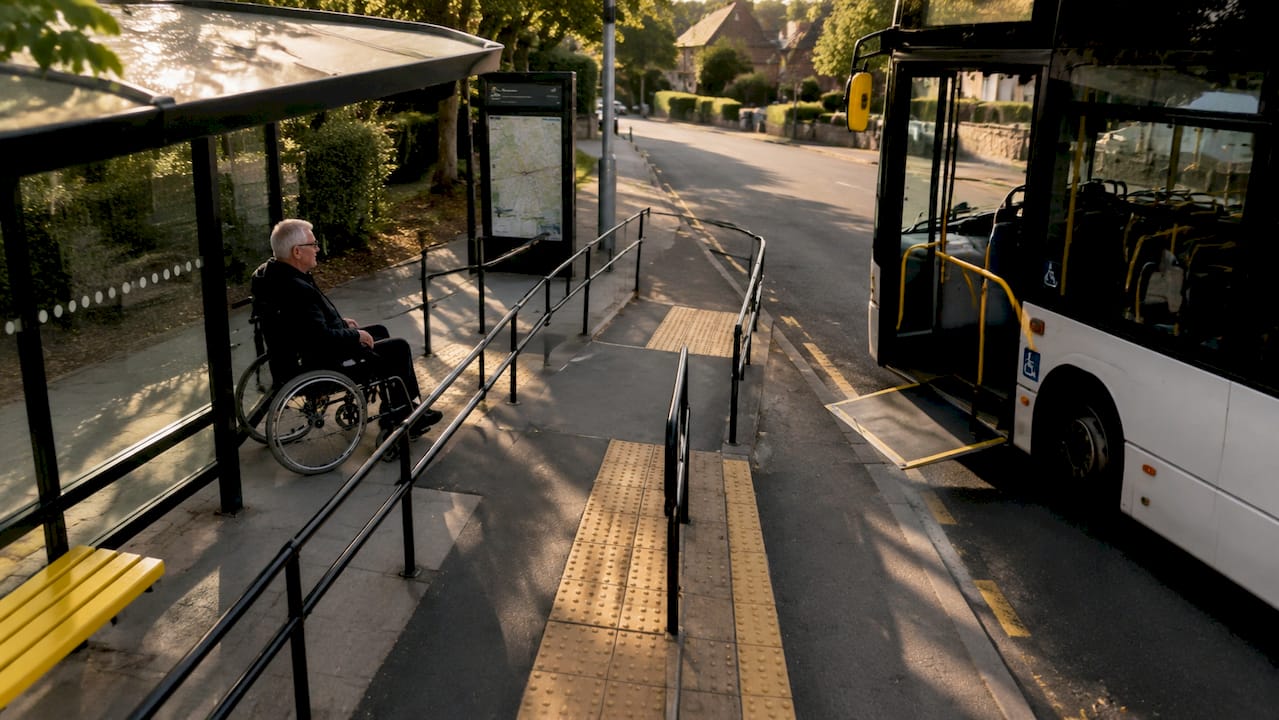
Barrier-free infrastructure is the most visible component. Ramps, tactile paving, step-free station access, dropped kerbs, and adequate seating all fall under this category. Peri-urban areas consistently lag behind city centres in delivering these features, which means rural and suburban residents with mobility challenges face compounded disadvantage.
Vehicle accessibility
Accessible vehicles include dedicated wheelchair spaces, handholds at varying heights, audible next-stop announcements, and real-time visual displays. These features serve wheelchair users, people with visual or hearing impairments, and older adults who may struggle with sudden movement. Designing vehicles to serve all these groups simultaneously is the practical expression of universal design.
Service and policy elements
Policy sets the conditions under which physical and vehicle improvements actually work. Zero-tolerance harassment policies protect disabled travellers from abuse. Affordability measures prevent economic exclusion. Trained staff who understand both visible and non-visible disabilities convert compliant infrastructure into genuinely usable services.
Pro Tip: When auditing a transport service for inclusivity, test it without a smartphone. If a passenger cannot complete a journey using only printed information and staff assistance, the service fails the digital equity test.
Why do ramps alone not deliver inclusive transportation?
Ramps address one barrier. Inclusive mobility is a socio-technical challenge requiring institutional alignment across hardware, human behaviour, and digital systems. Most organisations fail by treating accessibility as a compliance checklist rather than a user experience goal.
Non-visible disabilities illustrate this gap clearly. Conditions such as autism, chronic fatigue, anxiety disorders, and Crohn's disease create real travel barriers that no ramp addresses. A passenger with severe anxiety needs predictable environments, clear signage, and staff who respond calmly to distress. A passenger with Crohn's disease needs guaranteed access to toilet facilities. Neither need is met by physical infrastructure alone.
Digital equity compounds the problem. Compliance with minimum accessibility standards does not equal inclusive mobility. Digital-only ticketing systems exclude users with low digital literacy or no internet access, requiring parallel low-tech services to maintain genuine inclusivity. Older adults and people in lower-income households are disproportionately affected by digital-only service models.
Gendered barriers add another layer. Nearly 50% of women with disabilities experience accessibility barriers, compared with 35% of men. That gap reflects differences in journey patterns, safety concerns, and the types of destinations women with disabilities most commonly need to reach.
The practical implication is clear. Organisations must address four dimensions simultaneously:
- Physical infrastructure: ramps, lifts, tactile surfaces, and seating
- Human factors: staff training on visible and non-visible disabilities, support animal access, and harassment response
- Digital equity: parallel non-digital service channels alongside app-based options
- Institutional alignment: policies, budgets, and governance structures that sustain improvements over time
Pro Tip: Pilot any new accessibility feature with a group of disabled users before full rollout. Paper prototyping and small-scale trials catch failures that infrastructure audits miss entirely.
How is inclusive mobility measured and evaluated?
Measurement separates genuine progress from compliance theatre. Accessibility metrics in 2025 include staff interaction quality, real-time information accessibility, and last-mile connectivity. Peri-urban areas report accessibility rates of approximately 46%, compared with approximately 99% in urban areas. That gap quantifies the scale of the problem for planners and funders.
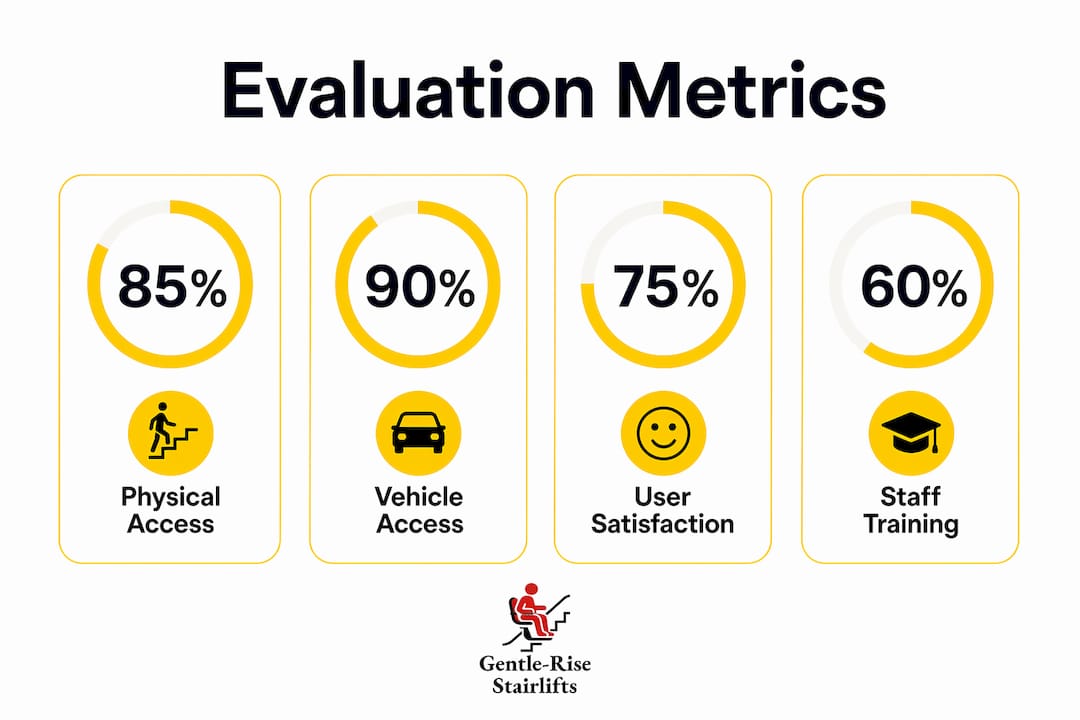
Combining static measurements with user-assessment surveys captures dynamic barriers that standard audits miss. Uneven pavements, temporary construction works, and poorly maintained lifts all appear in user feedback before they appear in infrastructure reports. This combined method produces richer data than either approach alone.
The table below summarises the main evaluation metrics and what each one reveals.
| Metric | What it measures | Why it matters |
|---|---|---|
| Physical accessibility rate | Proportion of stops or stations with step-free access | Reveals infrastructure gaps by geography |
| Staff interaction quality | User-rated helpfulness and disability awareness | Captures human experience beyond hardware |
| Real-time information access | Availability of live updates via audio, visual, and print | Identifies digital exclusion risks |
| Last-mile connectivity | Accessible options between transport hubs and final destinations | Exposes gaps that urban metrics hide |
| Complaint and incident rate | Volume and type of accessibility complaints | Tracks systemic failures over time |
Rail accessibility complaints have remained steady at approximately 1.5% from 2020 to 2024. That figure suggests infrastructure improvements have not yet translated into measurable reductions in user dissatisfaction, pointing to the service and human factors that physical upgrades cannot fix.
What practical steps can organisations take to implement inclusive mobility?
Implementation requires deliberate choices, not just goodwill. The most successful transit agencies involve people with disabilities and older adults directly in planning processes, shifting from planning for to planning with these groups. That shift builds trust and produces better outcomes.
Universal design benefits not only people with disabilities but also a rapidly ageing population. Barrier-free crossings, noise reduction, and clear wayfinding improve mobility for all residents. Framing inclusivity as a universal benefit strengthens the political and financial case for implementation.
The following steps give organisations a practical starting point:
- Involve disabled users from the start. Recruit people with a range of disabilities, including non-visible conditions, to co-design services and review proposals before they are finalised.
- Adopt universal design principles. Design for the most demanding user case and the result works for everyone. A step-free entrance serves wheelchair users, parents with pushchairs, and delivery workers equally.
- Train all staff, not just frontline teams. Managers, planners, and procurement staff all make decisions that affect accessibility. Training must reach every level.
- Maintain parallel service channels. Every digital service needs a non-digital equivalent. Phone lines, printed timetables, and in-person assistance are not legacy options. They are accessibility requirements.
- Address intersectional factors. Gender, income, ethnicity, and age all interact with disability to shape travel experience. Inclusive planning accounts for these overlapping factors rather than treating disability as a single, uniform category.
- Set measurable targets and publish results. Accountability requires public reporting. Organisations that publish accessibility data annually improve faster than those that do not.
For households, adaptive home mobility solutions apply the same principles at a residential scale, ensuring that inclusive access extends beyond public transport into the places where people actually live.
Key takeaways
Inclusive mobility requires physical, digital, human, and policy changes working together. No single intervention delivers genuine accessibility for all.
| Point | Details |
|---|---|
| Three-pillar definition | Inclusive mobility rests on physical accessibility, digital equity, and geographic and economic reach. |
| Beyond physical compliance | Ramps and lifts address one barrier; staff training, digital equity, and policy alignment address the rest. |
| Gendered and intersectional gaps | Women with disabilities face higher accessibility barriers than men, requiring targeted planning responses. |
| Measurement matters | Combining static audits with user-assessment surveys captures dynamic barriers that infrastructure checks miss. |
| Plan with, not for | Involving disabled users directly in planning produces better outcomes and builds lasting trust. |
Why inclusive mobility is still misunderstood
The most persistent mistake I see in transport planning is treating inclusive mobility as a compliance exercise. Organisations install a ramp, tick a box, and move on. The ramp may be there, but the lift is broken, the staff member on duty has never been trained to assist a wheelchair user, and the real-time information screen is showing the wrong platform. The physical feature exists. The accessible journey does not.
What actually works is starting with the user experience and working backwards to the infrastructure. I have seen small transit operators with modest budgets outperform well-funded agencies simply because they asked disabled passengers what was wrong and then fixed it. That process is not expensive. It requires listening, not capital.
Technology gets oversold in this space. Real-time journey apps and AI-powered routing tools are genuinely useful, but only for passengers who have a smartphone, a data connection, and the digital confidence to use them. For everyone else, they are irrelevant. The organisations that get this right invest in technology and maintain the phone line, the printed timetable, and the trained human being at the information desk.
Inclusive mobility also benefits people who do not identify as disabled. A parent with a pushchair, a delivery worker with a heavy trolley, a teenager with a broken leg. Age-friendly home modifications follow the same logic at a domestic level. When you design for the hardest case, you improve the experience for everyone. That is not a side effect. It is the point.
— lee
Gentlerise Stairlifts and inclusive mobility at home
Inclusive mobility does not stop at the front door. For many people with disabilities and older adults, the stairs inside their own home present the most significant daily barrier they face.

Gentlerise Stairlifts specialises in making home mobility accessible and affordable across the UK. With stairlift solutions starting at £795 for straight models, and options including curved, reconditioned, and rental stairlifts, Gentlerise Stairlifts covers the full range of residential needs. Installation often completes within hours, and the Protect+ maintenance programme provides ongoing safety assurance. If you are extending inclusive mobility principles into your home, a free home survey from Gentlerise Stairlifts is the practical next step.
FAQ
What is the definition of inclusive mobility?
Inclusive mobility is the design and delivery of transportation systems that provide equitable, safe, and affordable access for all individuals, including people with disabilities, older adults, and low-income users. It rests on three pillars: physical accessibility, digital equity, and geographic and economic reach.
Why is inclusive mobility important?
Inclusive mobility determines whether people can reach employment, healthcare, education, and social connections. Without it, people with disabilities and older adults face systematic exclusion from public life, regardless of legal protections.
What are the main barriers to inclusive mobility?
The main barriers include inaccessible physical infrastructure, poorly trained staff, digital-only service channels that exclude users without smartphones, and a lack of provision for non-visible disabilities such as autism or chronic illness.
How do you measure inclusive mobility effectively?
Effective measurement combines static infrastructure audits with user-assessment surveys that capture dynamic barriers such as broken lifts and uneven pavements. Key metrics include physical accessibility rates, staff interaction quality, real-time information access, and complaint volumes.
Does inclusive mobility apply to home environments?
Inclusive mobility principles apply directly to residential settings. Features such as stairlifts, ramps, and family mobility adaptations extend accessible travel into the home, ensuring people can move safely between floors and rooms without assistance.