

TL;DR:
- A mobility review evaluates how safely and independently a person moves at home, guiding tailored safety solutions. Regular assessments every six months, or after a health change, help prevent falls and ensure equipment matches current needs. The resulting report supports funding applications and often leads to practical home adaptations like stairlifts and grab rails.
A mobility review is a formal assessment conducted by a qualified occupational therapist or healthcare professional to evaluate how safely and independently a person moves within their home. The process examines physical ability, the home environment, and daily tasks together. The goal is not to find fault but to identify practical changes that restore confidence and reduce risk. For anyone considering mobility assistance at home, understanding what a mobility review involves is the first step toward making genuinely informed decisions about aids and adaptations.
What is a mobility review and what does it assess?
A mobility review, also called an occupational therapy assessment in formal NHS and Health and Care Professions Council (HCPC) settings, is a structured evaluation of how a person performs everyday physical tasks. The two terms are used interchangeably in UK healthcare, though "mobility review" is the phrase most people use when speaking with their GP or local authority. Knowing both terms helps you ask the right questions.
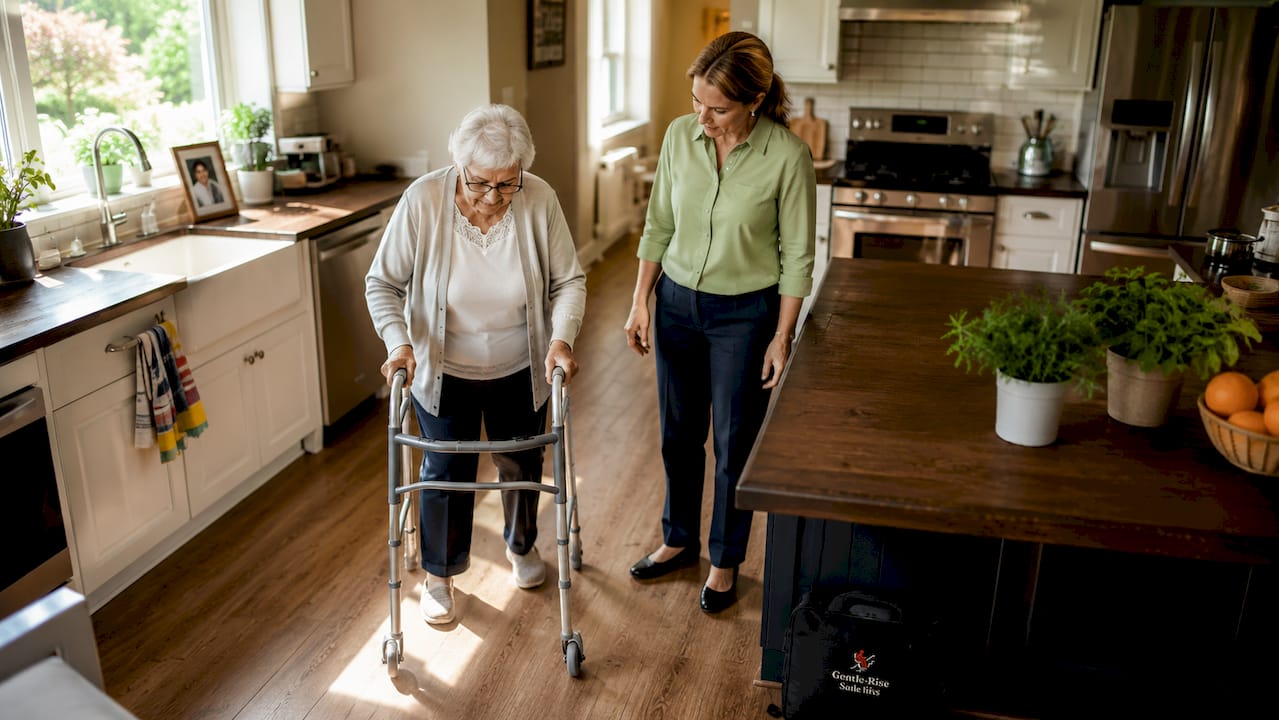
The assessment covers three interconnected areas: the person, the task, and the environment. This triad is the foundation of every professional mobility review. A thorough environmental assessment can reveal that a simple change, such as repositioning furniture or adding a grab rail, delivers a significant safety gain without any major expenditure.
A typical home visit lasts 60–90 minutes. That duration reflects the depth required. The occupational therapist observes the person moving through their actual living space, not a clinical simulation, which produces far more accurate recommendations.
What happens during the mobility review process?
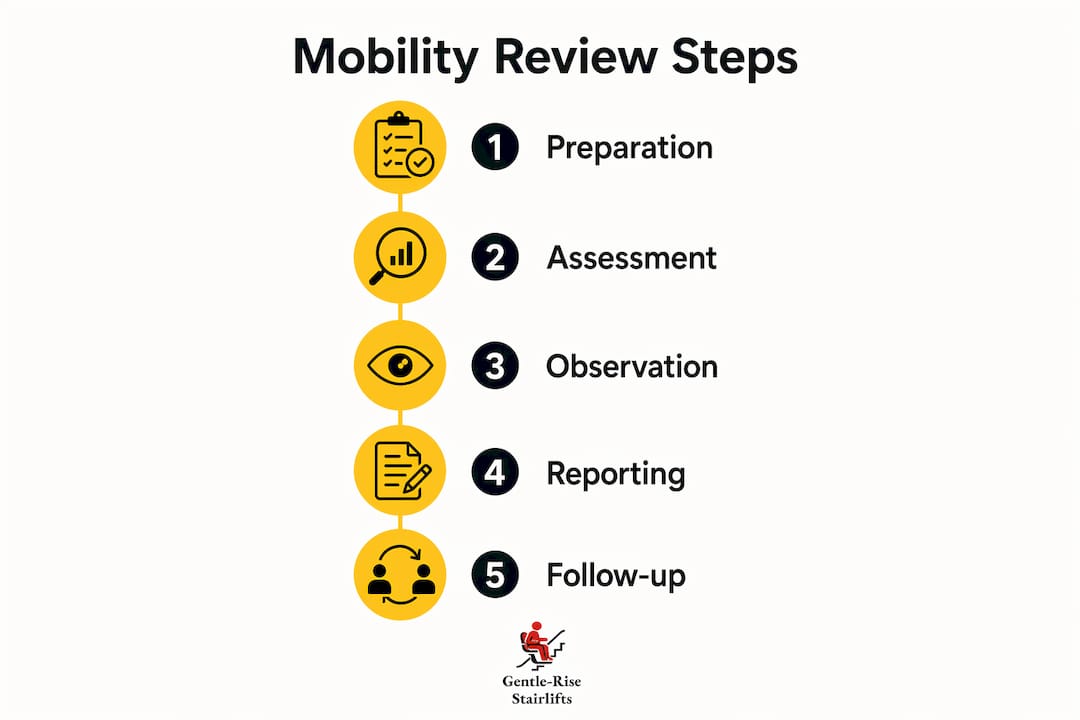
The review follows a clear sequence. Each step builds on the last to produce a complete picture of need.
-
Initial conversation. The therapist asks about your daily routine, medical history, current aids, and any recent falls or near misses. This sets the context for everything that follows.
-
Observation of daily tasks. You are asked to perform activities such as climbing stairs, moving from a chair, using the bathroom, and navigating the kitchen. The therapist watches how you manage, not whether you can manage.
-
Standardised mobility tests. The Timed Up and Go (TUG) test is one of the most widely used tools. A completion time of over 12 seconds indicates an increased fall risk. That single number gives the therapist an objective baseline to compare against future reviews.
-
Home environment evaluation. The therapist checks floor surfaces, lighting, stair dimensions, bathroom layout, and external access. Small hazards that feel normal to you often stand out immediately to a trained eye.
-
Written report and recommendations. The assessment ends with a formal document. It outlines findings, identifies risks, and recommends specific aids, adaptations, or referrals. This report carries clinical weight and is used in funding applications.
Pro Tip: Prepare a short written list of the tasks you find difficult before the visit. Therapists appreciate specific examples, and it prevents you from forgetting key concerns in the moment.
The person, task, and environment framework means the therapist is not simply looking at your body. They are looking at how your body interacts with your specific home. That distinction matters because two people with identical diagnoses can need entirely different solutions.
Why are regular mobility reviews important?
A single assessment captures one moment in time. Mobility changes, and the review schedule should reflect that.
Formal mobility assessments for at-risk individuals should be conducted at least every six months when mobility is stable. That regularity catches gradual decline before it becomes a crisis. Waiting until a fall occurs means the risk was already present and unaddressed.
Situations that require an immediate reassessment include:
- A fall, even one that caused no injury
- A new diagnosis or significant change in an existing condition
- Recovery from surgery or a hospital stay
- A noticeable change in balance, strength, or confidence on stairs
- Moving to a new home or significant home renovation
Failing to request reassessment after a fall or health change increases risk and delays necessary adaptations. The gap between a change in need and an updated care plan is where accidents happen.
The benefits of regular mobility assessments extend beyond physical safety. A current, accurate assessment keeps your equipment matched to your actual needs. An aid that suited you two years ago may now be inadequate or even counterproductive. Reviews also update the clinical record, which strengthens any future funding applications you make.
How do mobility reviews support funding and home adaptations?
A mobility review report is a clinical document. It carries far more weight in funding applications than a personal statement or a supplier's recommendation.
Occupational therapist reports are critical in securing Disabled Facilities Grants and similar local authority funding. They provide independent, clinical justification for adaptations such as stairlifts, level-access showers, and widened doorways. Without that report, many grant applications stall or fail.
The independence of the occupational therapist is a key feature of the process. Occupational therapists are independent of equipment suppliers and act as advocates to find cost-effective solutions tailored to your home. That independence means their recommendations are unbiased. They have no financial reason to suggest one product over another.
Common adaptations recommended following a mobility review include:
| Adaptation type | Typical purpose |
|---|---|
| Grab rails and handrails | Improve balance on stairs, in bathrooms, and at doorways |
| Stairlifts (straight or curved) | Restore safe access between floors |
| Level-access or wet-room showers | Eliminate step-over bath or shower tray hazards |
| Raised toilet seats and frames | Reduce strain when sitting and standing |
| Ramp installation | Provide safe external access for wheelchair or walking aid users |
A mobility care plan produced after the review outlines specific goals and interventions. That document guides both the individual and any care professionals involved in their support.
Pro Tip: Ask the occupational therapist to include the Disabled Facilities Grant reference explicitly in their report. Councils process applications faster when the relevant funding pathway is named in the clinical document.
If your review identifies the need for major home adaptations, it is worth exploring home improvement grant options alongside the occupational therapist's report to understand what financial support may be available.
Common misconceptions about mobility reviews
The most damaging misconception is that a mobility review is simply a route to obtaining free equipment. Occupational therapists emphasise that families often misunderstand mobility assessments in exactly this way. The review is a safety and independence consultation first. Equipment recommendations are one possible outcome, not the purpose.
A second misconception is that you need to be in crisis before requesting a review. The opposite is true. Mobility reviews are proactive assessments aimed at uncovering functional independence factors before problems escalate. Requesting one early gives you more options and more time to implement changes thoughtfully.
"UK healthcare standards require mobility reviews to be person-centred, prioritising dignity, preferences, and lifestyle over only clinical safety measures. The review is about your life, not just your limitations."
Practical advice for getting the most from your assessment:
- Bring a family member or advocate if you feel uncertain about speaking up
- Write down your goals, not just your difficulties. What do you want to be able to do?
- Ask the therapist to explain each recommendation before you leave
- Request a copy of the written report for your own records
- If your needs change before the next scheduled review, contact your GP or local authority to request an earlier reassessment
The age-friendly home modifications that follow a review are most effective when the individual has been actively involved in the assessment conversation. Your knowledge of your own home and daily routine is information the therapist cannot gather from observation alone.
Key takeaways
A mobility review is the most direct route to safe, independent living at home because it combines clinical assessment, environmental analysis, and personalised recommendations into a single, fundable action plan.
| Point | Details |
|---|---|
| Definition and purpose | A mobility review assesses physical ability, daily tasks, and home environment to recommend safe, tailored solutions. |
| TUG test threshold | A Timed Up and Go score over 12 seconds signals increased fall risk and triggers specific recommendations. |
| Review frequency | Stable individuals should be reassessed every six months; reassess immediately after any fall or health change. |
| Funding support | An occupational therapist's report is the key document for Disabled Facilities Grant and council funding applications. |
| Person-centred approach | UK healthcare standards require reviews to prioritise dignity and lifestyle goals, not only clinical safety metrics. |
Why I think most people wait too long for a mobility review
The pattern I see most often is this: someone waits until after a fall, or until they are genuinely frightened on the stairs, before they ask for an assessment. By that point, the risk has already materialised. The review becomes reactive rather than preventive, and the options available are narrower.
What strikes me most about well-conducted mobility reviews is how often the recommendations are smaller than people expect. A repositioned handrail, a non-slip mat removed from a hazardous position, a raised chair. These are not dramatic interventions. They are the kind of changes that take an afternoon to implement and then quietly protect someone for years.
The families I speak with who delay assessments often do so because they associate the process with loss of independence. The reality is the opposite. A review that identifies a stairlift as the right solution does not signal decline. It signals that someone has chosen to stay in their home safely, on their own terms.
My advice is to treat a mobility review the way you treat a dental check-up. You do not wait for pain before you go. You go regularly, you catch small problems early, and you leave with a clear picture of where you stand. The home mobility survey process works the same way. The earlier you engage, the more control you retain.
— lee
Gentlerise Stairlifts: support after your mobility review
A mobility review often identifies stairlifts as the right solution for safe access between floors. Gentlerise Stairlifts works with individuals across the UK who have received that recommendation and want to act on it without delay.

Gentlerise Stairlifts offers straight, curved, and reconditioned stairlift models, with prices starting at £795 and installation often completed within hours. The Protect+ maintenance programme provides ongoing aftercare, so your stairlift remains safe and reliable long after fitting. Rental options are also available for short-term needs. If your assessment has pointed toward a stairlift, explore your stairlift options with Gentlerise Stairlifts and arrange a free home survey at a time that suits you.
FAQ
What is a mobility review in the NHS?
A mobility review in the NHS is a formal occupational therapy assessment that evaluates how safely a person moves at home. It typically lasts 60–90 minutes and results in a written report with recommendations for aids, adaptations, or further referrals.
How often should a mobility review be carried out?
Stable individuals should receive a formal mobility assessment at least every six months. An immediate reassessment is required after any fall, new diagnosis, or significant change in physical condition.
Can a mobility review help me get a stairlift funded?
Yes. An occupational therapist's report provides the independent clinical justification required for Disabled Facilities Grant applications and local authority funding for home adaptations, including stairlifts.
What is the Timed Up and Go test used in mobility reviews?
The Timed Up and Go (TUG) test measures how long it takes a person to stand from a chair, walk three metres, turn, and sit back down. A time of over 12 seconds indicates an increased fall risk and informs the therapist's recommendations.
Do I need a GP referral to request a mobility review?
You can request a mobility review through your GP, a community occupational therapy team, or directly through your local authority's adult social care department. A GP referral is the most common route but is not always required.