
TL;DR:
- A folding rail is a hinged section that clears the bottom landing of a stairlift, improving safety and space.
- The choice between manual and powered folding rails depends on the user's mobility, with powered options offering more independence.
A folding rail is a movable section at the end of a stairlift track, designed to fold away and clear the space at the bottom of the stairs for safe, unobstructed access. Without one, the rail can extend into a hallway or doorway, creating a tripping hazard for anyone walking past. For many homes with narrow entrances or busy ground-floor corridors, a folding rail is the difference between a stairlift that works for the whole household and one that causes daily frustration. Gentlerise Stairlifts assesses every home individually to determine whether a folding rail is genuinely needed or whether a simpler rail configuration will do the job just as well.
What is a folding rail, and how does it work?
A folding rail, known in the industry as a hinged rail extension, is a short section of stairlift track that pivots upward or folds flat when the lift is not in use. The rail sits at the bottom landing and, when deployed, allows the stairlift carriage to travel the full length of the stairs. When folded, it clears the floor space so people can walk freely past the foot of the staircase.
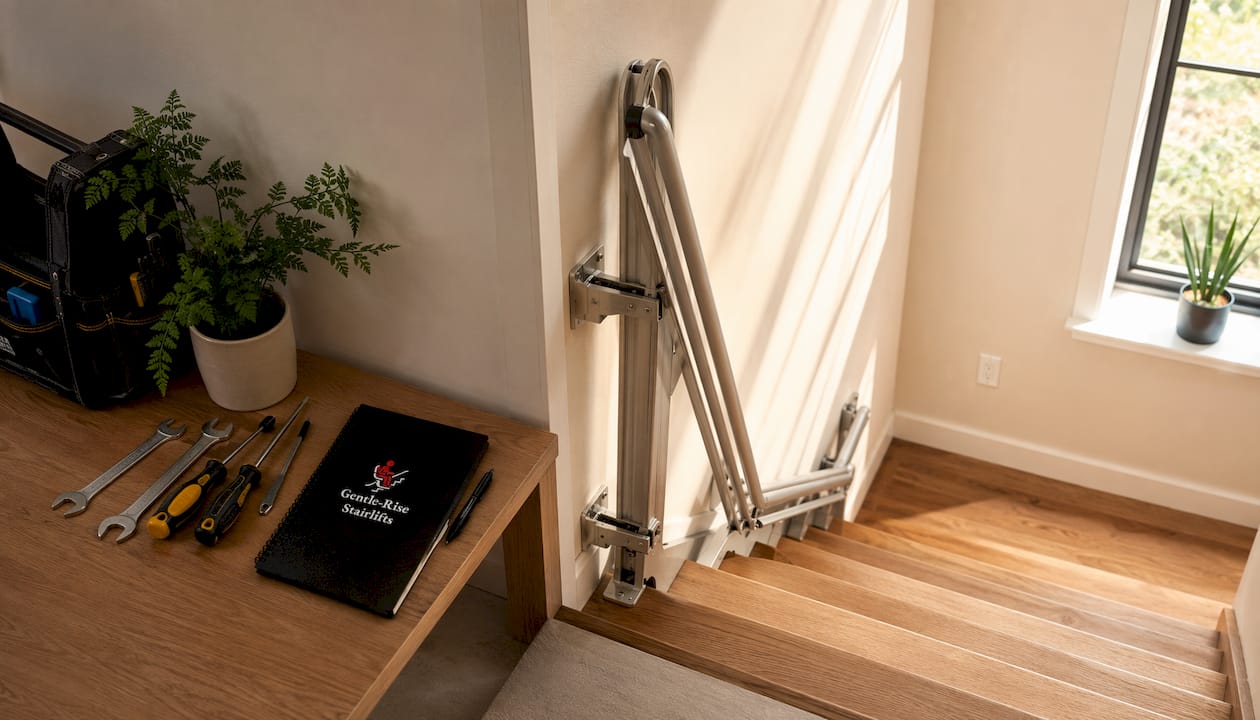
The mechanism matters because the bottom landing is typically the most trafficked area in a home. A fixed rail that juts into a hallway or sits across a doorway creates a genuine tripping hazard at the landing, particularly for older adults or anyone with reduced vision. Folding the rail away removes that risk entirely.
Not every staircase needs one. Where the wall extends 30–40cm beyond the bottom step, the rail can often be cut short or angled to avoid obstruction without any folding mechanism at all. A professional home survey identifies this quickly, which is why Gentlerise Stairlifts offers free surveys before recommending any configuration.
What are the main types of folding rails?
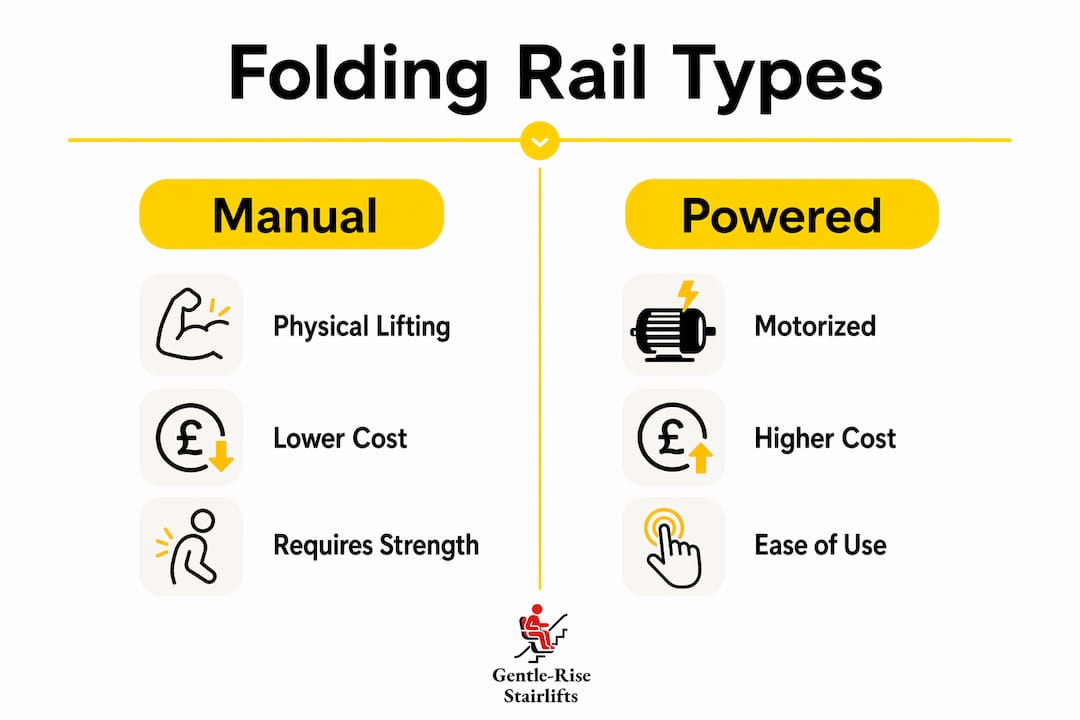
Two main types of folding rail exist: manual and powered. Each suits a different type of user, and the choice has real consequences for both safety and daily convenience.
Manual folding rails
A manual folding rail requires the user, or a household member, to physically lift and lower the rail section by hand. The mechanism is straightforward and adds less cost to the overall installation. The trade-off is physical effort.
Manual rails require bending and manipulation of the rail, which can be hazardous for people with limited mobility, balance problems, or joint pain. This is a genuine concern. A stairlift exists to reduce physical strain, and a manual folding rail can contradict that purpose if the person using it struggles to operate it safely.
Manual rails suit households where a carer or family member will reliably manage the rail, or where the person using the stairlift has sufficient upper body strength and balance to do so without risk.
Powered folding rails
A powered folding rail operates automatically. It folds and unfolds via a motor, controlled by a remote handset or integrated into the stairlift's own controls. Powered rails enhance independence by removing any need for manual effort, which makes them the better choice for most people with significant mobility challenges.
The cost reflects this added functionality. Adding a folding rail to a stairlift installation typically costs £200–£500, with powered versions sitting at the higher end of that range. That figure is worth weighing against the daily benefit of not having to bend down to manage the rail.
Pro Tip: If the person using the stairlift lives alone and has limited hand strength or balance, a powered folding rail is almost always the right choice. The extra cost is modest compared to the independence it preserves.
| Feature | Manual folding rail | Powered folding rail |
|---|---|---|
| Operation | Physical lifting by hand | Automatic via motor or remote |
| Typical added cost | Lower end of £200–£500 range | Higher end of £200–£500 range |
| Best suited to | Households with a carer present | Independent users with limited mobility |
| Physical effort required | Yes | No |
| Risk for mobility-impaired users | Higher | Lower |
How do folding rails improve safety and manage space?
Folding rails solve a specific problem: the stairlift rail extends beyond the last step, and that extension sits in a space people need to walk through. The folding mechanism clears the walkway entirely when the lift is parked, removing the hazard without requiring any structural changes to the home.
The situations where a folding rail becomes necessary include:
- A front door that opens directly onto the bottom stair landing
- A hallway that is too narrow to accommodate a fixed rail extension
- A doorway at the foot of the stairs that would be blocked by a static rail
- A ground-floor layout where other household members regularly pass the stair foot
Space management is particularly relevant for small homes and flats, where every centimetre of corridor matters. A fixed rail in a tight hallway is not just inconvenient. It can make the space inaccessible for wheelchair users or anyone using a walking frame.
"Not all staircases require folding rails. A professional home survey determines whether simpler rail configurations can avoid obstructions entirely, potentially saving the homeowner both cost and ongoing maintenance."
The survey point is worth taking seriously. Gentlerise Stairlifts conducts free home surveys precisely because the right solution depends on the specific layout of each property. Recommending a folding rail when the staircase does not need one adds unnecessary cost and complexity.
What are the key installation and maintenance considerations?
Installing a folding rail is not simply a matter of attaching a hinge to the existing track. Several practical factors affect how the installation is carried out and how the rail performs over time.
-
Power point placement. A powered folding rail requires the stairlift to charge its battery even when the rail is in the folded position. Custom power points are sometimes needed to achieve this, which adds to the installation scope. Homeowners are often surprised by this requirement, so it is worth confirming during the survey stage.
-
Rail parking position. The stairlift carriage must park at a point where the battery can charge. When the rail folds, the carriage moves with it or stays on the main track. The installer needs to confirm that the charging contacts remain connected in the folded configuration.
-
Staircase type compatibility. Straight stairlift models can accommodate a folding rail effectively in most cases. Curved staircases may require custom rail designs or alternative solutions, as the geometry of the track makes standard folding mechanisms harder to fit.
-
Ongoing maintenance. The hinge mechanism on a folding rail is a moving part and needs periodic inspection. Lubrication of the pivot point, checking for wear on the locking mechanism, and testing the motor on powered versions should all be part of a regular service schedule.
Pro Tip: Ask your installer to demonstrate the folding and unfolding cycle at least five times before they leave. This confirms the mechanism operates smoothly and gives you confidence in using it daily.
Gentlerise Stairlifts includes aftercare through its Protect+ maintenance programme, which covers the folding rail mechanism as part of routine servicing. This removes the guesswork from long-term upkeep.
Are there alternatives to folding rails for managing rail obstructions?
A folding rail is one solution to rail obstruction, but not the only one. The right answer depends on the home layout, the staircase geometry, and the budget available.
| Solution | How it works | Best suited to | Cost implication |
|---|---|---|---|
| Shortened fixed rail | Rail cut to end before the obstruction | Homes with 30–40cm wall beyond bottom step | Lower than folding rail |
| Angled rail termination | Rail angled away from doorway or walkway | Hallways with offset door positions | Moderate, case-dependent |
| Folding rail (manual) | Rail section folds by hand | Households with a carer present | £200–£500 added cost |
| Folding rail (powered) | Rail folds automatically via motor | Independent users with limited mobility | Higher end of £200–£500 |
| Elevated parking position | Stairlift parks higher on the stairs | Where bottom landing space is very limited | Minimal, configuration change only |
The home layout directly affects which solution is viable. A wall that extends sufficiently beyond the bottom step means the rail can be shortened or angled without any folding mechanism. This is the simplest and most cost-effective outcome, and a professional home survey is the only reliable way to identify it.
For homes where no structural shortcut exists, a folding rail remains the most practical answer. The choice between manual and powered then comes down to the user's mobility level and whether a carer is regularly present. Understanding the full range of stairlift types and configurations helps you make that decision with confidence rather than guesswork.
Key takeaways
A folding rail is a hinged stairlift track section that clears the bottom landing when folded, and the choice between manual and powered versions should be based on the user's mobility level, not just cost.
| Point | Details |
|---|---|
| Folding rail definition | A hinged section of stairlift track that folds to clear the bottom landing walkway. |
| Two main types | Manual rails require physical effort; powered rails operate automatically via motor or remote. |
| Typical added cost | A folding rail adds £200–£500 to the stairlift installation, with powered versions at the higher end. |
| Not always necessary | A home survey may reveal that a shortened or angled fixed rail removes the obstruction without a folding mechanism. |
| Installation detail | Powered folding rails may require custom power points to maintain battery charging when folded. |
Why I think most people overthink the folding rail decision
The folding rail question comes up in almost every stairlift consultation I encounter, and the honest answer is that it is simpler than most people expect. The real decision is not "folding rail or not." It is "does this specific hallway actually need one?" A surprising number of homes do not, and a good installer will tell you that upfront rather than add the cost.
Where a folding rail is genuinely needed, the manual versus powered choice is usually straightforward. If the person using the stairlift has any meaningful mobility limitation, a manual rail is the wrong choice. Bending down to lift a rail section is exactly the kind of movement a stairlift is meant to eliminate. The powered version costs more, but the independence it preserves is worth considerably more than the price difference.
The maintenance angle is underappreciated. A folding rail is a mechanical component with a hinge, a locking point, and, in powered versions, a motor. These parts wear. Signing up for a proper aftercare plan from the outset, rather than treating servicing as optional, is the decision that protects the investment long-term. A stairlift that fails because the folding rail mechanism seized is no use to anyone.
— lee
Gentlerise Stairlifts can help you find the right rail solution
Choosing the right stairlift configuration starts with understanding your home, not a product catalogue. Gentlerise Stairlifts offers free home surveys across the UK, assessing your staircase layout to determine whether a folding rail is genuinely needed and, if so, which type suits your situation.
Straight stairlifts start from £795, and the Protect+ maintenance programme covers all mechanical components, including folding rail mechanisms, as part of ongoing aftercare. Whether you need a reliable stairlift solution for long-term use or a short-term rental during recovery, Gentlerise Stairlifts provides honest advice and professional installation. Contact the team today to arrange your free survey and get a clear, no-obligation quote for your home.
FAQ
What is a folding rail on a stairlift?
A folding rail is a hinged section of stairlift track at the bottom landing that folds away when not in use. It clears the walkway and removes the tripping hazard created by a fixed rail extending into a hallway or doorway.
Do I need a folding rail for my stairlift?
Not necessarily. Where a wall extends 30–40cm beyond the bottom step, the rail can often be shortened or angled to avoid obstruction without a folding mechanism. A professional home survey is the most reliable way to confirm whether one is needed.
What is the difference between a manual and powered folding rail?
A manual folding rail requires the user to physically lift and lower the rail by hand, while a powered folding rail operates automatically via a motor and remote. Powered rails are recommended for anyone with limited mobility or balance issues.
How much does a folding rail add to the cost of a stairlift?
Adding a folding rail typically costs £200–£500 on top of the stairlift installation price. Powered versions sit at the higher end of that range due to the motor and control mechanism involved.
Can a folding rail be fitted to any stairlift?
Most straight stairlift models can accommodate a folding rail. Curved staircases may require custom rail designs or alternative solutions, as the track geometry makes standard folding mechanisms harder to fit reliably.