
A stairlift home survey is an on-site technical visit where a fitter measures your stairs, checks power and safety, and produces a tailored recommendation with a written quote. Most visits last between 20 and 60 minutes, depending on how complex your staircase is. Gentlerise Stairlifts Ltd carries out this assessment free of charge, with no obligation to buy.
By the end of the visit, you'll have:
- Full measurements of your stairs, landings and doorways
- A safety and structural check of the treads and fixing points
- A clear view of which stairlift type suits your home and needs
- A written quote covering the product, installation and any aftercare options
Key Takeaways
A stairlift home survey combines detailed stair measurements, a mobility assessment and a structural safety check to produce a written quote you can act on with confidence.
| Point | Details |
|---|---|
| Survey duration | Most visits take 20 to 60 minutes, depending on staircase complexity and stair type. |
| Preparation saves time | Clear the stairs, note mobility needs, and photograph awkward features before the fitter arrives. |
| Full measurement checklist | Expect checks on stair length, width, pitch, tread condition, obstructions and power sockets. |
| Written quote follows | The report covers model type, costs, installation timescale and warranty or aftercare terms. |
| Gentlerise offers free surveys | Gentlerise Stairlifts provides free home surveys, straight stairlifts from £795, rentals and Protect+ aftercare. |
Table of Contents
- How to prepare for your stairlift home survey
- What does the fitter check during the visit?
- What's in the survey report and what happens next?
- Questions to ask your fitter and warning signs to avoid
- From survey to installation: a realistic timeline
- Book a free survey with Gentlerise Stairlifts
- Sources
- FAQ
How to prepare for your stairlift home survey
A little preparation means the fitter can complete a full assessment in a single visit, rather than coming back for missing details.
Whoever will actually use the stairlift should be there, ideally alongside a carer or family member who understands their day-to-day mobility. If someone else will be making the final decision on cost or model, it helps if they can attend too, even by phone.
Before the fitter arrives, have a few things ready:
- A brief note on mobility: any hip or joint issues, current medications that affect balance, and how much support the user needs to transfer from a chair
- House plans or existing measurements, if you have them, though these are not essential
- Clear access to the stairs and landings, with rugs, shoes and clutter moved out of the way
- Pets secured somewhere they won't interrupt the visit
Pro Tip: Take a few photos of anything unusual on your staircase, such as a low windowsill, an exposed radiator, or a narrow doorway at the top of the stairs. Sending these ahead can speed up the visit and helps the fitter arrive prepared for tricky spots.
What does the fitter check during the visit?
The technician's checklist follows a logical order, starting with you and ending with the wiring.
The conversation usually opens with a mobility assessment. The fitter will ask about the user's height, approximate weight, ability to transfer independently, and preferred seat height, along with whether an assistant will operate the stairlift. This isn't idle chat. It determines seat width, footrest position and whether a powered swivel seat is worth the extra cost.
Next comes the physical survey. The fitter inspects the shape of the staircase first, straight, curved, spiral, narrow, or split across multiple flights, because this decides which rail system is even possible. From there, they measure:
- Total stair length and pitch (the angle of incline)
- Tread depth and riser height on each step
- Stair width, checked against minimum clearance for a passing family member
- Headroom throughout the run, particularly under sloped ceilings
- Landing dimensions at the top and bottom of the stairs
Structural checks follow. The fitter examines the condition and strength of the treads, looking for loose boards, creaking, or early signs of rot, since a straight stairlift's rail bolts directly into the tread. Carpet type matters here too. Thick underlay can affect how securely brackets sit.
Then the fitter notes fixed obstructions: radiators, skirting boards, balustrades, newel posts, low windowsills, pipework and existing handrails. Any of these can shift where the rail sits or force a different bracket configuration.
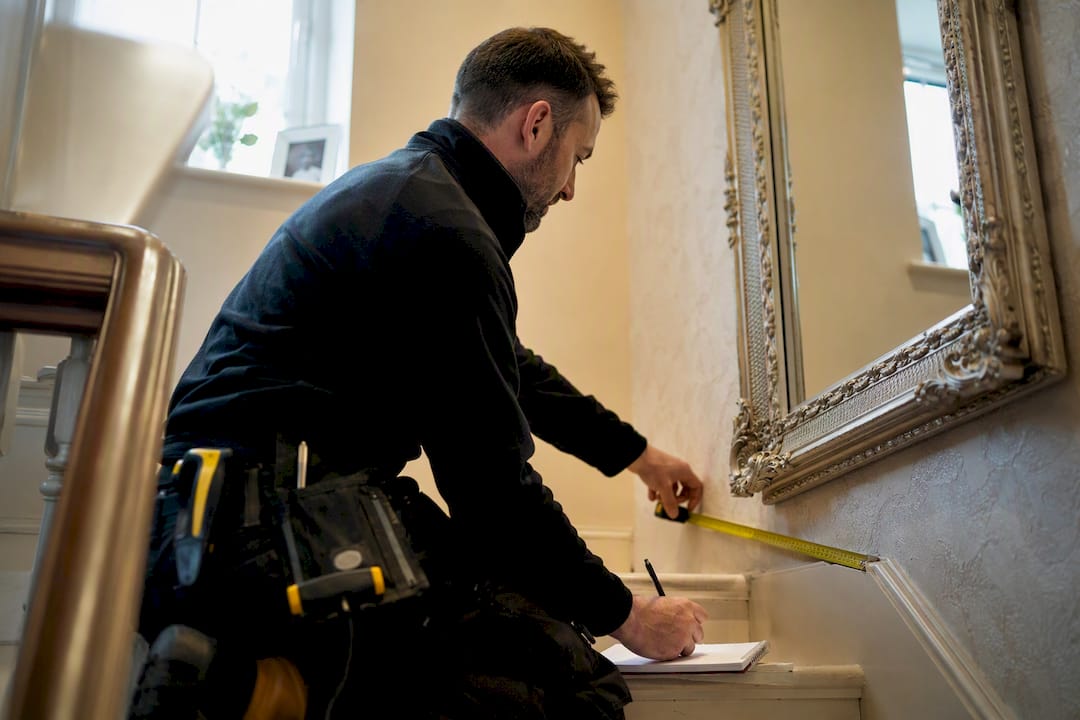
Power is checked last but matters just as much. The fitter identifies the nearest usable socket and decides whether a fused spur is needed to charge the stairlift battery safely, then marks where the charging point at each end will go.
Curved and spiral staircases need extra attention. Fitters increasingly use digital or laser measurement to capture the exact curve of the stair for a bespoke rail, since no two curved staircases are quite the same. Outdoor stairlifts and multi-flight layouts with intermediate landings bring their own checks around weatherproofing and rail continuity across landings.
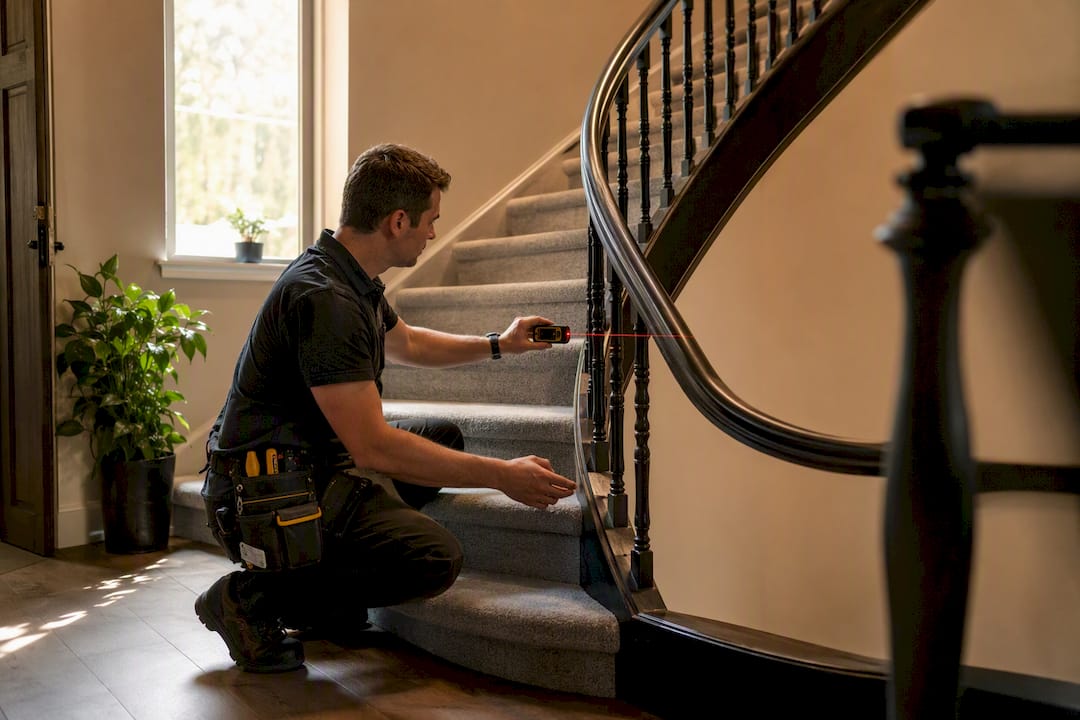
As a rough guide, most straight-stair installations need a landing space of around 800mm to allow the seat to swivel and the user to stand safely, though every property varies enough that this always gets confirmed on site rather than assumed.
Pro Tip: Ask the fitter to confirm an indicative installation date and where the rail sections will be temporarily stored at the top and bottom landings on the day. It avoids surprises when the installers turn up.
What's in the survey report and what happens next?
Once the visit ends, you should receive a written report rather than a verbal estimate scribbled on a business card.
A proper report includes detailed measurements, photographs of the staircase, and a clear recommendation on model type, straight, curved, perch, outdoor, or reconditioned, along with the proposed rail position and fixing points. From there, the installer typically issues a quote breaking down the product cost, any optional extras such as a powered swivel seat or folding footrest, installation charges, preparatory work, and warranty terms.
Timescales vary by complexity:
- Straight rails are often stocked as standard lengths, so installation can happen quickly once you accept the quote
- Curved rails are made to measure, so expect a longer lead time while the bespoke track is manufactured
- Installation itself, once the rail arrives, usually takes a matter of hours rather than days
The report should also set out your options clearly: outright purchase, short-term rental for temporary recovery needs, or a reconditioned model for a lower upfront cost. If a maintenance plan such as Protect+ is offered, it should be priced separately so you can see exactly what ongoing cover costs. Next steps typically involve confirming acceptance, agreeing a deposit, and booking an installation date that works around the household.
Questions to ask your fitter and warning signs to avoid
A good fitter welcomes questions. A poor one rushes past them.
Worth asking directly:
- Have they fitted this exact stair type before, curved, narrow, or split-level?
- What warranty or guarantee comes with the stairlift, and for how long?
- How will the rail affect stair clearance for other household members?
- Will any structural modifications be needed before installation?
- What training and aftercare support is included once the stairlift is fitted?
Some behaviours should make you pause. Watch for a hard sell that pushes you to sign before you've had time to compare quotes, vague or evasive answers about the electrics, a fitter who can't show sample rail sections or a completed measurement sheet, or any refusal to provide a written quote. A legitimate company answers these questions without hesitation, and it's worth checking what questions to raise with a local stairlift company before the visit so you know what a thorough answer sounds like.
From survey to installation: a realistic timeline
Once the survey is booked, the rest of the process tends to follow a predictable rhythm.
- The survey itself: typically 20 to 60 minutes on site
- The quote: usually arrives within a few days of the visit
- Straight stairlift installation: often completed within hours on the day it's booked
- Curved rail lead time: measured in weeks, since the track is manufactured to your exact stair shape
Straight stairlift prices with Gentlerise Stairlifts start at £795, with short-term rental and Protect+ aftercare available alongside outright purchase. Bear in mind that structural repairs, bespoke curved rails, or unusual staircase layouts can extend both the timeline and the final cost, so treat any quote as specific to your property rather than a fixed industry figure.
Why a proper survey matters: an installer's note
Get the measurements wrong and everything downstream suffers, misaligned brackets, a rail that catches on a skirting board, a seat that won't clear a newel post. Spotting a loose tread or an awkward radiator during the survey, rather than on installation day, is what keeps a job running to schedule. The priority is always the same: a rail that sits true, a seat the user can trust, and as little disruption to the home as possible.
Book a free survey with Gentlerise Stairlifts
Where many local fitters charge a call-out fee just to assess your stairs, Gentlerise Stairlifts carries out the full survey free of charge and with no obligation to buy, so you get a firm, written quote before spending a penny.

Whether your staircase is straight, curved, or an awkward split-level, our surveyors bring the same measurement checklist covered above and can usually install a straight stairlift within hours of the rail arriving on site. If budget is tight or you only need mobility support for a few months, ask about our reconditioned models and short-term rental options rather than committing to a full purchase. Once installed, the Protect+ maintenance programme keeps your stairlift serviced and running safely for the long term, detailed on our Protect+ aftercare page. Straight stairlifts start at £795. To get your own measurements and a written quote, book your free home survey and a fitter will be in touch to arrange a convenient time.
Sources
For a deeper look at what surveyors assess before quoting, the initial survey breakdown covers measurement standards in more detail. Homeowners wanting to measure their own stairs before the visit can follow this step-by-step measuring guide, while those planning a wider staircase project may find this staircase installation guide useful for understanding structural considerations. For a plain-English explanation of what a free survey actually involves, see what a free home survey covers.
FAQ
How long does a stairlift home survey take?
Most surveys take between 20 and 60 minutes, depending on whether your staircase is straight, curved, or has multiple flights.
Is a Gentlerise Stairlifts survey free?
Yes, Gentlerise Stairlifts offers a free, no-obligation home survey with no charge for the visit or the written quote that follows.
What should I have ready before the fitter arrives?
Clear access to the stairs, brief notes on the user's mobility needs, and photographs of any awkward features such as radiators or low windowsills.
How soon can a stairlift be installed after the survey?
Straight stairlifts are often installed within hours once you accept the quote, while bespoke curved rails typically take several weeks to manufacture.
Can I rent a stairlift instead of buying one?
Yes, short-term rental is available for temporary mobility needs, alongside reconditioned models for homeowners working to a tighter budget.