
TL;DR:
- A stairlift user profile assesses physical, cognitive, and environmental factors to determine safe utilization. It emphasizes full transfer abilities, home layout, and support needs, especially for users with dementia. Proper assessment by an occupational therapist ensures safety and appropriateness, and involving family in decisions is crucial.
A stairlift user profile is the structured set of physical, cognitive, and environmental criteria used to determine whether a person can safely and reliably use a seated stairlift. Occupational therapists, stairlift manufacturers, and dementia care specialists all use this profile to assess candidacy before any equipment is recommended. The profile is multi-dimensional. It covers far more than whether someone struggles on the stairs. Strength, balance, cognitive function, home layout, and even family circumstances all feed into the final picture. Understanding what is a stairlift user profile helps families make confident, well-informed decisions rather than costly guesses.
What functional abilities define a stairlift user profile?
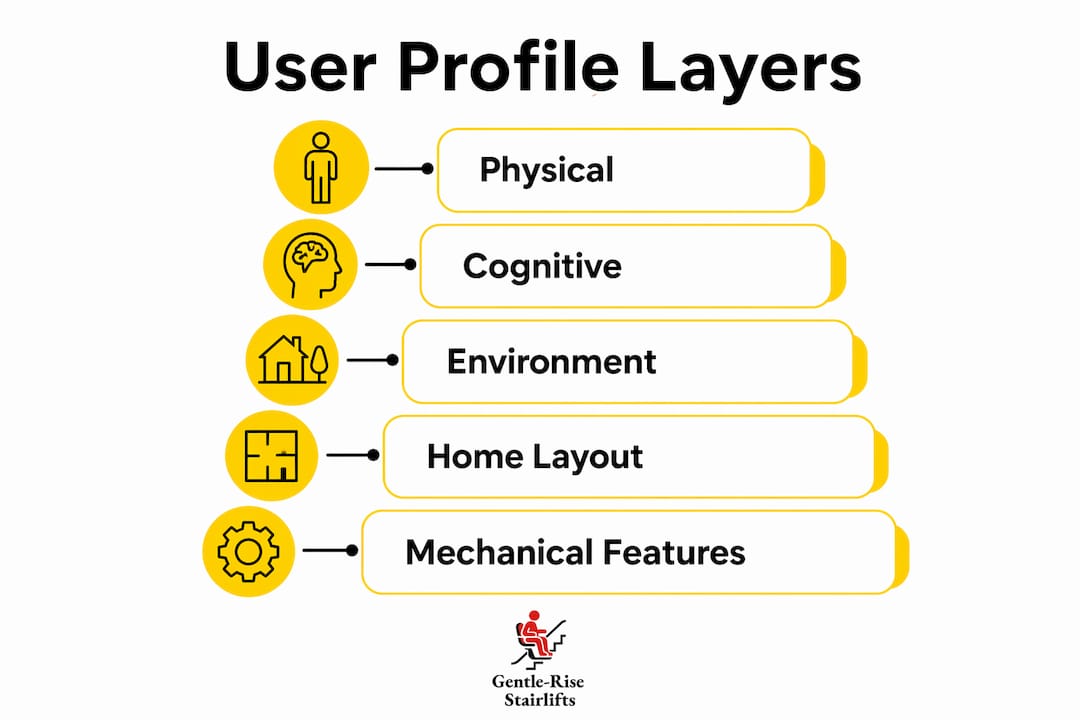
A stairlift user profile comprises the functional abilities and constraints needed to use a stairlift safely, covering transfer ability, control operation, and endurance. This definition, used by occupational therapists, shifts the focus away from the staircase itself and onto the person using the equipment.
Physical requirements for safe use
The physical side of the assessment covers several distinct areas:
- Lower body strength: The user must be able to stand from a seated position reliably, both at the bottom and top of the staircase.
- Upper body strength: Operating the joystick or button controls, fastening a seatbelt, and steadying oneself during transfer all require arm and hand function.
- Balance and endurance: The user must remain stable while seated during the ride and while standing at each landing.
- Range of motion: Hip and knee flexibility affects whether the user can sit comfortably and swivel safely at the top landing.
- Vision and environmental awareness: Good enough vision to see the controls, the landing, and any obstacles is part of the candidacy picture.
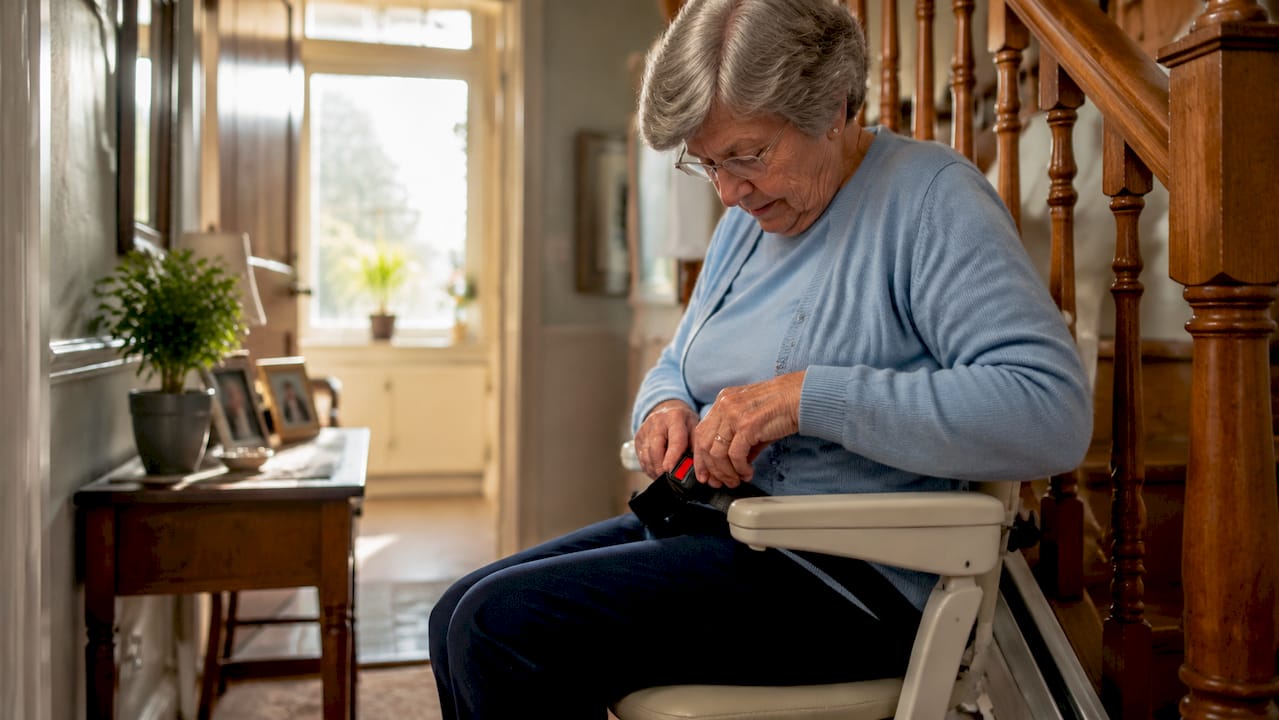
Safe stairlift candidacy requires the user to complete the full sequence: approach standing, sit down, fasten the seatbelt, ride, swivel the seat, and then stand up safely at the other end. Each step in that sequence is a potential failure point. A person who can climb three stairs unaided but cannot stand reliably from a low seat is not a suitable candidate without the right equipment adjustments.
Cognitive requirements
Cognitive ability is often underestimated in stairlift assessments. The user must learn and remember how to operate the controls, judge when it is safe to stand, and respond appropriately if the lift stops unexpectedly. Memory, attention, and basic problem-solving are all relevant. A person with mild cognitive impairment may still be a strong candidate with the right support in place.
Pro Tip: Ask the assessor to observe the user completing the full transfer-and-ride sequence at least twice. A single successful attempt does not confirm safe daily use. Consistency matters far more than a one-off performance.
How do home environment and stairlift design influence user profiles?
The home itself is as much a part of the user profile as the person's physical condition. Home layout safety includes adequate space at landings, good lighting, and the removal of trip hazards. Without these, even a physically capable user faces unnecessary risk.
Stair width determines which stairlift models are compatible. Narrow staircases may restrict seat size options, which in turn affects transfer comfort. The space available at the top and bottom landings dictates whether the user can approach and exit the seat safely without twisting awkwardly.
Seat fit and mechanical features
Seat height adjustment in the range of 16–20 inches and powered or manual swivel at the top landing are critical for safe daily use, particularly for users with limited mobility. These are not optional extras. They are transfer enablers. A seat that is too low forces the user to drop into it rather than lower themselves in a controlled manner, which creates fall risk on both entry and exit.
Weight capacity is another hard boundary in the profile. Standard stairlift models typically hold up to around 136 kg, while heavy-duty models accommodate significantly more. Selecting a model without matching it to the user's weight plus a safety margin is a serious oversight.
Stairlift vs platform lift: which profile fits which?
| User Characteristic | Standard Stairlift | Platform or Home Lift |
|---|---|---|
| Reliable independent transfers | Well suited | Less necessary |
| Wheelchair user | Not suitable | Recommended |
| Inconsistent transfer ability | Unsuitable | Safer alternative |
| Good cognitive function | Well suited | Suitable |
| Limited upper body strength | May need adaptations | Often better option |
A stairlift suits users who transfer reliably and can operate controls consistently. Where transfers are problematic or unpredictable, a platform stairlift or home lift is the safer choice.
Pro Tip: Before any home survey, walk the full staircase route yourself and note where the lighting is poorest. Poor lighting at the top landing is one of the most commonly missed hazards in home assessments.
How do cognitive conditions like dementia affect the stairlift user profile?
Dementia changes the stairlift candidacy picture in ways that a single assessment cannot fully capture. Dementia impacts the user profile differently by stage: early-stage users often learn to use a stairlift safely, middle-stage users require supervision, and advanced-stage users are generally not appropriate candidates.
The critical challenge is cognitive variability. A person with dementia may use the stairlift safely on Monday and be confused and unsafe by Wednesday. This time-dependent risk means that a snapshot assessment is never sufficient on its own.
Key considerations for dementia-related user profiles include:
- Early stage: The user can often learn the controls with repetition and may use the stairlift independently with periodic reassessment.
- Middle stage: Supervision during every journey becomes necessary. The risk of attempting to use the stairs alongside the lift increases significantly.
- Advanced stage: Stairlift use is typically contraindicated. Alternatives such as ground-floor living arrangements or through-floor lifts should be explored.
- Clinician involvement: A qualified occupational therapist or dementia care specialist must be part of the assessment process, not just the stairlift dealer.
- Supervision planning: Families need a clear protocol for who supervises, when, and what triggers a reassessment of candidacy.
Cognitive fluctuation in dementia creates time-dependent risk profiles that require dynamic supervision and reassessment plans rather than a fixed green light. This is one of the most important things families often do not hear from equipment suppliers alone.
What role do family dynamics play in defining a user profile?
In multigenerational homes, the stairlift user profile must account for more than the rider's physical condition. The profile must include rider comfort, decision-makers' safety priorities, and payers' cost concerns. These three perspectives do not always align, and the tension between them shapes which equipment gets chosen and whether it actually gets used.
A UK survey found that 27% of stairlift enquiries are made by adult children researching on behalf of relatives. That figure shows how often the person funding and choosing the stairlift is not the person who will use it daily. The rider's preferences, including seat comfort, ease of controls, and aesthetic fit with the home, can easily be overlooked when a family member is driving the decision.
Key stakeholder considerations in a family context include:
- The rider: Prioritises comfort, dignity, and ease of use. May resist the idea of a stairlift entirely if not involved in the decision.
- The decision-maker (often an adult child): Prioritises safety and reliability above all else.
- The payer: Focused on cost, funding options, and long-term value. May push for the cheapest available model regardless of fit.
- The carer or support worker: Needs to understand how the equipment works and when to intervene.
Family and multigenerational dynamics complicate simple user profiling, making inclusive assessment the only reliable approach. The best outcomes happen when the rider is present and heard throughout the process. You can read more about caregiver safety planning to understand how to structure these conversations effectively.
What steps are involved in a stairlift needs assessment?
A formal stairlift needs assessment follows a structured sequence that goes well beyond measuring the staircase. Occupational therapy guided selection shifts focus from staircase characteristics to the person's safe and repeatable functional sequence. This is the standard that separates a thorough assessment from a sales visit.
A typical assessment process covers the following steps:
- Functional ability review: The assessor observes the user standing, sitting, transferring, and operating a sample control. Strength, balance, and range of motion are all noted.
- Cognitive screening: The user is asked to demonstrate understanding of the controls and respond to a simulated stop scenario.
- Endurance evaluation: Can the user sit comfortably for the duration of the ride and stand safely at the end without excessive fatigue?
- Home environment check: Landing space, stair width, lighting levels, and trip hazards are all assessed. Stairlift placement directly affects whether the profile is viable in that specific home.
- Frequency of use: How often does the user need to access the upper floor? Daily use demands a higher standard of reliability than occasional use.
- Alternatives review: If the assessment reveals that a standard stairlift is unsuitable, the assessor should discuss stairlift alternatives such as platform lifts, through-floor lifts, or ground-floor adaptations.
Dealers can conduct useful home surveys, but an independent occupational therapist provides the most objective assessment of candidacy. Where a condition is progressive, such as Parkinson's disease or dementia, the OT assessment should include a reassessment schedule from the outset.
Key takeaways
A stairlift user profile is defined by the person's ability to complete the full transfer-and-control sequence safely and repeatedly, not simply by whether they struggle on the stairs.
| Point | Details |
|---|---|
| Transfer sequence is the real test | Safe candidacy depends on sitting, belting, riding, swivelling, and standing reliably every time. |
| Cognitive ability matters as much as physical | Memory, attention, and control operation are assessed alongside strength and balance. |
| Home environment shapes suitability | Landing space, lighting, and stair width all affect whether a stairlift is viable in a given home. |
| Dementia requires stage-based assessment | Early-stage users may qualify independently; middle and advanced stages require supervision or alternatives. |
| Family dynamics influence equipment choice | Adult children make 27% of enquiries, so the rider's own preferences must be actively included in decisions. |
The detail families often miss
Most families I speak with come to a stairlift assessment focused on one question: can Mum or Dad get up the stairs? That is the wrong starting point. The real question is whether they can complete the full transfer sequence, both getting on and getting off, safely and consistently, day after day.
Seat height and swivel mechanism are the two features I see most often overlooked in early conversations. A powered swivel at the top landing is not a luxury. For someone with limited hip mobility or poor balance, it is the difference between a safe exit and a fall. I have seen families choose a cheaper model without a powered swivel and then find the equipment unused within a fortnight because the exit was too difficult.
Progressive conditions change the profile over time. A person who qualifies today may not qualify in six months. Building a reassessment schedule into the plan from the start is not pessimistic. It is responsible. Families who do this avoid the difficult situation of realising the stairlift has become unsafe long after the fact.
My strongest advice is to involve an independent occupational therapist before committing to any equipment. A dealer's home survey is a useful starting point for understanding the staircase. An OT assessment tells you whether the person can actually use what gets installed. Those are two very different conversations, and both matter.
— lee
Find the right stairlift solution with gentlerise stairlifts
Understanding a stairlift user profile is the first step. Finding the right equipment to match it is the next.

Gentlerise Stairlifts offers free home surveys across the UK, carried out by experienced advisers who understand the full range of user needs, from standard straight stairlifts starting at £795 to heavy-duty models and dementia-friendly options with simplified controls. Whether you are exploring options for the first time or need a second opinion on a previous assessment, the team at Gentlerise Stairlifts is ready to help. You can also review stairlift costs in the UK to understand what to budget before your survey. Book your free consultation today and get advice matched to your relative's specific profile.
FAQ
What is a stairlift user profile?
A stairlift user profile is the set of physical, cognitive, and environmental criteria used to assess whether a person can safely use a seated stairlift. It covers transfer ability, control operation, endurance, and home layout suitability.
Who carries out a stairlift needs assessment?
An occupational therapist provides the most thorough and objective stairlift needs assessment, evaluating the full transfer-and-control sequence. Stairlift dealers also conduct home surveys, but these focus primarily on the staircase rather than the user's functional ability.
Can someone with dementia use a stairlift?
Early-stage dementia users often learn to use a stairlift safely with periodic reassessment. Middle-stage users require supervision for every journey, and advanced-stage dementia typically makes stairlift use unsuitable.
What physical characteristics affect stairlift suitability?
Lower and upper body strength, balance, range of motion, and weight are the primary physical factors. Standard stairlifts have a weight capacity of around 136 kg, with heavy-duty models available for users who exceed that limit.
Why do seat height and swivel matter so much?
Seat height and swivel mechanism directly affect whether a user can transfer on and off the stairlift safely. A seat set at the wrong height or a manual swivel that requires too much effort can make an otherwise suitable stairlift impossible to use safely in daily life.