
TL;DR:
- A stairlift swivel mechanism rotates the seat toward the landing to ensure safe and easy exits, especially at the riskiest transfer point. Powered swivels, controlled by a motor, are better for users with limited grip strength, while manual ones require more physical effort. Selecting a powered swivel from the start is advisable for long-term safety, with the mechanical safety interlock providing consistent protection regardless of power or software status.
A stairlift swivel mechanism is a device that rotates the seat towards the landing at the top of the stairs, allowing the user to exit facing away from the staircase rather than twisting dangerously over the steps. Explaining stairlift swivel mechanisms matters because the transfer point at the top landing is, according to safety experts, the riskiest moment of the entire stairlift journey. Two main types exist: manual swivels, operated by a hand lever, and powered swivels, driven by a small motor at the press of a button. Understanding which type suits your needs, your home, and your long-term mobility is the difference between a stairlift that keeps you safe for years and one that becomes a daily struggle.
How do stairlift swivel mechanisms work?
A stairlift swivel mechanism works by rotating the seat through 90–180 degrees once the carriage reaches its parking position at the top or bottom landing. The rotation only becomes possible when the lift has stopped and locked in place. This is not a coincidence. It is the result of a deliberate safety design built into every reputable stairlift.
The mechanical components behind seat rotation
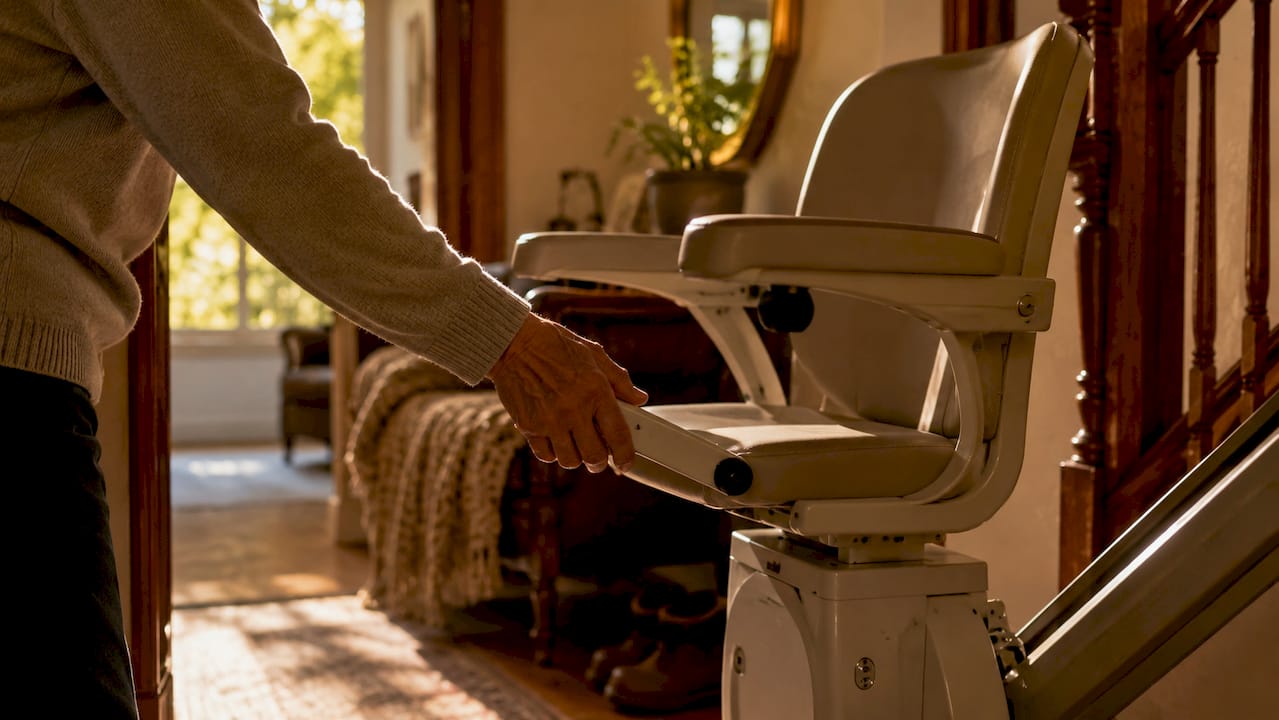
The core of any swivel system relies on spring-loaded pins and detent locking to control rotation precisely. A detent is a small mechanical catch that holds the seat firmly in position during travel and releases only when the correct force or motor signal is applied. Spring-loaded pins snap into pre-set lock positions, typically at 0 degrees for travel and 90 degrees for exit, giving the user a firm, stable seat at every stage.
The safety interlock is the most critical component in this system. The swivel interlock is a hard mechanical constraint, not merely an electronic sensor, that physically prevents the carriage from moving if the seat is rotated away from the forward travel position. This means that even if a button is pressed accidentally, the lift will not move while the seat faces the landing. That level of redundancy is what separates a well-engineered stairlift from a basic one.
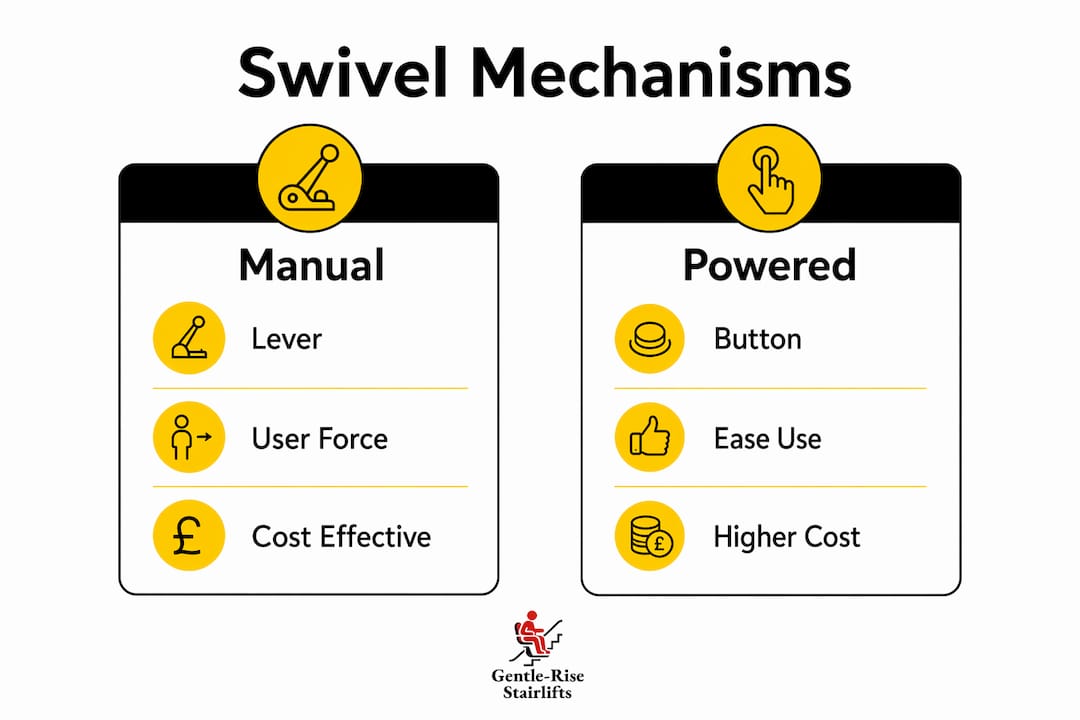
Manual swivel operation
With a manual swivel, the user grips a lever, typically located on the side of the seat, and applies steady pressure to rotate the seat towards the landing. The spring-loaded pins disengage, the seat rotates, and then the pins re-engage at the exit position with an audible click. The process is straightforward but does require a degree of grip strength and coordination.
Powered swivel operation
A powered swivel replaces the lever with a small electric motor. The user presses a button on the armrest or remote control, and the motor drives the seat through its rotation automatically. The locking mechanism still engages at the end of rotation, maintaining the same safety standard as a manual system. The difference is purely in how the rotation is initiated.
Pro Tip: Always test the swivel action during a home demonstration before committing to a model. The click of the locking pin engaging should be firm and audible. If it feels loose or silent, ask the installer to inspect the detent mechanism before installation.
What are the differences between manual and powered swivel mechanisms?
The choice between manual and powered swivel is one of the most consequential decisions when selecting a stairlift. Both achieve the same safety outcome, but they suit very different users and circumstances.
Side-by-side comparison
| Feature | Manual Swivel | Powered Swivel |
|---|---|---|
| Operation method | Hand lever, user-operated | Button press, motor-driven |
| Additional cost | £0–£120 above base price | £160–£400 above base price |
| Grip strength required | Approximately 5–8 lbs of force | Minimal, button only |
| Best suited to | Users with good hand strength | Users with arthritis or weakness |
| Retrofit difficulty | Straightforward | More complex, higher cost |
Manual swivels require 5–8 lbs of force to rotate the seat, which is a significant challenge for anyone managing arthritis, post-stroke impairment, or general age-related weakness. That figure sounds modest, but applied repeatedly, every single day, it becomes a real barrier to independence. Powered swivels remove that barrier entirely.
Cost is the most common reason people choose manual over powered. The upgrade to a powered swivel typically adds £160–£400 to the installation cost. However, retrofitting a powered swivel to an existing manual stairlift later costs more, often in the range of £240–£400 for parts and labour, plus potential disruption to the rail system. Choosing powered from the outset is frequently the more economical long-term decision.
Pro Tip: If you are purchasing a stairlift for a parent or relative, always opt for the powered swivel from day one. Mobility tends to decline over time, and the cost of upgrading later almost always exceeds the cost of specifying it correctly at the start.
Reliability is comparable between both types. Spring-loaded pins and straightforward detent designs are built to perform consistently over thousands of cycles, and the minimal moving parts in both systems mean failure rates are low when the lift is properly maintained. For guidance on keeping your swivel mechanism in good condition, the stairlift maintenance advice from Gentlerise Stairlifts covers what to check and when.
Why is a swivel seat important for stairlift safety?
"The transfer at the top landing is the riskiest part of stairlift use, not the ride itself." — Safety guidance from stairlift industry experts
That single insight reframes how most people think about stairlift safety. The mechanical ride up the rail is smooth and controlled. The moment of standing up and stepping onto the landing is where falls happen. A swivel seat directly addresses that risk.
Without a swivel, a user must stand from a seat that faces the stairs, then turn their body while balancing on a narrow landing. For anyone with reduced balance, hip problems, or weak legs, that manoeuvre is genuinely dangerous. Swivel rotation at 90–180 degrees aligns the user with the stable landing surface before they stand, so their first step is forward onto solid ground rather than sideways over the staircase edge.
The safety benefit extends beyond fall prevention. A swivel seat also reduces the physical effort required to exit the chair. When the seat faces the landing, the user can push up from the armrests and stand in a natural, forward-facing position. This matters enormously for people with hip replacements, knee problems, or limited core strength. The transfer process safety risks are significantly reduced when the user never has to twist their torso over the staircase.
For older adults living alone, this is not a minor convenience. It is the feature that determines whether a stairlift genuinely supports independent living or simply moves the risk from one place to another. You can read more about why swivel seats matter for daily home safety on the Gentlerise Stairlifts blog.
What practical factors should you consider when choosing a swivel?
Selecting the right swivel mechanism requires honest assessment of four areas: your physical condition now, your likely condition in five years, your staircase layout, and your budget over the long term.
-
Assess your grip strength and dexterity honestly. If you already find jar lids or door handles difficult, a manual swivel will frustrate you within weeks. A powered swivel is the correct starting point, not an optional upgrade.
-
Consider your staircase direction and landing space. Most swivel seats rotate only at the top landing, which suits the majority of straight staircases. Two-way powered swivels exist for narrow or curved staircases where the exit direction at the bottom differs from the top, but these are specialist features with specific safety constraints. Confirm with your installer which rotation direction your landing requires.
-
Think about future-proofing from the outset. Industry experts recommend powered swivels for users expecting long-term use or managing joint conditions, precisely because retrofitting later is more expensive and disruptive than specifying correctly at installation.
-
Factor in maintenance access. Powered swivel motors are reliable but do require periodic inspection as part of a service plan. Gentlerise Stairlifts' Protect+ maintenance programme covers this as standard, which removes the guesswork from long-term upkeep.
-
Check the rotation angle your model offers. A 90-degree swivel is sufficient for most homes. Some models offer up to 180 degrees, which can be useful on very wide landings or where furniture placement limits the exit path. Confirm the angle during your free home survey rather than assuming a standard model will suit your specific layout.
For a broader view of how swivel options fit within the full range of stairlift choices, the types of stairlifts guide on the Gentlerise Stairlifts blog is a useful next step.
Key takeaways
The swivel seat is the single most important safety feature on a stairlift, because the transfer at the top landing carries far greater fall risk than the ride itself.
| Point | Details |
|---|---|
| Swivel mechanism purpose | Rotates the seat 90–180 degrees at the landing so users exit facing forward, away from the stairs. |
| Manual vs powered choice | Powered swivels suit users with arthritis or reduced grip; manual suits those with good hand strength. |
| Safety interlock is mechanical | The swivel interlock physically blocks carriage movement if the seat is not locked in travel position. |
| Future-proofing saves money | Specifying a powered swivel at installation costs less than retrofitting one later. |
| Two-way swivels are specialist | Two-way rotation is designed for narrow or curved stairs and carries specific safety restrictions. |
Why i think most people get the swivel decision wrong
People tend to focus on the rail, the speed, and the weight capacity when they are comparing stairlifts. The swivel mechanism is treated as a footnote. In my experience, that order of priority is exactly backwards.
The rail and motor are engineering commodities at this point. Every reputable stairlift runs smoothly and reliably. The swivel is where the real difference in daily experience lives. I have spoken with users who chose a manual swivel to save money and regretted it within six months as their grip weakened. The cost saving felt significant at the time. The daily frustration of wrestling with a lever they could barely operate felt far more significant afterwards.
The safety interlock point is also consistently underestimated. Most people assume it is a software switch that could theoretically fail. It is not. It is a hard mechanical block. That distinction matters because it means the protection is always present, regardless of battery level or software state. That is the kind of engineering decision that deserves more attention than it gets.
My honest advice: treat the powered swivel as the default and the manual swivel as the exception for users with confirmed, sustained grip strength. Test the swivel action in person before signing anything. And if a supplier cannot clearly explain how the interlock works, find one who can.
— lee
How gentlerise stairlifts helps you choose the right swivel
Choosing between a manual and powered swivel is straightforward when you have the right guidance from the start. Gentlerise Stairlifts supplies and installs stairlifts with both swivel types across the UK, and every installation begins with a free home survey to assess your staircase layout, your physical requirements, and your long-term needs.
Gentlerise Stairlifts' stairlift range and swivel options includes straight, curved, and reconditioned models, all available with professional installation and covered by the Protect+ aftercare plan. Prices for straight stairlifts start at £795, and the team can advise on stairlift costs in the UK including swivel upgrades, so there are no surprises. Contact Gentlerise Stairlifts today to book your free survey and get a clear, honest recommendation for your home.
FAQ
What is a stairlift swivel seat?
A stairlift swivel seat is a rotating seat that turns 90–180 degrees at the landing, allowing the user to exit the chair facing forward rather than twisting over the staircase edge.
How does the swivel safety interlock work?
The swivel interlock is a hard mechanical block that prevents the stairlift carriage from moving unless the seat is locked in the forward travel position, providing protection independent of any electronic system.
Is a powered swivel worth the extra cost?
For users with arthritis, reduced grip, or long-term mobility needs, a powered swivel is worth the additional cost. Retrofitting one later typically costs more than specifying it at the point of installation.
Can a swivel seat be added to an existing stairlift?
A manual swivel can often be retrofitted to compatible models, but a powered swivel retrofit is more complex and may not be possible on all rail systems. Always confirm compatibility with your installer before purchasing.
Do all stairlifts have swivel seats?
Not all stairlifts include a swivel seat as standard. Many entry-level models offer it as an optional upgrade, so it is worth confirming the specification before purchase rather than assuming it is included.