
TL;DR:
- Stairlift speed control is a fixed safety feature designed to ensure safe, steady travel at 0.1–0.2 meters per second. This speed is manufacturer-set and cannot be adjusted by users without voiding safety certifications, emphasizing safety over speed. Ride comfort depends more on soft-start and soft-stop technology, motor quality, and installation precision than on travel pace itself.
Stairlift speed control is a fixed safety feature that maintains a steady, slow travel pace to protect riders on every journey up or down the stairs. All residential stairlifts operate at 0.1–0.2 metres per second, meaning a typical 12–14 step staircase takes roughly 30–60 seconds to travel. This speed is not a setting you choose. It is engineered into the lift by the manufacturer to preserve your balance and prevent falls. Understanding what is stairlift speed control, and why it works the way it does, helps you make a confident, informed decision when choosing a lift for yourself or a loved one.
How does stairlift speed control work?
Stairlift speed is governed by a combination of mechanical and electronic systems working together. No single component controls speed alone. Each part plays a specific role in keeping travel smooth, consistent, and safe.
The rack-and-pinion drive system
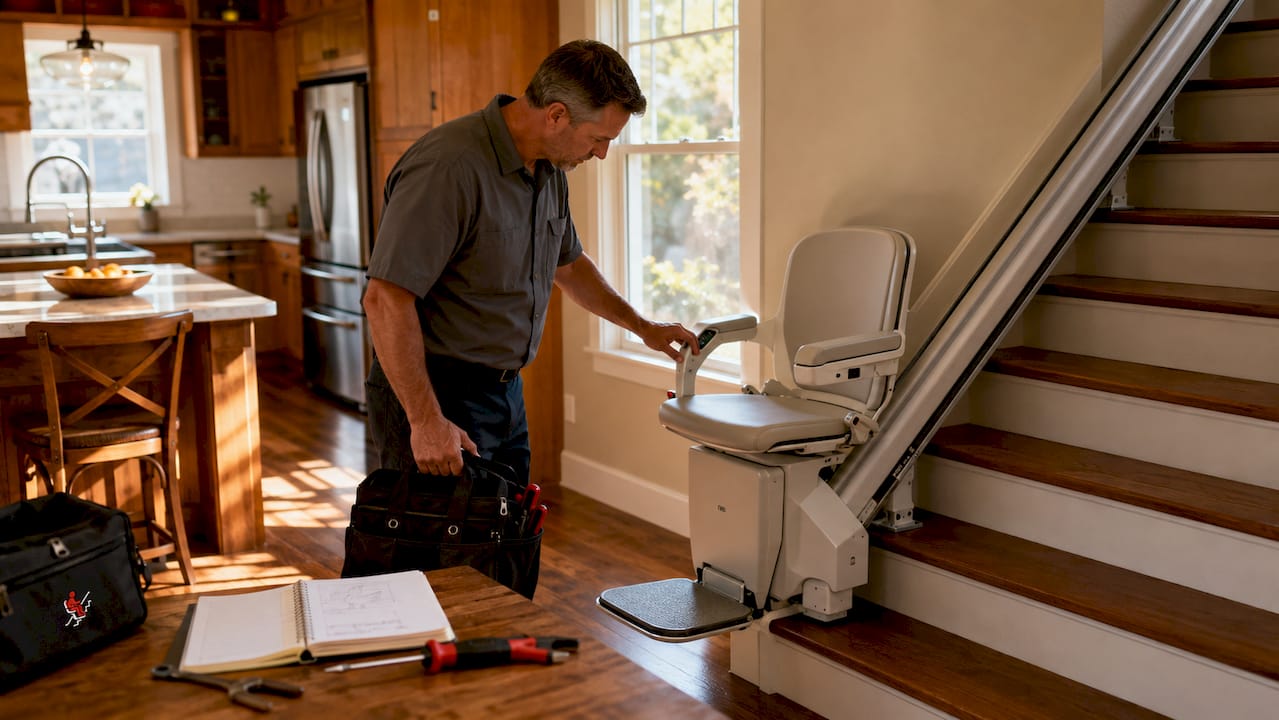
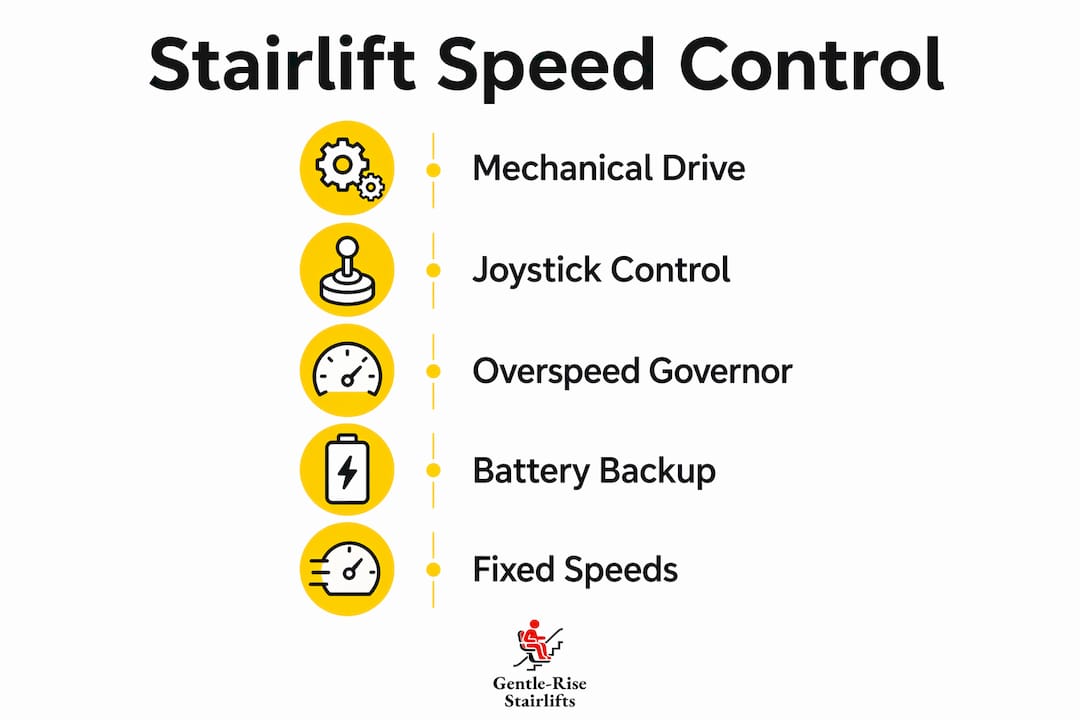
The rack-and-pinion drive is the mechanical backbone of speed control. A toothed rail runs along the staircase, and a motorised pinion gear meshes with it to move the carriage at a controlled rate. This design physically prevents freewheeling or backward rolling, even if power is lost. The result is a locked, predictable travel speed at every point on the staircase.
Constant pressure joystick control
Stairlift movement requires constant pressure on the control joystick or paddle. The moment you release it, the lift stops immediately. This gives you real-time control over when the lift moves, but it does not change the speed at which it travels. Think of it like a car's accelerator that only ever reaches one speed regardless of how hard you press it.
The overspeed governor
The overspeed governor is the critical safety backup in any quality stairlift. Governors engage mechanical brakes if the lift exceeds 125–150% of its normal speed, and they operate independently of the electronics and battery. That independence matters. If a motor fault or rail issue causes the carriage to accelerate, the governor activates without needing any signal from the control board.
Battery backup and power
Battery backup keeps the stairlift operational during a power cut, but it does not alter the speed settings in any way. The lift travels at exactly the same pace on battery as it does on mains power. Reliability is maintained through the power source, while speed remains constant regardless of how the lift is being powered.
Pro Tip: When assessing a stairlift, ask the installer specifically about the overspeed governor. A quality unit should have a mechanical governor that works independently of the electronics, not just an electronic speed limiter.
Can you adjust stairlift speed settings?
The short answer is no, and the reason is entirely about your safety. Stairlift speed is a fixed safety parameter engineered for steady, balance-preserving travel. Users cannot safely alter it, and reputable manufacturers do not offer variable speed as a consumer option.
All major stairlift brands adhere to the same international safety standards that cap travel speed to protect riders. No reputable manufacturer offers higher travel speeds for home stairlifts. This is not a commercial limitation. It is a deliberate design choice rooted in the physics of balance and the realities of stair travel for people with mobility challenges.
Here is why fixed speed settings exist:
- Balance preservation. At speeds above 0.2 m/s, the body has insufficient time to adjust posture on a moving incline. Even a small increase in speed raises the risk of a rider lurching forward at the top or bottom of the staircase.
- Regulatory compliance. Stairlifts sold in the UK must meet BS EN 81-40, the British and European standard for inclined stairlifts. Speed limits are baked into that standard.
- Mechanical integrity. The rack-and-pinion system and carriage are engineered to specific load and speed tolerances. Exceeding those tolerances accelerates wear and increases the risk of mechanical failure.
- Warranty and certification protection. A dealer adjusting speeds outside standard limits risks voiding safety certifications and the user's warranty. Speed is factory-set to maintain compliance.
If you ever encounter a trader offering to "unlock" a faster speed setting, treat it as a serious red flag. The quality of a stairlift is not measured by how quickly it travels. It is measured by how safely and smoothly it does so.
What affects stairlift speed and ride quality?
Since the travel speed itself is fixed, the real question becomes: what makes one stairlift feel smoother and more comfortable than another? The answer lies in how the lift manages acceleration and deceleration, not in how fast it moves.
Here are the four factors that most directly affect your experience of the ride:
-
Soft-start and soft-stop technology. Soft-start and soft-stop systems manage acceleration and deceleration over 1–2 seconds to prevent jarring movements. For someone with arthritis, joint pain, or poor balance, this gradual transition makes a significant difference to comfort and confidence. A lift that lurches into motion feels unsafe even if it is technically within speed limits.
-
Motor control quality. The smoothness of the motor's power delivery affects how consistently the carriage maintains its speed across the full length of the rail. A well-engineered motor holds a steady pace without micro-variations that can cause subtle jolting, particularly on curved staircases with bends and level changes.
-
Rail condition and installation accuracy. A poorly fitted rail introduces vibration and uneven travel even when the motor and drive system are functioning correctly. Professional installation, with precise rail alignment, is one of the most underappreciated factors in stairlift placement and ride quality.
-
Seat swivel, seatbelt, and obstruction sensors. Emergency stop, seatbelt, swivel locks, and obstruction sensors complement speed control for comprehensive user safety. The swivel seat allows you to mount and dismount safely at the top landing without twisting. The seatbelt keeps you secure during travel. Obstruction sensors on the footrest and carriage stop the lift immediately if something blocks the path.
Pro Tip: When trialling a stairlift, pay close attention to the first and last two seconds of movement. That is where soft-start and soft-stop technology either earns its keep or lets you down. A smooth, gradual transition is far more important than the travel speed in between.
Speed is often misunderstood as the primary comfort variable. The true sensation of a quality ride comes from soft-start and soft-stop technology combined with smooth motor control, not from variable velocity. Users who feel a stairlift is "too slow" are almost always responding to a jarring start or stop, not the actual travel pace.
Speed control vs. other stairlift safety features
Speed control does not operate in isolation. It works alongside a broader set of safety features that together create a secure ride. The table below compares the core speed-related mechanisms with the wider safety systems found on quality stairlifts.
| Feature | How It Works | Purpose |
|---|---|---|
| Fixed speed setting (0.1–0.2 m/s) | Factory-set motor and drive limits | Maintains safe, balance-preserving travel pace |
| Overspeed governor | Mechanical brake triggered at 125–150% of normal speed | Backup braking independent of electronics |
| Soft-start and soft-stop | Gradual acceleration and deceleration over 1–2 seconds | Prevents jarring movements at journey start and end |
| Battery backup | Mains-independent power supply | Maintains operation during power cuts without altering speed |
| Obstruction sensors | Pressure-sensitive sensors on footrest and carriage | Stops lift immediately if path is blocked |
| Seatbelt and swivel lock | Mechanical restraint and seat rotation lock | Secures rider during travel and at landing points |
| Emergency stop button | Manual override on armrest or remote | Allows immediate halt at any point on the staircase |
The overspeed governor is the most critical of these features because it operates as a mechanical fail-safe independent of all electrical systems. Every other feature on this list relies on power or electronics to function. The governor does not. That distinction makes it the last line of defence in any speed-related failure scenario.
Key takeaways
Stairlift speed control is a fixed, factory-set safety parameter that cannot and should not be altered, with ride quality determined by soft-start technology and motor smoothness rather than travel pace.
| Point | Details |
|---|---|
| Speed is fixed by design | All residential stairlifts travel at 0.1–0.2 m/s; this is a safety standard, not a limitation. |
| Users cannot adjust speed | Modifying speed settings voids warranties and safety certifications; no reputable brand offers variable speed. |
| Soft-start and soft-stop matter most | Gradual acceleration over 1–2 seconds defines ride comfort far more than travel speed. |
| Overspeed governor is the key safeguard | This mechanical brake activates independently of electronics if speed exceeds 125–150% of normal. |
| Installation quality affects the ride | Precise rail fitting and motor quality directly influence smoothness, regardless of speed settings. |
Speed, safety, and what actually matters
I have spoken with a lot of people who come to us convinced they want a "faster" stairlift. They have tried a neighbour's model, or read something online, and decided the one they used felt sluggish. Almost every time, what they actually experienced was a poor soft-start. The lift lurched into motion and that jolt felt like slowness. It was not.
The honest truth is that speed is not a meaningful differentiator among reputable stairlift brands. Every manufacturer selling into the UK market is working within the same speed envelope. What separates a good lift from a mediocre one is the quality of the motor control, the precision of the installation, and the smoothness of those first and last two seconds of travel.
I would also caution anyone against trusting a trader who suggests they can adjust the speed for you. Beyond the warranty implications, you are dealing with a piece of equipment that a family member relies on every single day. The factory settings exist because engineers with decades of experience in mobility equipment decided they were the right settings. That judgement deserves respect.
My advice: focus your questions on soft-start quality, rail fitting standards, and aftercare. Those are the variables that will determine whether your loved one feels confident on the lift every morning. Speed will take care of itself.
— lee
Find a stairlift that gets every detail right
Understanding the benefits of stairlift speed control is the first step. Finding a lift that delivers on every safety and comfort detail is the next one.

Gentlerise Stairlifts installs straight, curved, and reconditioned stairlifts across the UK, with every unit set to manufacturer speed specifications and fitted by trained engineers. The Protect+ aftercare programme keeps your lift performing safely long after installation. Prices start from £795 for straight stairlifts, and a free home survey costs nothing. If you are weighing up your options, explore the reliable stairlift range or visit the Gentlerise Stairlifts website to book your survey today.
FAQ
What is stairlift speed control?
Stairlift speed control is a fixed safety mechanism that limits travel to 0.1–0.2 metres per second. It is set by the manufacturer and cannot be adjusted by users or dealers without voiding safety certifications.
Can i request a faster speed setting from my installer?
No reputable installer will alter factory speed settings. Doing so voids the stairlift's warranty and breaches UK safety standards under BS EN 81-40.
What is an overspeed governor on a stairlift?
An overspeed governor is a mechanical brake that activates if the stairlift exceeds 125–150% of its normal speed. It operates independently of the electronics and battery, making it the most reliable safety backup on the lift.
Why does my stairlift feel jerky if the speed is fixed?
Jerkiness is almost always caused by poor soft-start and soft-stop calibration, not the travel speed itself. A well-maintained lift with properly adjusted motor control should accelerate and decelerate smoothly over 1–2 seconds.
Does battery backup change how fast a stairlift travels?
Battery backup maintains operation during a power cut but does not alter the speed in any way. The lift travels at exactly the same pace on battery as it does on mains power.