
Most UK stairlift owners do not need a separate insurance policy. Declare the stairlift to your home insurer for damage, theft and liability cover. Rely on the manufacturer warranty for mechanical faults while it lasts. Once that warranty ends, or if you own a higher-value curved lift, buy breakdown cover or a service contract to fill the gap.
Costs are modest across the board. Declaring a stairlift rarely moves your home insurance premium much. Breakdown cover typically runs £50 to £200 a year, with servicing at £80 to £200 a visit.
Do this today:
- Find your warranty paperwork and note the installation date, model and serial number.
- Call your home insurer, confirm the stairlift is covered, and ask for written confirmation.
Key Takeaways
Most UK stairlift owners need no separate policy: declare the lift to your home insurer, rely on the warranty first, then add breakdown cover or a service contract once that warranty ends.
| Point | Details |
|---|---|
| Declare, don't duplicate | Tell your home insurer about the stairlift and get written confirmation; it rarely raises your premium. |
| Warranty covers faults first | Manufacturer warranties typically run 12 to 24 months and handle mechanical or electrical faults. |
| Budget £50 to £200 a year | Breakdown cover and servicing sit in this range; curved lifts trend towards the higher end. |
| Match cover to lift type | Curved, out-of-warranty or rental stairlifts justify dedicated cover more than new straight ones. |
| Consider installer contracts | Gentlerise Stairlifts's Protect+ bundles servicing and priority call-outs from £795 for straight lifts. |
Authoritative trade bodies and useful UK pages
Check the BHTA for supplier standards, Which? Trusted Traders for verified installers, and Stairlift Guru's warranty guides for policy wording.
This article is general information, not a substitute for advice from a qualified financial advisor. Consult a qualified financial professional about your own circumstances before acting on anything here.
Table of Contents
- What different types of stairlift cover actually pay for
- What does stairlift insurance cost in the UK?
- Warranty, extended warranty or service contract: what's the difference?
- Checking and declaring your stairlift: a short checklist
- When is specialist stairlift insurance actually worth it?
- Installer service contracts versus third-party insurance
- Legal and safety responsibilities around stairlift insurance
- Does insuring a stairlift affect your home insurance premium or claims?
- How do you make a stairlift insurance claim?
- How long do stairlift insurance and warranty terms last?
- Sources
- FAQ
What different types of stairlift cover actually pay for
Home buildings and contents insurance, once you've declared the stairlift as a fixed installation, typically covers fire, flood, theft, vandalism and third-party liability if it injures someone or damages property. It does not cover wear and tear, battery replacement or mechanical breakdown. That distinction trips up a lot of owners who assume "insured" means "everything's covered."
Specialist stairlift insurance policies commonly cover accidental damage, malicious damage, theft, fire, storm and flood, but they exclude wear and tear and mechanical breakdown too. Mechanical and electrical faults sit with a different product entirely: the manufacturer warranty, an extended warranty, or a specialist breakdown policy or service contract.
Rental stairlifts work differently again. If you're renting rather than owning, the rental company usually insures the equipment itself, while your liability as a tenant depends on the terms of the rental agreement.
- Buildings/contents insurance: fire, flood, theft, vandalism, liability.
- Warranty or breakdown cover: motor faults, worn components, electrical failure.
- Rental agreement: check who insures the unit and what you're liable for.
Pro Tip: Ask your rental provider to show you the insurance certificate for the specific unit installed in your home, not a generic company policy summary.
What does stairlift insurance cost in the UK?
Declaring your stairlift to your home insurer usually costs little to nothing extra, since it's treated as a minor fixed addition to the property. The real costs sit in breakdown cover and servicing.
Dedicated stairlift breakdown cover typically costs £50 to £200 a year, with servicing visits running £80 to £200 each. Extended warranties vary more widely depending on the provider and the term, but they're generally sold as a fixed annual or one-off fee that extends the manufacturer's original cover.
Several factors push these figures up or down:
- Lift type: curved lifts cost more to repair than straight ones, so cover tends to cost more.
- Age: older units out of warranty carry higher breakdown risk.
- Usage: a lift used multiple times daily wears faster than one used occasionally.
- Ownership: rented lifts are usually covered by the rental company, not the tenant.
When comparing options, add up the annual premium or contract fee against the likely repair bill it would save you. That's the real measure of value, not the headline price.
Warranty, extended warranty or service contract: what's the difference?
These three products get confused constantly, and the confusion costs people money. Here's the practical breakdown:
- Manufacturer warranty: covers faulty parts and workmanship for a fixed term. New stairlifts typically come with a 12 to 24 month warranty, free of charge, included in the purchase.
- Extended warranty: a paid extension of that same manufacturer cover, bought before or as the original warranty expires.
- Service contract: pays for routine maintenance, annual servicing and call-outs, sometimes alongside warranty cover, sometimes as a standalone product after warranty ends.
The gaps matter more than the overlaps. Warranties generally exclude accidental damage; home insurance generally excludes mechanical breakdown. Nobody automatically covers everything.
A simple rule: if your lift is still within its manufacturer warranty, don't duplicate that cover with a paid extension yet. Once it lapses, move straight to either an extended warranty or a service contract, whichever includes the call-out speed and parts cover you need.
Pro Tip: Some in-home warranty schemes include accidental damage cover from day one, plus parts, call-out and labour bundled into one plan, which removes the need to juggle three separate products.
Checking and declaring your stairlift: a short checklist
Before you call anyone, gather the basics:
- Warranty document, installation date, model and serial number.
- An estimate of the stairlift's value (ask your installer if unsure).
Then contact your insurer and installer directly:
- Ask your home insurer whether the stairlift is covered as a fixed installation, and request written confirmation.
- Ask your installer or manufacturer how much warranty term remains and what it covers.
- If comparing breakdown providers, ask specifically about guaranteed call-out time, what parts and labour are included, and any excess you'd pay per claim.
When is specialist stairlift insurance actually worth it?
Specialist cover earns its keep in specific situations, not universally. Curved stairlifts and reconditioned models cost more to repair, making them stronger candidates for dedicated breakdown cover. The same goes for lifts well past their warranty, rental properties where liability is unclear, and households where the lift gets used many times a day and simply cannot be out of action.
Conversely, if your lift is new, straight, and still within its manufacturer warranty, declaring it to your home insurer and doing nothing further is usually the right call. You're already covered for the things most likely to go wrong.
A quick way to decide: multiply the likely repair cost by the probability of it happening in a given year, then compare that figure to the annual premium.
- High dependence + curved lift + out of warranty = buy cover.
- New, straight, in-warranty = home insurance declaration is enough.
- Rental property = check the agreement before assuming anything.
Installer service contracts versus third-party insurance
An installer-backed service plan, like Gentlerise Stairlifts's Protect+ programme, bundles annual servicing, priority call-outs, and parts and labour terms into one relationship with the company that fitted your lift. Installer-backed contracts often deliver faster response times and more consistent technician expertise than third-party insurers, who frequently subcontract repairs to local engineers unfamiliar with your specific model.
Gentlerise Stairlifts operates across the UK, with straight stairlifts starting from £795 and installations often completed within hours.
- Annual servicing included as standard.
- Priority call-out scheduling for existing customers.
- Clear parts and labour terms agreed upfront.
Pro Tip: Whichever installer contract you're weighing up, ask for the guaranteed response time in writing and whether the engineer is factory-trained on your specific lift model.
Legal and safety responsibilities around stairlift insurance
There's no legal requirement in the UK to insure a stairlift specifically. What you do have is a general duty as a homeowner to maintain fixtures safely, and separate obligations tied to your existing buildings insurance policy.
Most home insurance policies include a condition requiring you to disclose material changes to the property, and a stairlift generally counts as one once it's professionally installed and permanently fixed to the staircase. Failing to declare it doesn't automatically void your whole policy, but it can create real problems if you later try to claim for damage involving the lift or an incident on the stairs, since the insurer can argue the risk wasn't accurately represented when the policy was agreed.
Safety responsibility sits primarily with whoever installed the equipment and whoever maintains it. A reputable installer will carry public liability insurance covering the installation work itself, separate from any ongoing cover for the stairlift once fitted. Ask to see evidence of this before any work begins in your home.
If you're a landlord or managing a rental property with a fitted stairlift, you carry additional responsibility for ensuring it's serviced and safe for tenants, similar to other fixed equipment like boilers or fire alarms. Councils and housing associations installing stairlifts in social housing typically have their own maintenance and safety inspection schedules built into tenancy agreements, which is worth checking if you're a council tenant rather than a private owner.
None of this replaces professional legal advice for unusual situations, but for the average homeowner, declaring the lift and keeping warranty and service paperwork on file covers the practical basics.
Does insuring a stairlift affect your home insurance premium or claims?
Declaring a stairlift to your insurer is, in most cases, a non-event for your premium. Because it's usually treated as a low-risk fixed addition to the property rather than a high-value contents item, it typically doesn't push your premium up materially.
The bigger risk sits on the claims side, not the pricing side. If your stairlift isn't declared and something goes wrong, whether that's fire damage to the staircase, theft of the unit, or an injury linked to a fault, your insurer can dispute the claim on the basis that they didn't have full information about the property when they set your terms. That's a far more expensive problem than a small premium bump would ever be.
There's also a knock-on effect worth knowing about: making a claim involving your stairlift, even a small one, can affect your no-claims history the same way any other claim would. If the repair cost is modest, and you have a service contract or warranty that would cover it instead, it's often worth using that route rather than your home insurance, purely to protect your long-term premium history.
The safest approach is straightforward. Declare the lift, get written confirmation from your insurer that it's covered, and keep that confirmation alongside your warranty and service documents. That paperwork trail is what actually protects you if a dispute ever arises, far more than the premium itself.
How do you make a stairlift insurance claim?
The claims process depends entirely on which product you're claiming against, so knowing which one applies to your situation before something breaks saves a lot of frustration.
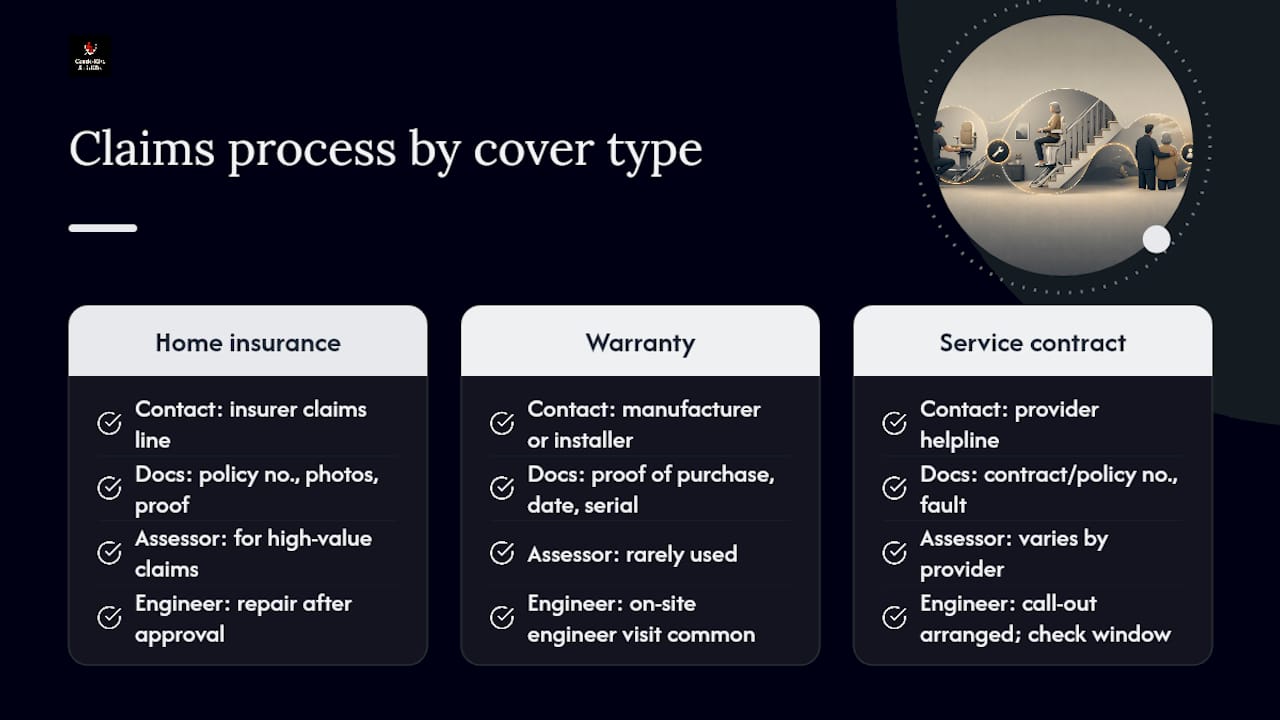
For a home insurance claim (fire, flood, theft, storm damage, or liability), contact your insurer's claims line as you would for any other incident. You'll typically need your policy number, photographs of the damage, and any relevant paperwork proving the stairlift was declared. Insurers usually appoint an assessor for higher-value claims before authorising repair or replacement.
For a warranty claim, contact the manufacturer or the installer who fitted the lift, not your home insurer. You'll need proof of purchase, the installation date, and the model and serial number. Most warranty claims for straightforward faults are resolved by an engineer visit rather than a lengthy assessment process.
For a breakdown cover or service contract claim, call the provider's dedicated line, quote your policy or contract number, and describe the fault. Ask upfront how long the guaranteed call-out window is and whether parts are included or charged separately, since this varies significantly between providers.
Across all three routes, the criteria that matter are consistent: proof of ownership or contract, a clear description of the fault or incident, and any excess or contribution you're required to pay. Keeping a single folder with your warranty document, insurance confirmation letter and service contract means you're never scrambling to find the right paperwork at the moment you need it most.
How long do stairlift insurance and warranty terms last?
Term lengths vary by product, and mixing them up is a common source of confusion for owners trying to track what's still active.
Manufacturer warranties on new stairlifts typically run for 12 to 24 months from the installation date, not the purchase date, which matters if there was a gap between ordering and fitting. Extended warranties are usually sold in additional yearly blocks once the original term ends, renewable each year at the provider's discretion.
Service contracts, including installer-backed plans, typically run on an annual cycle with automatic renewal unless you cancel. Read the renewal terms carefully. Some contracts lock in a price for the term and then increase it at renewal, so it's worth checking the following year's cost before you commit long-term.
Home insurance itself usually renews annually alongside your existing buildings or contents policy, and there's rarely a separate renewal process just for the stairlift declaration once it's on file. If you switch insurers, though, you'll need to declare the stairlift again to the new provider from scratch. It doesn't carry over automatically.
The practical habit worth building is simple: mark your warranty expiry date and your service contract renewal date in your calendar the moment you arrange cover, so you're never caught relying on cover that quietly lapsed months earlier.
Author's practical recommendation for the typical UK reader
For most owners, the sensible path is unglamorous but effective: declare the lift to your home insurer, lean on the manufacturer warranty while it lasts, and move to an installer service contract or breakdown cover the moment that warranty runs out. Installer contracts generally win on response speed. The exceptions are rental and commercial settings, and high-value curved lifts, where dedicated cover earns its cost from day one.
— lee
Protect+ from Gentlerise Stairlifts: cover without the guesswork
If you'd rather not juggle a warranty document, a separate breakdown policy and a home insurer's claims line, an installer-backed plan solves that in one relationship. Gentlerise Stairlifts's Protect+ programme bundles annual servicing, priority call-outs, and agreed parts and labour terms into a single contract with the company that installed your lift, rather than a third party who's never seen your staircase.
Protect+ includes:
- Scheduled annual servicing to catch faults before they become breakdowns.
- Priority call-out access for existing customers.
- Clear parts and labour terms agreed at the outset, not negotiated after a fault.
Gentlerise Stairlifts installs straight lifts from £795, with fitting often completed within hours, and also handles curved lifts, reconditioned models and short-term rentals across the UK. If your warranty is running out or you're weighing up cover for a curved or rented unit, book a free home survey with Gentlerise Stairlifts and ask directly about Protect+ pricing for your model.
Sources
- Stairlift Insurance | Fish Insurance | Fish Insurance
- Stairlift prices and costs | Stairlift Guru®
- In Home Warranty for Riser Chairs, Beds, Hoists & Stairlifts
- BHTA
FAQ
How much does stairlift insurance cost in the UK?
Declaring a stairlift to your home insurer usually adds little or nothing to your premium. Dedicated breakdown cover typically costs £50 to £200 a year, with servicing at £80 to £200 per visit.
Does Age UK offer insurance for stairlifts?
Age UK doesn't sell stairlift insurance directly; cover comes from your home insurer, the manufacturer warranty, specialist breakdown providers, or an installer service contract such as Protect+.
What should I look for in a stairlift company?
Look for BHTA membership, a listing on Which? Trusted Traders, clear warranty terms, and an aftercare plan. Gentlerise Stairlifts covers straight, curved and reconditioned lifts with installation often within hours.
How much does an extended warranty for a stairlift cost?
Extended warranty pricing varies by provider and term length, typically sold as an annual fee once the original manufacturer warranty, usually 12 to 24 months, has expired.
Do I need separate insurance if my stairlift is still under warranty?
No. While the manufacturer warranty is active, mechanical and electrical faults are covered. You still need to declare the lift to your home insurer for damage, theft and liability protection separately.