
TL;DR:
- A stairlift comfort rating is a weighted sub-score evaluating seat padding, armrest design, footrest ergonomics, controls, and mounting ease, accounting for about 20% of the total review score. Factors like ride smoothness, ergonomic support, safety features, and installation quality significantly affect real-world comfort beyond the rating. The right stairlift fit depends on personal physical needs and proper assessment through trials, with high-quality installation critical for ensuring long-term comfort.
A stairlift comfort rating is a scored measurement of how pleasant and manageable a stairlift is to use, assessed across criteria such as seat padding, armrest design, footrest ergonomics, ease of controls, and the mounting and dismounting process. These ratings matter because a stairlift you use multiple times a day must feel secure and comfortable from the moment you sit down to the moment you step off. Brands like Stannah and Handicare are regularly assessed against these criteria in UK review methodologies, and comfort typically accounts for around 20% of the total score in structured evaluations. Understanding what sits behind that percentage helps you choose a stairlift that genuinely suits your body and your home.
What is a stairlift comfort rating and how is it calculated?
A stairlift comfort rating is not a single, universally standardised figure. It is a weighted sub-score within a broader review framework, and the criteria used can differ significantly between reviewers. That said, the most structured UK methodologies follow a consistent set of factors.
The core criteria assessed in a typical comfort rating include:
- Seat padding and dimensions: Is the cushioning firm enough to support posture without being so soft that it offers no structure? Seat width and depth matter for users of different builds.
- Armrest design: Are the armrests padded, adjustable, and positioned to help you lower yourself onto the seat and push yourself up when exiting?
- Footrest ergonomics: A poorly angled footrest forces the knees into an uncomfortable position throughout the ride, which becomes significant on longer staircases.
- Ease of controls: Joystick or paddle controls should respond without requiring grip strength or precise finger dexterity, particularly for users with arthritis.
- Mounting and dismounting: Getting on and off safely and without strain is often the most physically demanding part of using a stairlift, yet it is frequently underweighted in headline scores.
According to UK review data, comfort is scored at 20% of the total stairlift review, sitting alongside categories such as safety, value, and after-sales support. This means a model with a comfort score of 8 out of 10 contributes 1.6 points to an overall score out of 10. That weighting is meaningful but not dominant, which is why you should always look at the comfort sub-score in isolation rather than relying on the headline figure alone.
Pro Tip: Focus on the comfort sub-features rather than the headline score. A model rated 9.2 overall may score only 7.5 for comfort, which matters far more if you have joint pain or limited mobility.
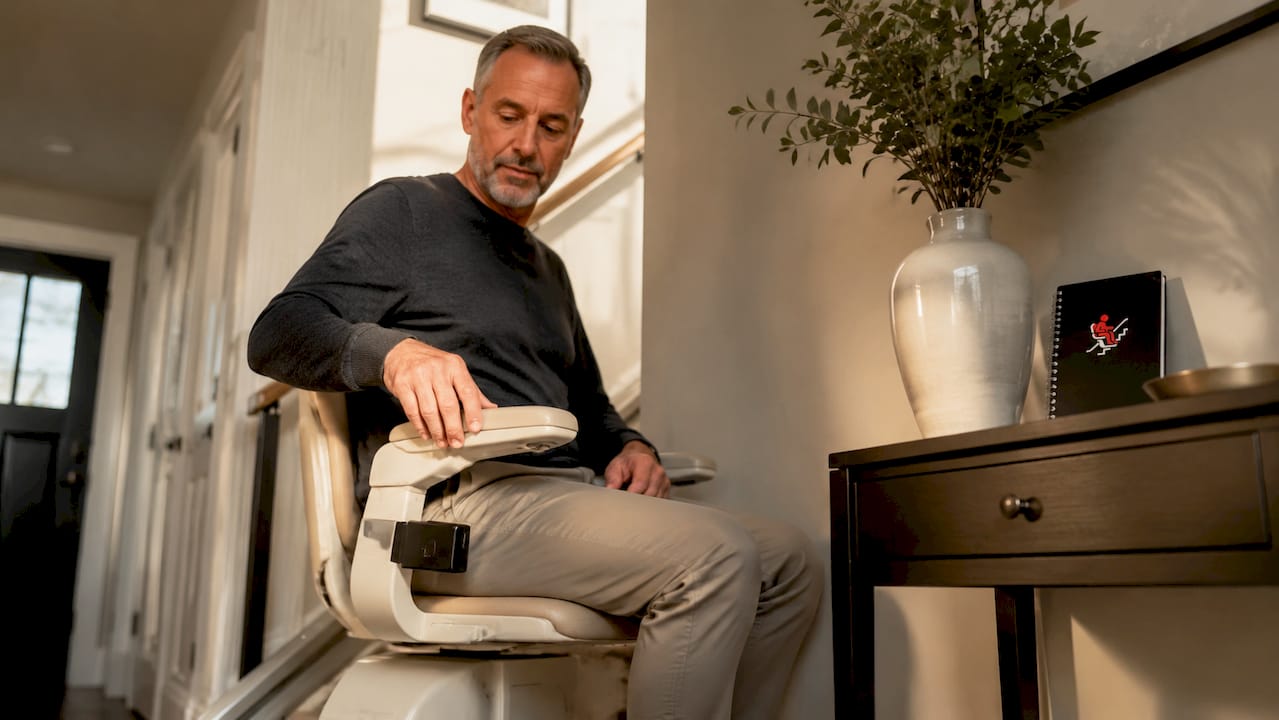
Comfort scores vary across brands because there is no universal standard. One reviewer may weight mounting ease heavily; another may focus almost entirely on seat cushioning. Before comparing two models side by side, check what each reviewer's comfort category actually includes.
| Comfort criterion | Why it matters |
|---|---|
| Seat padding and dimensions | Supports posture and reduces pressure on hips and tailbone during the ride |
| Armrest design | Aids safe lowering and rising, reducing strain on wrists and shoulders |
| Footrest ergonomics | Prevents knee strain, particularly on longer or steeper staircases |
| Control usability | Reduces grip and dexterity demands for users with arthritis or reduced hand strength |
| Mounting and dismounting ease | The most physically demanding phase; poor design increases fall risk and fatigue |
What else affects stairlift comfort beyond the rating?
A comfort rating captures a snapshot of the seat and controls. It rarely captures the full physical experience of using a stairlift every day. Several factors that significantly affect real-world comfort sit outside or at the edges of standard scoring.
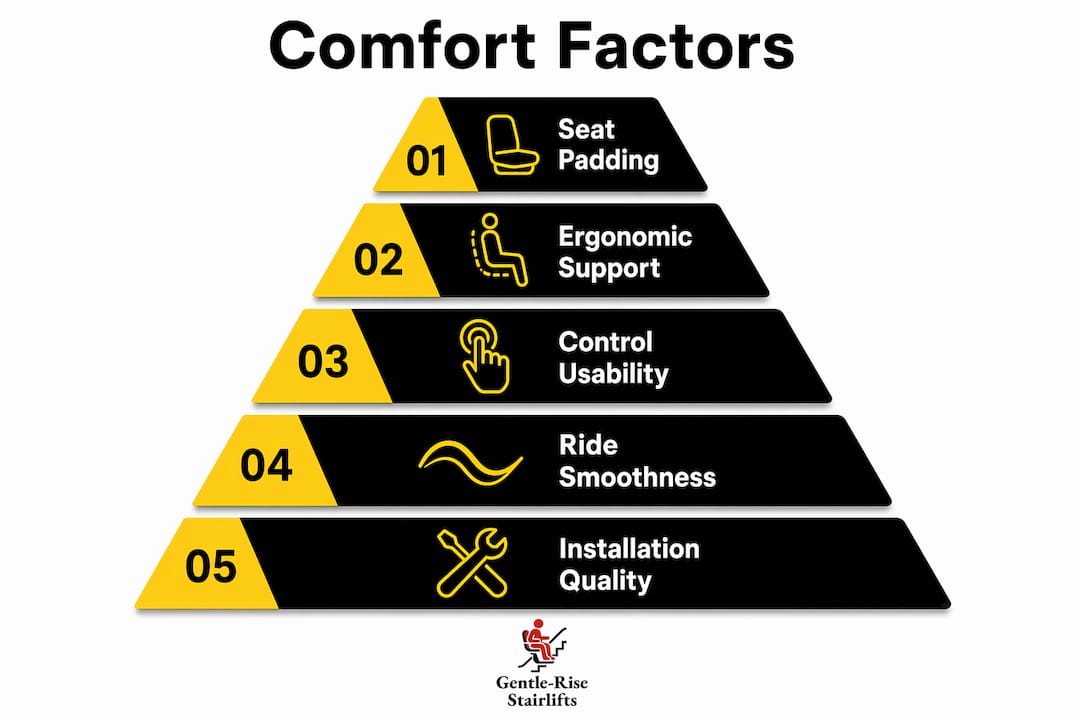
Ergonomic support goes beyond cushion thickness. Consumer testing by the NCOA of multiple models found that back support, chair contouring, and overall posture alignment were more decisive for comfort than seat softness alone. A high-density foam seat that holds your spine in a neutral position will serve you better over months of use than a plush seat that lets you sink into a slouch.
Ride smoothness is a separate dimension entirely. Stairlifts operate at speeds between 0.1 and 0.2 metres per second, and within that range, the quality of the start and stop matters enormously. A jerky departure from the bottom landing or an abrupt halt at the top creates physical strain on the neck and lower back. For users with arthritis or balance difficulties, smooth start/stop and stable rail design reduces strain on knees and hips and builds rider confidence over time.
Safety features also contribute directly to comfort in a way that ratings do not always capture. A seat belt that is easy to fasten with one hand, a powered swivel seat that rotates you to face the landing before you stand, and footrests that fold automatically all reduce the physical and psychological effort of each journey. Powered swivel seats and transfer aids dramatically improve real-world comfort and can be decisive even when two models have similar padding scores.
The following factors deserve attention when you go beyond the rating:
- Backrest contour: Does the chair support the natural curve of your lower back, or does it sit flat?
- Powered swivel seat: Does the seat rotate automatically to face the landing, reducing the need to twist your body when standing?
- Soft start and stop: Does the lift accelerate and decelerate gradually, or does it lurch?
- Rail stability: Is the rail fixed firmly to the staircase, with no flex or vibration during the ride?
- Installation quality: Even the best-rated model will feel uncomfortable if the rail is not fitted correctly to your specific staircase angle and width.
Pro Tip: Ask your installer about the rail fixing method and the number of fixing points used. A rail secured at too few points will flex under load, creating vibration that you feel throughout the ride.
Proper installation and fit to your staircase is not a comfort feature you can assess from a review. It is something you need to verify with your provider before and after fitting. Gentlerise Stairlifts, for example, surveys each staircase individually before installation to match the rail specification to the exact gradient and width, which directly affects ride quality.
How to assess stairlift comfort levels when shopping
Evaluating stairlift comfort before you buy requires more than reading a review score. The process of assessing stairlift comfort should be structured around your specific physical needs and daily routine.
Start with the review methodology. Before trusting a comfort score, confirm what criteria the reviewer assessed and how they were weighted. A score that only reflects seat padding tells you very little about how the stairlift will feel after six months of daily use.
Read multiple user reviews with a focus on long-term comfort experiences. Short-term impressions of a showroom demo are unreliable. Look for reviews from users who have owned the model for at least three to six months and who describe their physical conditions, such as arthritis, hip replacements, or balance difficulties. Their accounts of mounting ease, ride smoothness, and fatigue after repeated use are far more useful than a single test ride.
Consider your own physical profile carefully:
- Joint issues: Users with hip or knee replacements need a powered swivel seat and a footrest that positions the knees below hip height.
- Grip strength: Users with reduced hand strength need controls that respond to light pressure, not a firm squeeze.
- Balance: Users with balance difficulties benefit from wider seats, higher armrests, and a powered swivel that eliminates the need to twist when standing.
- Endurance: Users who fatigue quickly need a seat that supports posture without requiring core muscle engagement throughout the ride.
A hands-on trial is non-negotiable. Short demo rides often miss factors such as endurance, joint comfort, and grip strength. Comfort depends on the entire sequence: sitting down, fastening the belt, riding, swivelling, and exiting. Ask to complete the full sequence at least twice, and pay attention to how your body feels at each stage, not just during the ride itself.
Comparing stairlift types and their comfort implications is also worth doing early in your research. Curved stairlifts, for instance, travel at varying angles around bends, which places different demands on the seat and rail system than a straight lift does.
How do popular stairlift models compare on comfort?
The table below draws on UK review data from 2026 to compare three widely reviewed models on comfort scores and standout features. These figures come from structured assessments and reflect the criteria discussed above.
| Model | Comfort score | Key comfort features | Best for |
|---|---|---|---|
| Stannah 600 | 9.0 / 10 | Superior powered swivel, high-density cushioning, intuitive joystick | Users needing maximum transfer support |
| Handicare 1100 | 8.2 / 10 | Slim seat profile, adjustable armrests, smooth rail system | Narrower staircases, lighter users |
| Brooks Lincoln | 7.8 / 10 | Firm supportive seat, easy-grip controls, manual swivel | Budget-conscious buyers with good mobility |
The Stannah 600 leads UK comfort ratings with a comfort score of 9.0 and an overall score of 9.2, driven largely by its powered swivel seat and after-sales network. This matters because the swivel seat addresses the single most physically demanding moment of the journey: standing up at the top landing. The Handicare 1100 scores well for users with narrower staircases, where a slimmer seat profile reduces the risk of the footrest catching the wall. The Brooks Lincoln suits users who are relatively mobile and prioritise value, though its manual swivel requires more physical effort than the Stannah equivalent.
From an international perspective, the Harmar stairlift was rated most comfortable by the NCOA in US consumer testing, credited to its extra-high backrest and ergonomic cushioning. Bruno ranked best overall in the same testing, with comfort and postural support cited as primary strengths. These models are not widely available in the UK, but their design features illustrate what ergonomic excellence looks like and what to ask about when evaluating UK alternatives.
Pro Tip: After-sales support is a comfort factor that no rating captures. A stairlift that develops a fault and sits unrepaired for two weeks is deeply uncomfortable in the most practical sense. Check the provider's average response time for call-outs before you commit.
What I have learned about comfort ratings after years in home mobility
Comfort ratings are useful starting points. They are not reliable finishing points. The single most consistent gap I see between what a rating promises and what a user experiences is the transfer problem: getting on and off the seat safely and without pain.
Seat padding scores are easy to measure in a showroom. The physical effort of lowering yourself onto a seat at the bottom of a staircase, with your knees already aching and your balance not quite what it was, is not something a cushion firmness test captures. A powered swivel seat that rotates you to face the landing before you stand is worth more to most users than an extra point on the padding score. I would always prioritise that feature over a softer seat.
Ride smoothness is the second factor that ratings consistently undervalue. I have spoken with users who found a highly rated model genuinely unpleasant to use because the rail had a slight flex at a mid-staircase fixing point. The vibration was minor on paper. Over three rides a day, it became a source of real discomfort for someone with lower back pain. Placement and installation quality affect ride comfort as much as the engineering of the lift itself.
My advice is this: use the comfort rating to create a shortlist, then assess each shortlisted model against your own physical sequence of movements. Sit down. Fasten the belt. Ride the full length. Swivel. Stand. If any step in that sequence causes strain or uncertainty, the rating is irrelevant. The right stairlift is the one that makes every step feel manageable, not just the ride itself.
— lee
How Gentlerise Stairlifts can help you find the right fit
Choosing a stairlift on comfort alone is only part of the decision. The quality of the installation, the responsiveness of aftercare, and the fit to your specific staircase all determine whether a well-rated model actually delivers in your home.
Gentlerise Stairlifts provides straight, curved, and reconditioned stairlift solutions across the UK, with prices starting at £795 for straight models. Every installation begins with a free home survey, so the rail specification and seat configuration are matched to your staircase and your physical needs before a single fitting begins. The Protect+ maintenance programme covers ongoing servicing and call-outs, so comfort and reliability do not degrade over time. If you are ready to explore your options, visit Gentlerise Stairlifts to book your free survey or speak with the team about which model suits your home and mobility requirements.
FAQ
What does a stairlift comfort rating measure?
A stairlift comfort rating measures how easy and pleasant a stairlift is to use, covering seat padding, armrest design, footrest ergonomics, control usability, and the mounting and dismounting process. In structured UK reviews, comfort typically accounts for around 20% of the overall score.
Are stairlift comfort ratings standardised across brands?
No. There is no universal standard for stairlift comfort ratings, and criteria vary between reviewers. Always check what a specific comfort score includes before comparing models from different review sources.
Which stairlift has the highest comfort rating in the UK?
The Stannah 600 currently leads UK comfort ratings with a score of 9.0 out of 10, driven by its powered swivel seat, high-density cushioning, and strong after-sales support network.
How should I assess stairlift comfort for my own needs?
Complete the full sequence during any trial: sit, fasten the belt, ride, swivel, and stand. Pay attention to how each stage feels for your specific physical conditions, such as joint pain, grip strength, or balance difficulties, rather than relying on the ride alone.
Does installation quality affect stairlift comfort?
Yes. A poorly fitted rail can flex or vibrate during the ride, creating discomfort that no seat rating predicts. Proper rail fixing and correct installation to your staircase gradient directly affect ride smoothness and long-term comfort.
Key takeaways
A stairlift comfort rating is a weighted sub-score that covers seat ergonomics, control usability, and transfer ease, but ride smoothness and installation quality determine whether that score translates into real-world comfort.
| Point | Details |
|---|---|
| Comfort rating weighting | Comfort typically accounts for 20% of a total stairlift review score in UK methodologies. |
| No universal standard | Criteria vary between reviewers, so always check what a comfort score includes before comparing models. |
| Transfer ease is underrated | Powered swivel seats improve real-world comfort more than padding scores alone suggest. |
| Ride smoothness matters | Soft start/stop and stable rail design reduce strain on joints and build rider confidence over time. |
| Installation affects comfort | Rail fitting quality and placement directly influence ride smoothness, regardless of the model's rating. |