
TL;DR:
- Home mobility consultants, mainly occupational therapists, assess environments to recommend safety adaptations for independent living. They produce clinical reports that help unlock funding and guide building feasibility for major modifications. Engaging them reduces fall risks, maintains independence, and secures funding, especially when accessed early.
Home mobility consultants are professionals who assess your home environment and recommend adaptations to support safe, independent living. In the UK, the term most often refers to occupational therapists (OTs), who are regulated by the Health and Care Professions Council (HCPC). The role of home mobility consultants extends well beyond equipment provision. These specialists evaluate how you move through your home, identify risks, and produce clinical reports that unlock funding under the Care Act 2014. Gentlerise Stairlifts works alongside this process, providing stairlift solutions that OTs frequently recommend as part of a wider adaptation plan.
What functions do home mobility consultants perform during an assessment?
A home mobility assessment is a structured clinical visit, typically lasting 60–90 minutes, conducted by a registered occupational therapist. The OT evaluates daily living tasks such as moving in and out of bed, climbing stairs, cooking, dressing, and using the toilet. Every task is observed in your actual home, not a clinical setting, which makes the findings directly relevant to your daily life.
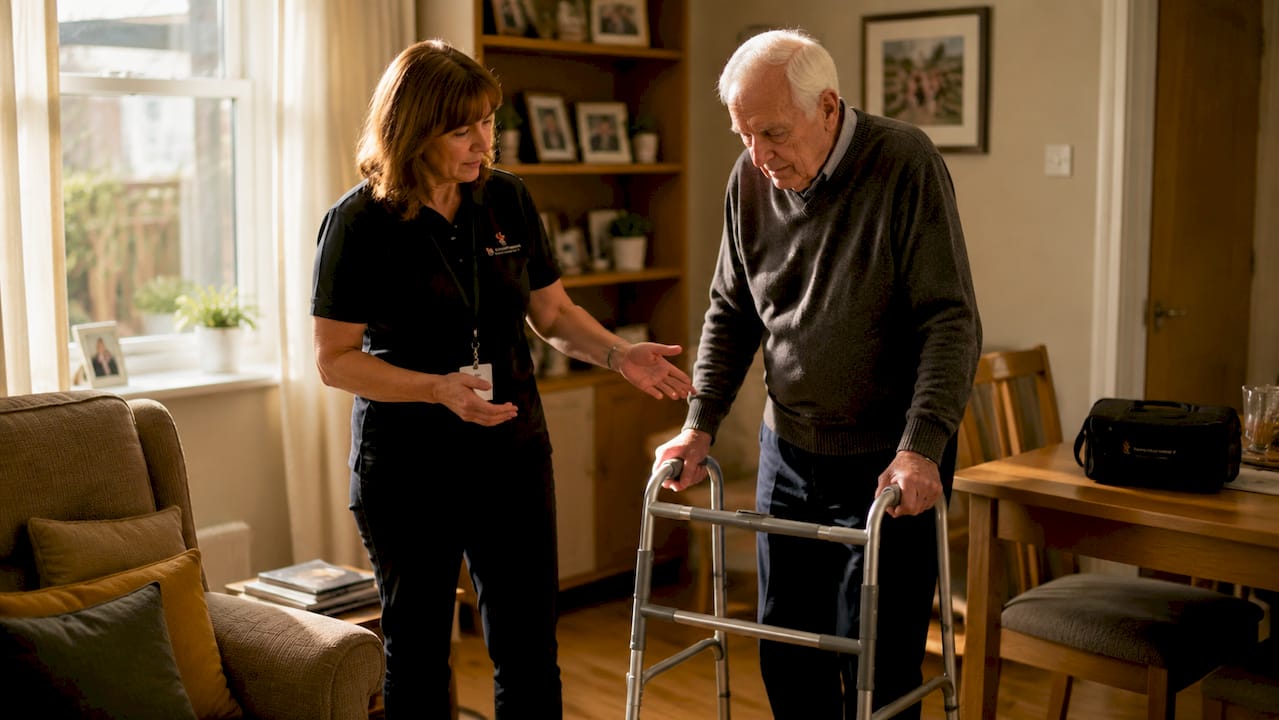
The OT then produces a written report that separates outcomes into two categories: "essential" and "desired." Essential outcomes are those your safety and independence depend on. Desired outcomes improve quality of life but are not critical. This distinction matters because local authorities use it to prioritise funding under the Care Act 2014.
Common adaptations recommended after an assessment include:
- Grab rails fitted in bathrooms, hallways, and on stairs
- Stairlifts for people who cannot safely climb steps
- Level-access showers replacing baths where bathing has become unsafe
- Ramps at entrances where steps create a barrier
- Raised toilet seats and perching stools for those with limited strength or balance
The report does not just list equipment. It explains the clinical reasoning behind each recommendation, which gives it legal weight in funding applications. You can read more about adaptive home mobility solutions to understand how these recommendations translate into practical changes.
Pro Tip: Before your OT visit, write down every task you find difficult, including those you have quietly stopped doing. OTs can only assess what they observe or are told about. Mentioning that you no longer use the bath, for example, may be the detail that justifies a level-access shower on your report.
How do occupational therapists and adaptations surveyors differ?
Occupational therapists are clinical professionals whose focus is your functional ability and independence. They assess what you can and cannot do safely, and they produce regulated professional reports that carry legal significance in funding decisions. Adaptations surveyors, by contrast, are technical experts. They assess the building itself, produce CAD drawings, and determine whether a proposed adaptation is structurally feasible.
The two roles are complementary, not interchangeable. An OT identifies that you need a stairlift or a wet room. The adaptations surveyor then assesses whether your staircase or bathroom can accommodate the required work, and oversees the build. For major projects, both professionals are involved at different stages.
| Role | Primary focus | Key output |
|---|---|---|
| Occupational therapist | Functional ability and clinical need | Written assessment report, funding justification |
| Adaptations surveyor | Building structure and technical feasibility | CAD drawings, structural specifications |
OT reports are regulated documents that serve as clinical justification in Disabled Facilities Grant (DFG) applications. Without a valid OT report, a DFG application is unlikely to succeed. This is why the OT's role is the foundation of any major home adaptation project, not simply a preliminary step.
The best outcomes come when both professionals work as a team. The OT defines what the person needs clinically. The surveyor defines what the building can deliver technically. Where those two answers align, the adaptation goes ahead. Where they conflict, the team finds an alternative solution.
What are the benefits of engaging home mobility consultants?
The most direct benefit of a professional home mobility assessment is a reduction in fall risk. Falls are the leading cause of injury-related hospital admissions among older adults in the UK. A trained OT identifies hazards that you may have adapted around without realising, such as gripping a door frame to steady yourself on the stairs, and recommends changes before an incident occurs.
Beyond safety, the benefits of home mobility services include:
- Maintained independence. Adaptations allow people to continue living at home rather than moving into residential care.
- Personalised recommendations. Unlike generic product guides, an OT assessment accounts for your specific diagnosis, home layout, and daily routine.
- Access to funding. OT reports are crucial for Disabled Facilities Grant applications, which can fund adaptations up to £30,000 in England.
- Confidence. Knowing your home has been professionally assessed gives you and your family reassurance that risks have been addressed.
- Preventative care. Early consultation prevents crises. An OT who visits before a fall is far more effective than one called in after a hospital admission.
Timely access to assessment matters. Families often wait for council OT assessments, and in urgent cases a private OT may be the faster route. Private fees vary by region, but the cost of a private assessment is often far lower than the cost of a preventable hospital stay or emergency care package.
OT-led assessments also address lifestyle factors that equipment alone cannot fix. An OT might recommend a change in routine, a different sequence for getting dressed, or a referral to a physiotherapist alongside a grab rail. That breadth of thinking is what separates a clinical consultation from a product sale. For practical ideas on age-friendly home modifications, these assessments provide the clinical foundation that makes modifications genuinely effective.
How do you access home mobility consulting services in the UK?
The starting point for most people is their local authority. Under the Care Act 2014, UK local authorities must provide free community equipment and minor adaptations valued under £1,000, and they are legally obliged to conduct a needs assessment when requested. You do not need a GP referral to request one, though a GP or hospital discharge team can also trigger the process.
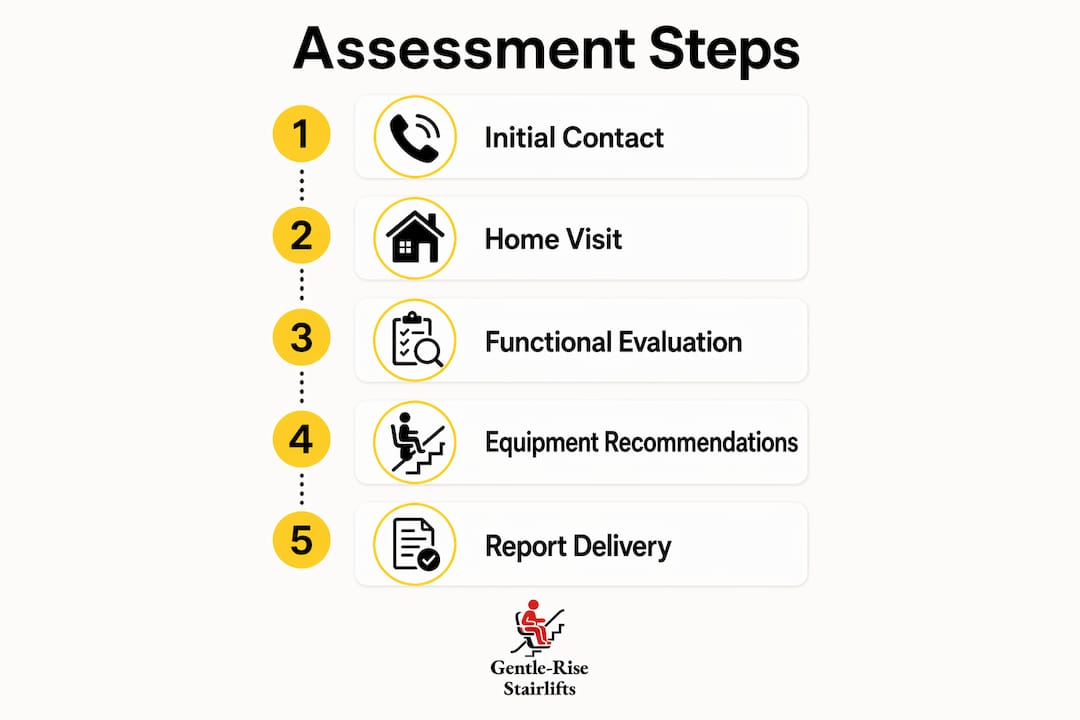
The steps to access a council OT assessment are:
- Contact your local council's adult social care team. Ask specifically for a home occupational therapy assessment.
- Describe your difficulties clearly. Include any tasks you have stopped doing, not just those you struggle with.
- Attend the assessment at home. The OT will visit and observe your environment directly.
- Receive the written report. This document outlines recommended adaptations and their clinical justification.
- Apply for funding if needed. For adaptations above £1,000, the council will conduct a means test and may direct you to a Disabled Facilities Grant application.
For larger adaptations, the DFG is the primary funding route. The grant is means-tested in England, meaning your financial contribution depends on your income and savings. Local authorities also provide up to six weeks of intermediate care without charge to support safe transitions after adaptations are made.
If council waiting times are too long for your situation, a private OT is a legitimate alternative. Private consultations offer faster access, and the resulting report carries the same clinical and legal weight as one produced through the council pathway. Costs vary by region, so contact your local OT professional body or ask your GP for a recommendation.
Pro Tip: When applying for a Disabled Facilities Grant, ask the council for a named contact and request written confirmation of each stage. Councils are legally required to process applications within set timeframes, and knowing your rights keeps the process moving. You can also find useful context on wheelchair-friendly home improvements to understand what adaptations are typically covered.
For bathroom adaptations specifically, a UK bathroom renovation guide can help you understand the practical scope of works before your surveyor visit.
Key takeaways
Home mobility consultants, primarily occupational therapists regulated by the HCPC, are the clinical foundation of every effective home adaptation plan in the UK.
| Point | Details |
|---|---|
| OTs lead clinical assessments | Occupational therapists assess daily living tasks and produce legally significant reports for funding. |
| Reports unlock grant funding | A valid OT report is required for Disabled Facilities Grant applications and local authority decisions. |
| Two roles work together | OTs define clinical need; adaptations surveyors handle building feasibility and design. |
| Council access is free | Local authorities must provide free minor adaptations under £1,000 and conduct needs assessments on request. |
| Private OTs offer faster access | Private consultations carry the same legal weight as council assessments and suit urgent cases. |
Why the OT role is wider than most people realise
People often think of occupational therapists as the professionals who turn up and recommend a grab rail. That picture is incomplete. OTs are highly trained clinical diagnosticians whose work spans preventative care, crisis response, and system-wide service design. The grab rail is the output. The clinical reasoning behind it is the real work.
What concerns me, having followed this sector closely, is how often people wait until after a fall or a hospital admission before seeking an assessment. By that point, the OT is responding to a crisis rather than preventing one. The evidence is clear that OT leadership in integrated care teams produces better outcomes for residents. Early intervention is where the real value lies, and most people never access it.
Approximately 3,400 occupational therapists work in UK adult social care, a number that is stretched thin across a growing population of older adults. The workforce is focused largely on crisis response rather than prevention, not by choice, but by demand. If you are waiting for a council assessment and your situation is urgent, do not hesitate to explore a private OT. The cost is real, but so is the risk of waiting.
My advice is straightforward. Request your assessment early. Be honest about every difficulty, including the ones you have quietly worked around. And treat the OT visit as a clinical conversation, not a form-filling exercise. The more you share, the more useful the report becomes.
— lee
Gentlerise Stairlifts and your home mobility needs
When an occupational therapist recommends a stairlift, the next step is finding a provider you can trust to install it correctly and support you afterwards.

Gentlerise Stairlifts installs straight, curved, and reconditioned stairlifts across the UK, with prices starting at £795 and installation often completed within hours. The Protect+ maintenance programme keeps your lift running safely after installation. Whether you need a permanent solution or a short-term rental while you recover from surgery, Gentlerise Stairlifts offers options that fit your situation. Book a free home survey through Gentlerise Stairlifts and get a clear, no-obligation recommendation based on your staircase and your needs. For a deeper look at what to expect, the guide to safer home mobility covers the key questions before you commit.
FAQ
What does a home mobility consultant actually do?
A home mobility consultant, most commonly a registered occupational therapist, visits your home and assesses how safely you perform daily tasks such as climbing stairs, bathing, and cooking. They produce a written report recommending adaptations and providing clinical justification for funding applications.
Do I need a GP referral to get a home mobility assessment?
No referral is required. You can contact your local council's adult social care team directly to request a home occupational therapy assessment under the Care Act 2014.
How long does a home mobility assessment take?
A typical home assessment lasts 60–90 minutes. The OT observes your home environment and discusses every task you find difficult, so the more detail you provide, the more thorough the resulting report will be.
Can a private OT report be used for a Disabled Facilities Grant?
Yes. A report from a private occupational therapist carries the same clinical and legal weight as one produced through the council pathway and can support a Disabled Facilities Grant application.
What is the difference between an OT and an adaptations surveyor?
An occupational therapist assesses your functional ability and clinical need, producing the report that justifies adaptations. An adaptations surveyor assesses the building itself, producing technical drawings and overseeing construction. Both roles are needed for major adaptation projects.