
TL;DR:
- Customer support in mobility aids covers assessments, installation, troubleshooting, and ongoing maintenance to ensure safety and functionality. Effective support prevents emergencies, helps access funding, and extends device lifespan through timely responses and expert care. Gentlerise Stairlifts offers free surveys, structured maintenance, and fast emergency responses focused on user needs.
Customer support in mobility aids is defined as the full range of services that guide users from initial assessment through to long-term device maintenance, covering consultations, technical assistance, funding advice, and emergency response. For anyone relying on a stairlift, power wheelchair, or mobility scooter, this support is not a bonus feature. It is the difference between a device that works safely every day and one that fails at the worst possible moment. Gentlerise Stairlifts, along with other specialist UK providers, builds its entire service model around this principle. The quality of aftercare shapes user confidence, independence, and safety far more than the device specification alone.
What is the role of customer support in mobility aids?
Customer support for mobility aids covers every touchpoint between a provider and the person using the device. That includes the first phone call, the home assessment, the installation, and every technical query or breakdown that follows. In the industry, this is often called aftercare or post-sale support, and the best providers treat it as a continuous relationship rather than a transaction.
The impact of customer service on mobility is direct and measurable. A stairlift that stops working traps a person on the wrong floor of their own home. A poorly fitted wheelchair causes pressure injuries. A caregiver who cannot get through to a support line faces real risk. Good customer care in mobility solutions prevents all three of these outcomes by ensuring the right product is fitted correctly and kept in working order.
Specialist providers go further than standard helplines. They offer emergency call-out services, funding navigation with staff who understand benefits and grants, and structured maintenance programmes. Gentlerise Stairlifts, for example, offers the Protect+ maintenance programme specifically to keep stairlifts reliable between scheduled services. That kind of structured aftercare reflects a clear understanding of what users actually need once the installation is complete.
How do initial consultations shape the right mobility aid choice?
The consultation is where customer support begins, and it sets the tone for everything that follows. Mobility consultations typically last 15–30 minutes and focus on the user's home layout, health conditions, and daily mobility goals rather than pushing a particular product. That distinction matters enormously. A consultation built around the user's life produces a far better outcome than one built around a sales catalogue.
Effective support staff act as needs assessors first. They ask about daily routines, body size, caregiver involvement, and the physical features of the home before recommending anything. Focusing on price over value is the most common pitfall in mobility aid consultations. It leads to unsuitable purchases that get abandoned within months, wasting money and leaving the user no better off.
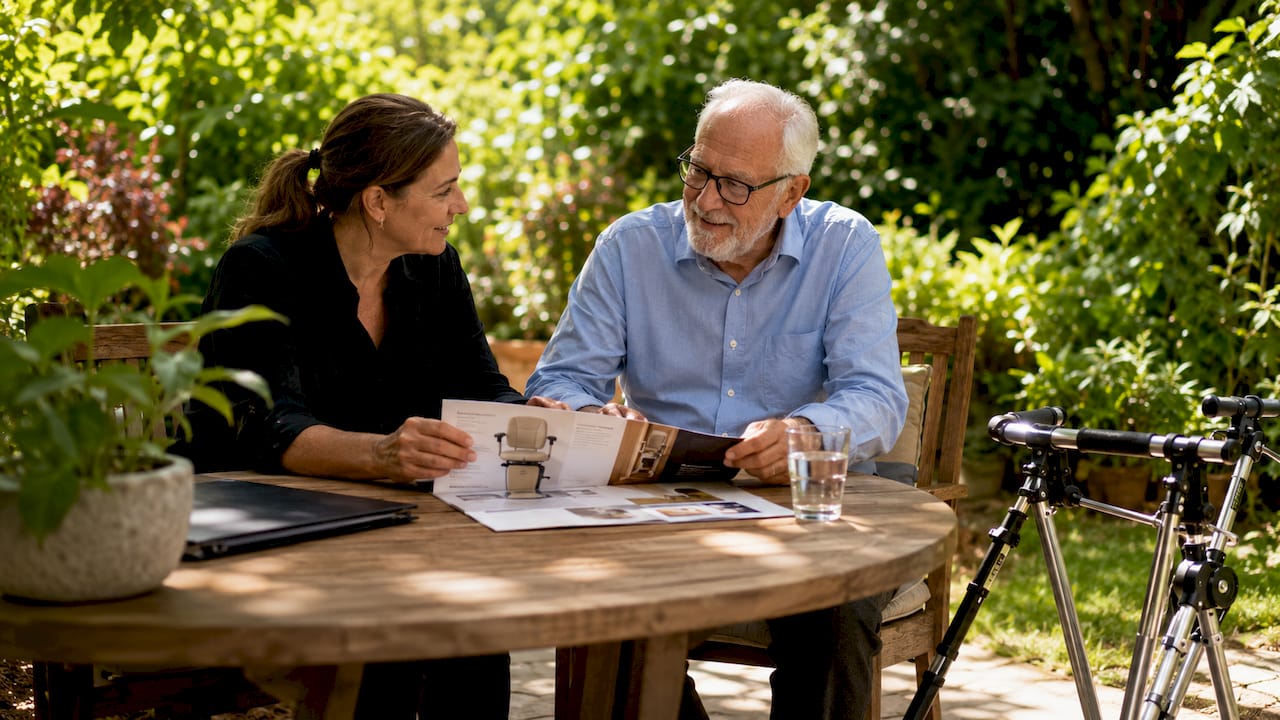
A good consultation for a stairlift, for instance, covers staircase width, turning radius at the top and bottom, the user's transfer ability, and whether the need is permanent or temporary. Gentlerise Stairlifts offers free home surveys for exactly this reason. Seeing the actual staircase and meeting the user in person produces a recommendation that a phone call alone cannot match.
The benefits of a no-obligation consultation include:
- Accurate product matching based on real home measurements rather than estimates
- Identification of funding options such as Disabled Facilities Grants before any purchase commitment
- Caregiver involvement so that the people supporting the user understand how the device works
- Realistic timeline planning covering installation, training, and follow-up visits
Pro Tip: Before your consultation, write down the three daily tasks that feel most difficult on the stairs. Sharing these specifics helps the assessor recommend the right device far faster than a general description of your condition.
You can read more about preparing for this process in this guide on assessing your mobility needs before booking a survey.
Why does responsive technical support matter for stairlift users?
A stairlift that stops mid-staircase is not an inconvenience. It is a safety emergency. Top providers target technician response times under 90 minutes, including weekends, because a stalled device can leave a vulnerable person stranded or at risk of a fall. That benchmark reflects the reality of who uses these devices and what is at stake when they fail.
Phone support resolves a significant share of problems before any engineer visit is needed. Around 30% of mobility device service issues can be resolved through guided phone walkthroughs. That saves time, reduces disruption, and means the user regains mobility within minutes rather than waiting hours for a visit. For caregivers managing a busy household, that speed matters.
The most effective technical support teams combine fast response with genuine device knowledge. Local expertise is particularly valuable for complex equipment. Local support simplifies maintenance for devices like stairlifts and power wheelchairs by reducing the time spent diagnosing unfamiliar service histories. A technician who knows the model, the installation, and the local area responds more effectively than a national call centre reading from a script.
A structured approach to technical support typically follows these steps:
- Initial phone triage to identify whether the issue is mechanical, electrical, or user-related
- Remote guided troubleshooting covering common faults such as obstruction sensors, battery charge, and key switch positions
- Scheduled engineer visit if the remote call does not resolve the fault
- On-call emergency dispatch for safety-critical failures where the user cannot safely leave the stairlift
- Post-visit follow-up to confirm the device is working correctly and the user feels confident
Pro Tip: Keep a short note near your stairlift with the model number, installation date, and your provider's direct support line. In an emergency, having this information ready cuts the triage call time significantly.
Standard business-hour support typically runs Monday to Friday, with unresolved complaints investigated within two business days. For stairlift users, confirming that your provider also offers out-of-hours emergency cover is a non-negotiable part of choosing a supplier.
How do mobility aid providers compare on customer support?
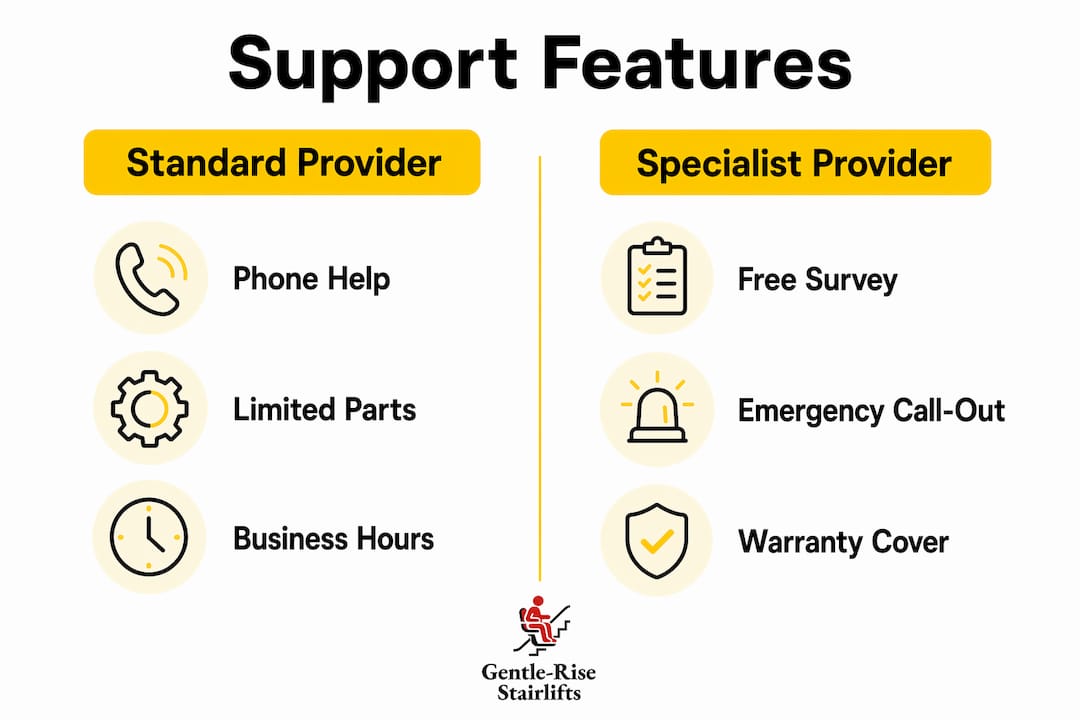
Not all providers structure their support in the same way, and the differences have real consequences for users. The table below compares the key support features that distinguish providers in the UK mobility aid market.
| Support feature | Standard provider | Specialist provider |
|---|---|---|
| Consultation type | Phone or online only | Free in-home assessment |
| Response time (phone) | Same day or next day | Within 1 hour during business hours |
| Emergency cover | Business hours only | On-call, under 90 minutes |
| Staff expertise | General customer service | Includes former benefits counsellors |
| Maintenance programme | Ad hoc on request | Structured plans such as Protect+ |
| Replacement parts | Ordered on request | Stocked locally for faster repair |
| Warranty support | Standard manufacturer terms | Extended with accessible claims process |
The staffing difference is worth examining closely. Specialist teams often include former benefits counsellors who help users navigate Disabled Facilities Grants, Attendance Allowance, and other funding routes. For many households, this guidance makes the difference between affording the right device and settling for an unsuitable one.
Reliable providers maintain trust through accessible replacement parts and warranty policies that reflect real user needs. A warranty that requires the user to post a component to a central depot is not designed for someone who depends on that device daily. Providers who stock parts locally and dispatch engineers quickly demonstrate that they understand their customers' actual circumstances.
Gentlerise Stairlifts sits firmly in the specialist category. The Protect+ programme, free home surveys, and local installation teams reflect a support model built around the user rather than around operational convenience.
Practical tips for getting the most from mobility aid support
Knowing how to engage with customer support makes a real difference to the outcome. These steps help users and caregivers get faster, more accurate help every time they contact their provider.
- Document your device details including model number, serial number, and installation date. Keep this information somewhere accessible, not just in an email archive.
- Describe faults in behavioural terms. "The chair stops halfway up and the red light flashes twice" is far more useful than "it's not working." Specific descriptions speed up remote triage.
- Ask about escalation routes when you first sign up. Know who to contact if a standard support call does not resolve your issue within the agreed timeframe.
- Schedule annual servicing proactively rather than waiting for a fault to appear. Ongoing maintenance extends device lifespan and catches wear before it becomes a safety issue.
- Involve your caregiver in the consultation. The person who assists you daily needs to understand the device's controls, safety features, and basic troubleshooting steps.
- Clarify funding options early. Ask your provider whether they have staff who can advise on grants or benefits before you commit to a purchase or rental agreement.
Regional support teams consistently outperform national call centres for stairlift users because they carry local knowledge, shorter travel times, and familiarity with the specific models installed in their area. When comparing providers, ask directly whether your engineer will be local or dispatched from a central hub.
Key takeaways
Customer support is the single most important factor in whether a mobility aid delivers lasting safety and independence for its user.
| Point | Details |
|---|---|
| Consultations determine fit | Free in-home assessments lasting 15–30 minutes produce far better product matches than remote or catalogue-based sales. |
| Emergency response is safety-critical | Stairlift providers should target technician response under 90 minutes, including weekends, for stalled devices. |
| Remote support resolves many faults | Around 30% of service issues can be resolved by phone, saving time and avoiding unnecessary engineer visits. |
| Specialist staff add real value | Teams with benefits counsellors help users access grants and funding, making the right device financially accessible. |
| Ongoing maintenance prevents failure | Structured programmes like Protect+ extend device lifespan and catch faults before they become safety risks. |
What I have learned about support quality in mobility aids
People shopping for stairlifts almost always focus on price first. I understand why. The cost is visible and the support quality is not. But after years of observing how these decisions play out, I am convinced that the aftercare model matters more than the purchase price in the long run.
The providers who genuinely serve their customers well share one characteristic: they treat the consultation as a diagnostic process, not a sales call. Effective assessors prioritise the user's daily routine and caregiver situation over the product margin. That orientation shows up in every subsequent interaction, from the installation quality to the speed of an emergency call-out.
The misconception I encounter most often is that a cheaper device with minimal support is a reasonable trade-off. It rarely is. A stairlift that breaks down and takes three days to fix has effectively failed its user. The device's specification becomes irrelevant the moment the support structure around it collapses. Localised, expert aftercare is not a premium add-on. It is the foundation that makes the device worth having in the first place.
— lee
Gentlerise Stairlifts: support built around you
Gentlerise Stairlifts provides free home surveys across the UK, where a specialist assesses your staircase, your mobility needs, and your home layout before recommending anything. There is no obligation and no pressure. The goal is the right fit, not the fastest sale.
The Protect+ maintenance programme keeps your stairlift in reliable working order with scheduled servicing and priority call-out cover. Straight stairlifts start from £795, with rental options available for short-term needs. Whether you are planning ahead or need a solution quickly, Gentlerise Stairlifts is ready to help you stay safe and independent at home. Book your free survey today and speak to a specialist who will give you honest, personalised advice from the first conversation.
FAQ
What does customer support include for stairlift users?
Customer support for stairlift users covers initial home assessments, installation guidance, remote technical troubleshooting, emergency call-out services, and ongoing maintenance programmes. Specialist providers also offer funding advice to help users access grants such as the Disabled Facilities Grant.
How quickly should a stairlift provider respond to a breakdown?
Top stairlift providers aim for technician response times under 90 minutes for safety-critical failures, including out-of-hours and weekend emergencies. A stalled stairlift is treated as a safety risk, not a routine service request.
Can stairlift problems be fixed over the phone?
Around 30% of stairlift service issues can be resolved through guided phone troubleshooting, covering common faults such as obstruction sensors, battery charge, and key switch positions. If the remote call does not resolve the fault, an engineer visit is arranged.
Why does a free home survey matter before buying a stairlift?
A free home survey allows a specialist to measure the actual staircase, assess the user's transfer ability, and identify any installation challenges before any purchase is made. This produces a far more accurate recommendation than a phone or online consultation alone.
What is the Protect+ programme from Gentlerise Stairlifts?
The Protect+ programme is Gentlerise Stairlifts' structured aftercare plan, providing scheduled servicing and priority call-out cover to keep stairlifts in safe working order. It is designed to catch wear and faults before they become safety issues.