
TL;DR:
- Choosing a regional stairlift provider offers faster emergency response, often within 1 to 3 days, which enhances safety and reduces risks. They provide bespoke installation that accounts for local home architecture, improving safety and aesthetic integration. Additionally, a single local provider manages all aspects of service, warranty, and maintenance, ensuring continuity and prompt support throughout the stairlift's lifecycle.
Choosing a regional stairlift provider is the single most effective decision a homeowner with mobility challenges can make for long-term safety, convenience, and peace of mind. The benefits of local stairlift services extend well beyond installation day. Regional providers offer faster emergency response, bespoke fitting knowledge, and a single trusted contact throughout the entire life of your stairlift. These advantages matter most when something goes wrong at 7am on a Monday, or when your staircase has a tight bend that a national call centre has never seen in person.
1. Regional stairlift service advantages: faster response when it matters most
Speed is the defining advantage of a regional provider. Regional specialists dispatch technicians within 1 to 3 business days, compared to the 2 to 7 business days or longer that national direct-to-consumer brands routinely take in less-populated areas. For someone who relies on a stairlift to reach their bedroom or bathroom, that difference is not a minor inconvenience. It is a genuine safety risk.
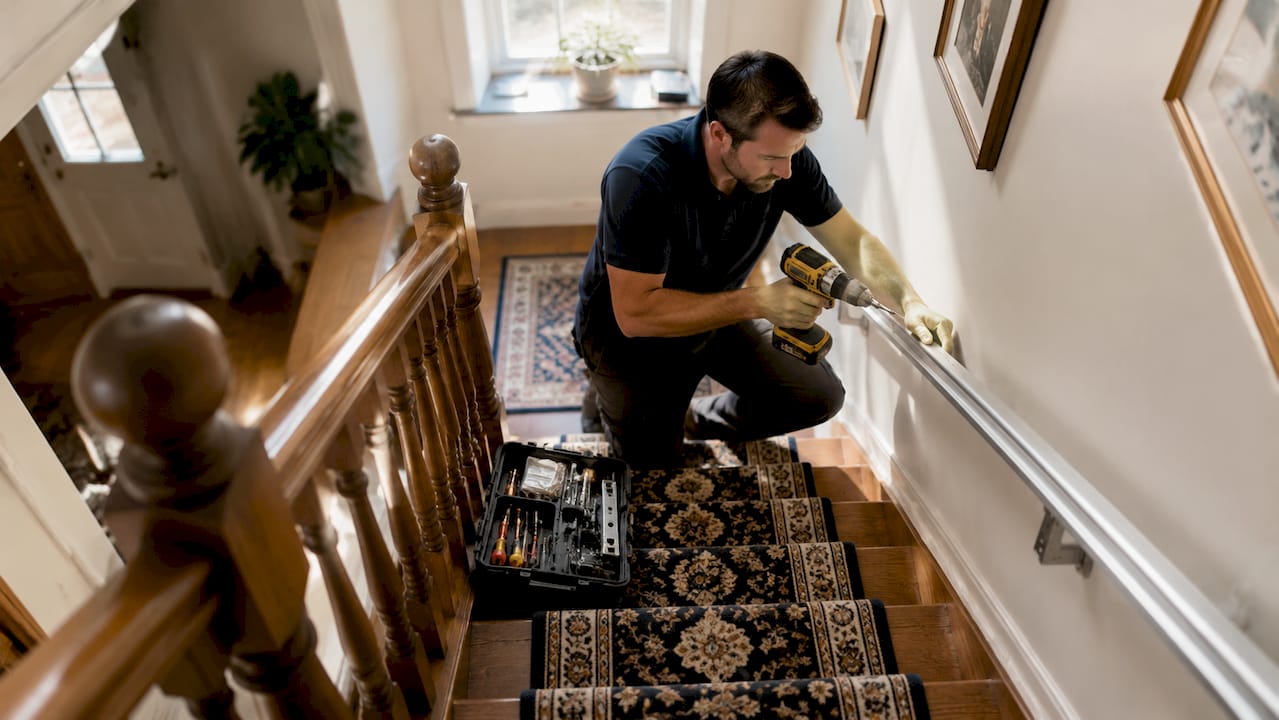
Local providers can often offer same-day or next-day emergency repairs because their technicians are already operating in your area. A national brand routes your call through a central booking system, then dispatches from a regional hub that may be two counties away. A local provider's engineer may already be working three streets from your home.
The parts situation reinforces this advantage. Local dealers hold spare parts in local inventory, which means a repair that would take a week with a national provider can often be completed in a single visit. You do not wait for a courier to deliver a component from a central warehouse.
- Same or next-day emergency callouts are far more common with regional providers
- Local parts inventory removes the courier delay from most repairs
- Dedicated aftercare plans mean your engineer knows your specific unit
Pro Tip: When comparing providers, ask directly: "What is your average emergency response time in my postcode?" A confident local provider will give you a specific answer. A national call centre will give you a policy document.
2. Bespoke installation tailored to your home's architecture
No two staircases are identical, and regional installers understand this better than anyone. Local providers specialise in the architectural nuances of homes in their area, whether that means Victorian terraces with narrow, steep stairs in Birmingham, Edwardian semis with quarter-turn landings in South London, or post-war council properties with non-standard staircase widths across the Midlands.
This local knowledge directly reduces your risk of falls. A rail that is not precisely fitted to your staircase geometry creates wobble, misalignment, or awkward transfer points at the top and bottom. Customised installations by local providers account for irregular staircases common in specific regions, improving both safety outcomes and day-to-day comfort.
The aesthetic dimension matters too. A regional installer who has fitted dozens of stairlifts in period properties knows how to route cables discreetly, choose seat colours that complement existing décor, and position the unit so it does not dominate a narrow hallway. These are not trivial concerns when the stairlift will be a permanent feature of your home.
- Precise rail measurements reduce wobble and misalignment at transfer points
- Knowledge of local housing stock means fewer surprises during installation
- Aesthetic integration options are more thoughtfully applied by experienced local teams
3. A single point of contact throughout the stairlift's life
The local dealer model gives you one company responsible for everything: the survey, the sale, the installation, the warranty, and the ongoing maintenance. This accountability structure is one of the most underappreciated regional stairlift installation benefits. When something goes wrong, you call one number. You speak to someone who knows your name, your address, and the exact model fitted in your home.
National direct-to-consumer brands often separate these functions. The sales team is different from the installation team, which is different again from the aftercare team. Each handover creates an opportunity for information to be lost and for you to repeat yourself to someone who has no record of your previous calls.
Warranty handling is a clear example of where this matters. Local dealers manage warranty claims directly with manufacturers, handling the logistics of parts and repairs without requiring you to package and ship components yourself. With a direct-to-consumer model, the customer often becomes the intermediary between the manufacturer and the repair process.
"The technician who installed my stairlift was the same person who came back six months later for the service. He remembered exactly what we'd discussed and sorted the issue in under an hour." This kind of continuity is standard with regional providers and rare with national ones.
Ongoing maintenance plans, such as the Protect+ programme offered by Gentlerise Stairlifts, are designed around this model. Regular servicing by a familiar engineer extends equipment life and catches small issues before they become costly faults.
- One company manages survey, installation, warranty, and aftercare
- Warranty claims are handled by the dealer, not passed back to you
- Maintenance visits by the same engineer build genuine product familiarity
4. How regional providers compare to national brands
Understanding when to choose a regional provider and when a national brand might be considered requires an honest look at the trade-offs. The table below sets out the key differences.
| Factor | Regional provider | National direct-to-consumer |
|---|---|---|
| Emergency response time | 1 to 3 business days | 2 to 7 business days or longer |
| Local parts inventory | Typically yes | Rarely |
| Installation expertise | Tailored to local housing stock | Standardised process |
| Single point of contact | Yes, throughout lifecycle | Often split across departments |
| Upfront price | Slightly higher on average | Often lower |
| Multi-brand product range | Common | Usually single brand only |
National brands can offer lower upfront costs, and for straightforward straight staircases in newer properties with good urban coverage, the service gap may be smaller. The problem is that national brands have limited technician coverage in rural and semi-rural areas, and response times in those regions can stretch well beyond a week. For someone who cannot safely use the stairs without their stairlift, a week is an unacceptable wait.
Regional providers also tend to offer products from multiple manufacturers, including Handicare, Acorn, and Brooks, rather than being locked into a single brand. This means your installer can recommend the product that genuinely suits your staircase and budget, rather than the one they are contractually obliged to sell. You can explore stairlift costs in the UK to understand the full pricing picture before committing.
The decision comes down to four factors: the complexity of your staircase, your location relative to national service hubs, the urgency of your mobility needs, and your appetite for risk if the lift breaks down. For most homeowners with genuine mobility challenges, the regional model wins on every factor except initial price.
Pro Tip: Ask any provider whether the engineer who installs your stairlift will also carry out future servicing. If the answer is no, you are likely dealing with a model that separates installation from aftercare. That separation costs you continuity.
5. The peace of mind that comes with local accountability
Local stairlift providers contribute to aging in place by forming part of the community infrastructure around you. This is not a marketing phrase. It means that your installer has a reputation to protect in your area, has likely fitted stairlifts for your neighbours, and has a direct commercial interest in your satisfaction that a national brand operating at scale simply does not share.
Homeowners report greater peace of mind with local providers because the response to emergencies is personal and rapid. When you call a local provider, you are not entering a queue. You are calling a business that knows your postcode, your staircase, and your name. That familiarity translates directly into faster, more accurate service.
The stairlift service convenience of a regional model also reduces the cognitive load on family members and carers. When a parent's stairlift stops working, the last thing a family needs is to navigate a national call centre, explain the model number, and wait for a callback from a scheduling team. A local provider removes that friction entirely.
For homeowners researching reliable stairlifts near you, the combination of rapid response, bespoke fitting, and single-point accountability makes the regional model the clear choice for anyone prioritising safety and long-term independence.
Key takeaways
Regional stairlift service advantages centre on faster response times, bespoke local installation, and single-point accountability throughout the stairlift's lifecycle.
| Point | Details |
|---|---|
| Faster emergency response | Regional providers respond in 1 to 3 business days versus up to 7 or more for national brands. |
| Bespoke installation knowledge | Local expertise in regional housing styles reduces falls risk and improves comfort. |
| Single point of contact | One company manages survey, installation, warranty, and maintenance throughout. |
| Local parts inventory | On-hand spare parts enable same-day repairs that national providers cannot match. |
| Long-term value over price | Slightly higher upfront costs are offset by superior service, continuity, and safety outcomes. |
Why I always recommend the regional route first
When someone asks me whether they should go with a local provider or a national brand, my answer is almost always the same: go local, and here is why that is not just a preference.
The national brand pitch is built on price and brand recognition. It sounds reassuring. But the moment your stairlift stops working and you are stranded on the wrong floor of your own home, brand recognition means nothing. What matters is whether an engineer can be at your door today, not in five business days.
What I have seen repeatedly is that homeowners who choose the cheaper national option often end up paying more over time. They pay for emergency callouts that take longer, for parts that arrive late, and for the stress of managing warranty claims themselves. The local provider model builds the cost of good service into the relationship from the start.
The other thing I would say is this: do not underestimate the value of an engineer who has fitted twenty stairlifts in Victorian terraces in your borough. That knowledge is not in a training manual. It is in the hands of someone who has solved the same problem in the same type of home, dozens of times. That expertise protects you in ways that a standardised national installation process simply cannot replicate.
Prioritise long-term safety and support over the lowest upfront cost. Your stairlift is not a one-time purchase. It is a relationship with a service provider that may last ten years or more. Choose the provider you would trust to answer the phone on a Sunday morning.
— lee
Gentlerise Stairlifts: local expertise, lasting support
Gentlerise Stairlifts provides bespoke in-home assessments, expert installation, and fast aftercare across the UK, with straight stairlifts starting from £795. The Protect+ maintenance programme gives you scheduled servicing and priority response from engineers who know your specific unit. Whether you need a straight, curved, or reconditioned stairlift, Gentlerise Stairlifts combines the regional service advantages this article describes with genuinely affordable pricing. Book a free home survey today and take the first step towards enhanced home accessibility with a provider you can trust. Visit Gentlerise Stairlifts to get started.
FAQ
How quickly can a regional stairlift provider respond to a breakdown?
Regional stairlift specialists typically dispatch technicians within 1 to 3 business days, with same-day or next-day emergency callouts available in many areas. This is significantly faster than national direct-to-consumer brands, which can take 2 to 7 business days or longer in rural locations.
Are local stairlift providers more expensive than national brands?
Regional providers are often slightly higher in upfront cost, but they offset this through faster repairs, local parts inventory, and single-point aftercare that reduces long-term maintenance costs. The full cost picture includes service quality, not just the purchase price.
Why does local installation expertise matter for stairlifts?
Local installers understand the architectural characteristics of homes in their area, enabling precise rail fitting that reduces wobble and lowers falls risk. This is particularly important in older housing stock with non-standard staircase dimensions.
What is the benefit of a single point of contact with a regional provider?
A regional provider manages your survey, installation, warranty, and ongoing maintenance through one team, removing the handover gaps common in national models. This means faster problem resolution and an engineer who already knows your stairlift when they arrive.
Can a regional provider handle warranty claims on my behalf?
Yes. Local dealers manage warranty claims directly with manufacturers, holding spare parts in local inventory to speed up repairs. This removes the need for you to ship components or act as an intermediary between the manufacturer and the repair process.