
Request an Occupational Therapy (OT) assessment from your local council social services team as your very first move. If you're already under a district nurse or hospital team, ask them to make the referral directly. Everything else in the mobility adaptation process in the UK flows from that single appointment.
From there, expect one of two funding routes. Small adaptations under £1,000 (grab rails, raised toilet seats, small ramps) are usually arranged and paid for by the council once the OT recommends them. Bigger structural work, such as a stairlift, wet room, or extension, typically needs a Disabled Facilities Grant (DFG), which is means-tested and comes with a legal requirement: councils must decide on a completed application within six months.
You'll hear four names repeatedly through this process:
- OT assessment – the evidence base for everything that follows
- Disabled Facilities Grant (DFG) – the main funding mechanism for larger works
- The 6-month statutory decision deadline councils must meet
- Suppliers such as Gentle Rise Stairlifts Ltd, who offer a faster private route when time matters more than saving money
Key Takeaways
The mobility adaptation process in the UK moves fastest when you request an OT assessment immediately and run a private supplier survey in parallel rather than waiting on one route alone.
| Point | Details |
|---|---|
| Start with an OT assessment | Request it from council social services or via your care team as the first action. |
| Know the two funding routes | Small aids under £1,000 are usually council-provided; larger works need a means-tested DFG. |
| Track the statutory deadline | Councils must decide on a completed DFG application within six months. |
| Prepare specific evidence | Note concrete daily difficulties, gather quotes, and secure landlord consent before applying. |
| Consider a faster private route | Gentle Rise Stairlifts Ltd offers free surveys, rental options, and Protect+ aftercare for urgent stairlift needs. |
Where to find official guidance and support
Save every OT report you receive. It's the core evidence for any DFG application or later appeal.
- Gov explains the means test and occupancy conditions.
- Gov helps you find your local council and start the process.
- The full DFG guidance document covers staged delivery and Home Improvement Agency support in detail.
This article is general information, not a substitute for advice from a qualified lawyer. Consult a qualified legal professional about your own circumstances before acting on anything here.
Table of Contents
- What are the stages of the council-led home adaptation process?
- Who qualifies for funding, and how does the means test work?
- Which mobility adaptations suit which situation?
- How should you prepare for the OT assessment and application?
- When does a private stairlift or rental make more sense than waiting?
- Sources
- FAQ
What are the stages of the council-led home adaptation process?
Start at Stage 0. That's your first contact with the council, whether by phone, referral, or online form, and it's the point at which the clock effectively starts running, even though the statutory six-month window only applies once a formal DFG application is complete. The full pathway runs through five stages, each defined in official DFG guidance.
- Stage 0: First contact – you or your carer flag the need, and the council logs it.
- Stage 1: Assessment and identification of works – an OT visits, assesses your home and daily function, and recommends specific adaptations.
- Stage 2: Preparing and submitting the application – paperwork, quotes, and means-test documentation are gathered.
- Stage 3: Application to approval – the council reviews eligibility and the "necessary and appropriate" test. This is where the six-month statutory clock applies.
- Stage 4: Approval to completion – works are scheduled, installed, and signed off.
| Stage | What happens | Typical driver of delay |
|---|---|---|
| 0. First contact | Referral logged with the council | Waiting lists for OT appointments |
| 1. Assessment | OT visits and identifies works | Complex cases needing multiple visits |
| 2. Application prep | Quotes and means-test evidence gathered | Missing documents or landlord consent |
| 3. Application to approval | Council decides within 6 months | Panel review backlogs |
| 4. Approval to completion | Contractor books and installs | Contractor availability |
Delays cluster at Stages 1 and 2 far more often than during the statutory decision window itself. Councils that run an integrated team, one adviser who follows your case from referral to completion rather than passing you between departments, tend to move faster, according to DFG delivery guidance. If your council offers a named contact or a Home Improvement Agency caseworker, ask for one by name at Stage 0.
Who qualifies for funding, and how does the means test work?
Small aids under £1,000 are usually provided without a means test once an OT has recommended them. Anything larger, a stairlift, a level-access shower, or a home extension, generally requires a means-tested DFG application, and eligibility hinges on two specific tests.
The council must be satisfied the works are "necessary and appropriate" for your needs, and "reasonable and practical" given the property. You're also normally expected to intend to live in the property for the grant period, which is typically five years. If you're planning to move sooner, say so early, because it changes what the council will approve.
Statutory timescale: once your DFG application is complete, the council has a legal duty to issue a decision within a statutory deadline. Incomplete applications, missing quotes or unsigned consent forms, don't start that clock.
The means test itself looks at household income and savings, not just the applicant's. In practice:
- Ask the council for a preliminary means check before you gather full paperwork. It tells you roughly what contribution, if any, you'll need to make.
- Confirm whether your partner's or household's finances are included, as rules differ by circumstance.
- Keep a record of the check. It shortens the formal application later.
Scope's guidance on DFGs notes that grant caps vary by nation, so a DFG that fully covers a wet room in one authority might leave a shortfall elsewhere. That gap is where private funding or a stairlift purchase often steps in.
Which mobility adaptations suit which situation?
Four categories cover most needs: minor aids (grab rails, raised seating), wet-room or bathroom adaptations, ramps, and stairlifts. Which one applies depends on where the difficulty actually shows up, on the stairs, in the bathroom, or getting through doorways.
An OT report typically tries the cheapest, least disruptive option first. If a grab rail solves the problem, that's what gets recommended before anything structural. Stairlifts and wet rooms come into play once the OT has documented that minor aids won't be enough, usually because the difficulty is with a specific fixed feature like a staircase rather than general mobility.
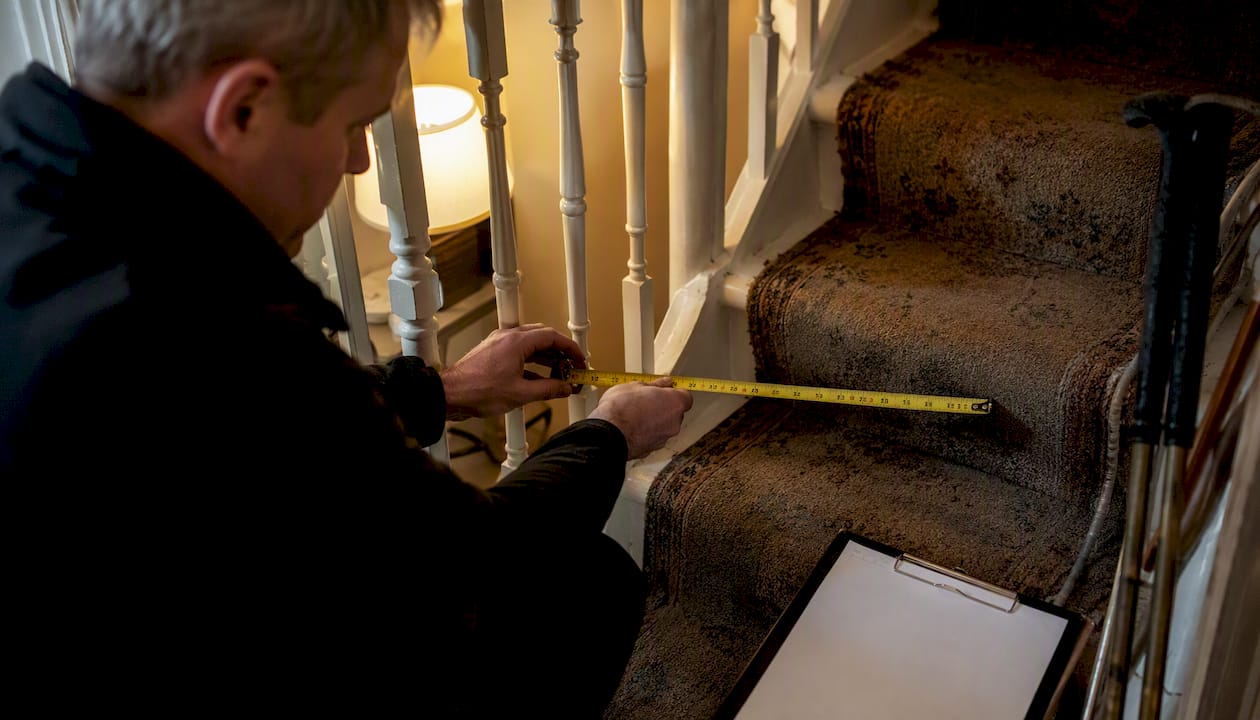
For stairlifts specifically, expect a free feasibility survey before any quote is finalised. Which?'s buying guide points out that installation lead-times differ sharply between straight staircases, which can often be fitted within hours, and curved staircases, which need a custom-built rail and typically take longer to source and fit.
| Option | Speed of delivery | Typical cost | Permanence | Property impact |
|---|---|---|---|---|
| Minor aids (rails, seats) | Days to weeks | Usually free under £1,000 | Removable | Minimal |
| DFG-funded structural work | Months (council process) | Means-tested, often no direct cost | Permanent | Structural |
| Private stairlift (purchase/rental) | Often within days | Fixed price, from entry-level for straight lifts | Removable | Low |
Gentle Rise Stairlifts Ltd sits in that third row: straight stairlift installation is often completed within hours of a survey, curved lifts take longer to manufacture, and every installation comes with a Protect+ aftercare option covering training, warranty, and annual servicing. Reconditioned units and short-term rental are also available, which matters if the adaptation is needed for recovery rather than permanently.
Pro Tip: Ask whichever route you choose, council or private, for the OT's written reasoning alongside the recommendation. It becomes useful evidence if you ever need to appeal a funding decision or switch suppliers.
How should you prepare for the OT assessment and application?
The single best habit before your OT visit is writing down concrete daily difficulties rather than general statements. "I struggle with the stairs" tells the OT far less than "I can't manage the third step because the handrail ends too soon." Specific detail is what turns into a strong report, and the OT report is the core evidence for any funding decision that follows.
Before the assessment, gather:
- Any previous OT or medical letters describing your condition
- Photos of the problem areas (stairs, bathroom, entrances)
- Proof of tenancy or ownership, plus written landlord consent if you rent
- Quotes from suppliers where you already have them, even informal ones
Mention specific tasks: reaching the second stair tread, transferring from bath to standing, managing a step at the front door. Our guide on how mobility consultants assess a home covers the kinds of questions to expect and how to describe difficulties clearly.
- Ask for a preliminary means check before submitting a full DFG application.
- Request a private feasibility survey in parallel if the council waiting list looks long. There's no rule against doing both.
When does a private stairlift or rental make more sense than waiting?
A private route makes sense when time matters more than saving money, hospital discharge deadlines, a recent fall, or a council waiting list stretching past what's practical. Private purchase or rental is generally faster because the limiting factor for councils is caseload and procurement, not the physical work itself, while a private supplier can often survey and fit within days.
The trade-off is straightforward: private routes usually cost more upfront but remove the waiting entirely, while a DFG can cover the full cost of larger works but on a longer timeline.
At the survey, ask suppliers directly:
- Is the home survey free, and what does the written quote include?
- What's the realistic lead-time for my staircase, straight or curved?
- What warranty period comes with the lift, and what does Protect+ style aftercare actually cover?
- Does the work qualify for VAT exemption on accessibility equipment?
Pro Tip: Getting three independent quotes isn't just about price. It reveals whether different surveyors agree the job is feasible, which is useful evidence if you later apply for a DFG top-up.
Watch for red flags: high-pressure sales on the day of the survey, no written quote, vague answers about warranty length, or a supplier unwilling to explain their handover procedure.
What installers wish clients asked about upfront
The handover is when you should ask about maintenance, training, and warranty, not after the installer has left. A properly run installation treats fitting day as the start of an ongoing relationship, not the end of one. That's the thinking behind Protect+, which bundles annual servicing and support into the purchase rather than leaving it as an afterthought.
Book a survey with Gentle Rise Stairlifts Ltd
If waiting on a council timeline isn't practical, Gentle Rise Stairlifts Ltd offers free home surveys and can often install a straight stairlift within hours of confirming the job. Rental options cover shorter-term needs, such as recovery after surgery, and every installation includes the option of Protect+ aftercare: handover training, warranty cover, and annual servicing built in from day one.
The practical next step is simple: book a free home survey, ask for a written quote covering both the lift and the aftercare terms, and confirm warranty length before you sign anything. If you're still weighing purchase against rental, our guide to understanding stairlift solutions breaks down which suits recovery periods versus permanent need.
Sources
- Home adaptations - Social care and support guide - NHS
- Gov
- Disabled Facilities Grant guidance (England and Wales)
- Gov
- Buying and installing a stairlift - Which?
FAQ
How long does a Disabled Facilities Grant take to approve?
Once your application is complete, the council has a statutory duty to decide within six months, though the assessment and preparation stages beforehand can add several more months.
Do I need an OT assessment before applying for a DFG?
Yes. The OT assessment identifies what adaptations are necessary and provides the written evidence councils use to judge whether works are "necessary and appropriate."
Is a stairlift covered by a Disabled Facilities Grant?
Stairlifts can qualify for DFG funding if an OT recommends one and it passes the necessity test, though many people choose a private purchase or rental through a supplier like Gentle Rise Stairlifts Ltd to avoid the waiting time.
What happens if my DFG application is refused or delayed?
You can request a review from the council or make a formal complaint through its adult social care complaints procedure; keeping your OT report and correspondence organised strengthens any appeal.
How much does a private stairlift cost compared to waiting for a DFG?
Private stairlifts carry an upfront cost but can often be installed within days, while a DFG may cover the full cost of larger adaptations on a longer, means-tested timeline.