
TL;DR:
- Red flags in stairlift companies include pressure selling, fixed pricing without home surveys, and vague warranties. Verifying credentials, responsible after-sales support, and VAT exemption ensure trustworthy service. Asking detailed questions protects users from scams and poor-quality installations.
Local stairlift company red flags are warning signs that reveal unreliable or unsafe providers lacking proper pricing transparency, authorisation, or genuine customer care. Choosing the wrong company can cost you far more than money. A poorly fitted stairlift puts a vulnerable person at real physical risk. The British Healthcare Trades Association (BHTA) sets recognised standards for reputable suppliers, and the Consumer Rights Act 2015 protects buyers when installations fall short. Knowing what to look for before you sign anything is the single most effective way to protect yourself, your budget, and the person who depends on that stairlift every day.
1. Pressure selling and "sign today" deals
Pressure selling is the most common red flag in stairlift sales. Tactics like "today only" pricing, limited-time discounts, or a salesperson who refuses to leave without a signature are designed to stop you thinking clearly. A reputable company gives you time. Good stairlift companies allow at least a week for clients to decide after quoting and never pressurise for immediate sign-ups. That breathing space exists because a stairlift is a significant purchase, not an impulse buy.
Homeowners and caregivers should always get at least 3 quotes before committing to any provider. Comparing quotes reveals the market rate and exposes pricing that is either suspiciously low or unjustifiably high. You also have a statutory right to cancel a contract signed in your home within 14 days under the Consumer Contracts Regulations 2013. Any company that does not mention this right is either uninformed or hoping you will not find out.
Pro Tip: If a salesperson tells you the price will rise tomorrow, thank them for their time and show them the door. Legitimate suppliers do not operate this way.
- Watch for verbal-only "special" offers with no written confirmation
- Be cautious if the salesperson discourages you from seeking other quotes
- Ask for the quote in writing before any discussion of signing
2. Fixed pricing without a proper home survey
A fixed price given over the phone or online, without anyone visiting your home, is a stairlift installation warning sign you cannot afford to ignore. A reliable supplier always performs a free, thorough in-person home survey before quoting a price. Fixed pricing without seeing the home creates a high risk of incorrect quotes and poor fitment. Staircases vary enormously in width, angle, length, and the presence of doorways or landings.
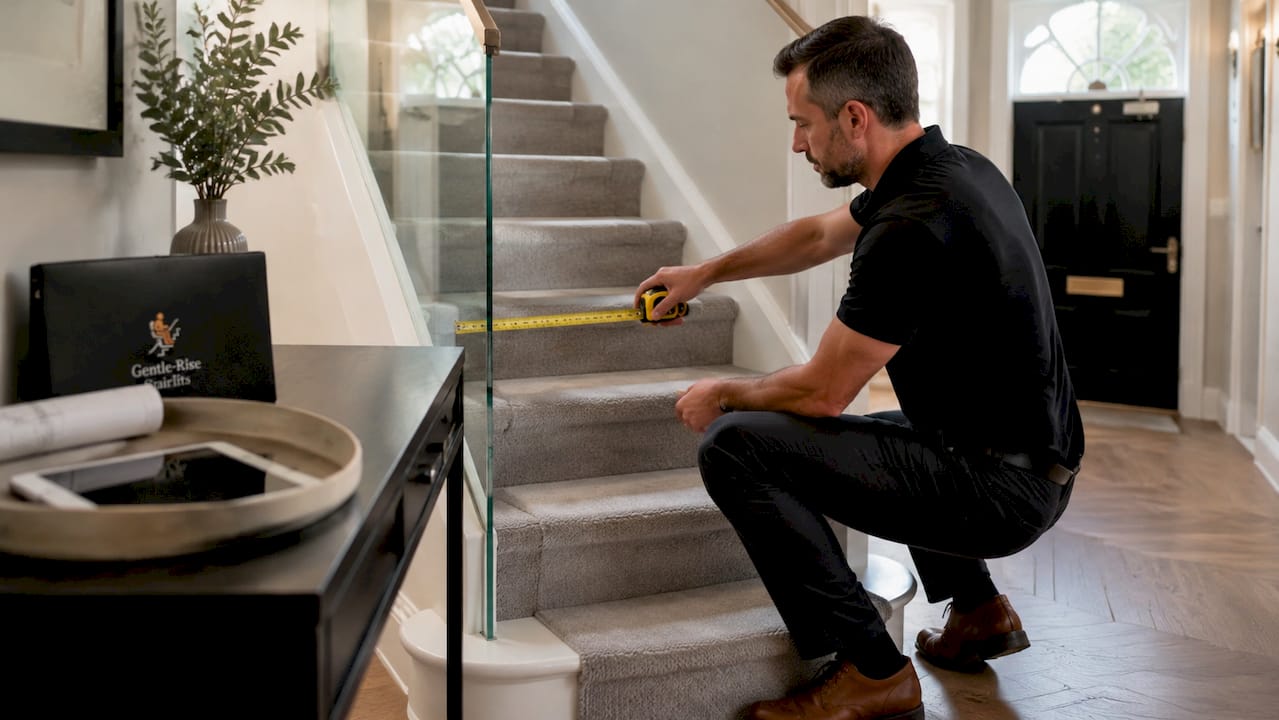
Straight staircases are relatively straightforward to measure, but curved staircases require custom-built rails unique to each property. Custom-built curved stairlift rails are unique to each staircase, which is why a reconditioned curved lift from another property will not fit yours. A company quoting a curved stairlift without a site visit either does not understand this or does not care. Neither option is acceptable.
The survey should also assess the user's physical needs, the condition of the staircase wall for bracket fixings, and the location of the nearest power socket. Gentlerise Stairlifts conducts free home surveys before providing any quote, precisely because accurate measurement protects both the customer and the quality of the installation.
3. Vague or missing warranty and after-sales support
Unclear warranty terms are a core item on any budget stairlift red flags list. Industry norms sit at 12–24 months for parts and labour on new stairlifts, but the detail matters as much as the duration. Ask specifically whether the warranty covers the motor, the rail, the seat mechanism, and the battery. A company that cannot answer these questions clearly has not thought through its after-sales obligations.
Reputable local stairlift companies provide 24-hour local emergency call-out and clear details on after-sales support. Relying on a national call centre often leads to delays in urgent repairs. For an elderly person or someone recovering from surgery, a broken stairlift is not an inconvenience. It is a safety crisis. Local servicing capability is therefore a practical necessity, not a luxury.
Pro Tip: Ask the company directly: "If my stairlift stops working at 9pm on a Sunday, who do I call and how quickly will someone arrive?" The answer tells you everything about their after-sales commitment.
- Confirm whether annual servicing is included or charged separately
- Ask about battery replacement costs and frequency
- Check whether the warranty is provided by the installer or a third party
4. Unverified credentials and authorisation status
Checking a company's credentials is one of the most practical steps in learning how to choose stairlift companies safely. BHTA membership provides an independent dispute resolution process, which means that if something goes wrong, you have a formal route to resolution outside of the courts. BHTA membership is not an absolute guarantee of quality, but its absence removes an important layer of consumer protection.
Beyond trade body membership, ask whether the company is an authorised reseller or installer for the stairlift brand they are selling. Unauthorised resellers may source units through grey markets, which can void manufacturer warranties and leave you without recourse if the product is faulty. The Consumer Rights Act 2015 gives you the right to demand repeat performance when an installation falls below reasonable care and skill. Documenting the installation process with photographs supports any claim you may need to make.
| Credential to check | Why it matters |
|---|---|
| BHTA membership | Provides independent dispute resolution |
| Manufacturer authorisation | Confirms legitimate supply chain and warranty validity |
| Public liability insurance | Protects you if installation causes property damage |
| Company registration number | Verifies the business is legally registered in the UK |
Confirm the company's registered address and Companies House number before signing anything. Stairlift provider scams often involve traders with no fixed address or companies registered at virtual offices with no local presence.
5. VAT charged when you qualify for exemption
VAT relief for disabled users is 20% and should be applied automatically by any reputable supplier. If a quote includes VAT and the person using the stairlift has a long-term illness or disability, question it immediately. HMRC allows zero-rated VAT on mobility aids for eligible individuals, and a knowledgeable company will raise this with you without being prompted. A company that charges full VAT without asking about eligibility is either poorly trained or deliberately overcharging.
The Disabled Facilities Grant is another financial avenue worth raising with your provider. A company that has never heard of it, or dismisses it, lacks the experience to serve customers with genuine mobility needs. Reputable providers understand the financial pressures their customers face and actively help them access available support.
6. Unclear responsibility for installation and maintenance
Confirming precisely which company is responsible for installation and ongoing maintenance is critical, and it is independent of the stairlift brand itself. Some companies sell the unit but subcontract installation to a third party. Others pass ongoing maintenance to a separate servicing firm. Each handoff creates a gap in accountability. When something goes wrong, you need to know exactly who is responsible and how to reach them.
Ask for this information in writing before you sign. The contract should name the company responsible for installation, the company responsible for servicing, and the contact details for both. If a company is evasive about this, treat it as a significant red flag in stairlift services. Knowing who handles local servicing before you commit protects you from being passed between departments when you need urgent help.
7. Suspicious pricing and refusal to provide references
A quote significantly below the market rate deserves scrutiny, not celebration. Unusually low prices often indicate reconditioned units sold as new, substandard components, or an intention to add costs after installation. Reconditioned straight stairlifts can be a cost-effective option when properly warranted and installed by professionals. The problem arises when they are sold without disclosure or without appropriate warranty coverage.
Any company that refuses to provide references from recent local customers is hiding something. Genuine local stairlift company reviews from real customers in your area give you the most reliable picture of a company's workmanship and after-sales behaviour. Ask for two or three names and follow up. A company confident in its work will not hesitate.
Unusual noises such as squeaking or jerking movements during a demonstration are physical red flags that should never be ignored. They indicate potential quality or maintenance issues that will only worsen over time. If a demo unit performs poorly, the installed unit will not perform better.
- Refuse any quote that lacks a full written breakdown of costs
- Ask whether the unit is new, reconditioned, or refurbished before agreeing to anything
- Check Google reviews and Trustpilot for patterns in complaints, not just the overall score
Key takeaways
The most reliable protection against stairlift provider scams is asking the right questions before you commit, not after something goes wrong.
| Point | Details |
|---|---|
| Reject pressure selling | Walk away from any company that demands a same-day decision or withholds written quotes. |
| Insist on a home survey | Never accept a fixed price without an in-person assessment of your staircase and needs. |
| Verify credentials | Confirm BHTA membership, manufacturer authorisation, and public liability insurance in writing. |
| Clarify after-sales responsibility | Get written confirmation of who handles installation, servicing, and emergency call-outs. |
| Check VAT eligibility | Eligible disabled users pay zero-rated VAT; a reputable supplier raises this without prompting. |
Why I think most people get this wrong
People tend to focus on the stairlift itself and forget to scrutinise the company selling it. The unit matters, but the company behind it matters more. A well-made stairlift installed by an unreliable company, with no local servicing and a warranty that disappears when you need it, is a worse outcome than a mid-range unit from a provider who answers the phone on a Sunday evening.
The questions most homeowners and caregivers forget to ask are the ones about what happens after installation. What is the call-out time? Who owns the warranty? Is the engineer local or travelling from three counties away? I have seen families pay less upfront and spend far more over two years in emergency call-out fees and replacement parts that should have been covered.
My honest advice is to treat the sales visit as an interview. You are assessing the company, not the other way around. Use a checklist of questions to keep the conversation structured. Ask about the worst-case scenario and watch how the salesperson responds. Confidence and transparency are the marks of a company worth trusting. Evasion and deflection are the marks of one you should avoid.
The signs of a trustworthy stairlift company are not complicated. They are just easy to overlook when you are under time pressure or emotional stress. Take the time. The person relying on that stairlift deserves it.
— lee
Gentlerise Stairlifts: transparent, local, and properly accredited
Gentlerise Stairlifts addresses every red flag covered in this article through its standard operating practice. Every quote begins with a free home survey conducted by a local engineer who measures your staircase, assesses the user's needs, and provides a written, itemised price with no hidden costs. VAT exemption is raised as a matter of course for eligible customers.
Gentlerise Stairlifts offers straight, curved, and reconditioned stairlifts from £795, backed by clear warranty terms and the Protect+ maintenance programme for ongoing peace of mind. Local engineers handle both installation and servicing, so there is no gap in accountability. If you want to avoid the warning signs described here and work with a provider that answers your questions plainly, contact Gentlerise Stairlifts to arrange your free survey.
FAQ
What are the biggest red flags in stairlift sales?
Pressure to sign on the day, fixed pricing without a home survey, and vague warranty terms are the three most common warning signs. A reputable company provides written quotes, allows time to decide, and confirms after-sales responsibility in writing.
How do I check if a stairlift company is legitimate?
Verify BHTA membership, confirm the company's Companies House registration number, and ask for proof of public liability insurance. Authorised reseller status for the stairlift brand they sell is also a key indicator of legitimacy.
Should I pay VAT on a stairlift if I have a disability?
No. HMRC applies zero-rated VAT to stairlifts purchased by people with a long-term illness or disability. A reputable supplier applies this exemption automatically and will not wait for you to ask.
What questions should I ask before choosing a stairlift provider?
Ask who is responsible for installation, who handles servicing, what the call-out time is for emergencies, and whether the warranty covers parts and labour. Also ask whether the unit is new, reconditioned, or refurbished.
Is a reconditioned stairlift a safe choice?
A reconditioned straight stairlift can be a sound option when it carries a proper warranty and is installed by an authorised engineer. Reconditioned curved stairlifts carry higher risk because the rail is custom-built for a specific staircase and will not fit another property correctly.