
TL;DR:
- Discuss mobility early by emphasizing independence and what your relative gains.
- Offering reversible rental trials reduces resistance and supports a calm family conversation.
The most effective way to discuss mobility with family is to lead with independence, not limitation. Frame the conversation around what your relative gains, not what they're losing, and you'll find the door opens far more easily. Trusted routes like a free home survey from Gentlerise Stairlifts, a referral through NHS local services, or funding via the Disabled Facilities Grant give you concrete, low-pressure options to offer from the start.
Three steps you can take right now:
- Choose a calm moment. A quiet afternoon at home, not after a difficult event or a busy family gathering.
- Lead with independence. Open with what the person values most: staying in their own home, on their own terms.
- Offer a reversible first step. A short-term rental trial removes the permanence that makes many people say no.
Starter script: "I've noticed the stairs seem to take more out of you lately. I'd love to hear how you're feeling about it. Would you be open to just looking at some options together, no decisions needed?"
Trial script: "What if we tried a rental for a few weeks? If it doesn't feel right, we return it. No commitment at all."
Pro Tip: A short-term stairlift rental is one of the most effective tools practitioners use. It reframes the decision as reversible, which significantly reduces the psychological barrier to saying yes.
Table of Contents
- When is the right time to start talking about mobility?
- How to prepare before the conversation
- What to say: enabling language and ready-made scripts
- How to handle resistance and identity concerns
- Practical next steps after the conversation
- Where to get help in the UK
- Key takeaways
- A provider's perspective on family conversations
- Gentlerise Stairlifts: practical help when you're ready
- Useful sources
- FAQ
When is the right time to start talking about mobility?
The answer, almost always, is before you think you need to. Waiting for a crisis such as a fall forces hasty, stressful decisions at exactly the moment when everyone is least equipped to make them calmly.
Watch for these early warning signs:
- Furniture-surfing: steadying themselves on chairs, worktops, or walls while moving through a room
- Avoiding certain rooms or skipping floors of the house altogether
- Moving the bedroom downstairs to avoid the staircase
- Pausing mid-stair to rest, or gripping the banister with both hands
- A recent near-miss or fall, even one they've played down
Starting the conversation early, while your relative still has full decision-making capacity, preserves their choice and reduces everyone's stress. Timely home accessibility planning means decisions are made thoughtfully, not under pressure.
How to prepare before the conversation
Good preparation makes the difference between a productive talk and a defensive standoff. Think carefully about who attends, where you meet, and what you bring.
- Keep the group small. One or two trusted people works best. A room full of relatives feels like a tribunal and triggers defensiveness.
- Consider involving a professional early. A GP or occupational therapist (OT) carries neutral authority that family members often don't. Their recommendation lands differently.
- Choose the right setting. A private, calm environment at home is ideal. Age Space guidance notes that a gentle walk can be easier than a face-to-face sit-down for sensitive topics.
- Pick the right moment. Avoid times when your relative is tired, unwell, or just back from a difficult appointment.
- Write down specific observations. "You seemed to struggle on the stairs on Tuesday" is far more useful than a vague "I'm worried about you."
- Bring simple options, not a decision. Have information on rental, OT assessment, and funding routes ready, but don't present them as a fait accompli.
- Know the funding routes. The Disabled Facilities Grant can cover significant adaptation costs for eligible homeowners and private renters.
What to say: enabling language and ready-made scripts
The words you choose matter enormously. Professionals consistently recommend framing a stairlift as a tool for freedom and safety rather than a concession to frailty.
Phrases to avoid:
- "You can't manage the stairs anymore."
- "You need to do something about this."
- "We're all worried about you."
- "You're not safe."
Each of these positions your relative as a problem to be solved. They trigger resistance because they signal identity loss, not support.
Enabling alternatives:
- "This would mean you can get upstairs whenever you want, without it costing you energy."
- "It keeps every room in your home available to you."
- "It's your choice entirely. We're just here to look at options."
Three ready-made scripts:
Starter: "I've been thinking about how much you love being in your own home. I'd like to talk about one thing that might make that easier. Is now a good time?"
OT assessment offer: "There's a specialist called an occupational therapist who visits at home and just has a look at what might help. It's free through the council and completely up to you what you do with their advice."
Rental trial: "What if we borrowed one for a month? No cost to keep it, no obligation. Just to see whether it makes a difference."
Dos and don'ts for tone:
- Do sit at the same level, make eye contact, and listen more than you speak.
- Do start with listening and ask how they feel before proposing anything.
- Don't check your phone, stand over them, or finish their sentences.
- Don't bring printed brochures to a first conversation.
How to handle resistance and identity concerns
Resistance is rarely about the stairlift itself. It's about what the stairlift represents: a visible sign that things have changed. Understanding that distinction changes how you respond.

When your relative says no, validate before you push back. "I completely understand. It's a big thing to think about." Then stop. Let the conversation breathe. Multiple short, low-pressure conversations are consistently more effective than a single dramatic confrontation. An initial no is rarely final.
Involve them in every choice: the style of the unit, the colour, the timing of installation. Giving them genuine agency over the details shifts the dynamic from "being managed" to "making a decision." A single calm spokesperson is usually easier to accept than a chorus of family voices, all well-meaning but overwhelming in combination.
Pro Tip: When resistance is strong, return to the rental option. "We don't have to buy anything. We can just try it for a few weeks." A reversible choice is psychologically far easier to accept than a permanent one.
Practical next steps after the conversation
Once there's even a tentative agreement to explore options, move to concrete steps quickly but without pressure.
| Option | Typical cost | Lead time |
|---|---|---|
| Short-term rental | From affordable weekly rates | Often within days |
| Reconditioned straight stairlift | From a modest starting price | Days to 1–2 weeks |
| New straight stairlift | From a modest starting price (Gentlerise Stairlifts) | Often installed same day or next day |
| New curved stairlift | Higher (bespoke rail required) | Installation typically takes a few weeks |
Who to contact first:
- GP: Can refer directly to an NHS occupational therapist for a home assessment.
- Local council adult social care: Provides a free needs assessment and can advise on the Disabled Facilities Grant.
- Stairlift provider: A free home survey from a reputable installer costs nothing and carries no obligation.
An OT assessment is the standard independent route to confirm whether a stairlift is appropriate. OTs assess transfers, seating position, and broader mobility needs before making a recommendation. If two or more warning signs apply, booking an OT assessment is worth doing promptly.
Immediate administrative steps:
- Write down specific incidents and dates to share with the OT or GP.
- Ask your local council's housing department about the Disabled Facilities Grant.
- Request a free home survey from a stairlift provider.
- Check whether a bathroom safety renovation or other complementary adaptation would also help.
Where to get help in the UK
- NHS (local services): Your GP is the starting point for an OT referral. NHS.uk also lists local adult social care contacts.
- Age UK: Offers practical guidance on home adaptations and can signpost to local support services.
- Disabled Living Foundation: Provides independent advice on mobility equipment and home adaptations, including stairlifts.
- Local council adult social care: Carries out free needs assessments and administers the Disabled Facilities Grant for eligible residents.
- Occupational therapists: Assess the home environment and recommend specific adaptations; accessible via GP referral or self-referral through the council.
- Gentlerise Stairlifts: Offers a no-obligation free home survey, short-term rental options, and professional installation across the UK.
Key takeaways
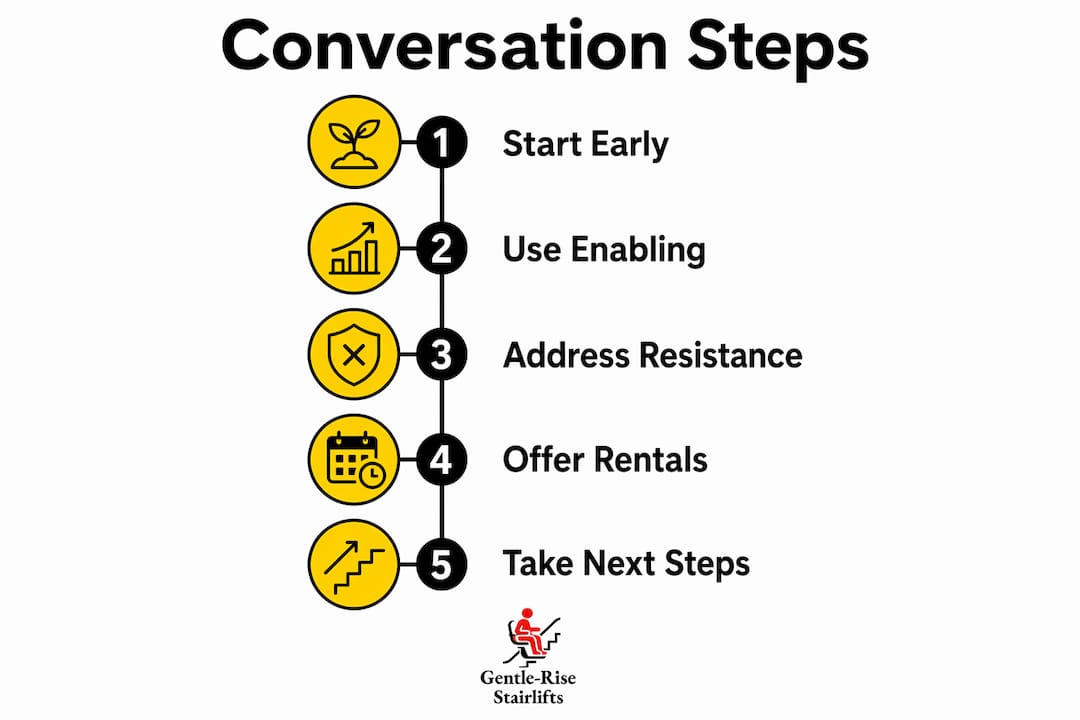
Starting the conversation early, framing it around independence, and offering a reversible first step are the three factors most likely to lead to a calm, constructive family dialogue on mobility solutions.
| Point | Details |
|---|---|
| Start early | Conversations before a crisis preserve choice and reduce stress for everyone involved. |
| Use enabling language | Frame a stairlift as gaining freedom, not losing independence. |
| Offer a rental trial | A short-term rental makes the decision reversible and lowers resistance significantly. |
| Book a free assessment | An OT assessment or a free home survey costs nothing and gives everyone objective information. |
| Gentlerise Stairlifts | Offers free home surveys, rental options, and same-day or next-day installation from £795. |
A provider's perspective on family conversations
The conversations families find hardest are rarely about the equipment. They're about what the equipment means. At Gentlerise Stairlifts, the approach starts with listening: understanding what independence looks like for the person who will use the stairlift, and working backwards from there. A free home survey is genuinely no-obligation. Rental options exist precisely because a reversible first step is often the only step a person is ready to take. The Protect+ maintenance programme means the relationship doesn't end at installation. Dignity and choice run through every stage, from the first phone call to ongoing aftercare.
Gentlerise Stairlifts: practical help when you're ready
When the conversation has moved from "maybe" to "let's find out," Gentlerise Stairlifts offers a clear, pressure-free route forward. A free home survey means a specialist visits, assesses the staircase, and gives you honest options, with no obligation to proceed. Straight stairlifts start from £795, with installation often completed the same day or the next. Short-term rental is available for those who want to try before committing. Every installation is backed by the Protect+ aftercare plan, covering ongoing maintenance and peace of mind.

To book your free home survey or ask about rental availability, visit Gentlerise Stairlifts and get in touch today.
Useful sources
- Independent Age: Home adaptations — Clear guidance on the Disabled Facilities Grant, OT assessments, and what local councils are required to provide.
- Age UK: Adapting your home — Practical advice on stairlifts, banister rails, and a full range of home adaptations for older people.
- Age Space: Starting conversations about care — Useful framing questions and advice on how to open sensitive conversations with older relatives.
- NHS.uk — Use your local NHS services page to find adult social care contacts and GP referral pathways for OT assessments.
- Stairlift Costs: Stairlift advice for families — Covers the practical and emotional aspects of helping a relative accept a stairlift, including timing and alternatives.
FAQ
How do I start talking to a parent about mobility problems?
Begin by asking how they feel about the stairs rather than proposing a solution. Listening first, then validating their feelings, keeps the conversation collaborative rather than confrontational.
What if my relative refuses to consider a stairlift?
An initial refusal is rarely final. Multiple short, low-pressure conversations over time are more effective than one direct push. Offering a short-term rental trial, which is fully reversible, often shifts the response.
Can I get a stairlift assessment for free in the UK?
Yes. Your GP can refer to an NHS occupational therapist at no cost, and your local council's adult social care team provides a free needs assessment. Gentlerise Stairlifts also offers a free, no-obligation home survey.
What does the Disabled Facilities Grant cover?
The Disabled Facilities Grant, administered by local councils, can fund larger home adaptations for eligible homeowners and private renters. Contact your council's housing or environmental health department for an application form.
How quickly can a stairlift be installed after a survey?
For straight staircases, installation can often happen the same day or the next day. Curved stairlifts require a bespoke rail and typically take 2–4 weeks from survey to installation.