
Expect to pay £3,800 to £10,000+ for a new curved stairlift installed in the UK, with most single-turn staircases landing around £4,500 to £6,000. Reconditioned curved models, where available, typically run a range of prices for reconditioned units, and rental costs more than you'd expect for curved rails because each one is still custom-built.
Here's the quick breakdown:
- New, installed: £3,800 to £10,000+, midpoint roughly £5,000
- Reconditioned: a range of prices for reconditioned units, subject to stock availability
- Rental: higher setup and monthly fees than straight lifts, sensible only for genuinely short-term needs
The single most useful thing you can do right now is book a free home survey. It's the only way to get an accurate figure for your own staircase, and it lets you check VAT relief and Disabled Facilities Grant eligibility before you commit to anything. Gentlerise Stairlifts offers this as a direct route to a firm, itemised quote.
Key Takeaways
Curved stairlift cost in the UK typically ranges from £3,800 to £10,000+ new, driven mainly by bespoke rail fabrication and the number of bends.
| Point | Details |
|---|---|
| New installed price range | Expect £3,800 to £10,000+, with a common mid-range of £4,500 to £6,000 for a single-turn staircase. |
| Bends drive cost | Each additional turn adds rail fabrication complexity, pushing multi-bend jobs towards the top of the range. |
| VAT relief cuts costs fast | Qualifying disabled people get the 20% VAT removed, a roughly 17% saving on the total invoice. |
| Service plans protect your budget | Annual servicing runs £60 to £150, or £5 to £25 monthly through a plan, preserving safety and warranty. |
| Gentle Rise offers a direct route | Gentlerise Stairlifts provides free home surveys, itemised quotes, and Protect+ aftercare for ongoing peace of mind. |
Table of Contents
- What drives curved stairlift cost in the UK
- New, reconditioned, or rental: which suits your budget?
- How long does curved stairlift installation take?
- VAT relief and Disabled Facilities Grants: what you can actually save
- How do you compare curved stairlift quotes properly?
- What does servicing a curved stairlift cost each year?
- Three real-world curved stairlift cost scenarios
- Gentle Rise: book your free curved stairlift survey
- Sources
- FAQ
What drives curved stairlift cost in the UK
The rail is the reason curved stairlifts cost more than straight ones, full stop. A straight stairlift uses an off-the-shelf track cut to length. A curved stairlift needs a rail designed from scratch around your exact staircase, then fabricated to match. Which? confirms this pattern directly: curved lifts are typically several thousand pounds more expensive than straight equivalents, precisely because of that bespoke manufacturing step.
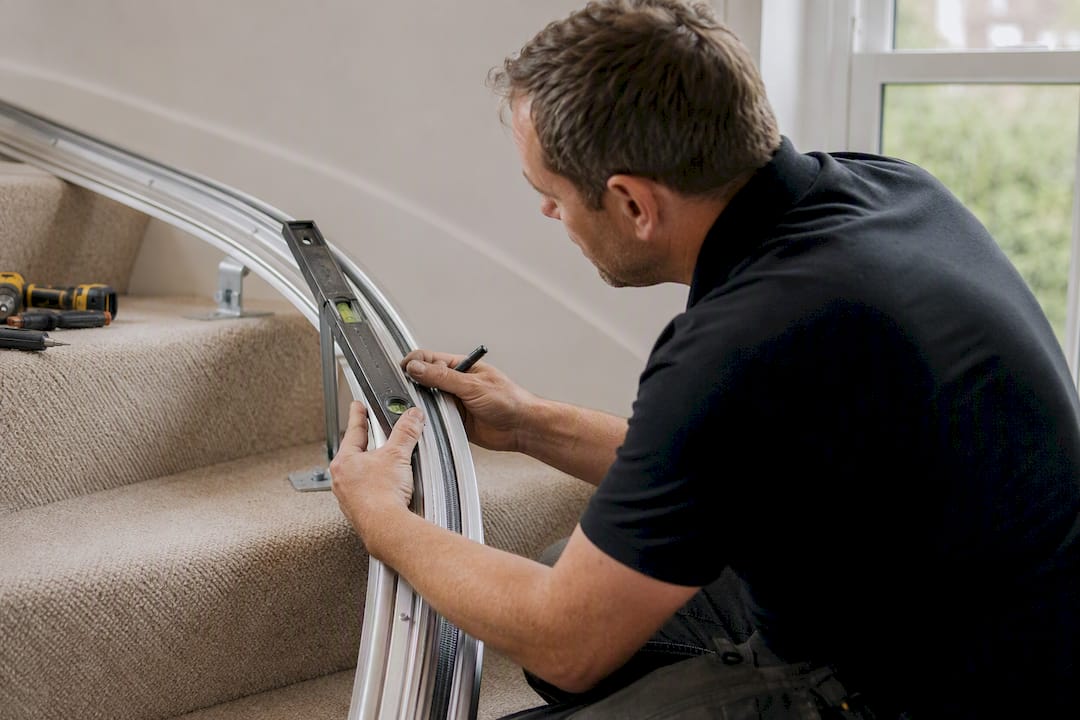
Every bend adds cost, and the relationship isn't linear. A single 90-degree turn is the simplest curved job and sits at the lower end of the price range. Two turns, a half-landing, or a spiral section pushes the rail design and fabrication time up sharply, because each additional bend means more welded joints, more precision measurement, and more room for the whole rail to need reworking if something's off by even a centimetre.
Staircase length and width matter too. A long staircase needs more rail material and, often, additional support brackets fixed into the wall or stairs. Narrow staircases, common in older terraced houses and some London properties, can force engineers to fit narrower carriages or adjust the seat position, which adds labour time. If your stairs are unusually tight, it's worth reading up on solutions for narrow staircases before your survey, so you know what to ask about.
Optional extras stack on top of the base price:
- Powered swivel seat: typically a few hundred pounds
- Folding footrest or rail: modest addition, often bundled in standard packages
- Higher weight capacity (for users over the standard 20 stone limit): can add several hundred pounds
- Additional call/send stations: priced per unit
Pro Tip: Ask your installer to itemise the rail cost separately from installation labour and extras. A quote that lumps everything into one number is much harder to compare against a second or third quote.
A reputable supplier will break your quote into rail manufacture, installation labour, any remedial works, and optional extras, rather than presenting one bundled figure. That itemisation is what lets you spot where the money is actually going.
New, reconditioned, or rental: which suits your budget?
Choosing between these three routes depends less on your budget alone and more on how long you need the stairlift and how much bend your staircase has.
- New curved stairlift. Installed prices typically fall between £3,800 and £10,000+, with a common mid-range around £4,500 to £6,000 for a straightforward single-turn staircase. This usually includes the home survey, bespoke rail manufacture, installation, testing, and a manufacturer's warranty.
- Reconditioned curved stairlift. These are genuinely rarer than reconditioned straight models, because a curved rail built for one staircase rarely fits another exactly. When a match is found, or a new rail is fabricated to fit a reconditioned motor unit, prices usually sit at a range of prices for reconditioned units. The trade-off is availability. You may wait longer to find a suitable unit, and warranty terms tend to be shorter than on new equipment.
- Rental. Rental makes financial sense for a clearly temporary need, such as recovering from hip surgery or a short-term mobility setback. For curved staircases specifically, rental carries a higher setup fee and monthly cost than straight-lift rentals, since the rail still has to be custom-fitted and later removed.
A few practical differences worth weighing:
- New stairlifts usually carry the longest warranty and the most comprehensive aftercare options.
- Reconditioned units often come with shorter cover, so check the warranty terms before assuming parity with new equipment.
- Rental agreements typically include servicing within the monthly fee, which can simplify budgeting for a short stay.
How long does curved stairlift installation take?
The home survey is where accuracy either gets built in or gets lost. A surveyor measures every angle, riser height, and landing dimension on your staircase, because that data feeds directly into the CAD design used to fabricate your rail. Get the measurements wrong and the rail may need reworking, which delays everything and can add cost.
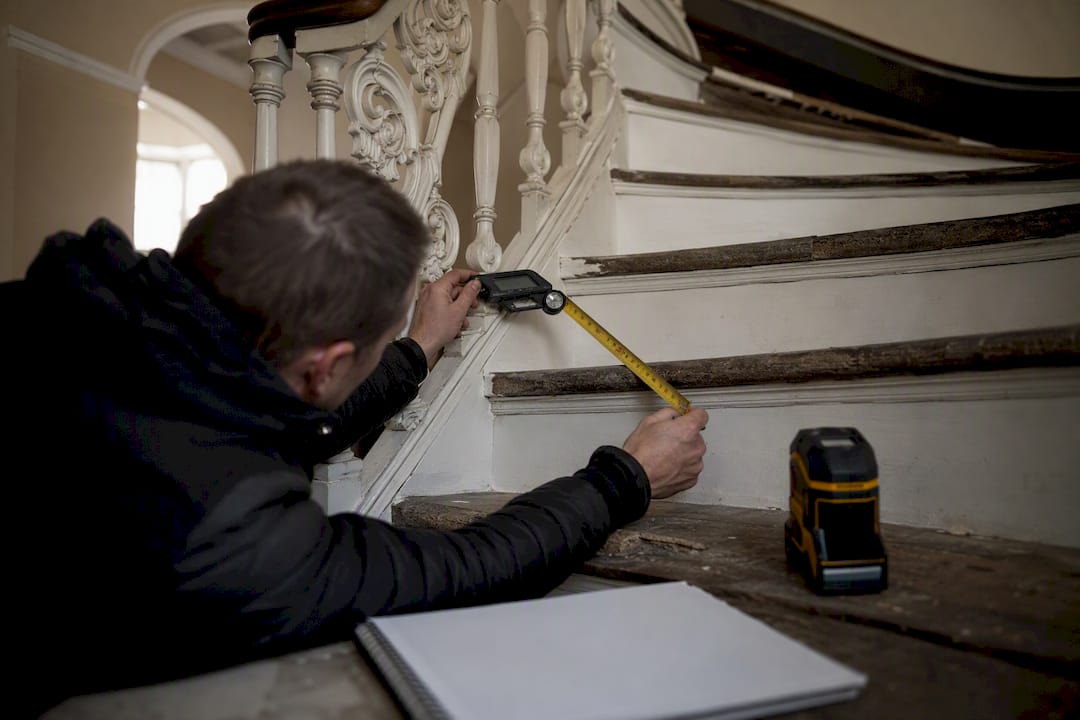
From survey to working stairlift, most bespoke curved installations take a few weeks, though some suppliers offer modular rail systems that shorten this for certain layouts. Installation day itself usually takes several hours, depending on the number of bends and whether any structural work is needed first.
Watch for these common extras:
- Wall or floor strengthening, needed where the staircase structure can't take standard bracket fixings without reinforcement
- Electrical work, if a nearby socket isn't available for charging points
- Removal and disposal of an old stairlift, sometimes included free, sometimes charged separately
Pro Tip: Ask upfront whether removal of your existing stairlift is included in the price. It's a small line item that catches people out when it appears as a surprise add-on.
Regional variation exists too. Installations in London and the South East tend to run higher than the national average, largely down to labour costs and tighter access in period properties.
VAT relief and Disabled Facilities Grants: what you can actually save
VAT relief is the fastest, simplest saving available, and it applies immediately if you qualify. Qualifying disabled people can have the 20% VAT component removed entirely from the price of a stairlift, which works out to roughly a 17% reduction on the total invoice once relief is applied. Reputable suppliers apply this automatically once you confirm eligibility, so you shouldn't need to claim it back separately.
The Disabled Facilities Grant (DFG) is the bigger potential saving, though it takes longer to access.
- Check eligibility with your local council. DFGs are administered locally, so caps and processing times vary by nation and even by borough.
- Gather supporting evidence. This usually means an occupational therapist assessment confirming the stairlift is medically necessary, plus proof of income for means-testing.
- Apply before committing to a supplier, where possible, since grant approval can take weeks and some councils require quotes submitted alongside the application.
Suppliers experienced with DFG applications can usually help you prepare the right paperwork, which saves you chasing forms alone. Beyond VAT and DFGs, some charities and disability support organisations offer smaller grants or interest-free loans for mobility equipment, worth checking if you fall outside DFG income thresholds. You can read more on how VAT exemption works in practice before your survey.
How do you compare curved stairlift quotes properly?
Getting quotes from two or three suppliers only works if you're comparing genuinely equivalent line items, not just a bottom-line figure.
- Request an itemised breakdown: rail manufacture, installation labour, removal of any old unit, testing, warranty length, and any service plan cost, listed separately rather than bundled.
- Ask exact questions at the survey: What's the realistic lead time from order to installation? Who manufactures the rail, in-house or a third party? Is the engineer manufacturer-accredited? Can they show photos or references from a similarly-shaped staircase?
- Compare warranty and service-plan terms carefully. A cheaper headline price sometimes hides a shorter warranty or excludes call-out charges, so read what's excluded, not just what's included.
- Treat unusually low quotes with suspicion. If one quote is dramatically below the others, ask what's missing, most often it's the removal of the old lift, testing, or a proper warranty.
Pro Tip: Insist on itemisation before you sign anything. It's the single easiest way to spot whether a "cheap" quote is genuinely cheaper or just missing pieces you'll pay for later. Which? guidance backs this approach, recommending multiple itemised quotes precisely because bespoke curved rails make like-for-like comparison harder than with straight lifts. For more on reading a survey quote line by line, see this guide to stairlift survey quotes.
What does servicing a curved stairlift cost each year?
A stairlift isn't a one-off purchase and then done, it needs upkeep to stay safe and to keep its warranty valid. Annual servicing typically costs typical annual single-visit service costs, or you can spread that cost through a monthly service plan running roughly £5 to £25.
Servicing covers safety checks on the braking system, battery condition, seatbelt and swivel mechanisms, and rail alignment, all of which matter more on a curved rail than a straight one because misalignment is harder to spot by eye.
- Mid-life costs: battery replacements and minor part adjustments, usually modest
- Heavier repairs once out of warranty: motor or rail component replacement can run into hundreds of pounds
- Service plans: often bundle call-outs and priority repairs into the monthly fee, avoiding surprise bills
An aftercare plan like Gentlerise Stairlifts' Protect+ builds these costs into one predictable monthly figure rather than leaving you exposed to a large bill years down the line.
Three real-world curved stairlift cost scenarios
Numbers are easier to picture against an actual staircase, so here are three common layouts and what they typically cost.
- Single 90-degree curve, standard staircase. A new installed curved stairlift here typically lands at the lower to middle end of the range, roughly £4,500 to £6,000. A reconditioned unit for the same layout, if available, might come in around £2,800 to £3,500, but expect a longer search for a matching rail.
- Two-turn or long curved staircase with a half-landing. More bends mean more rail fabrication complexity, pushing the total towards higher prices for complex, multi-bend installations. Reconditioned options become rarer still at this complexity, since matching an existing rail to a two-turn layout is unusual.
- Two straight stairlifts instead of one curved lift, where the staircase has a half-landing and the user can transfer safely between chairs. This is sometimes materially cheaper than a bespoke curved rail, and Which? notes it as a genuine alternative worth discussing with an occupational therapist first.
| Scenario | Typical new cost | Key cost driver |
|---|---|---|
| Single 90° curve | £4,500 to £6,000 | One bend, standard rail length |
| Two-turn / long curved stair | £3,800 to £10,000+ | Multiple bends, longer bespoke rail |
| Two straight lifts (alternative) | Often lower than one curved lift | Two off-the-shelf rails vs one bespoke rail |
Worth factoring in long term: two straight lifts mean two service plans running indefinitely, so the cheaper upfront option can cost more across several years than a single curved installation with one plan.
Author Lee: practical priorities and common buyer mistakes
The mistake I see people make most often is choosing on headline price alone, without asking what happens if the lift needs a repair in year three. A detailed survey and a properly itemised quote tell you far more than any single number ever will, because they show you exactly what you're paying for and what's missing. Budget for aftercare from day one. No stairlift, curved or straight, runs maintenance-free forever, and pretending otherwise just moves the cost from now to later.
— lee
Gentle Rise: book your free curved stairlift survey
Comparing quotes yourself takes time you might not have, especially if you're arranging care for a parent while managing your own household. Gentlerise Stairlifts removes that legwork by giving you one itemised, no-obligation quote from a single free home survey, covering rail design, installation, removal of any old unit, and warranty terms in one document you can actually compare against anything else you've been sent.
A standard quote from Gentlerise Stairlifts includes the bespoke curved rail, full installation, testing, and the option to add Protect+ aftercare cover for ongoing servicing and priority call-outs. Straightforward jobs start from competitive pricing, and reconditioned or rental options are available for qualifying cases where a new installation isn't the right fit. The survey itself is free and typically leads to a firm quote with a clear installation timescale, no pressure to commit on the spot.
If you're ready to see what your own staircase would cost, book a free home survey with Gentle Rise and get your itemised quote in writing. You can also explore detailed cost breakdowns for UK stairlifts before your appointment if you want to walk in already knowing what questions to ask.
Sources
- Gov
- Buying and installing a stairlift - Which?
- Stairlift
- Curved stairlift costs UK 2026 | Stairlift Guru
FAQ
Are curved stairs more expensive than straight ones?
Yes. Curved stairlifts cost several thousand pounds more than straight models on average, because the rail is custom-designed and fabricated for each staircase rather than cut from a standard length.
What is the best curved stairlift for my staircase?
The right choice depends on your staircase's bends, width, and your budget, which is exactly what a free home survey establishes before you commit to a specific model or supplier.
What is the price of an Acorn 180 curved stairlift?
Specific model pricing varies by supplier and staircase complexity, but curved stairlifts from major manufacturers generally fall within the broader £3,800 to £10,000+ UK market range, so ask for a like-for-like itemised quote rather than relying on a headline model price.
Can you get stairlifts fitted for curved staircases?
Yes, curved stairlifts are specifically designed for staircases with bends, landings, or spiral sections, using a bespoke rail built to match your exact stairs after a home survey.