
TL;DR:
- A quality stairlift track requires secure rails, a reliable battery, and safety sensors to ensure safety. Budget options like straight, modular tracks offer affordable, durable, and easy-to-install solutions when properly maintained. Professional installation, regular maintenance, and careful assessment are essential for long-term safety and reliability.
A quality stairlift track is defined by three non-negotiable factors: secure stair-mounted rails, a reliable battery-powered drive system, and certified safety sensors that stop the lift when needed. This cheap stairlift track quality guide exists because budget does not have to mean unsafe. The difference between a track that lasts a decade and one that fails within months comes down to a handful of measurable features, not price alone. Gentlerise Stairlifts installs straight stairlifts from £795, proving that affordability and quality can coexist when you know what to look for.
1. What are the main types of stairlift tracks?
Track type is the single biggest cost driver in any stairlift purchase. Understanding the three main categories tells you immediately where the budget options sit and why.
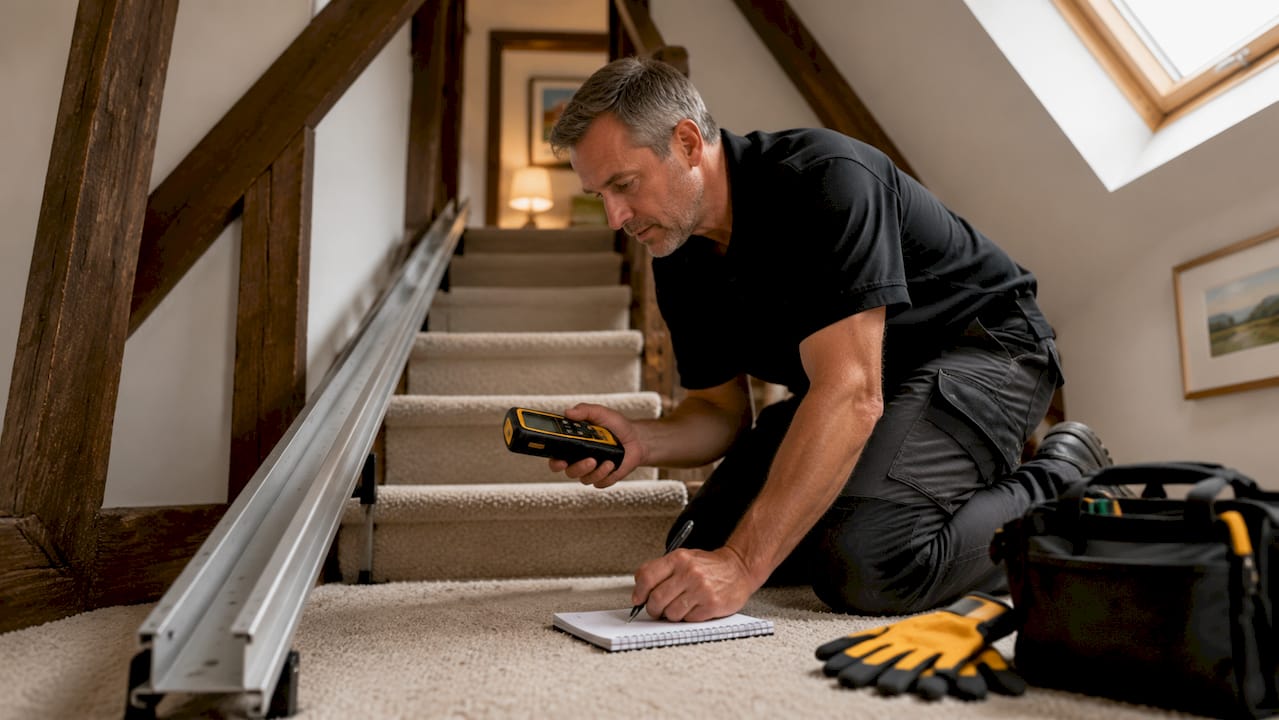
Straight tracks are modular rails cut to the length of your staircase. Straight stairlift installation typically takes a couple of hours, and the stock rail design keeps manufacturing costs low. This modularity also means a reconditioned straight rail can be trimmed to fit a new home, making straight tracks the only realistic option in a used stairlift track condition guide.
Curved tracks are bespoke. A curved rail is custom-made for one specific staircase and almost never fits a different home. Curved rails also require 4–6 weeks to manufacture. That combination of custom fabrication and long lead times puts curved tracks firmly outside the affordable stairlift options category for most buyers.
Outdoor tracks require weatherproof materials and sealed motor housings. Those additional materials raise costs noticeably above a comparable indoor straight rail.
- Straight tracks: modular, low cost, fast to install, suitable for reconditioned units
- Curved tracks: bespoke, expensive, long lead times, not viable for budget resale
- Outdoor tracks: weatherproof materials add cost, suitable only where indoor access is impossible
Pro Tip: If you are buying a reconditioned stairlift, only consider straight track models. A used curved rail is almost never transferable, so any seller offering a cheap curved track for a different home is a red flag.
2. How to assess the quality of a cheap or used stairlift track
A low price means nothing if the track fails a basic quality check. Work through these indicators before committing to any budget or second-hand purchase.
-
Rail condition. Run your hand along the full length of the rail. Look for rust, pitting, or bent sections. A rail fixed to the stair treads rather than the wall is the correct installation method. Rails fixed to stair treads adapt to most staircases without structural work, so any unit mounted to the wall instead is a sign of poor original installation.
-
Battery age and health. Batteries are the most common failure point in any stairlift. Stairlift batteries last 2–4 years regardless of how often the lift is used. Ask for the battery replacement date. If the seller cannot provide it, budget for immediate replacement.
-
Safety sensor function. Safety sensors on the carriage and footrest must stop the lift the moment an obstruction is detected. Test this yourself during any viewing. Place a soft object on the track and activate the lift. If it does not stop, walk away.
-
Weight capacity. Standard stairlifts carry up to 120–130 kg. Confirm the rated capacity matches the user's weight before purchase. Exceeding the rated load accelerates wear on both the rail and the drive mechanism.
-
Warranty and service history. A quality budget track should come with at least a parts warranty. A full service history shows the previous owner maintained the unit. No paperwork is a risk, not a bargain.
3. How installation affects cost-effectiveness and safety
Installation quality determines whether even a well-made track performs safely over time. The fitting process is not a formality.
Stairlift rails are always fixed to the stair treads, not the walls. This method distributes load through the staircase structure and avoids the need for any structural wall work. A professional installer will complete a 30–60 minute home survey first, then fit a straight rail in a few hours. That survey matters because it confirms socket proximity, stair angle, and any obstructions that affect cost.
The location of your nearest power socket affects both the fitting complexity and the final price. A socket within reach of the bottom of the staircase keeps cabling simple. A socket on the opposite side of the hallway requires additional work and adds to the bill.
Professional installation by certified technicians is non-negotiable for safety compliance and warranty coverage. DIY fitting voids any warranty and creates liability if the lift fails. The commissioning test carried out after fitting confirms the rail is secure, the sensors respond correctly, and the drive system operates within specification.
| Installation factor | Impact on cost | Impact on safety |
|---|---|---|
| Straight vs curved rail | Straight is significantly cheaper | Both safe when professionally fitted |
| Socket proximity | Closer socket reduces cabling cost | No direct safety impact |
| Stair angle and length | Steeper or longer stairs add time | Affects rail load distribution |
| Professional vs DIY | Professional costs more upfront | DIY creates serious safety risk |
Pro Tip: Book a free home survey before agreeing any price. Gentlerise Stairlifts offers free surveys, and the survey findings often reveal fitting factors that change the final quote. Knowing these upfront prevents surprises.
4. Features and maintenance tips that extend track lifespan
Buying a budget track is only half the decision. Keeping it reliable over time is where the real cost-effectiveness is won or lost.
Choosing a modular straight rail means individual sections can be replaced without fitting an entirely new track. This is a significant long-term saving compared to a proprietary or curved system where the whole rail must be replaced if one section corrodes.
- Battery replacement every 2–4 years. Budget for this from day one. A failing battery causes the lift to slow, stop mid-stair, or lose power-cut capability entirely.
- Annual servicing. Annual stairlift servicing costs £100–£200 and covers safety inspections, lubrication, and sensor checks. Skipping a service to save money typically leads to a more expensive repair within two years.
- Safety sensor checks. Test sensors every three months by placing an object on the track and running the lift. This takes two minutes and confirms the most critical safety feature is working.
- Rail lubrication. Most manufacturers specify a light machine oil applied to the rail every six months. This reduces wear on the drive mechanism and keeps the ride smooth.
- Financial support. UK buyers may claim VAT relief of 20% if chronically sick or disabled. A Disabled Facilities Grant covers up to £30,000 in England and £36,000 in Wales towards stairlift and home adaptation costs. These are not widely advertised but are worth claiming to offset the cost of quality maintenance.
A well-maintained budget track outlasts a neglected premium one. The maintenance schedule above costs less than £250 per year when averaged across battery replacement and annual servicing. That is a fraction of the cost of a replacement unit.
Key takeaways
The most cost-effective stairlift track is a professionally installed straight rail with tested safety sensors, a known battery age, and a regular maintenance schedule.
| Point | Details |
|---|---|
| Straight tracks offer the best value | Modular design keeps purchase, installation, and replacement costs low. |
| Battery age is the first quality check | Replace batteries every 2–4 years to maintain reliability and power-cut operation. |
| Safety sensors are non-negotiable | Test obstruction detection before purchase; a failing sensor is a disqualifying fault. |
| Professional installation protects your investment | Certified fitting ensures safety compliance, warranty validity, and correct rail load distribution. |
| Financial support reduces upfront cost | VAT relief and Disabled Facilities Grants can significantly offset the cost of quality installations. |
What I have learned from years of stairlift track decisions
The conventional wisdom says "buy the cheapest track that works." My experience says that is the wrong frame entirely. The question is not how cheap the track is. The question is how cheap the track stays over five years.
I have seen buyers save £300 on a reconditioned unit and then spend £400 within eighteen months on a battery replacement, a sensor repair, and an emergency call-out because the original installation was not done properly. The track itself was fine. Everything around it was not.
My strong preference is always for a straight modular rail from a reputable installer, even on a tight budget. The modularity means you can replace one section rather than the whole rail. The installation speed means labour costs stay low. And the resale value, if circumstances change, is actually meaningful because another household can use the same rail.
The one thing I would never compromise on is the home survey. Skipping it to save time or money is the most expensive shortcut I have seen caregivers take. A survey takes an hour and prevents months of problems. Get at least two quotes after the survey, compare what each installer includes in their service plan, and choose the one that covers annual maintenance rather than the one with the lowest headline price.
Battery and sensor maintenance is where most people fall down. They buy well and then neglect the unit. Set a calendar reminder for annual servicing and a battery check every two years. That discipline alone is worth more than any premium feature on a more expensive model.
— lee
Affordable stairlift track options from Gentlerise Stairlifts
Gentlerise Stairlifts offers straight stairlifts from £795, with professional installation, a free home survey, and aftercare plans that cover annual servicing and safety checks. Every installation is carried out by certified technicians who fix the rail to the stair treads, complete a full commissioning test, and confirm sensor function before leaving.
The Protect+ maintenance programme keeps your track in reliable condition year after year, covering lubrication, battery monitoring, and safety inspections. Reconditioned models are also available for buyers who want a cost-effective stairlift option without sacrificing safety standards. Contact Gentlerise Stairlifts to book a free home survey and get a fixed quote tailored to your staircase.
FAQ
What makes a cheap stairlift track safe to use?
A safe budget track has rails fixed to the stair treads, functioning obstruction sensors, and a battery replaced within the last 2–4 years. Professional installation and a commissioning test confirm all three before the lift goes into daily use.
Can a used stairlift track fit my staircase?
A used straight track can be cut to fit most standard staircases. A used curved track almost never fits a different home and should not be purchased for resale or reuse.
How often does a stairlift track need servicing?
Annual servicing is the standard recommendation, covering safety inspections, lubrication, and sensor checks. Annual servicing costs £100–£200 and prevents more expensive faults developing over time.
Is VAT relief available on stairlift purchases in the UK?
Yes. Buyers who are chronically sick or disabled can claim 20% VAT relief on stairlift purchases. A Disabled Facilities Grant can also cover up to £30,000 in England towards the cost of home adaptations including stairlifts.
How long does a straight stairlift installation take?
A straight stairlift installation typically takes a few hours after a 30–60 minute home survey. The modular rail is cut to length on site, fitted to the stair treads, and commissioned the same day.