
A complete stairlift aftercare services list covers six core areas: scheduled safety inspections, battery and electrical checks, preventive maintenance, emergency call-outs with guaranteed response times, parts and repairs cover, and documented records of every visit. Under HSE guidance and the Lifts Regulations 2016, landlord-provided equipment may require 6-monthly thorough examinations carried out by suitably competent engineers. Gentlerise Stairlifts' Protect+ maintenance programme covers all of these elements in a single contract.
Your stairlift aftercare checklist at a glance:
- Scheduled maintenance visits (at least annually; landlord-provided equipment often requires maintenance at regular intervals)
- Battery condition checks and planned replacement
- Emergency call-out cover with a written response-time commitment
- Parts and labour policy (what is included, what is excluded)
- Thorough examination records kept on file
- Engineer competency evidence available on request
Pro Tip: Ask any provider to confirm in writing whether their engineers meet the "suitably competent" standard referenced in HSE and Canterbury City Council guidance before signing a contract.
Key takeaways
A complete stairlift aftercare services list must include scheduled inspections, battery cover, emergency call-outs with written SLAs, and documented records kept for the life of the equipment.
| Point | Details |
|---|---|
| Six-monthly examinations for landlords | Landlord-provided stairlifts require thorough examinations every 6 months under HSE and NHMF guidance. |
| Written SLA is non-negotiable | Always confirm emergency response times in writing before signing any aftercare contract. |
| Battery cover matters | Battery-powered stairlifts need planned replacement every 1–2 years; confirm whether this is included. |
| Keep full service records | Retain service reports, parts invoices, and engineer competency evidence for the life of the equipment. |
| Gentlerise Stairlifts Protect+ | Covers scheduled maintenance, battery checks, emergency call-outs, and parts within a single plan. |
Table of Contents
- What does a robust aftercare services contract actually include?
- Who is responsible for stairlift aftercare in the UK?
- What should a good aftercare contract look like?
- How do you choose the right aftercare plan for your situation?
- What do stairlift aftercare services typically cost?
- What should you do if the stairlift stops working?
- What records should you keep for compliance and tenancy changeovers?
- Why aftercare is the part of stairlift ownership most people underestimate
- Protect+ from Gentlerise Stairlifts: what's included and how to arrange it
- Sources
- FAQ
What does a robust aftercare services contract actually include?
The list of aftercare services in a well-written contract goes beyond a single annual visit. HSE's INDG339 guidance identifies the components engineers should examine during a thorough inspection: drive systems, braking systems, governors, suspension devices, and electrical safety devices. A contract that does not reference these items by category is likely to be vague when a dispute arises.
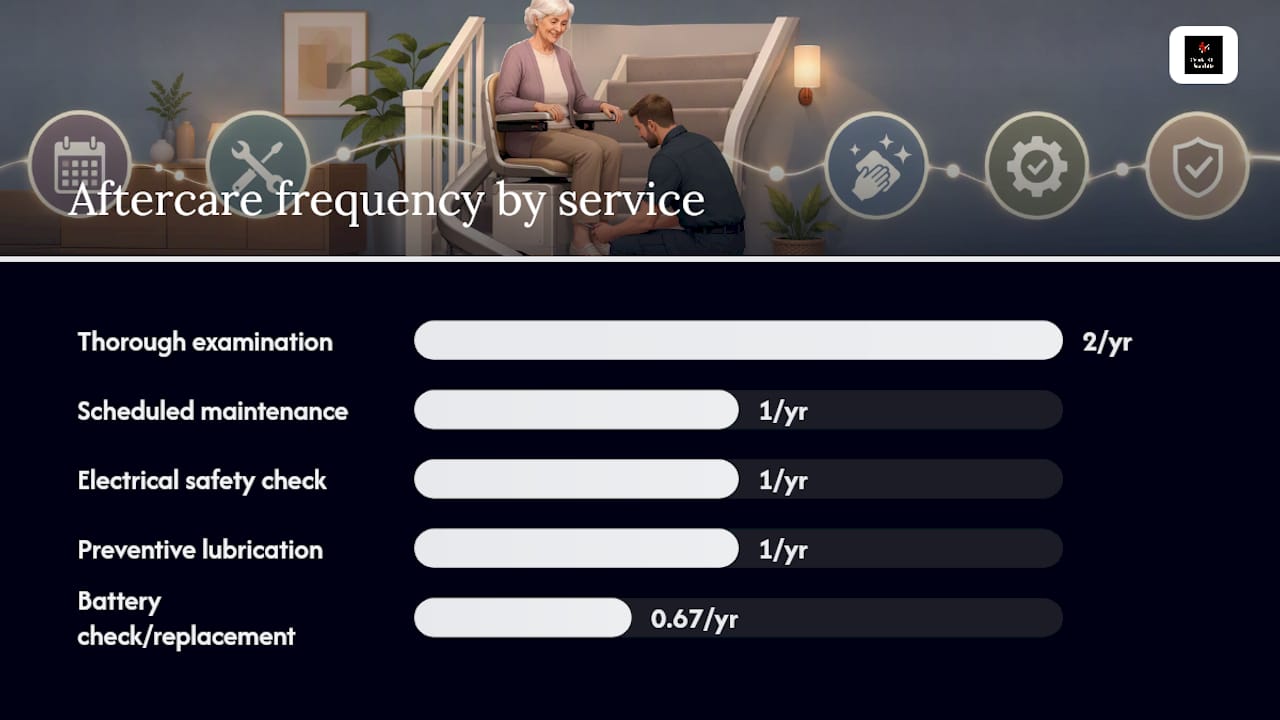
| Service item | Typical frequency | What the engineer checks |
|---|---|---|
| Scheduled maintenance visit | Annually (minimum) | Mechanical drive, safety interlocks, seat and swivel, track condition |
| Battery check and replacement | Every 1–2 years | Charge capacity, terminal condition, earthing |
| Electrical safety check | Annually | Wiring integrity, earthing, control unit function |
| Preventive lubrication and wear check | Annually | Gears, brakes, belts, call/control units, safety sensors |
| Emergency call-out | As needed | Fault diagnosis, temporary fix or safe isolation |
| Thorough examination (landlord equipment) | Every 6 months | Full INDG339 component list, written report issued |
Parts and repairs policy deserves particular attention. Contracts should state whether original manufacturer parts or reconditioned equivalents are used, since substituting non-conforming components can affect the product's status under the Lifts Regulations 2016. Standard exclusions typically cover cosmetic damage, accidental misuse, and any damage caused by building works carried out after installation.
Pro Tip: Ask for a sample service report before signing. If the provider cannot show you what a completed inspection record looks like, that is a gap in their process.
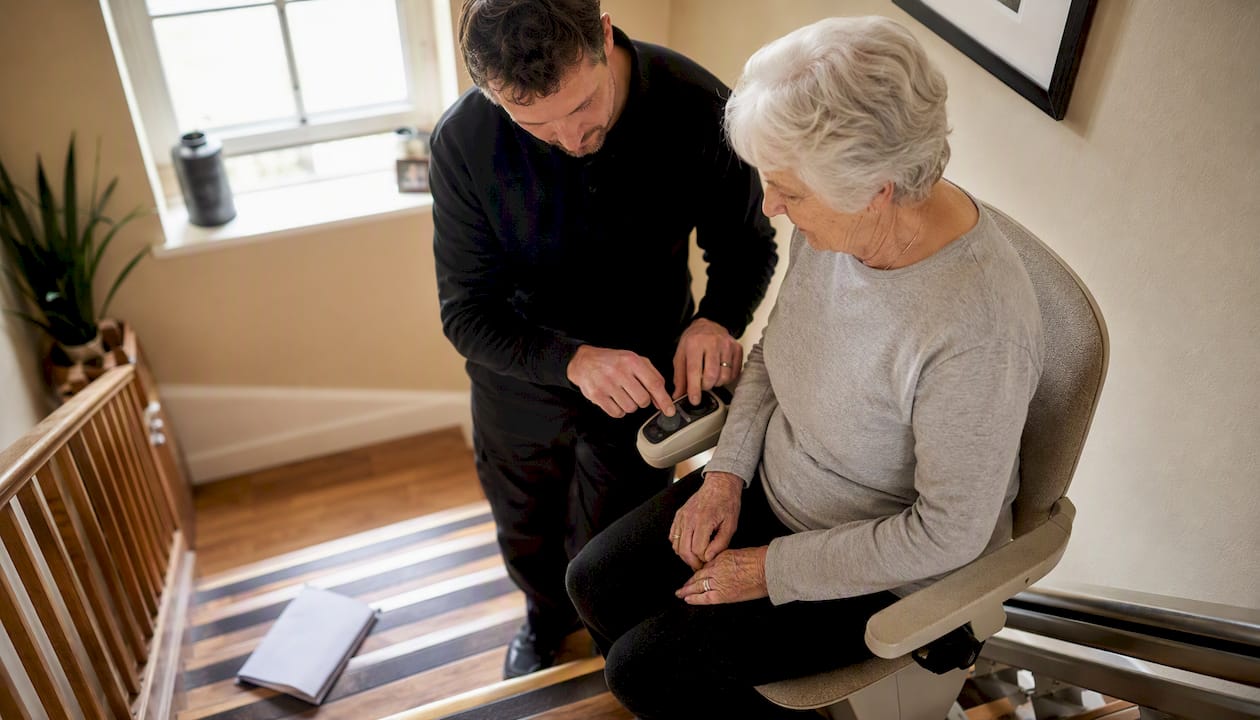
Good aftercare also includes user support and training so the person using the stairlift understands the controls, the safety features, and what to do if the lift stops unexpectedly.
Who is responsible for stairlift aftercare in the UK?
Responsibility depends on who owns the equipment and how it is used.
- Private homeowners who purchase a stairlift for personal use are not normally subject to LOLER or PUWER. Maintenance is their own responsibility, and there is no statutory frequency requirement, though annual servicing is the widely recommended standard.
- Landlords occupy a different position. Under the Health and Safety at Work etc Act 1974, a landlord who provides a stairlift as part of a tenancy has a duty to keep it safe. HSE guidance confirms that landlord-provided lifting equipment may require regular maintenance and, in some cases, 6-monthly thorough examinations.
- Local authorities and social landlords are subject to the same duties. NHMF guidance notes that maintenance, inspection, and 6-monthly thorough examinations are a recognised way for social landlords to meet their Section 3 duties under the 1974 Act.
- Canterbury City Council's policy is a clear practical example: it requires thorough examinations every six months for all lifting aids in its managed properties, and specifies that only suitably competent engineers may carry out inspection and repair work.
- NHS and local authority equipment loan schemes retain responsibility for equipment they loan. If a stairlift is provided through a Disabled Facilities Grant or loan scheme, the administering body should confirm who holds the maintenance obligation in writing before handover.
All statutory or safety-critical work must be carried out by suitably competent engineers. This is not a preference; it is a condition of meeting the duties above.
What should a good aftercare contract look like?
A Protect+-style contract from Gentlerise Stairlifts gives a useful benchmark. The core elements any solid contract should contain are:
| Contract element | What to look for |
|---|---|
| Scheduled maintenance | Confirmed visit frequency, scope of checks, written report issued |
| Emergency call-out SLA | Maximum response time in writing (e.g. same-day or next-day) |
| Parts and labour cover | Which parts are included, labour rate for excluded items |
| Battery replacement | Whether planned replacement is included or charged separately |
| Thorough examination | Frequency stated, INDG339-aligned scope, report kept on file |
| Transferability | What happens to the contract on property sale or tenancy change |
Contract clauses to verify before signing:
- Response time commitment: is it a guaranteed SLA or a best-endeavours statement?
- Engineer competency: does the contract confirm engineers meet the suitably competent standard?
- Cancellation terms: how much notice is required, and are there exit fees?
- Transferability: can the contract transfer to a new owner or incoming tenant without penalty?
- Complaints route: is there a named escalation contact and a written process?
NHMF guidance highlights transferability as a frequent source of dispute. A clear clause protecting both landlord and incoming tenant removes ambiguity at the point of tenancy change.
How do you choose the right aftercare plan for your situation?
- Assess usage frequency. A stairlift used multiple times daily by a sole occupant carries more wear than one used occasionally. Higher usage justifies a plan with shorter service intervals.
- Identify your track type. Curved rail stairlifts have more components and tighter tolerances than straight models. Parts costs and engineer time tend to be higher, so a plan with parts cover included offers better value.
- Consider user dependency. If the person using the lift has no alternative way to access upper floors, a guaranteed emergency response time is not optional. Confirm the SLA in writing.
- Check the power source. Battery-powered stairlifts need planned battery replacement every one to two years. Confirm whether this is included in the plan or billed separately.
- Clarify ownership status. Landlords need a contract that explicitly covers thorough examinations at the required frequency. Homeowners have more flexibility but should still confirm the engineer's competency.
- Ask about parts availability. For reconditioned or older models, ask how quickly the provider can source parts and whether they stock common components.
Red flags to watch for:
- Vague SLAs with no written commitment ("we aim to respond as soon as possible")
- No written record of inspections provided after each visit
- Unclear or silent parts policy
- Refusal to confirm engineer competency in writing
- Excessive exclusions for normal wear and tear
What do stairlift aftercare services typically cost?
Several factors shape the price of any aftercare plan. Curved rail models cost more to service than straight ones because of their complexity. Travel time affects one-off call-out charges, particularly in rural areas. Whether a plan bundles parts and labour or charges them separately makes a significant difference to the total cost over three to five years.
- One-off service visit: typically covers a single inspection and basic lubrication; parts and labour billed additionally if needed.
- Annual maintenance contract: usually includes one scheduled visit, a written report, and a reduced call-out rate; battery replacement may or may not be included.
- Protect+-style subscription: covers scheduled visits, emergency call-outs, battery checks, and parts cover within a fixed monthly or annual fee, giving predictable costs.
- Rental plus aftercare bundle: Gentlerise Stairlifts offers rental options that pair the equipment with ongoing service cover, which suits short-term needs or those who prefer not to commit to a purchase.
For routine non-emergency visits, expect a lead time of a few days to two weeks depending on the provider's schedule. Emergency SLAs in a written contract should specify same-day or next-day response for a user who is dependent on the lift.
What should you do if the stairlift stops working?
- Stop using the stairlift immediately. Keep the user away from the equipment until an engineer has assessed it.
- Isolate the power at the wall socket or isolator switch if it is safe to do so.
- Check for an obvious obstruction on the track (a bag, a foot, a piece of clothing). Remove it only if you can do so safely without touching internal components.
- Use the emergency lowering function if the stairlift is fitted with one and the user is seated. Follow the manufacturer's instructions exactly.
- Call your provider's emergency number. Have the model name, the symptoms, and whether the user is trapped or injured ready to give to the operator.
- Contact the landlord if the equipment is landlord-provided. The landlord holds the maintenance obligation and needs to be informed promptly.
- Do not attempt mechanical repairs. Only suitably competent engineers should access internal components. Attempting a repair yourself may void the warranty and create a safety risk.
Safety note: If the user is injured or cannot be safely assisted, call 999. Do not delay emergency services while waiting for an engineer.
What records should you keep for compliance and tenancy changeovers?
Good documentation protects both homeowners and landlords. Keep the following on file:
- Service reports from every scheduled maintenance visit, including the date, engineer name, and work carried out
- Thorough examination records (required for landlord-provided equipment), including the INDG339-aligned component checklist and any remedial actions noted
- Parts invoices showing the components replaced and their conformity status under the Lifts Regulations 2016
- Engineer competency evidence (qualification certificates or employer confirmation of suitably competent status)
- Contract terms including the signed agreement, SLA commitments, and transferability clause
- Correspondence relating to any faults, repairs, or complaints
Retain service records for the life of the equipment and for at least two years after disposal. At tenancy changeover, provide the incoming tenant or their representative with the full service history and confirm who holds the maintenance obligation going forward.
Suggested filing order: contract → installation record → service reports (chronological) → parts invoices → engineer competency evidence → correspondence.
Why aftercare is the part of stairlift ownership most people underestimate
Most people spend considerable time choosing the right stairlift model and almost no time reading the aftercare contract. That imbalance matters, because the contract is where the real risk sits. A stairlift that fails at 7am for a person with no alternative route upstairs is not just a minor inconvenience; it is a safety event The difference between a good outcome and a bad one is almost always whether a written SLA exists and whether the engineer who arrives is genuinely competent.
Regular thorough examinations for landlord-provided equipment are commonly required to ensure safety and compliance. Canterbury City Council's policy and NHMF guidance both point to the same standard, yet many landlords are unaware that it applies to their properties. Knowing the requirement exists is step one; having a contract that delivers it is step two.
Aftercare is also where independent living is either sustained or quietly eroded. A stairlift that is never serviced degrades gradually, and the person using it often adapts to the degradation without realising the risk has grown.
Protect+ from Gentlerise Stairlifts: what's included and how to arrange it
Gentlerise Stairlifts offers a level of aftercare that goes beyond a basic annual visit. The Protect+ programme is built around the items that matter most for safety and continuity.

Protect+ core inclusions:
- Scheduled maintenance visits with written service reports
- Battery condition checks and planned replacement
- Emergency call-out cover with a committed response time
- Parts and labour cover within the plan scope
- Support for thorough examination scheduling where required
Gentlerise Stairlifts installs straight stairlifts from £795, with curved and reconditioned models also available, and rental options for short-term needs. Installations are typically completed within hours of survey. To arrange a free home survey or request a sample Protect+ contract, contact Gentlerise Stairlifts directly.
Sources
- Passenger lifts and lifting equipment: HSE guidance
- Lift safety policy (Canterbury City Council)
- Gov
- Lift maintenance and access equipment (NHMF)
FAQ
What must a stairlift aftercare services list include?
A complete list covers scheduled maintenance visits, battery checks and replacement, emergency call-outs with a written response-time commitment, parts and labour policy, thorough examination records, and evidence of engineer competency.
How often should a landlord-provided stairlift be inspected?
HSE guidance and NHMF guidance both indicate that landlord-provided stairlifts should receive a thorough examination every six months, carried out by a suitably competent engineer.
Does a private homeowner need a formal aftercare contract?
There is no statutory requirement for private homeowners, but annual servicing by a competent engineer is the standard recommendation to maintain safety and protect any remaining warranty.
What is the Protect+ programme from Gentlerise Stairlifts?
Protect+ is Gentlerise Stairlifts' aftercare plan covering scheduled maintenance, battery checks, emergency call-outs, and parts cover within a single contract. Contact Gentlerise Stairlifts for a quote or sample contract.
What should you do if a stairlift stops mid-stair?
Stop using the lift, isolate the power if safe, check for a track obstruction, use the emergency lowering function if fitted, and call your provider's emergency number. Do not attempt internal repairs.