
Acorn does not buy back unwanted stairlifts. Their official position is that they offer resale assistance and guidance to original customers rather than a cash buyback scheme. So if you have an Acorn stairlift sitting unused and you want it gone, you have four realistic routes: Acorn's own resale-assistance programme, an independent buy-back company, a private sale, or donation and recycling.
Before you pick a route, set your expectations on price. Straight stairlifts often sell for a few hundred pounds on the second-hand market; curved models often fetch little to nothing because bespoke rails rarely fit another property. Your next steps depend heavily on which type you have.
Quick-start options:
-
Acorn resale assistance — contact Acorn directly if you are the original purchaser; they can advise on private sale
-
Independent buy-back firms — companies such as Helping Hand Stairlifts, StairliftBuyBack, Ableworld, and Multicare will assess and collect qualifying units
-
Private sale — list on eBay, Facebook Marketplace, or Gumtree for potentially higher returns
-
Donation or recycling — charities and specialist recyclers handle units that cannot be resold
-
Gentlerise Stairlifts — professional removal, reconditioning, and resale assistance across the UK
Table of Contents
- What are your main options for selling or removing an Acorn stairlift?
- Who actually buys Acorn stairlifts in the UK?
- What is your Acorn stairlift actually worth?
- How does the selling process work, step by step?
- Should you remove the stairlift before selling it?
- How do you spot a stairlift resale scam?
- When selling isn't possible: recycling and scrap options
- How a refurbisher values and handles an Acorn stairlift
- Key takeaways
- The seller's reality: what most guides won't tell you
- Gentlerise Stairlifts: removal, reconditioning, and a clear next step
- Useful sources and contact options
- FAQ
What are your main options for selling or removing an Acorn stairlift?
The table below sets out the five principal routes, covering the conditions each accepts, what you can realistically expect to receive, and how quickly each tends to move.
| Route | Conditions accepted | Typical payment | Collection included | UK coverage | Speed vs price |
|---|---|---|---|---|---|
| Acorn resale assistance | Original Acorn customers only | None (guidance only) | No | National | Slow / guidance only |
| Independent buy-back firms | Straight units, working condition | £200–£500 | Yes, often free | Regional / varies | Fast / lower price |
| Private sale | Any working unit | £200–£500 | Buyer arranges | National | Slower / higher price |
| Charity donation | Working units in good condition | None | Sometimes | Regional | Moderate / no payment |
| Recycling / scrap | Any condition | £0 or small fee | Usually yes | Regional | Fast / no payment |
Whether a unit qualifies for buy-back depends on make, model, age, and your location; some services offer free removal only if the unit meets their criteria. A curved stairlift that is more than eight years old will often fall outside what independent buyers will pay for, making recycling the pragmatic choice.
For sellers who want cash quickly, an independent buy-back firm is usually the fastest route. For those willing to wait a few weeks, a private listing on Facebook Marketplace or eBay tends to return the best price. Donation suits owners who simply want the unit to go to someone who needs it.
Who actually buys Acorn stairlifts in the UK?
Several distinct buyer types operate in the UK market, and understanding how each works helps you avoid wasted calls and unrealistic expectations.
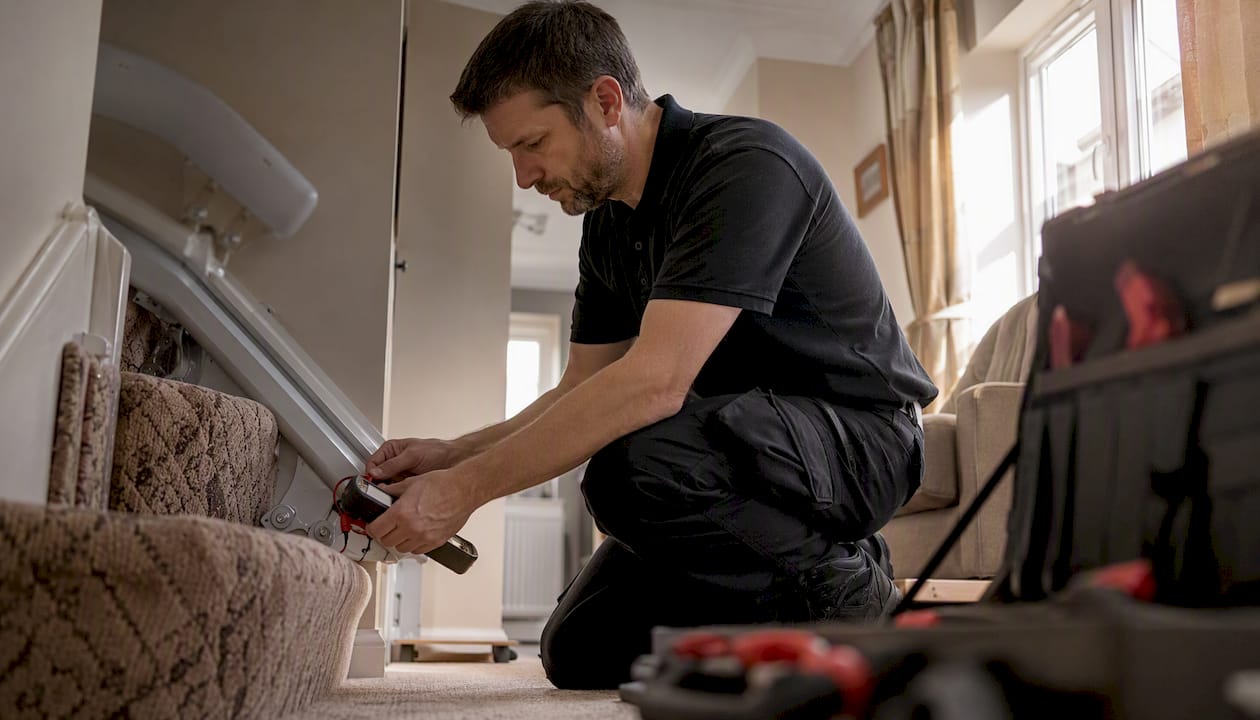
Independent reconditioners and refurbishers are the most active buyers of used straight stairlifts. They assess, refurbish, and resell units, so they need models with reusable rails and available spare parts. Acorn straight stairlifts are well-supported in this regard.
Regional buy-back and removal firms include services such as Helping Hand Stairlifts, StairliftBuyBack (stairliftbuyback.co.uk), Multicare, and Ableworld. Each has its own geographic coverage and age limits. Most prefer units under ten years old in working condition, and most pay on or after collection, never before.
Local charities occasionally accept working stairlifts in good condition, particularly those supporting older people or disability organisations. The British Heart Foundation and similar retailers sometimes accept mobility equipment, though policies vary by branch.
Private buyers on platforms like eBay and Facebook Marketplace are worth targeting for straight stairlifts in good condition. They tend to expect the unit to be in place for inspection before purchase, and collection is usually their responsibility.
Contact sequence most sellers should follow:
- First: contact Acorn (if original purchaser) for resale guidance
- Second: request quotes from independent buy-back firms such as Helping Hand Stairlifts, StairliftBuyBack, Ableworld, and Multicare
- Third: list privately on eBay or Facebook Marketplace if buy-back offers are too low
- Fourth: contact a local charity or recycler if the unit is too old or curved to attract buyers
- Fifth: contact Gentlerise Stairlifts for professional removal, reconditioning, or responsible disposal
For a broader overview of selling a stairlift in the UK, including eligibility criteria and what buyers look for, Gentlerise Stairlifts has published detailed guidance.
What is your Acorn stairlift actually worth?
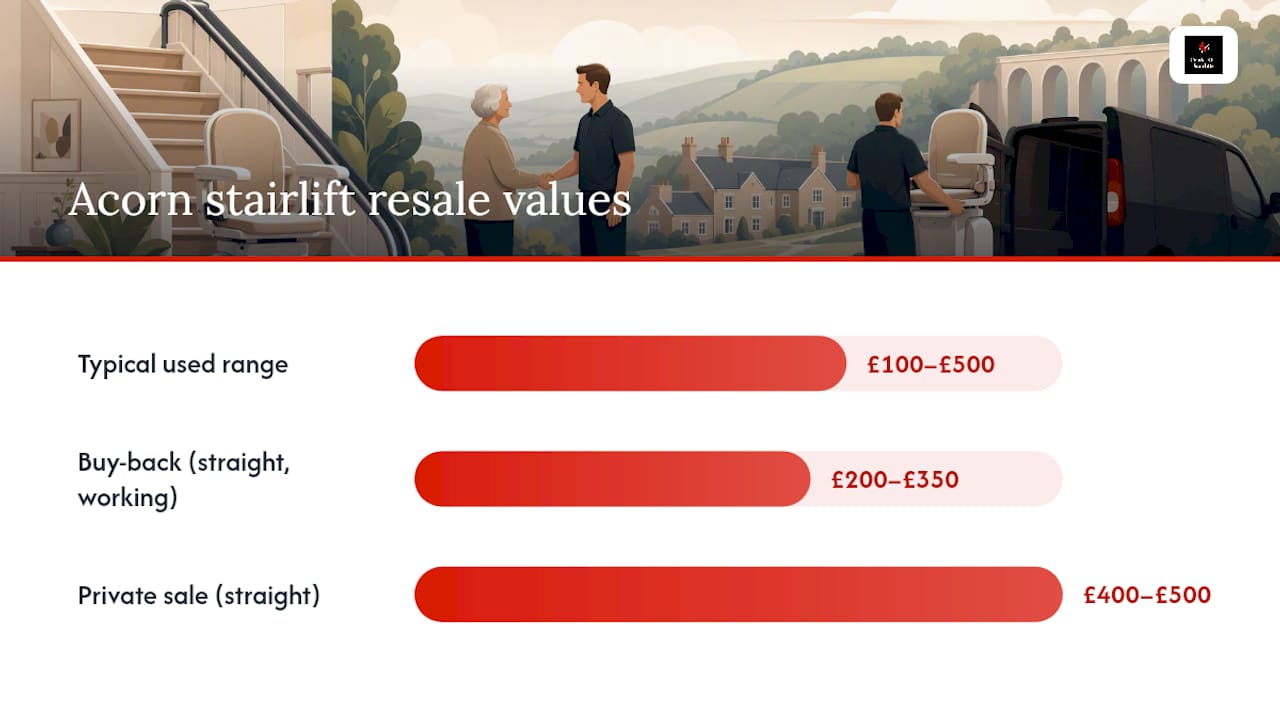
A used stairlift in the UK typically sells for £100–£500, with the figure varying sharply depending on whether the unit is straight or curved. Straight rails are reusable across different properties; curved rails are bespoke to the staircase they were built for, which is why they rarely attract meaningful offers.
| Type | Typical resale range | Key condition caveat |
|---|---|---|
| Straight Acorn stairlift | Typically several hundred pounds | Working, rail included |
| Straight Acorn stairlift | Lower value range | Older, non-working, or missing rail |
| Curved Acorn stairlift | Often little to no resale value | Rarely resells due to bespoke rail limits reuse |
Six factors determine where your unit sits within that range: straight vs curved configuration, age, working condition, parts availability, whether the rail is included, and local demand. A ten-year-old straight Acorn stairlift in working order with a full service history sits near the top of that range. The same unit with no service record and a faulty motor sits near the bottom.
Realistic mid-point: most sellers of straight Acorn stairlifts in good working order receive offers in the £200–£350 range from independent buy-back firms. Private sales can push closer to £400–£500 but take longer to complete.
The role of rail reusability is the single most underestimated factor. Sellers of curved units often expect several hundred pounds and receive nothing, because the cost of adapting a bespoke curved rail to a new property exceeds the value of the carriage itself.
How does the selling process work, step by step?
The process is straightforward once you know what buyers expect. Most transactions follow this sequence:
- Gather your details — model name, serial number, installation date, service history, and photos
- Contact buyers — reach out to Acorn (if applicable), independent buy-back firms, or list privately
- Remote pre-assessment — most buyers ask for photos and basic details before committing to a visit
- In-home inspection — legitimate buyers visit to assess the unit in situ before making a written offer
- Written offer — insist on a written quote before agreeing to anything
- Collection and payment — the buyer arranges removal; payment follows on or after collection
Seller checklist to prepare before making contact:
- Model name and serial number (usually on a label beneath the seat or on the rail)
- Installation date and name of original installer
- Service history records (even a single recent service certificate helps)
- Clear photos: the chair, the rail from top to bottom, the controls, and the power supply
- Proof of original purchase if available
- Notes on access: stair width, any tight turns, and whether the property is a house or flat
Payment on collection is the norm among legitimate buyers. Bank transfer on the day of collection is also common. Never accept a buyer who asks for payment before they have collected the unit.
Should you remove the stairlift before selling it?
No. Most buyers strongly prefer to assess and remove the unit themselves. Selling an already-removed stairlift narrows your buyer pool considerably, because buyers cannot verify the rail condition or confirm the unit is complete.
Leaving the stairlift in place also protects you. A professional removal carried out by the buyer means any damage to the staircase or unit during removal is their responsibility. If you remove it yourself and something breaks, that affects the sale price or kills the deal entirely.
That said, there are practical steps you can take to prepare the unit without removing it:
- Have a qualified engineer carry out a safety check and decommission the power supply if the unit has been unused for a long time
- Photograph the serial number plate clearly before anyone else handles the unit
- Clean the chair and rail thoroughly; a visibly well-maintained unit creates a better first impression
- Secure any loose components and label the rail sections if they have already been partially dismantled
- Gather all documentation into one folder so it is ready to hand over on collection day
Pro Tip: A recent service certificate, even one carried out shortly before sale, can materially improve buyer confidence and push offers towards the higher end of the range. Reliable stairlift servicing is available across the UK and typically costs far less than the uplift it generates in resale value.
How do you spot a stairlift resale scam?
Scams targeting stairlift sellers do exist, and they tend to follow recognisable patterns. Knowing the red flags protects you from losing money or handing over your unit for nothing.
Red flags to watch for:
- Upfront fees — no legitimate buyer charges you to assess or collect a stairlift
- Guaranteed high prices without inspection — a credible buyer always inspects before committing to a figure
- Payment before collection — real buyers pay on or after collection, never before
- Mobile-only contact details — reputable companies have a registered trading address and a landline
- Pressure to decide quickly — legitimate buyers give you time to consider a written offer
Practical checks before agreeing to anything:
- Ask for the company's registered name and Companies House number and verify it at gov.uk
- Request a written, itemised quote before any work begins
- Check Google reviews and Trustpilot for the company name
- Verify the trading address exists using Google Maps or a phone directory
Pro Tip: Use cash on collection or a bank transfer made on the same day as collection. Never use payment apps that offer no recourse. For guidance on signs of a trustworthy stairlift company, Gentlerise Stairlifts has published a practical checklist.
If you encounter a suspicious buyer, report them to Citizens Advice (citizensadvice.org.uk) or your local Trading Standards office via the Citizens Advice consumer helpline on 0808 223 1133.
When selling isn't possible: recycling and scrap options
Some stairlifts simply cannot be resold. Very old units, discontinued curved models, and severely corroded outdoor lifts fall into this category. Recycling is the responsible outcome, and the costs are usually modest.
Typical outcomes when recycling:
- Some specialist mobility recyclers and removal firms will collect for free if the unit has scrap metal value
- Others charge a small removal fee, typically in the range of £50–£150 depending on location and access
- Scrap metal payment for a stairlift is rarely meaningful; the steel content is modest and curved rails add complexity
Routes for responsible disposal:
- Specialist mobility recyclers — search for mobility equipment recyclers in your region; some operate nationally
- Local scrap metal facilities — will accept the metal components but usually cannot collect; you would need to arrange removal first
- Charities accepting parts — some disability charities and repair cafés accept working components for reuse
- Your local council — some councils offer bulky waste collection for mobility equipment; check your council's website for eligibility and fees
Keep a note of who collected the unit and when. If the stairlift was provided through a council or housing authority, confirm with them whether they need to be notified before disposal.
For further guidance on responsible disposal options, including what to do when no buyer can be found, Gentlerise Stairlifts covers the full range of outcomes.
How a refurbisher values and handles an Acorn stairlift
Refurbishers follow a structured assessment checklist: electrical safety testing, battery health check, rail integrity inspection, and confirmation that spare parts are available for the specific model. Acorn straight stairlifts score well on parts availability because Acorn has been manufacturing at scale for decades and components remain in circulation.
The typical refurbishment and re-certification timeline runs from two to four weeks once a unit has been collected. Sellers should expect a written offer within a few days of an in-home inspection, with collection arranged shortly after agreement.
Pro Tip: Sellers who want to understand how reusability affects value before contacting a buyer are better placed to negotiate. Knowing that your straight rail is an asset, not just an accessory, changes the conversation.
Sellers preparing their unit for sale should gather serial numbers, service history, and clear photographs before making contact with any refurbisher or buy-back service.
For a professional removal and refurbishment quote, contact Gentlerise Stairlifts directly.
Key takeaways
Acorn does not buy back stairlifts directly; your best route depends on whether your unit is straight or curved, its age, and how quickly you need it gone.
| Point | Details |
|---|---|
| Acorn's policy | Acorn offers resale assistance to original customers only; no cash buyback is available. |
| Straight vs curved value | Straight units sell for £200–£500; curved units rarely attract meaningful offers due to bespoke rail costs. |
| Best route for speed | Independent buy-back firms such as Helping Hand Stairlifts, StairliftBuyBack, Ableworld, and Multicare offer fast collection with payment on collection. |
| Red flags to avoid | Never pay upfront fees, accept payment before collection, or deal with buyers who cannot provide a registered trading address. |
| Gentlerise Stairlifts | Offers professional removal, reconditioning, and resale assistance across the UK with transparent pricing and no-obligation surveys. |
The seller's reality: what most guides won't tell you
Most articles about selling a stairlift focus on the optimistic scenario: a working straight unit, a motivated buyer, and a clean £400 in your pocket. The reality for a significant proportion of Acorn owners is different. Curved stairlifts, older models, and units without service records often have no meaningful market value at all, and the kindest thing anyone can do is say so clearly rather than send sellers on a months-long chase for offers that will never materialise.
The other thing worth saying plainly: the buy-back market is genuinely patchy. Geographic coverage varies, age limits differ between companies, and some firms that advertise nationally only operate in certain regions. Getting three quotes before accepting anything is not overcaution; it is the minimum sensible approach.
What actually works for most sellers is a combination of realistic expectations and good preparation. A clean unit with its serial number, a recent service record, and clear photographs will always attract better offers than one presented with none of those things. The preparation takes an afternoon. The difference in offers can be substantial.
Gentlerise Stairlifts: removal, reconditioning, and a clear next step
If you want the unit gone safely, professionally, and without the uncertainty of chasing multiple buyers, Gentlerise Stairlifts offers a straightforward alternative. Rather than navigating buy-back eligibility criteria and regional coverage gaps, you get a single point of contact for removal, reconditioning assessment, and resale or responsible disposal.
Gentlerise Stairlifts works with straight and curved units across the UK, with transparent pricing and no obligation to proceed after a home survey. For sellers who have already received low offers from independent buyers, a Gentlerise assessment often clarifies whether a better outcome is achievable.
What a Gentlerise quote includes:
- Free no-obligation home survey
- Professional removal by qualified engineers
- Reconditioning assessment for straight stairlifts
- Protect+ aftercare options if you are replacing rather than removing
- Clear written pricing with no hidden fees
Request a free home survey or visit the Gentlerise Stairlifts homepage to find out what your unit is worth and arrange collection at a time that suits you.
Useful sources and contact options
- Selling a stairlift — second-hand stairlift value (stairliftcosts.co.uk)
- What affects stairlift resale value? (Stairlift Guru)
- Sell a stairlift UK: options, value & how it works (Stairlift Guru)
- Cost‑effective ways to remove and sell unwanted stairlifts (Stairlift Experts)
- Acorn Stairlift FAQ: Does Acorn buy back used or unwanted stairlifts? (Acorn Stairlifts blog)
- How to sell a secondhand stairlift (Felgains blog)
When you call a buyer or Gentlerise Stairlifts, have ready: the model name, serial number, installation date, a brief service history, and at least two photos of the unit in situ.
FAQ
Will Acorn buy back my stairlift?
No. Acorn does not offer a cash buyback scheme. If you are an original Acorn customer, they can provide resale guidance, but you will need to find your own buyer or use an independent buy-back service.
Who will buy my second-hand Acorn stairlift?
Independent buy-back companies such as Helping Hand Stairlifts, StairliftBuyBack, Ableworld, and Multicare buy qualifying units, as do private buyers via eBay and Facebook Marketplace. Straight stairlifts in working condition attract the most interest.
How do I get rid of an Acorn stairlift I no longer need?
Contact an independent buy-back firm for a free assessment; if the unit does not qualify, arrange recycling through a specialist mobility recycler or your local council's bulky waste service. Gentlerise Stairlifts also offers professional removal across the UK.
How much is a used Acorn stairlift worth?
Straight Acorn stairlifts in good working order typically sell for £200–£500. Curved models rarely attract meaningful offers because bespoke rails cannot be reused.
Is it safe to sell a stairlift privately?
Yes, provided you follow standard precautions: insist on an in-home inspection before agreeing a price, accept payment on or after collection only, and verify the buyer's identity and contact details before allowing access to your home.